Investors deciding on their asset allocation and asset selection often start with WCI’s classic post, 150+ Portfolios Better Than Yours. They may notice that many portfolios are variations of the 60/40 portfolio (that is, 60% stocks and 40% bonds) and wonder why. One of my favorite financial bloggers sought to answer that question.
Cullen Roche, a financial advisor whose writing on the banking system and inflation data I have followed since the COVID-19 pandemic, wrote Your Perfect Portfolio in 2026. In his book, Roche goes in depth on 20 portfolio strategies, evaluating them against his evidence-based principles for constructing a portfolio.
Here are my three takeaways from his book that any investor would find useful, whether they are still drafting their financial plan or have been investing through multiple bear markets.
Only 1 Portfolio Is Truly ‘Passive’
Many of us following the WCI principles believe that we are “passive investors” because we use index funds, such as the total US stock market ETF. Instead of picking stocks or portfolio managers, we buy the entire stock or bond market. But the recent debate over the inclusion of SpaceX and various AI companies in different indices revealed how each index provider makes active decisions about market constituents.
Roche argues that what makes investing “passive” depends on asset allocation, not asset selection. The only truly “passive” allocation is the global market cap weighting of investable stocks and bonds. He calls this the “Global Financial Asset Portfolio” (GFAP), which is roughly 45% total world stock market (e.g., VT) and 55% total world bond market (e.g., BNDW).
Any allocation that deviates from the GFAP is, by this definition, “active investing.” A 60/40 portfolio is an active decision somewhat rooted in the Wellington Fund’s historical performance during the Great Depression. A two- or three-fund portfolio is an active decision shaped by how Taylor Larimore balanced his priorities of low fees, tax efficiency, and simplicity.
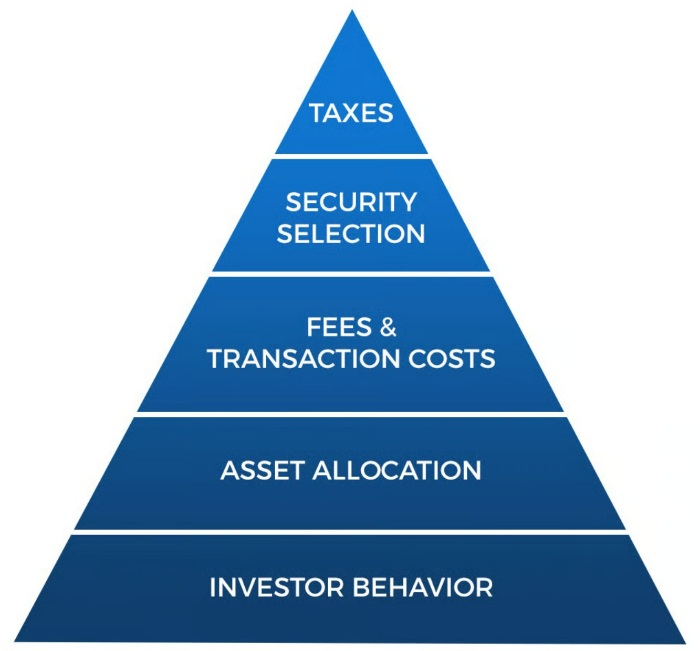
As a young investor, my biggest takeaway from Roche’s argument about passive vs. active portfolios is that we all need a solid foundation to make any “active” investing decisions. The GFAP is too conservative for me and many other young investors who should have the majority of their retirement portfolio in stocks. At the same time, my human nature is more likely to regret actions than inactions. If I want to take more risk than the GFAP (or any risk at all), then I need to master, in Dr. Bill Bernstein’s words, the “four pillars of investing:” theory, history, psychology, and business. All four of these enable good investing behavior, the most fundamental level in Morgan Housel’s “hierarchy of investor needs.”
Here’s Housel’s foundational pyramid, via The Motley Fool:
- The Perspectives of an Older Investor vs. a Younger Investor
- The 15 Questions You Need to Answer to Build Your Investment Portfolio
- The 1 Portfolio Better Than Yours
Active Cash Management Is Underrated
Cash is an important part of many financial plans. For retirees or parents of college students, sufficient cash allocation is vital. One’s emergency fund is typically in cash. Even those who do not believe in emergency funds sometimes have some cash available for taxes, business expenses, or investments.
Roche thinks many investors, even those who are keen on keeping investing costs low, ignore the costs of “passive” cash management. Banks profit off high-yield savings accounts with the margin between the APY and the yield of Treasury bills. Charles Schwab’s only default cash sweep option yields less than 1%. Fidelity and Vanguard allow investors to use their money market funds for cash sweep. But Fidelity’s SPAXX is 0.31% more expensive than Vanguard’s, and even Vanguard, which charges 0.03% for its various index funds, has an expense ratio of 0.11% for VMFXX.
Roche suggests that investors should buy individual Treasury bills (T-bills). The main brokerages allow investors to participate in the US Treasury auctions and trade individual T-bills on the secondary market for free. Once bought, the 1-3 month T-bills can be “auto-rolled” for free so that the original principal from the maturing Treasuries is automatically reinvested in new Treasuries with the same duration.
Many threads on Boglehead, Reddit, and the WCI Forum debate the merits of using the cheapest index funds. But the 0.01%-0.03% difference in expense ratio (e.g., between FZROX and VTSAX) has negligible impact compared to the 0.11%-0.42% difference. Assuming that the returns of two index funds are identical, using one that’s cheaper by 0.03% for 10 years would yield $30 more for every $10,000. Auto-rolling a ladder of 1-3 month T-bills instead of using SPAXX for 10 years would yield $420 more for every $10,000.
For DIY investors like myself, active cash management might be worth the squeeze. The initial set-up of a T-bill ladder and the occasional discontinuation of auto-roll would not take more than an hour. If $100 is the value of one hour (given it is one hour spent for a “hobby” rather than at work), then I should buy individual T-bills for two scenarios: (1) I plan on having an emergency fund in cash indefinitely, or (2) I need to have $100,000 or more in cash for at least a year. I will have an all-cash emergency fund until I have a sizable taxable account, so after I read the book, I bought one-month and three-month T-bills in my brokerage’s cash management account.
Asset-Liability Matching During the Accumulation Phase
I used to think that asset-liability matching (ALM) was only relevant for investors who are near retirement and need to match their future spending needs (that is, liability) with safe assets such as cash, TIPS, and annuities. I now understand that I have several near-term (3-7 years) and intermediate-term (7-15 years) liabilities, such as a down payment or my child’s college education. For the latter, target date funds within 529 plans tend to be the popular approach (not for us, though). For anything else, people start yet another thread on Boglehead, Reddit, or the WCI Forum.
For someone entering residency, stocks are risky if they need the money for a down payment after they graduate and live like a resident for 1-3 additional years. But life is unpredictable. They may not want to buy a house in 4-10 years. If they follow the advice against owning any stocks, their savings might not keep up with inflation.
Losing purchasing power can be as risky as losing the principal. Roche has sought to fill the gap in financial planning by creating the concept of defined duration investing. He calculates a duration for how long one should be willing to own the asset, given its volatility. Instead of 100% cash, one can take a reasonable risk for capital appreciation by owning a mix of US and international stocks, bonds, and cash that altogether have a “defined duration” of five or 10 years.
One of the book’s chapters is about his own ETF products, “Defined Duration ETFs.” As he also publishes the ETFs’ holdings online, one can replicate the asset allocation and rebalance themselves. For example, the Defined Duration 5 ETF (DDV) has the following asset allocation:
87% fixed income
- 38% 12-month T-bills
- 28% short-term Treasuries (e.g., VGSH)
- 21% intermediate-term Treasuries (e.g., VGIT)
13% stocks
- 9% international stocks (e.g., SPDW)
- 3% US value stocks (e.g., VTV)
- 1% US total stocks (e.g., VTI)
I plan on starting with a similar asset allocation to save for our down payment. Owning 40% T-bills, 30% VGSH, 15% VGIT, and 15% total world stocks (VT) would have a defined duration of about 5.6 years. By using Roche’s online tool, I can decrease the defined duration every 1-2 years and transition completely to T-bills when we are ready to buy a house.
More information here:‘[This Book Is] About the Portfolio That’s Best for You’
Roche’s book delivers on what it promises. It is one of the few books where I got more out of it after listening to the author discuss it on different podcasts. The best personal finance books do not just explain concepts. They give you a framework for decisions you had not thought to make yet. In Roche’s own words, this is a book about “the portfolio that’s best for you,” or more specifically, for your specific investing goals.
What do you think? Do you agree with Roche’s theories? Is that something you would consider implementing in your own portfolio?
Did you find this article helpful? Share it!