

A few years ago, I was put in charge of Bogleheads 101 at the annual Bogleheads Conference. The point of Bogleheads 101 was for people relatively new to Bogleheads to show up a little early and get up to speed on the basics of personal finance and especially investing so they could understand the remainder of the conference. We figured some relatively small percentage of attendees would come.
What actually happened was that everybody came. Basically, the conference just started early. Well, the next year we divided up that “pre-day” into Bogleheads 101 and Bogleheads 501 in an effort to maintain that opportunity for new people to get up to speed while giving the finance nerds an extra day of conference, too. We’ve kept that going each year. In 2025, there was a movement to add more “interesting” material on the 101 side, which meant we had to compress the material we had traditionally been using for 101 into a single lecture.
Guess who had to give the lecture? Here it is:
After creating the presentation, I realized I have never run a post on this blog specifically detailing the “11 Bogleheads Principles.” I’m sure I’ve written and talked about each of them individually many times, but today, let’s put them all in one place. It seems appropriate given that I’m a huge Bogleheads promoter and maybe even a prominent Bogleheads critic! Certainly I’m a more talented Bogleheads critic than Dave Ramsey.
The 11 Bogleheads Principles
Hopefully none of these are all that new to WCIers, but here’s the quick-hit list.
- Live Below Your Means
- Develop a Workable Plan
- Never Bear Too Much or Too Little Risk
- Invest Early and Often
- Diversify
- Invest With Simplicity
- Use Index Funds When Possible
- Minimize Costs
- Minimize Taxes
- Never Try to Time the Market
- Stay the Course
Now, let’s dive into a little more detail about each principle.
#1 Live Below Your Means
Getting rich isn’t all that complicated. Here are the four steps:
- Earn a lot of money.
- Don’t spend a lot of money.
- Make your money work as hard as you do (i.e., invest it in some reasonable way).
- Don’t lose your money to death, disability, divorce, creditors, scams, etc.
Most people want to spend all their time talking about #3 and maybe just a little time on #1. But all four steps matter, and maybe #2 is the most important. If you want more money in retirement accounts, you should PUT more money in retirement accounts. How do you do that? By carving out as big a chunk as possible from what you earn to invest. You can’t invest what you didn’t first save. This is really, really hard for many white coat investors. Check out this comment posted on a blog post where I told doctors they kind of blew it financially if they don’t retire as financially independent multimillionaires.
“Ever heard of taxes? Thirty-five percent of everything we make is going towards taxes. So technically, if you’re making $400,000 a year, realistically your take-home pay is closer to $250,000-$275,000. Minus the loan payments, mortgage, car and other expenses, and you’re not really left with much.”
Imagine how that sounds to the median American household living just fine and investing while grossing $80,000 a year. I assure you that you can spend all of what you earn. Plus, as you earn more, you’re apparently even more likely to be living paycheck to paycheck than lower earners, according to a 2025 Goldman Sachs study.
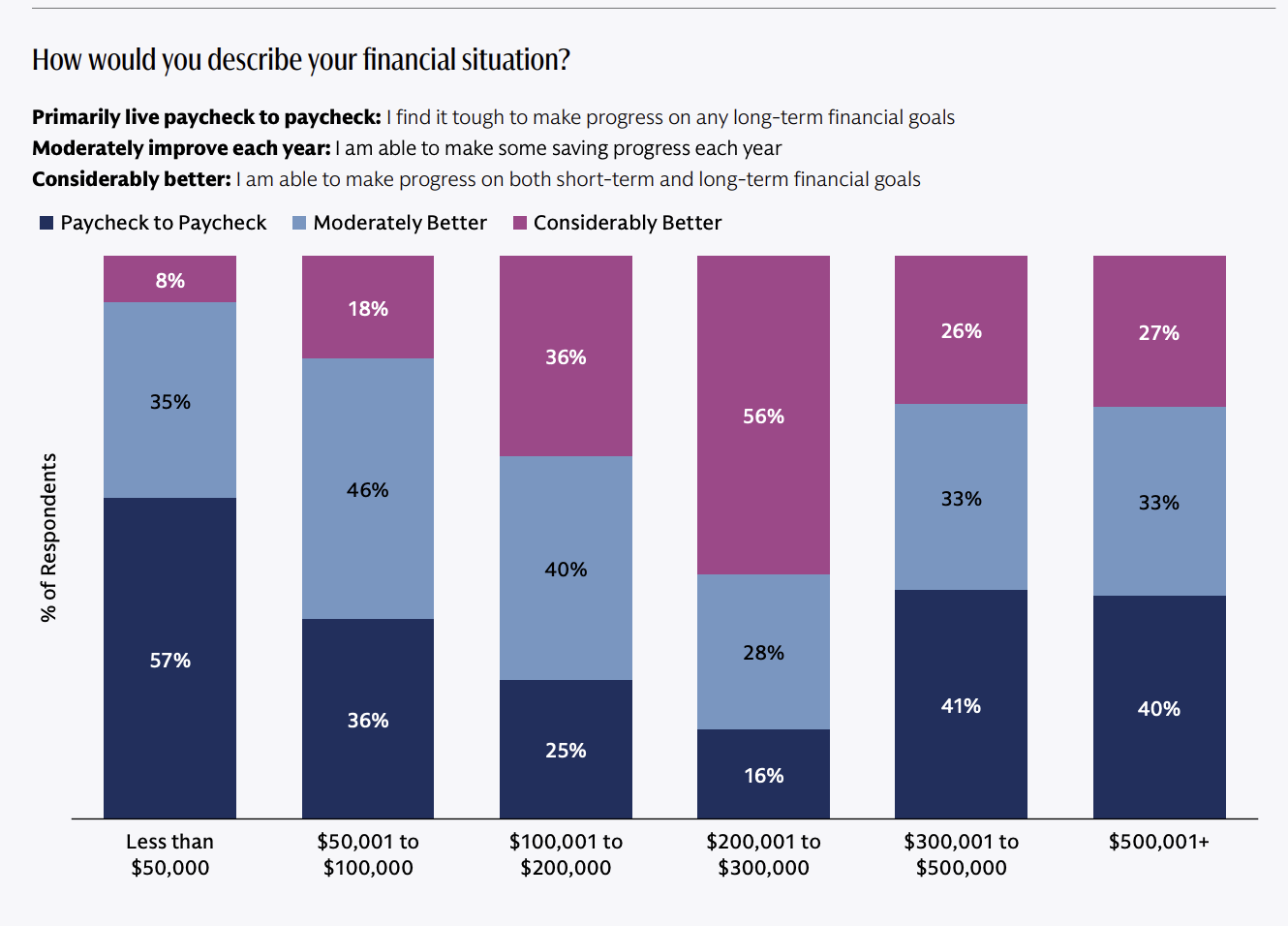
If you want to build wealth, you’re going to need to figure out how to spend less than you earn. Or marry rich. Perhaps the most important number to track annually during the first half of your investing career is your savings rate. Divide everything you put toward retirement last year by your gross annual income. Aim to get that number into the 20% range (higher if you want to retire early).
#2 Develop a Workable Plan
White Coat Investors know I’ve been an advocate of a written financial plan for a long time. We even made an online course to help people do it. Even if you have to hire a good financial planner to get one, it’s worth it. Failing to plan is planning to fail.
A financial plan is not just an investing plan. It is also a
- Student loan/debt reduction plan
- Housing plan
- Estate plan
- Asset protection plan
- Spending plan
- Insurance plan
- Giving plan
Investing plans have four steps. Don’t try to skip to the last one like most people do. Step #4 is really hard if that’s the only one you do. But it’s cake if you already did the first three.
- Set SMART (Specific, Measurable, Attainable, Relevant, Time-limited) goals (for example, I want $2.8 million on Jan 1, 2042).
- Choose accounts for each goal.
- Choose an asset allocation (mix of investments) for each goal.
- Choose investments (usually index funds) to give you that asset allocation.
#3 Never Bear Too Much or Too Little Risk
This applies to both insurance and investments. Insure well against financial catastrophes even though insurance has to be a “bad deal” on average for insurance companies to stay in business. When it comes to your investments, you have to balance two risks:
- Risk of not earning enough to reach your goals
- Risk of real loss or panic-selling due to temporary loss
If you only invest in safe investments, you’ll need to save 50% of your gross earnings for retirement, not 20%. Like me, you’re probably not willing to do that, so you need your money to do some of the heavy lifting. But don’t take on more risk than you can handle or more than you need to take on to reach your goals. This is often reflected in the most important ratio in your asset allocation (mix of investments), the stock/bond ratio. There is great wisdom in Benjamin Graham’s recommendation to never have more than 75% or less than 25% of your money in stocks.
More information here:#4 Invest Early and Often
Investing early gives the magic of compound interest more time to work. Investing often ensures that many of the shares you purchase will be purchased at lower prices. Investing successfully is more about habits and automation than keen insight and sheer intellectual power.
#5 Diversify
Most investing catastrophes stem from a lack of diversification (closely followed by the unwise use of leverage). You need to diversify both between asset classes (types of investments) and within asset classes. You don’t have to invest in everything to be successful, but aim to invest in thousands of investments across 3-1o asset classes.
#6 Invest with Simplicity
Boy, do some people make investing complicated. Trust me, your financial life will be complicated enough without a complex investing plan. An intelligent and sophisticated investing plan can be ridiculously simple. It can be as simple as a single fund of funds for some people. Don’t collect investments, and every time you see an opportunity to make your financial life more complicated in search of more money, carefully evaluate whether the juice is worth the squeeze. Jack Bogle said, “Investing is not nearly as difficult as it looks. Successful investing involves doing a few things right and avoiding serious mistakes.” Make sure you know what those few things are.
More information here:#7 Use Index Funds When Possible
If Jack Bogle and the Bogleheads are known for any one thing, it’s index funds. It turns out it is really hard to beat the market. So hard, in fact, that you probably shouldn’t try. You have a better use for your time. Even if you WANT to exchange your time for more money, you have a better use for your time. This chart gets updated by SPIVA every six months, but it always looks the same with 90%-95% of actively managed funds underperforming an index fund in the long run. That’s even before taxes, commissions, and advisory fees. The after-tax, after-fee number is higher.
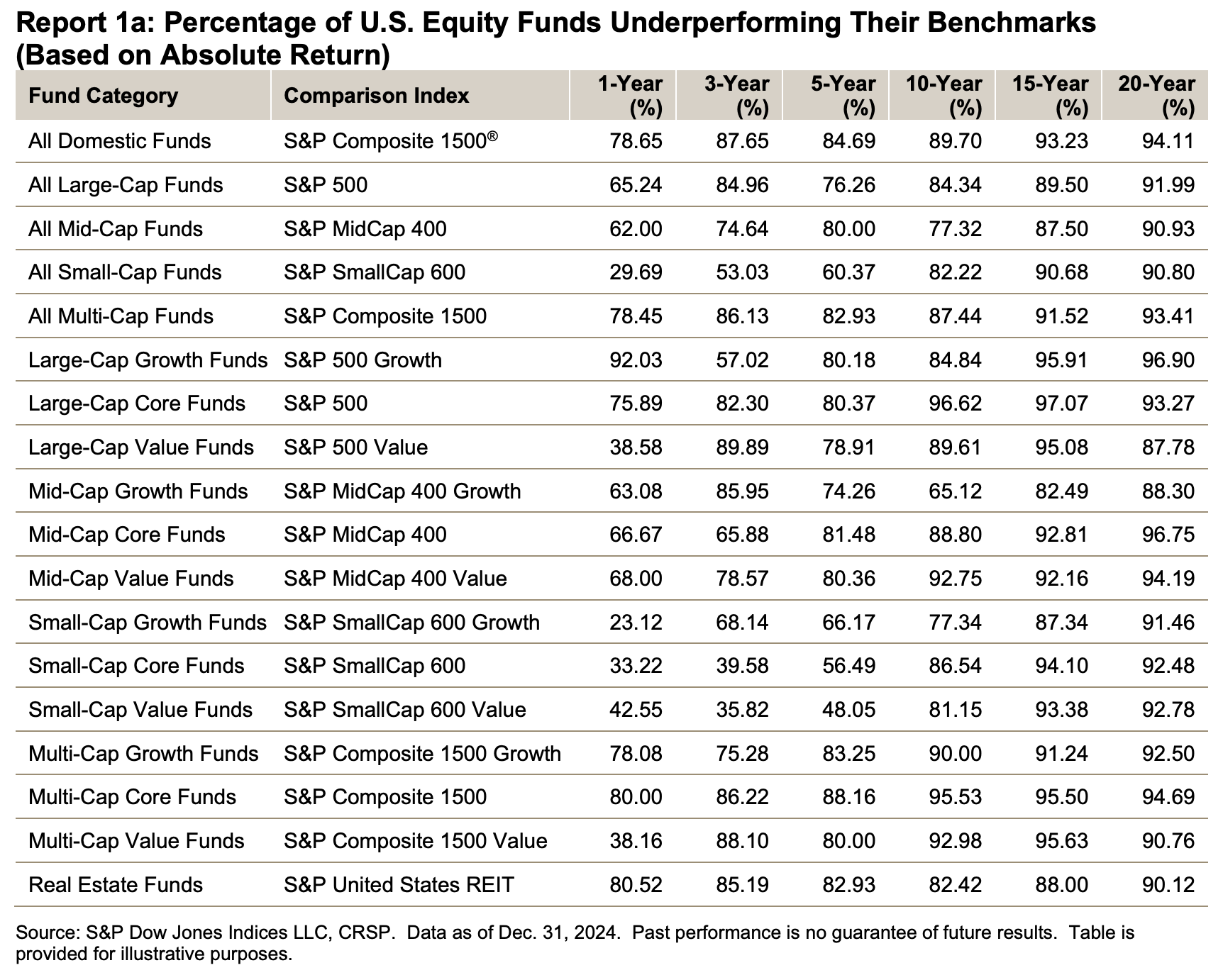
I’m not saying don’t invest in an asset class that doesn’t have a good index fund available. But I am saying if there is an index fund available, you better have a darn good reason not to use it.
#8 Minimize Costs
This refers to your day-to-day life (the less you pay, the more you can invest) and especially to your investment costs. The three greatest enemies of an investor are taxes, costs, and inflation. Well, it’s impossible to do much about inflation, and I don’t recommend tax evasion. But most investors can reduce their investment costs significantly. In fact, if you’re a hardcore DIYer, investing is essentially free.
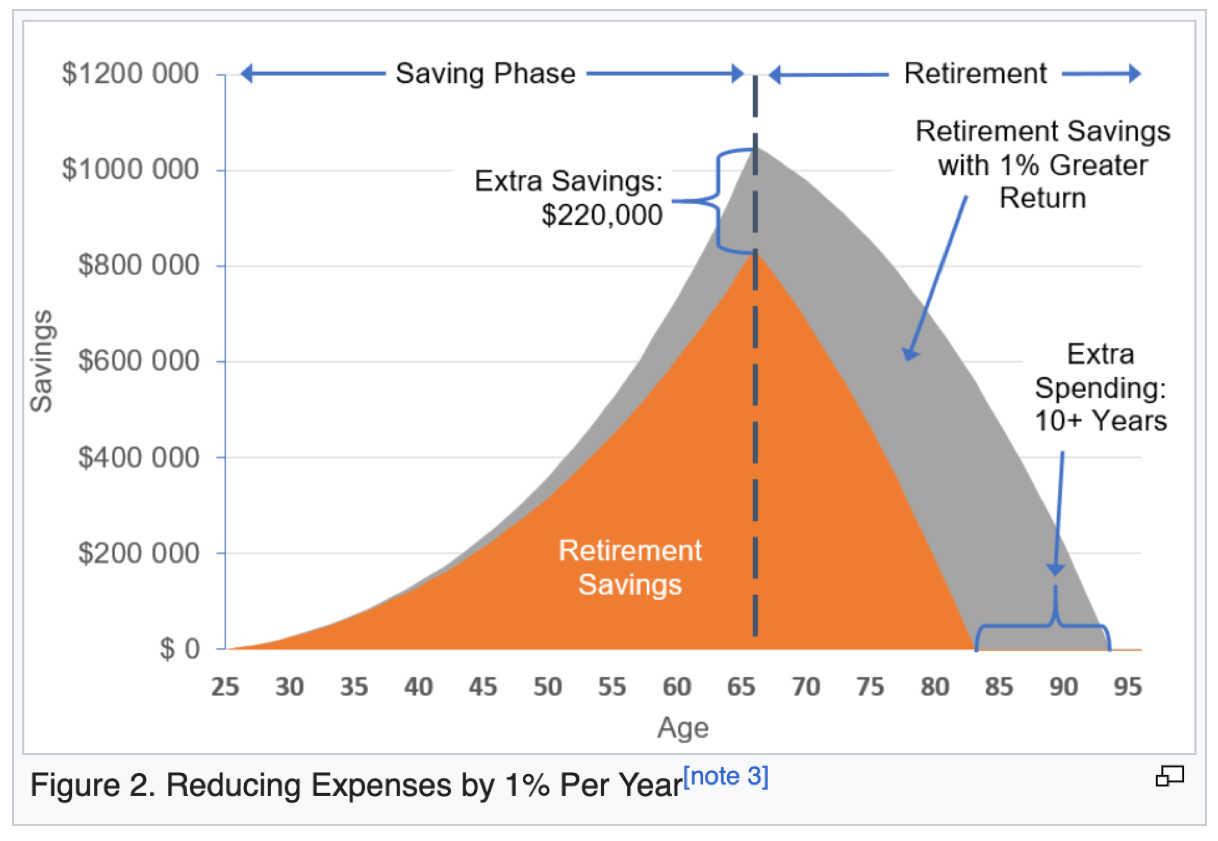
Little costs add up over long periods of time. As Jack Bogle said, “The miracle of compounding returns is overwhelmed by the tyranny of compounding costs.”
This chart from the Bogleheads wiki demonstrates long-term effects of an extra 1% a year in fees:
#9 Minimize Taxes
A surprising number of investors don’t know how to invest tax-efficiently. While you shouldn’t let the tax tail wag the investment dog (your primary goal shouldn’t be to pay less in taxes), you probably don’t want to leave the IRS a tip. Here are a few of the ways to reduce investment-related taxes:
- Invest inside tax-protected accounts (employer retirement accounts, Roth IRAs, 529s, HSAs).
- Use index/low turnover funds.
- Tax-loss harvest.
- Donate appreciated shares to charity instead of cash.
- Buy and hold.
- Exchange real estate investments instead of selling them.
- Cover equity real estate income with depreciation losses.
- Get a step up in basis at death.
- Pay attention to the tax location of asset classes.
Each of these topics has multiple posts about it on this blog. Use that search bar and start reading if any of this is a mystery to you. None of it is mysterious to the financially literate WCIers in this community.
#10 Never Try to Time the Market
Time in the market matters much more than timing the market. Market timing is very tempting, but it’s way harder to actually do than it appears. As Jack Bogle said, “The idea that a bell rings to signal when to get into or out of the stock market is simply not credible. After nearly 50 years in this business, I don’t know anybody who has done it successfully and consistently.” Nick Maggiulli advises investors to “just keep buying.” There’s a lot of wisdom there.
More information here:- Should I Try to Time the Market?
- What’s Your ‘Sleep Well’ Number? Lessons from a Market Boom, the Tariff Correction, and a Missed Rebalance
#11 Stay the Course
Don’t fall for get-rich-quick schemes. Real investing plans take decades to reach fruition. That means you have to stick with the plan for decades. One of the biggest “sins” in investing is panic-selling in the depths of a nasty bear market. Don’t do that. Stay the course. Buy when the market is up. Buy when the market is down. Buy when you have the money. Sell when you need the money. You should be using the same investments year after year after year. Good investing is boring investing—like watching grass grow or paint dry. Buy, hold, rebalance. Any reasonable investing plan is fine if you’ll just fund it adequately and stick with it. A final Jack Bogle quote emphasizes the importance of this often overlooked step:
“Stay the course. No matter what happens, stick to your program. I’ve said ‘Stay the course’ a thousand times, and I meant it every time. It is the most important single piece of investment wisdom I can give to you.”
There you go. The wisdom of the Bogleheads, distilled into 11 easy-to-understand principles.
What do you think? Do you consider yourself a Boglehead? Why or why not?
Did you find this article helpful? Share it!