

The IRS offers two different ways for you to lower your taxable income: by either taking the standard deduction or itemizing your deductions. Many people opt for the standard deduction since it’s easier and doesn’t require saving receipts. Let’s look at how the standard deduction works and how to decide which option makes the most sense.
How Does the Standard Deduction Work?
The standard deduction is a fixed amount you can subtract to reduce your taxable income. You’ll subtract it after calculating your Adjusted Gross Income (AGI). The amount you can claim depends on your filing status, age, and whether you’re claimed as a dependent on someone else’s tax returns.
You don’t have to spend a certain amount to qualify for the standard deduction. You just have to indicate on your tax return that you’re claiming the standard deduction.
What Is the Standard Deduction for 2027?
For 2027, the standard deduction ranges from $16,600 to $33,200, depending on your filing status. The IRS generally adjusts these amounts annually for inflation:
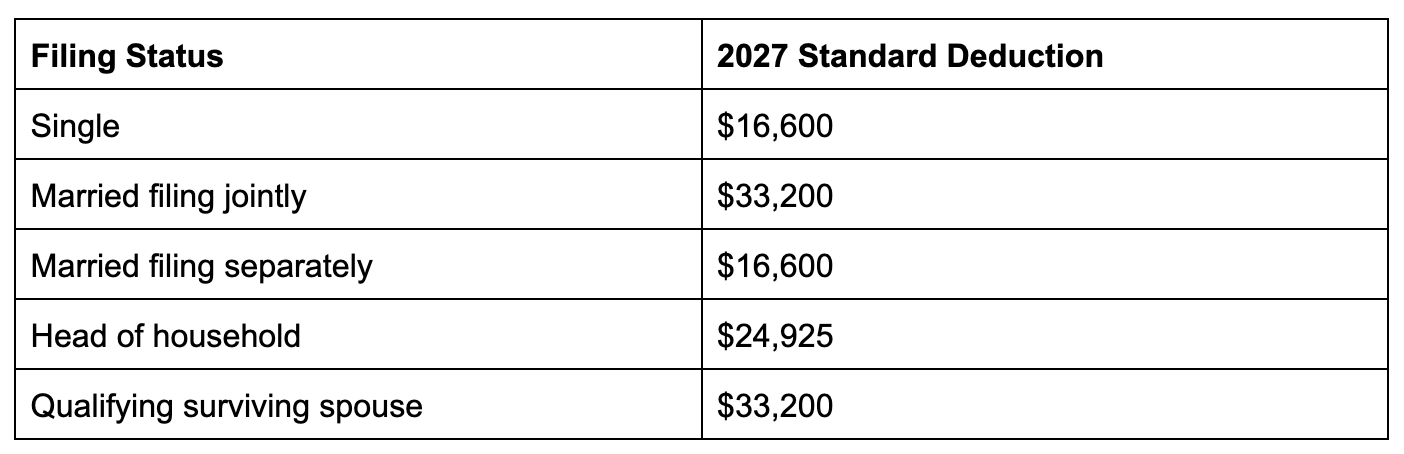
Those standard deduction numbers will be used for the taxes that will be due on April 18, 2028.
Additional Deductions for Seniors
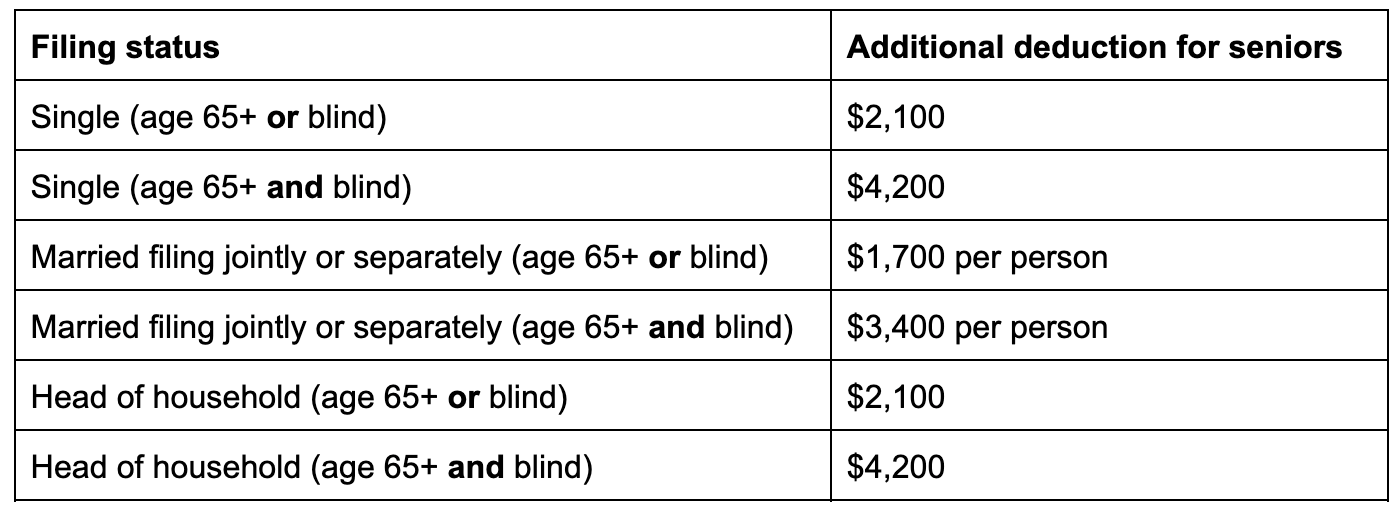
If you’re age 65 or older, you can add an additional deduction to your base standard deduction. The amount you qualify for depends on your filing and health status:
What Is the Standard Deduction for 2026?
For 2026, the standard deduction ranges from $16,100 to $32,200, depending on your filing status.
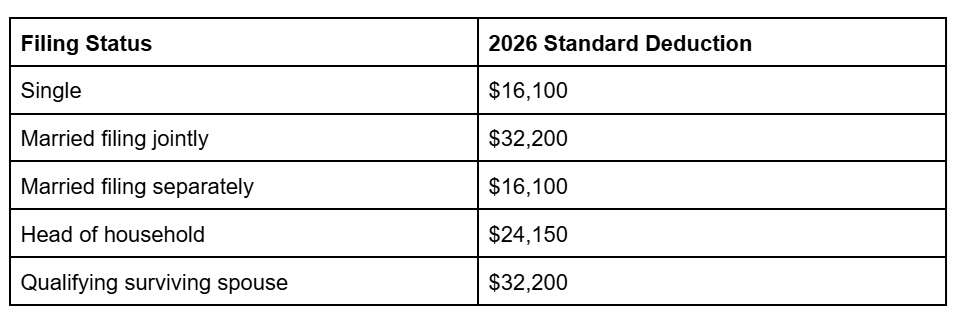
Those standard deduction numbers will be used for the taxes that will be due on April 15, 2027.
Who Qualifies for the Standard Deduction?
Most taxpayers qualify for the standard deduction, and there’s no income limit on the basic deduction. So, earning a high income doesn’t automatically require you to itemize. If someone else claims you as a dependent on their returns, your deduction may be limited.
However, you can’t claim the standard deduction if:
- You choose to itemize
- You’re Married Filing Separately, and your spouse chooses to itemize
- You’re a non-resident alien
- You’re an estate or trust
Standard Deduction vs. Itemized Deductions: Which Should You Choose?
The standard deduction is a preset amount you subtract from your income, while itemizing is a list of eligible deductions. Since you can’t claim both, you need to determine which results in the biggest tax break.
When the Standard Deduction Makes Sense
The standard deduction usually makes more sense when your expenses fall below the amount available for your filing status. For example, a single filer who rents an apartment and has relatively low state taxes may benefit more from the $16,100 standard deduction in 2026.
It can also make sense if you’re further along in your career. Someone who has a paid-off mortgage may have fewer itemized deductions than someone still making substantial mortgage payments.
Taking the standard deduction doesn’t prevent you from above-the-line deductions like Health Savings Account (HSA) contributions and eligible student loan interest (up to $2,500). And starting in Tax Year 2026, eligible non-itemizers can deduct qualifying cash donations of up to $1,000, or $2,000 for married couples filing jointly.
When Itemizing Makes Sense
If your total itemized deductions are higher than the standard deduction for your filing status, itemizing is usually the better choice. Common itemized deductions include:
- Mortgage interest on up to two homes
- Your state and local taxes or sales tax
- Property taxes
- Medical and dental expenses that exceed 7.5% of your AGI
- Charitable contributions
- Gambling losses
- Losses from federally declared disasters
However, you’re limited in how much you can deduct. For example, the state and local tax deduction has a $40,804 cap, or $20,402 for married taxpayers filing separately. The overall limit is also reduced for high earners with a Modified Gross Adjusted Income (MAGI) of $510,050 or more, or $255,025 for Married Filing Separately.
More information here:How to Claim the Standard Deduction
You’ll claim the standard deduction on your federal income tax return, typically Form 1040. Tax software or your tax preparer can calculate the amount based on the information you provide.
Here’s how you’ll claim it:
- Confirm your filing status: Your filing status determines your basic deduction.
- Provide relevant personal information: Next, indicate whether someone else claims you as a dependent and whether you or your spouse qualify for an additional deduction.
- Compare your options: Calculate your allowed itemized deductions and consider any state tax implications.
- Enter the deduction on your return: If you choose to itemize instead, report these deductions on Schedule A.
You can usually make a different choice each year, so it’s good to review this annually. Major life changes, like buying a home or paying off your mortgage, can change which makes the most sense.
The White Coat Investor is filled with posts like this, whether it’s increasing your financial literacy, showing you the best strategies on your path to financial success, or discussing the topic of mental wellness. To discover just how much The White Coat Investor can help you in your financial journey, start here to read some of our most popular posts and to see everything else WCI has to offer. And make sure to sign up for our newsletters to keep up with our newest content.
Did you find this article helpful? Share it!