

Here’s a problem: I suck at prognosticating. So much so that nearly everything that I predicted would happen in 2025 not only didn’t, but the opposite occurred! And it’s not just 2025; it’s every year. On Jim Dahle’s advice, I write down my predictions on an annual basis, each time proving myself perennially wrong. For someone who fancies himself decently abreast of world affairs and economic trends, I have long since recognized that it would be absurd foolery to act on these observations and “insights.”
This, despite a keen interest in personal finance.
I enjoy continued financial education. While this is generally good, there is a zone at which one knows enough to be dangerous but not enough to be prudent. This learning phase applies to unseasoned doctors, lawyers, pilots, engineers, nurses, and pretty much every profession. This is the Dunning-Kruger effect in action: armed with knowledge absent wisdom and experience, we charge headlong up the slopes of Mt. Stupid. There you may have met me buying Boeing (among other individual stocks), complicating my portfolio with preferred stocks, purchasing houses I probably shouldn’t have, and pursuing tax strategies that cost weeks to establish yet yielded me little actual benefit.
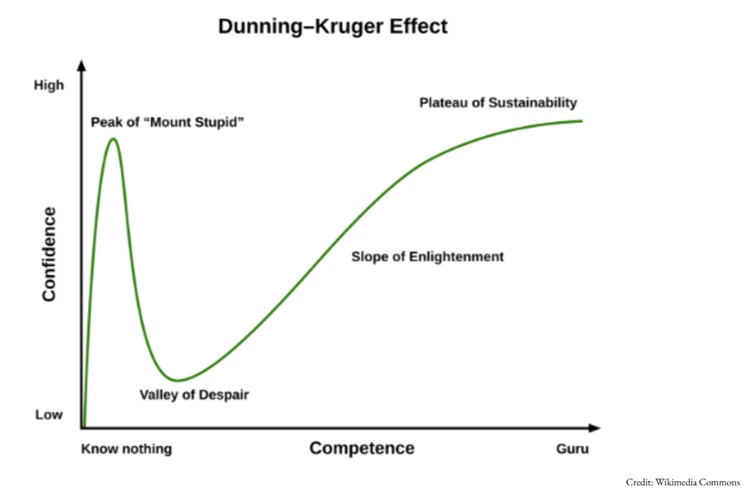
Looking back, I had the best intentions. I wanted to diversify. I wanted an appropriate risk exposure. Above all, I wanted to establish a solid financial footing for my family. I was devouring everything I could find related to financial literacy, and I shared my findings as if they were new discoveries. I was zealous, an acolyte of the personal finance enlightenment.
But it proved difficult to appreciate what I hadn’t yet experienced: that for all there is to learn, the portion which actually applied to me—a moderate-income professional—was quite small. Spend less than you earn, invest the difference wisely, and repeat the process for many months and years. Insuring against catastrophe and avoiding debt are important additions. And of course every individual investor must reconcile their circumstances and needs with their planning. For instance, I need to know how ABLE accounts function and what the best strategies for retiring with a pension might be. But this is simply the personal portion of personal finance.
For the moderate-income professional, the great majority of what one needs to know can be written and defined on a half sheet of paper. Unfortunately, you can make a mess of it in an infinite number of ways. Ask me how I know . . .
This is a column about how not to derail your journey to financial independence. It’s intended for the moderate-income investor, but it applies universally to professionals at all income levels. Like the basics described above, the message is rudimentary. Once your written financial plan is established, defense and patience are necessary guardrails.
A Sound Written Financial Plan
All the personal finance knowledge in the world is useless without a plan to integrate it. The White Coat Investor itself is an organization founded to help doctors and other high-income professionals establish a plan and execute it appropriately. The creation and implementation of an investor statement and plan is perhaps the greatest safety net for those who are in the early career years, those who enjoy learning about personal finance, and especially for those who are keen on “optimization.”
The written financial plan is foundational. Its functions are to tell you exactly what to do and when to do it. Barring catastrophe of some flavor, adherence to a reasonable plan is the closest thing to assurance that you are going to get in investing. For the moderate-income professional whose menu of possible investments is light (as compared to an accredited investor), complicating a portfolio is a task made more difficult by a well-constructed plan.
I wish that I had adopted a plan earlier. It certainly would have saved me years of dumb choices—for instance, the “selective” incorporation of individual stocks, the adoption of fixed-income investments that were inappropriate for the phase of my investing life, and even the underappreciation of term life insurance. As for the latter, while I will never live to regret not having more, I do believe it would have been more cost-effective to purchase more in my early days of personal finance exploration.
Implementing a plan was an epiphanous event in my financial life, five painful years after beginning the journey. It clarified the task, and it has since saved me from many a hazardous decision as opportunities have opened in the subsequent years.
In short: the plan has saved me from myself and has been a great means of defense.
More information here:- Setting Expectations for the Moderate-Income Physician
- Here’s How Much We Make, Save, and Spend as ‘Moderate Earners’
Defense
Knowledge is good, but alone and without wisdom or experience, it can be dangerous. For every slick new trick that one learns (options, the use of leverage, even real estate), there aren’t many guardrails to remind you that they may not be good or even safe. In professional practice, we have established systems to deter mistakes, systems like years-long apprenticeships (internships and residencies), certifications, continued education requirements, checklists, and bodies assembled for standards enforcement (the Joint Commission, FAA, NCEES, and the like). Such is not the case for individual investors.
The only means of defense is that which you build. Adherence to your written financial plan and personal investing statement means that the allure of the shiny new opportunity is either incongruent or measured to the level of risk that you have pre-ordained. Maybe your plan allows for a small portion of your portfolio to be actively traded or placed into crypto or alternatives. Maybe your exposure to real estate is higher. It’s your plan and no one else’s. In sticking to it, you are playing defense against one of the great perils of investing: performance chasing.
To the moderate-income professional, access to bespokes and alternative investments may be untenable for a good portion of their investing careers. Non-accredited investor status, investment minimums, and even the lack of exposure to “the right people” make certain pitfalls less likely. But new temptations arise as time passes. What new devilry is possible once your income increases after training, once you make partner, or once your practice is thriving? How will windfalls be allocated? Should your investing behavior change with circumstance?
In truth, nothing needs to change once a reasonable plan is in place. Defense is doing the same boring thing with cold ambivalence to the conditions around you. Defense is the humility to understand that we may not all be sophisticated financial professionals; that not all facets of personal finance apply to us; or, at the very least, to recognize that good enough is good enough and that the opposite of good is better.
Opportunities for poor decisions are all around us, even as moderate-income professionals. The amount of personal finance information available on this site and within these forums alone could impart one with enough to become literate. But it also could be dangerous if not implemented with care. This is true even when reading correct information. The risk is worse with spurious sourcing.
I’m told that the physician’s lounge is a great place to find knowledgeable experts discussing the highest of high-yield investment plays. It will come as no surprise that I have not been invited to the lounge (huge bummer because it actually sounds pretty rad). But that aside, I suspect that those plays are either unavailable to me or inconsistent with my investment strategy. Regardless, a lack of wealth building won’t be because I didn’t have access to the lounge. Rather, it would be because I either didn’t understand the basics of investing or, worse yet, didn’t understand that I didn’t understand.
As Twain probably said, “It ain’t what you don’t know that gets ya, it’s what you know for sure that just ain’t so.”
Patience
There is a familiar theme in the crowd of experts promoting a long-term investing horizon. Whether it’s Jim Dahle or Dave Ramsey, Scott Galloway or Paul Merriman, Bill Bernstein or Jack Bogle, all of them (and many more) tout a familiar line: “Wealth building is possible . . . with diligence and time.” Diligence is composed of a solid plan, habitual saving, and a good defense (and maybe some luck sprinkled in), all things discussed above.
Patience is another beast entirely.
Patience, I gather, is more complex than quiet waiting. It’s long-suffering through bear markets and scarcity. It’s finding contentment in the midst of frenzy. Patience is staying the course when the “obvious” choice is change. Sitting on your hands is a task made harder when your enthusiasm for a different strategy is encouraged by new knowledge or expert insight. Lapses in judgment occur when patience is not practiced. In my own journey, it has been impatience and the desire for quicker returns that pushed me from the precipice of Mt. Stupid. Tumbling into the Valley of Despair, the truth is reiterated: financial literacy is only useful insofar as investor behavior is sound. In personal finance, patience is the ultimate behavior.
Morgan Housel describes this in his book The Psychology of Money:
“Doing well with money isn’t necessarily about what you know. It’s about how you behave. And behavior is really hard to teach, even to really smart people.”
In the cacophony of world happenings and market volatility, it’s telling that the most successful long-term investors among us do little aside from continued and diligent investment.
More information here:- The Annual Statement of Personal Compensation (and Why You Need One)
- Finance Boldface: Why Doctors Should Take Their Money Cues from the Aviation Industry
- Phase of Life Spending
The Bottom Line
A successful investor is one who has found a complementary pairing of knowledge and behavior. How striking is it that one with “enough” knowledge (that which can be learned in a half hour) and discipline can find as much or more success in the long run than a sophisticated investor who actively manages their portfolio? How odd and wonderful is it that she or he who pays little heed to an automated, thoughtful plan is equally or better served than those of me whose curiosity far outpaces his competence.
I wonder if “Defense” and “Patience” shouldn’t be the most often referenced words in the parlance of the moderate-income professional. If in some strange future I am ever to be counted among the wealthy (not a goal, but perhaps a consequence), it will no doubt be in spite of my efforts. This is true because I know myself better than I ever did before. I see now that I must defend my plan against my intuitions and compulsions. I understand that I can’t outsave imprudence, and I’ve seen enough of the “unprecedented” to know that any misgivings that arise are best addressed with a quick look to the original plan (and maybe the counsel of those oblivious to the concern).
“Investing is a one-player sport,” as Jim likes to say. As I’ve learned the game, so too have I learned to play defense. When it’s over (hopefully a long time from now), I hope that my beneficiaries can say that in playing it patiently, I did right by them.
Have you ever summited the peak of Mt. Stupid? What happened? How did you recover? Where are you now in your financial journey?
Did you find this article helpful? Share it!