

I’ve been talking about, writing about, and personally using a type of defined benefit retirement plan called a Cash Balance Plan (CBP) for years. In January 2026, however, there seemed to be a massive resurgence of interest in these plans among WCIers. Part of that came from a mention I made on the podcast about how large contributions could be made, and part of that came from a guest post about an emergency doc who retired after a 40-year career with $27 million, a big chunk of which grew out of large CBP contributions.
Either way, a bunch of supersavers got very interested in these plans, so I thought it was important to create a little more content about them, particularly the downsides of a CBP.
What Is a Cash Balance Plan?
The best way to think about a CBP is an extra (large) tax-deferred 401(k) masquerading as a pension. The way doctors typically use them is to fund them for 5-10 years, particularly in mid to late career, and then close them and roll the proceeds into a 401(k) or IRA to reduce risks inherent in this plan masquerading as a pension. The end result of using these plans is larger tax-deferred retirement accounts than you would otherwise have. That’s generally a good thing, so in general, I’m a fan of doctors (and other high earners) using these accounts.
How Much Can You Contribute to a Cash Balance Plan?
The main appeal of a CBP is that you can make relatively massive contributions to it. These contributions are always tax-deferred, so they can dramatically lower your tax bill. Plus, retirement accounts like CBPs receive awesome asset protection benefits.
How big can these contributions be? Well, that’s not nearly as straightforward a question as you might think. Because these accounts have to masquerade as a pension, figuring out how much you can contribute is not a DIY project. You’re going to need an expert, probably an actuary, to sort it all out. It varies by how old you are (and by how old others using the plan are), by how much you have contributed in the past, and by how long you wish to fund the account. The older you are, the less you have contributed, and the fewer years you’re going to run the plan, the larger the contributions can be.
Let me show you a couple of examples showing just how massive the contributions can potentially be. The first comes from that independent contractor emergency doc who retired with $27 million.
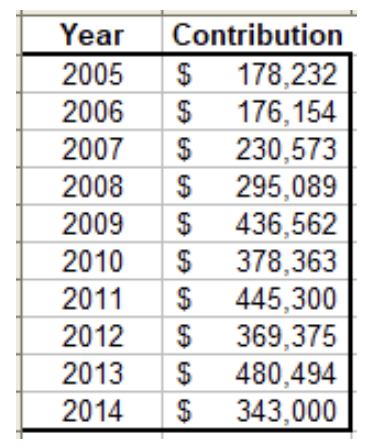
Note that for some or all of these years, the contribution included a contribution for his spouse, the only other employee of his company. But yes, even back in 2013, they could defer almost $500,000 into a CBP in a single year. That’s a lot more money than I’m allowed to put into our partnership CBP, which is $120,000 at 50 years old.
A more detailed example came in by email from a now 42-year-old doc who included this chart put together by his actuary/advisors and asked me to spend more time on CBPs on the blog and podcast.
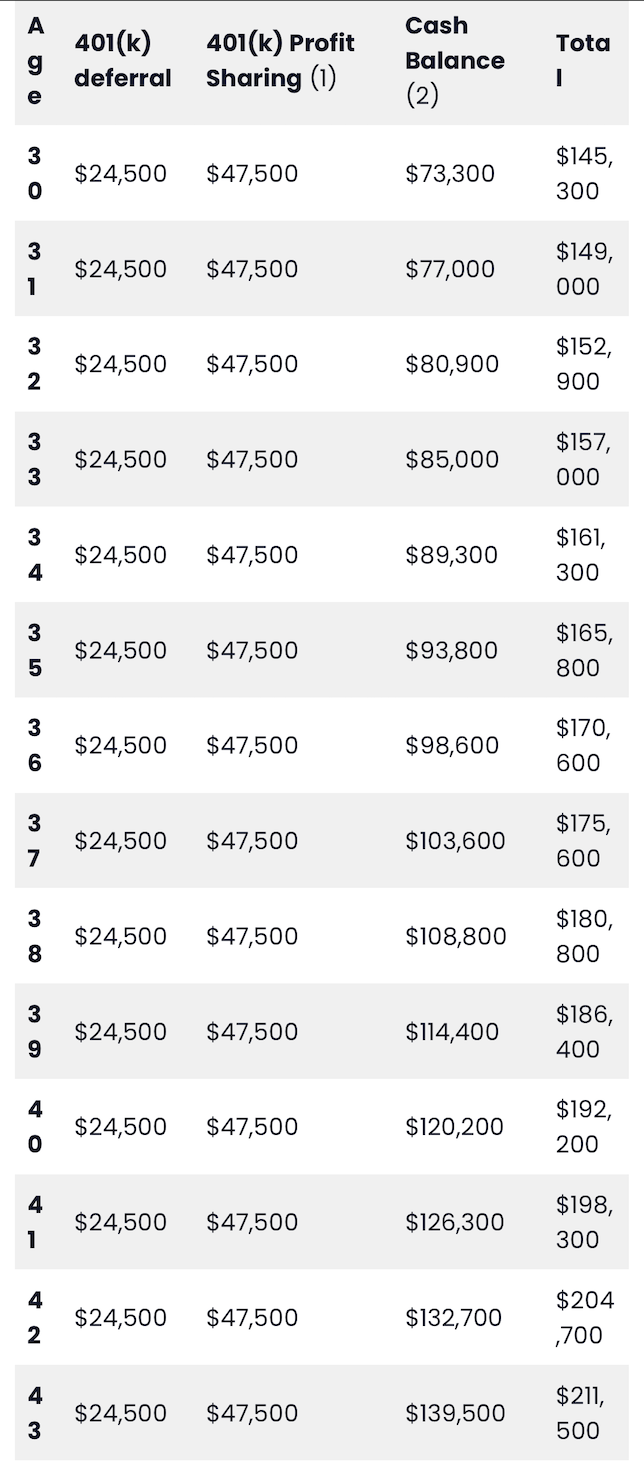
The chart shows CBP contributions ranging from $73,000 at age 30 to $140,000 at age 43. The doc who sent it in notes that:
“I have contributed an increasing amount every year since becoming a partner, and the low has been near $100,000 when I started in my 30s. As you can see at 42, it is now even higher. Every January with the IRS limits being published, I have our attorney and actuary update the plan for the partners for the new amount at the new ages, indexed to inflation. Inflation was so bad there for a while that one partner could contribute an extra year’s contribution to the CBP because of it. Amending the plan only costs us about $300 in fees but results in thousands of dollars extra in pre-tax contributions so why wouldn’t I have them amend the plan each year?”
Awesome, right? Well, there are a few caveats you should know about.
More information here:- Group Cash Balance Plans Best Practices, Avoiding Pitfalls, and Making the Most of Your Plan
- Is a Cash Balance Plan Right for Your Medical Practice?
6 Issues with Large Cash Balance Plan Contributions
Let’s go through the problems you can run into if you use a CBP very aggressively.
#1 Requires Large Amounts of Retirement Savings
The first issue, which applies to almost everybody, is that you can’t spend the money you’re putting into the cash balance plan. You have to save it for retirement. Most doctors just aren’t interested in saving that much for retirement. I mean, if you make $375,000, 20% of that is $75,000. That’s not even enough to max out a solo 401(k) and a Backdoor Roth IRA.
Why would you need a CBP? You don’t. Most of the docs in my organization aren’t contributing at all or are contributing minimally to our CBP, and almost none are maxing out our relatively conservative contribution limits. I’m not even doing it because I don’t earn all that much clinically, given how little I work (six day shifts a month). People who want to save that much money for retirement are also often looking to retire early, which means they’ll have to deal with the Age 59 1/2 rule. That’s not the end of the world (the 10% early withdrawal penalty has many exceptions), but it is one more strike against CBPs.
#2 Creates Massive Tax-Deferred Accounts
Those who can max out CBPs are typically people we refer to around here as “supersavers.” They put A LOT of money toward retirement. Well, the hardest dilemma in personal finance and investing is whether to make tax-deferred or Roth contributions to retirement accounts. The rule of thumb is to make tax-deferred contributions during peak earnings years and Roth contributions in other years. This rule of thumb also has plenty of exceptions, but the main one is supersavers. Lots of retirees or prospective retirees think they have a Required Minimum Distribution (RMD) problem, but the truth is that the main ones who actually do have an RMD problem are the supersavers. It takes a very large tax-deferred account for a doctor to be withdrawing money in retirement at a higher tax rate than was saved when putting the money into the account originally.
How do you get a very large tax-deferred account? By making massive contributions to a cash balance plan. The typical solution to this problem for supersavers is to make Roth contributions or do Roth conversions. But Roth CBP contributions don’t exist, and if you have to wait a long time to do Roth conversions, they can be so expensive tax-wise that they might not be worth it. Unless you’re planning to make large Qualified Charitable Distributions (QCDs) and leave your tax-deferred accounts to charity at death, you might want to think twice about making massive CBP contributions for very many years.
#3 Higher Fees
Solo 401(k)s and Roth IRAs, done well, have very low fees. In fact, they can be totally free. Combined with very low expense ratio index funds, investing for retirement can be essentially free. CBPs aren’t free. While you can pay attention to fees and reward those offering these plans at fair prices, the additional complexity required to masquerade as a pension just costs money. Those fees have a drag on your investment returns. This is one reason why it’s a good idea to close a CBP every 5-10 years if possible and roll the money into a 401(k) or an IRA (if you’re done doing Backdoor Roth IRAs and no longer have to worry about the pro-rata issue).
#4 Less Aggressive Investing
Due to the need to masquerade as a pension, CBPs are generally invested relatively less aggressively. Typically, the majority of investments in the plan are bonds. Some experts think my partnership plan, which is 40% stocks and 60% bonds, is too aggressive. If you invest a CBP too aggressively, two problems can show up.
The first is that the business owner (usually you) has to make huge contributions into the plan if risk and, thus, poor returns show up. That’s not necessarily all bad since those additional contributions are also done pre-tax, further lowering your tax bill. But lots of docs have trouble coming up with the cash flow for those additional contributions.
The second occurs when risk doesn’t show up and the plan has returns much higher than its crediting rate and you want to close it. Now, you may have to pay an excise tax. You took all the risk to get those returns, and Uncle Sam gets a good chunk of the benefit. Not cool. You can get around this need to invest a CBP less aggressively by “taking your risk on the 401(k) side” (i.e., increasing your non-CBP asset allocation to make up for it), but that only works to a certain extent if the CBP has become a huge part of your retirement portfolio—especially if you are a very aggressive investor. CBPs just don’t mix well with 100% stock asset allocations, and you’re probably not putting real estate or cryptoassets or whatever alternative asset class you love into it. Closing the plan periodically (and starting another) to roll assets into your 401(k) can only help so much.
#5 Lower 401(k) Contributions
Large CBP contributions also can lower your allowed 401(k) contributions for various reasons. Consider my situation at my partnership. I might earn $100,000-$150,000 clinically in a given year. Our 401(k)/profit-sharing plan theoretically allows me to put in $80,500 now that I’m 50+. That includes $24,500 as an employee contribution [2026 — visit our annual numbers page to get the most up-to-date figures], $8,000 as a catch-up contribution, and $47,500 as a profit-sharing contribution. The DBP theoretically allows me to put in another $120,000 for a total of $200,500. I don’t earn $200,500, but even if I make $130,000, I can’t put in $130,000.
The way calculations are made for 401(k) contributions, the CBP contribution is subtracted from my income before the calculation is made. So, if I earned $130,000, I could do that $24,500 contribution, that $8,000 contribution, and that $60,000 CBP contribution (as I do). But then my profit-sharing contribution becomes severely reduced.
Back in 2024, when I only earned $104,000, my profit-sharing contribution was only $4,673. That’s very different from the $46,000 I would have liked to contribute. Still, $23,000 + $60,000 + $4,673 = $87,673, or 84% of my income. Not bad as a percentage, but this is an issue that many people making massive CBP contributions can run into even on a much higher income. This can also further exacerbate the issue of having to invest the CBP less aggressively. Plus, most people would have a major challenge living on 16% of their income if there were no other source of household income.
#6 More Complexity and Little Flexibility
As you can tell, CBPs are just much more complex than a 401(k) plan. That costs money and time and hassle as you try to understand how they work and plan around their complexities and stay below lifetime contribution limits and the other defined benefit plan regulations. If in a partnership, all that hassle goes up 10-fold as you try to educate your partners about these plans and talk them into also saving six-figure amounts for retirement in the plan. As a small example of hassle, I don’t include my CBP in my asset allocation spreadsheet for rebalancing purposes. It’s just a bit of a pain.
On the other hand, one of the great benefits of investing in a taxable account is its flexibility. A CBP is the opposite of a taxable account when it comes to flexibility. You might not be able to stop contributing to it, even if you wanted. When I fell off a mountain and couldn’t work for a couple of months, I still had to make CBP contributions out of my pocket for those months. You typically can’t change your contribution amounts except once every three years or so.
More information here:Who Should Make Large Cash Balance Plan Contributions?
Have I talked you out of making large CBP contributions yet? I think it’s very reasonable to make small to moderate CBP contributions, such as the $60,000 I’m doing. If you’re contributing $20,000 or even $100,000 a year, I think most of the issues with large CBP contributions go away. It’s just a nice extra 401(k). But who would $200,000+ annual contributions be right for? There are five groups of people.
- Playing catch-up: If you’re 55 and have a tiny portfolio but just committed to a serious retirement savings plan, putting $100,000-$300,000+ into a CBP for five or 10 years late in your career shouldn’t cause you a huge RMD issue.
- Won’t have a CBP for long: Putting massive contributions into a CBP for just a few years, like 3-7, shouldn’t result in a huge RMD issue either. Whether the plan closes or you change jobs or whatever, it’s great to do this for just a few years.
- Great Roth contribution/conversion plan: The solution to a true RMD issue is Roth contributions and conversions. Maybe you’re making big CBP contributions, but you’re also doing personal and spousal Backdoor Roth IRAs and your employee 401(k) contributions are Roth and maybe you’re even doing Mega Backdoor Roth IRA contributions in your 401(k). Plus, you’re going to retire a little early, delay Social Security to 70, and do decent-sized Roth conversions for many years.
- You’re very charitable: Huge tax-deferred accounts are really only an issue if you want to spend the money eventually. If you’re OK giving it to charity, they’re not such a bad thing. I mean, they’re never really a bad thing (heaven forbid you have a high taxable income after retirement too, right?), but tax-deferred accounts are AWESOME for charity. Starting at age 70 1/2, you can do QCDs ($111,000 in 2026 and indexed to inflation) in place of RMDs. That’s the entire RMD of a $3 million+ tax-deferred account. If you itemize, you can offset additional withdrawals given to charity, too. Plus, the tax-deferred account can be left to charity at death. In all these situations, neither you nor the charity ever pays taxes on this money.
- Short-sighted Tax Phobics: If you just can’t stand to give the government any money until you are absolutely forced to do so, massive CBP contributions might make sense. Of course, it seems a little silly to save taxes at 10%, 12%, 22%, etc. and later pay them at 32%, 35%, 37%, etc. if you really hate giving the government money. But maybe you’ll die before 75, and your heirs won’t mind as much. Or you can leave the money to charity.
Cash balance plans are an extra 401(k) masquerading as a pension that allows one to build a very large tax-deferred retirement account. They may have a place in your financial plan.
What do you think? Do you use a CBP? Why or why not? How much will you contribute to it this year?
Did you find this article helpful? Share it!