

It’s no secret that physicians and many other medical professionals are among the highest-paid people in the United States and throughout the world. But despite nearly all medical professionals having above-average salaries, quite a bit of variance exists between both specialties and geographic areas.
We used information from the 2026 Medscape Physician Compensation Report, Doximity, and Marit to investigate trends in how much doctors get paid. What we learned may not be a total surprise if you’re at all familiar with physician salaries, but you may learn a few things you didn’t know before.
So, who are the highest-paid doctors? Let’s dive in and take a look.
The Highest-Paid Physician Specialties
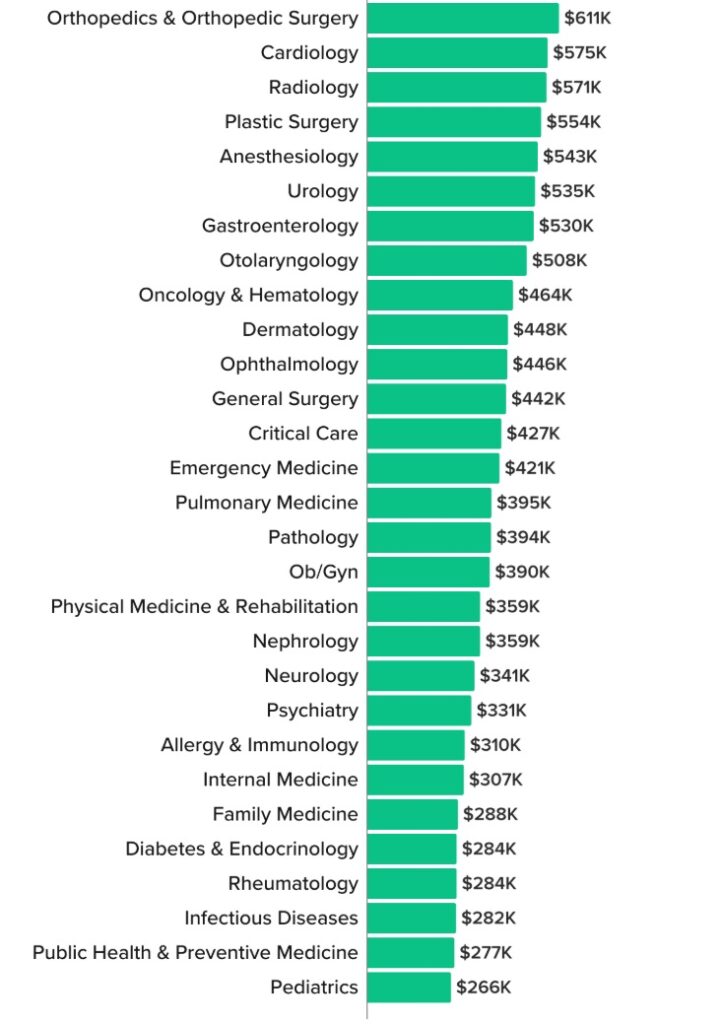
Using the recent benchmark data mentioned above, neurosurgeons lead the list of highest-paid doctors with an average compensation of roughly $740,000-$750,000 per year. This is followed by doctors specializing in thoracic surgery, orthopedic surgery, pediatric surgery, and plastic surgery. Besides procedural or surgical specialties, other high-paying specialties include cardiology, radiology, urology, gastroenterology, and ENT.
Here’s a chart from the 2026 Medscape survey that shows what its survey of nearly 6,000 doctors found.
Why Procedural Specialties Earn the Most
Some structural reasons behind these compensation patterns explain why the procedural and surgical specialties tend to earn the most. It’s important to understand that income differences between specialties are largely tied to reimbursement models and healthcare economics, not simply prestige or demand.
Procedural volume, RVU-based reimbursement, and surgical billing structures drive higher earnings, while specialties with cognitive or primary care fields often rely on evaluation and management billing codes. Additionally, physicians in surgical or procedural specialties tend to have higher malpractice risk and longer training pipelines. The technical complexity of procedures is another reason these specialties often top the lists of the highest-paid doctors.
More information here:
A Deep Dive into the Salaries of New Grad Physicians
12 Negotiation Techniques You Need to Know
The Other End of the Spectrum: Lower-Paid Specialties
On the other end of the compensation spectrum are specialties such as pediatrics, endocrinology, geriatrics, and infectious disease, with average yearly incomes between $230,ooo-$320,000. Some of the main reasons for this are as we discussed above—these specialties tend to have lower procedural volume, higher Medicaid reimbursement exposure, and a stronger focus on cognitive care.
It’s important to understand that, despite being on the low end of the scale compared to other physicians, doctors in these specialties still have above-average incomes compared to the general public. Also, many of these specialties remain essential to the healthcare system and often offer different lifestyle or mission-driven rewards, such as a better work-life balance.
Compensation Trends Across Medicine
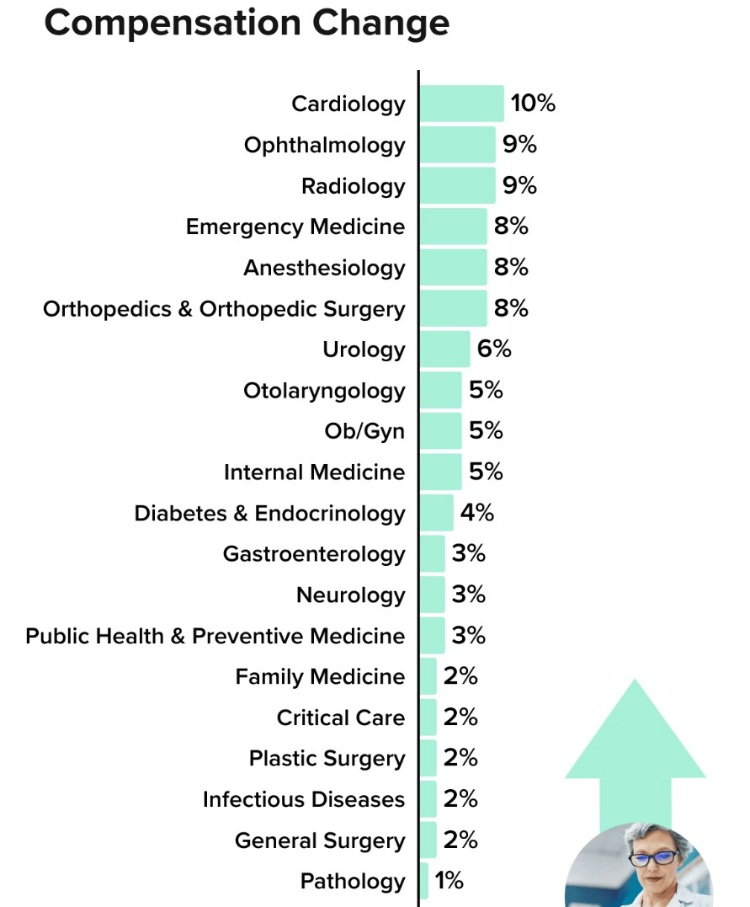
Average physician compensation has continued to increase modestly in recent years (about 3%-4% growth year over year in the recent surveys we looked at). It’s also interesting to note that the growth in physician compensation has not been even across specialties. Some specialties (including cardiology, ophthalmology, and radiology) have seen higher-than-average growth.
Geography Matters
Besides the exact specialty that you choose, few things matter as much to determine the highest-paid doctors than where you choose to live. Doximity’s 2025 Physician Compensation Report illustrates this by breaking out both overall compensation by metro area and the same pay rankings after a cost-of-living adjustment.
Where you live makes a big difference! San Francisco comes in as the ninth-highest overall compensation, at $449,830 per year. But after adjusting for cost of living, San Francisco actually makes the list of the LOWEST overall physician compensation (No. 5).
What Compensation Data Doesn’t Show
While physicians are fortunate in that comparing compensation to others in the field is much more common than for other professions, it’s important to realize that there are nuances that this compensation data doesn’t bring out. Physician income varies widely based on factors such as practice ownership vs. employment, geographic location, call burden, subspecialization, and procedural volume.
For example, a high-volume radiologist or cardiologist in private practice in an area with a high cost of living may earn far more than the specialty average. Similarly, compensation reports often include averages that obscure the wide spread between early-career physicians and senior partners.
More information here:
There Was No Golden Age of Medicine (at Least for Physician Incomes)
‘What Are Your Salary Expectations?’ Here’s Why You Should Stop Evading This Question
The Bottom Line
Physicians are among the highest-paid professionals, but not all doctors earn the same amount. Some of the biggest factors that influence who the highest-paid doctors are include the doctor’s specialty and geographic area. Surgical and procedural specialties tend to lead the compensation rankings, while primary care and cognitive specialties generally earn less on average.
In addition to specialty and geography, several other factors affect a physician’s income. This can include the practice structure, a physician’s experience, and overall workload. While compensation reports are useful tools to understand broad overall trends, they should not be the only thing used when picking a specialty. For most doctors, choosing a specialty still comes down to balancing income with lifestyle, interests, and the kind of work you find most meaningful.
The White Coat Investor is filled with posts like this, whether it’s increasing your financial literacy, showing you the best strategies on your path to financial success, or discussing the topic of mental wellness. To discover just how much The White Coat Investor can help you in your financial journey, start here to read some of our most popular posts and to see everything else WCI has to offer. And make sure to sign up for our newsletters to keep up with our newest content.
Did you find this article helpful? Share it!