Some people find bond investing to be more complicated than stock investing. I don’t really feel that way since only three levers are adjustable when it comes to bonds. First, you can change your term/interest rate risk by using shorter-term or longer-term bonds. Second, you can change your credit/default risk by investing in bonds less likely to pay you back in exchange for higher yields. Third, you can choose whether to index the bonds to inflation. I tend to take my risk on the equity side, so our bonds are pretty safe. They’re pretty much all Treasuries or munis, short- to intermediate-term, and about half indexed to inflation.
Part of the reason people find bonds so perplexing is that there are so many different types of “yield” being discussed. In this post, I’ll define them all and point out the ones where you should really pay attention.
Yield Is Not Return
The first thing to realize is that yield and return are not synonyms. Yield is generally what an investment pays you as cash flow. That is the interest payments on a bond, the dividend on a stock, or the rent on a property. Your total return, on the other hand, is far more comprehensive. It includes things like capital gains and losses along with cash flows, both positive and negative. Yield is income. Return is everything. With bonds, most of the return is going to come from the yield, but not necessarily all of it. They’re not the same thing.
Individual Bonds vs. Bond Funds
The next thing to realize is that some of the various yields being discussed only apply to individual bonds, while others only apply to mutual funds (whether traditional or exchange-traded) that own bonds. There are some good reasons to own individual bonds, but once you buy enough of them, you’re pretty much just running your own bond fund anyway.
We started with bond funds, and we transitioned for a while to some individual bonds. Then, we decided it wasn’t worth it, and we are gradually transitioning back to just using funds as the individual TIPS and I bonds we bought are redeemed or sold. Either decision is reasonable, and both ways have benefits. The main benefit of individual bonds (and we’re generally talking about very high-quality bonds like Treasuries, especially TIPS, here) is that if you hold to maturity, you know exactly what you’re going to get. The main benefits of a bond fund are liquidity and convenience. Either way, the underlying asset is the same, so don’t expect anything dramatically different long term no matter how you choose to invest in bonds.
More information here:SEC Yield
The SEC yield is a yield that mutual funds are required to report by their regulator, the Securities and Exchange Commission (SEC). This is the one you see when you go to Vanguard and look up the yield. It looks like this:
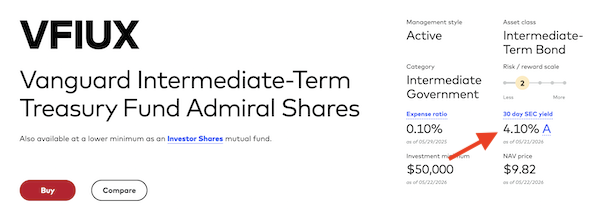
The SEC yield (or 30-day SEC yield) is a standardized annual yield calculation for bond funds developed by the SEC. It includes dividends and interest over the last 30 days, minus fund expenses, and then it is annualized to show what the return would be over a 12-month period if the rate remained exactly the same. It was developed to benefit investors, because different funds had been reporting yield in wildly varying ways, making it hard to compare apples to apples.
This yield is pretty useful, particularly when it comes to cash management. Money market funds are essentially very short-term bond funds, and you can use the SEC yield to compare to the APY (annual percentage yield) paid by a high-yield savings account (HYSA). They’re not exactly the same type of yield, but they’re close enough for your purposes.
TTM Yield
Interestingly, when you go to Morningstar, it does not report the SEC 30-day yield. It reports a similar yield that’s called the TTM yield, which stands for the trailing twelve months yield. It’s basically the SEC yield. But instead of the yield over the last 30 days being annualized, it is the yield actually paid over the last year. As you would expect, it’s slightly different from the SEC yield, but it’s close enough for government work.
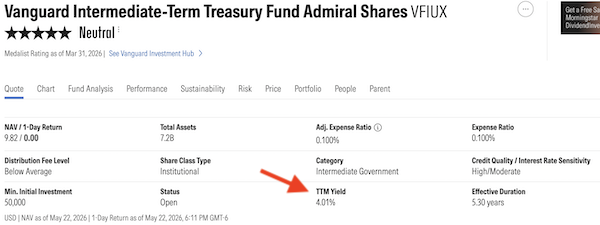
It really doesn’t matter which of these two you use, as long as you’re using the same one when comparing funds so you’re comparing apples to apples.
Coupon Interest Rate
As we move into a discussion about individual bonds, the first yield worth talking about is the initial yield, or the coupon interest rate. Years ago, paper bonds were issued with little tear-off coupons attached to them. You would take the coupons to the bond issuer to get your interest payments. The name stuck even though the coupons are long gone. This is just what the bond promised to pay when it was issued. If it was a 4% bond at issuance, the initial yield/coupon interest rate will always be 4%. The coupon rate is sometimes called the “nominal yield.”
Current Yield
However, as interest rates fluctuate (and as the likelihood that a bondholder actually pays you back fluctuates), the current yield (sometimes called “running yield”) changes. It is a simple calculation of the total of the annual coupon payments divided by the current price of the bond. Price fluctuation happens minute to minute when markets are open. When a bond goes down in value, its current yield goes up and vice versa.
For example, when general interest rates rise and new bonds are available paying a higher coupon rate, nobody will want your old, lower interest rate bond unless you sell it at a discount so the current yields are similar. The opposite happens when interest rates fall. For example, when you look up a bond on the internet or at your brokerage, it will likely list both the coupon rate and the current yield.
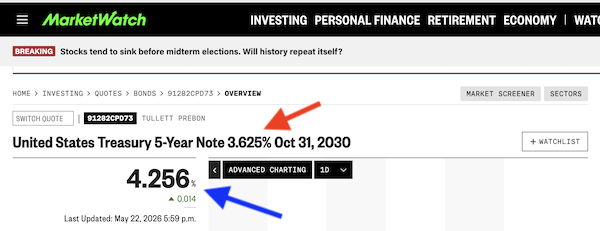
The red arrow shows the coupon, and the blue arrow shows the current yield. As you can infer, interest rates have gone up in the time since this bond was issued in October 2025. The yield is higher, but the value of the bond is actually lower. If that concept is too complicated for you, don’t feel bad, but do hire a good financial planner and investment manager to help you with this stuff. Or at least avoid buying individual bonds for your portfolio.
More information here:Yield to Maturity
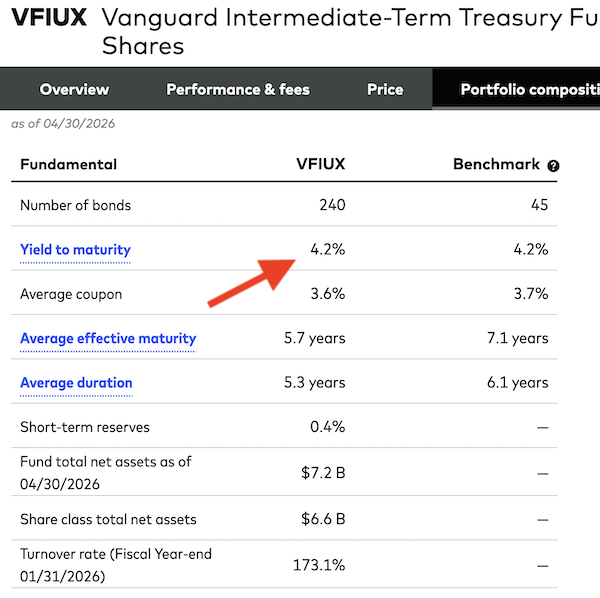
Bonds and bond funds will often report a yield to maturity (YTM). Bonds come with a term. It might be one year. It might be 30 years, but eventually they mature. The borrower (bond issuer) is then supposed to give the bondholder back all of their capital. Yield to maturity is the total estimated annual return on a bond held until its expiration date. Since the only source of long-term return for a bond is its yield, this can be a useful figure to use to compare one individual bond to another, especially if the two bonds have similar maturity. This calculation takes into account the coupon rate, the current market price, the face value (the amount the bond was worth “at par” or when it was issued [technically when it will be redeemed, as some bonds are designed to increase in value as they go]), and the time to maturity.
Calculating YTM requires some assumptions. First, that the bond issuer will actually pay back your principal as expected. Second, that you will hold on to the bond until then. Finally, that all interest payments are reinvested as you go.
This sort of calculation doesn’t really get done by hand since it is a complex polynomial equation, so it is usually solved with a spreadsheet YIELD function or a financial calculator.
Current yield and YTM are usually pretty similar, but when they are different, it indicates that the bond is selling at a discount (when YTM > current yield) or a premium (when YTM < current yield). Bond traders pay attention to those discounts and premiums, but most long-term investors don’t.
Bond funds will often report an “average TTM” for the bonds in their fund, as you can see here:
Yield to Call
Some bonds are callable, meaning the bond issuer can call the bond and pay back your principal earlier than you perhaps would have wanted. Bonds are typically called when interest rates fall. The issuers want to issue new bonds at lower interest rates instead of paying you back at the original higher interest rate. It’s like they’re refinancing their mortgage because rates fell. So, if you buy bonds that are callable, you should probably demand a higher yield for them to compensate you for the possibility of a call happening. A yield to call (YTC) is like a YTM but only goes until the date of the next call option for the issuer, rather than until the bond actually matures.
Yield to Worst
Yield to worst (YTM) is similar to YTC, but it reflects the lower of the YTC or the YTM. It is the lowest return an investor could get from buying that bond (assuming no default).
If all this YTM, YTC, and YTW is too much for you, you always have the option of just buying individual bonds at issuance/auction and holding them until maturity. Then, you can ignore all those other yields besides the initial coupon rate. These yields are most useful for traders and those needing liquidity.
Real Yield
OK, now let’s get into the complicated stuff. What about TIPS or other bonds that are indexed to inflation? What kinds of yields do they report? If you go to the Vanguard website and look up its TIPS fund, you’ll see something like this:
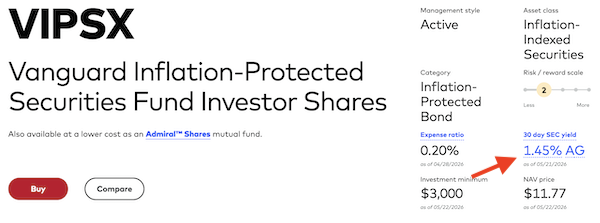
It says “30 day SEC yield,” so you might think it is comparable to the SEC yield from the nominal Treasury fund you saw earlier in this post. Not exactly. You see those letters “AG” next to the number? What do they mean? It turns out they’re just footnotes. The A was on the other fund and basically just explains what an SEC 30-day yield is. The G, however, indicates that this is a “real” (after-inflation) yield. It explains:
“G – Does not include any income adjustment resulting from change in inflation rate”
The true yield you should expect from this fund is 1.45% + whatever the Consumer Price Index for Urban Consumers (CPI-U) is. As I write this post, CPI-U is 3.8%. So, the total yield for this fund is about 1.45%+ 3.8% = 5.25%. Pretty good, because inflation just rose unexpectedly the month I wrote this post.
More information here:- Should I Hold Bonds In My Portfolio? Here’s Why I Don’t
- Best Investment Portfolios — 150+ Portfolios Better Than Yours
Tax Equivalent Yield
Should we keep going? Some people like to calculate a tax equivalent yield. This is a personal number, since everyone has their own marginal tax rate on their bond income. You’re just multiplying the yield by 1 minus the applicable marginal tax rate. Fidelity has a nice little calculator to help you, but basically if I put in my home state of Utah and that I’m in the highest tax brackets, I can see that a fully taxable 4% corporate bond yielding 4% yields about the same for me as a state income tax-free Treasury bond paying 3.71% or a federal income tax-free out-of-state municipal bond paying 2.45%.
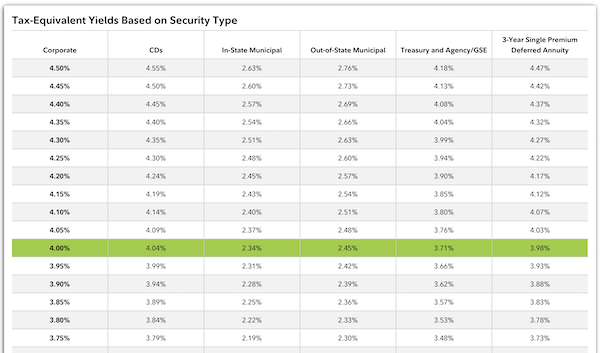
In my experience, this sort of calculation is mostly useful when deciding what type of money market fund to use (prime vs. Treasury vs. municipal) or whether to invest in taxable bonds vs. municipal bonds. As you move into the higher tax brackets, you’re more and more likely to prefer muni bonds. Some people in relatively high income tax states may get a slight advantage out of using a Treasury money market fund, but make sure your tax preparer is actually claiming that deduction! We’ve definitely seen some who are hesitant to do so because state tax authorities sometimes give them a hard time about it.
When investing in bonds, especially individual bonds, understanding the difference between the various reported yields is certainly useful to know.
What do you think? Which yields do you find most useful when making decisions? Why?
Did you find this article helpful? Share it!