The annuity puzzle, or paradox, is the contradiction between economic theory that suggests most people ought to annuitize a substantial portion of their retirement assets and the fact that very few do. Many people long for the days of yesteryear when employers provided their long-time employees with an inflation-adjusted pension (and often health insurance) for the remainder of their lives, no matter how long they lived. Few employers offer such a thing anymore. Most of those who do are government employers who are less susceptible to the risks of doing so, given political turnover and the ability to tax. Even the military has encouraged its members to opt out of pensions and into defined contribution-style retirement savings plans.
But ask yourself WHY people long for pensions, and you’ll quickly notice the disconnect between the idea that everyone wants one but very few are willing to buy one.
A WCI blog commenter wrote this on a recent post about retirement spending:
“Early retirement years are supposed to be the most enjoyable and expensive. And those are the years when uncertainty is the highest. There must be a better way than [safe withdrawal rates] to fully enjoy them and avoid regrets in your 80s, when you realize your nest egg has doubled, but you don’t have the health or desire to spend it.”
He is right. There must be a better way. That way is annuitization.
The Benefits of Annuitization
Annuitization is turning a lump sum of money into an income stream. Typically, that income is paid out monthly from the time of purchase until the month you die. This classic type of annuity is a Single Premium Immediate Annuity (SPIA), frequently listed as one of the “good annuities.” Immediate annuities eliminate one of the biggest worries that retirees and prospective retirees have—the risk of running out of money before they run out of time. Thus, annuities give the retiree “permission to spend,” an extremely valuable commodity based on the fact that so many spend less than they safely can. They can spend more than they would otherwise. They can give more prior to death than they would otherwise. They can take more risk with any remaining assets than they otherwise would.
Annuitizing a significant portion of your portfolio also helps eliminate the Sequence of Returns Risk (SORR). That money isn’t in your portfolio anymore where it can have poor returns. You’ve transferred that risk of poor returns to the insurance company.
More information here:Reasons for the Annuity Puzzle
Why don’t people annuitize more money? The annuity puzzle exists for a variety of reasons. Some of them are even logical.
Loss of Inheritance
One of the main things you exchange for that guaranteed income is the ability to leave money behind to your heirs. That’s why annuities generally offer higher rates than a typical portfolio. For example, an annuity purchased by a 70-year-old male pays 9.3%. But typical “safe withdrawal rates” are in the 3%-5% range. With a typical portfolio retirement scenario where you’re spending 3%-5%, you leave all the rest of that money behind to your heirs. Usually you leave even more money behind than you retired with because portfolio returns on average are MORE than 3%-5%. When you annuitize, you’re not just spending returns. You’re also spending principal.
Loss of Optionality
Annuitization is also generally final. There’s no going back. If you die the month after you buy the annuity, it’s all gone even though the company only ever paid you a single month of benefits. If interest rates later go up and an annuity purchased at that later time would have paid more, you can’t exchange it. If you later decide you would rather have a lump sum than an income stream, there are no do-overs. Sure, another entity might be willing to purchase that income stream from you, but don’t expect a good deal. And you’re probably going to have to prove you’re really healthy to get it sold.
Lose Out on Growth
You could possibly spend even more eventually if you leave your money in traditional investments—like stocks, bonds, and real estate—than if you annuitize it. That guaranteed income not only costs you the lump sum you used to buy it but also any future growth your money could have acquired. That growth, whether spent by you or your heirs, is gone.
Opt-In
Annuities are opt-in. You’ve got to go out and get it. 401(k) administrators have learned that when 401(k)s go from opt-in to opt-out, many more people participate. It just takes effort to go out, shop an annuity, think about your mortality, and write a big check.
Loss Aversion
While briefly mentioned above under loss of optionality, people really hate the fact that they might get paid back less than they paid into an annuity if they die soon after annuitizing. It feels like a bad investment, and nobody likes that.
Existing Annuitized Income
Some people don’t annuitize because they already have annuitized income from a pension and, of course, Social Security. They figure they already have enough guaranteed income. It makes a lot of sense to only annuitize part of your portfolio, and these folks already have.
Trust Issues
Annuities are commissioned products sold by commissioned agents, and many of us just don’t like buying from people who are paid to sell to us. It makes us feel like we’re at a used car lot. We’re afraid they’re lying to us, and we’re right to be afraid, given the experiences many WCIers have had with agents of insurance companies. In addition, you’re relying on the insurance company to live longer than you do. A guarantee is only as good as the entity standing behind it.
All states offer some sort of insurance guaranty corp run by the industry, but typically only a relatively small annuity is guaranteed even by that. The limit in Utah, where I live, is $500,000. Even for a 70-year-old man, that only buys an annual benefit of $45,000 or so. If you want more than that, you wouldn’t have a backup at all. Even for that $500,000, there are all kinds of caveats. Like, I have to remain a Utah resident, and the company has to have been licensed in Utah. You also have to go through a claims process. And if economic times are so bad that insurance companies are failing, how do you think the investments in this guaranty fund that are invested the same way as the insurance company’s money are faring?
Look at The White Coat Investor. For 15 years, we’ve been referring people to financial services companies, like mortgage companies, insurance agents, lenders, and financial advisors. Yet we still don’t have a page for annuity agents. Where are all the good guys in this space? Do they exist at all? We’ve never been told by our community about a single agent with whom we should be partnering.
Annuities Aren’t Good Deals
People who buy annuities generally live longer than those who don’t. Correlation is not causation, but in this case, it’s probably a selection bias. If you’re more likely to live a long time, you’re more likely to buy an annuity. They’re priced for healthy people, and, thus, annuities aren’t good deals for the average person—and they’re a terrible deal for someone in poor health. If you’re diagnosed with cancer at 70, you’re not going to go out and buy an annuity for $100,000, get 30 or 40 monthly payments of $700, die at 74, and be happy about your decision for those last four years.
High Costs and Complexity
Annuities, like cash value life insurance, pay commissions to agents. Guess which annuities pay the best commissions? That’s right, the worst ones. The ones that are the worst deal for you. And agents/insurance companies/insurance policies don’t want to be commodities like gasoline where you shop primarily on price. So, they all tweak their product a little so you can’t compare it to any other product. They add some bells and whistles, usually to address some of the downsides of annuities. Now, the purchaser has to pay the expenses and profits of the insurance company, including agent commissions, and also sort through all the complexity.
Pessimism/Underestimation of Longevity
Many people downplay longevity risk. They’re pessimistic, maybe overly pessimistic, about the likelihood of living a long time. The life expectancy of a 70-year-old man is a little over 15 years. Even an annuity paying 9% will only have a 15-year “return” of 4%. That doesn’t seem very good. But 10% of those 70-year-old men will live to be 95, and 2% of them will live to be 100. That’s the longevity risk you’re insuring against with an annuity.
Low Interest Rates
Part of the issue, at least in recent years, has been low interest rates. Insurance companies tend to invest most of their assets into relatively safe investments like bonds. Well, when bonds don’t pay much due to low interest rates, insurance companies have to offer relatively low rates on annuities. And when annuity rates are low, nobody wants to buy them. Just like they don’t want to buy bonds. So, they buy stocks and real estate instead and hope for the best.
Inflation
You used to be able to buy an inflation-indexed immediate annuity. You really can’t do that anymore. Some annuities do increase their payouts by 3% a year or so, which performs a similar function when inflation is controlled, but it’s not the same thing. The real risk with a SPIA is the same as with a 30-year Treasury bond—inflation. Sure, that annuity might be guaranteed to pay you $3,000 a month for the rest of your life, but what happens after a few years of high inflation when that $3,000 a month is only worth $1,000 a month in today’s dollars?
Decumulation Paradox
Finally, we have the decumulation paradox. Retirees often hesitate to spend down their savings, holding onto assets for fear of running out of money. That makes them reluctant to lock in a payout. This isn’t just an annuity-related issue, though. This is a retirement spending issue. After all those years of seeing your net worth and account balances climb, it’s psychologically painful to see them decrease. The vast majority of wealthy retirees (like most WCIers will be) aren’t spending as much as they could be spending. They don’t make it up with giving either. They just hoard it because they like to see the balances rise, and they fear an increasingly bizarre scenario where they run out of money.
They retire with $3 million and watch it climb to $4 million, then $6 million, and then they die with $8 million. They tend to only spend the income from their portfolios. Worse, many of them are still SAVING some of that income. Check out this chart.
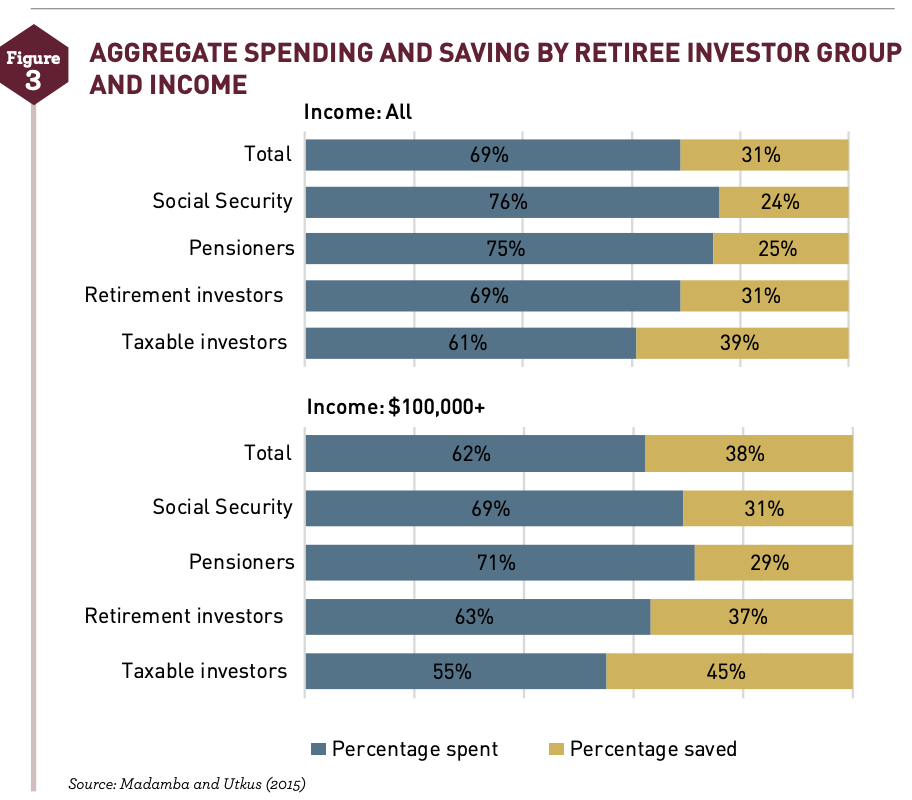
Let me interpret. People are saving 31% of their Social Security income, 29% of their pension income, 37% of the income from their retirement accounts, and 45% of the income from their taxable accounts. They’re not even close to touching the principal. They’re still saving for retirement in retirement. Why do we do that? Mostly because we think we’re immortal and we’re worried about all the wrong stuff. Look at what we’re worried about (same paper linked above):
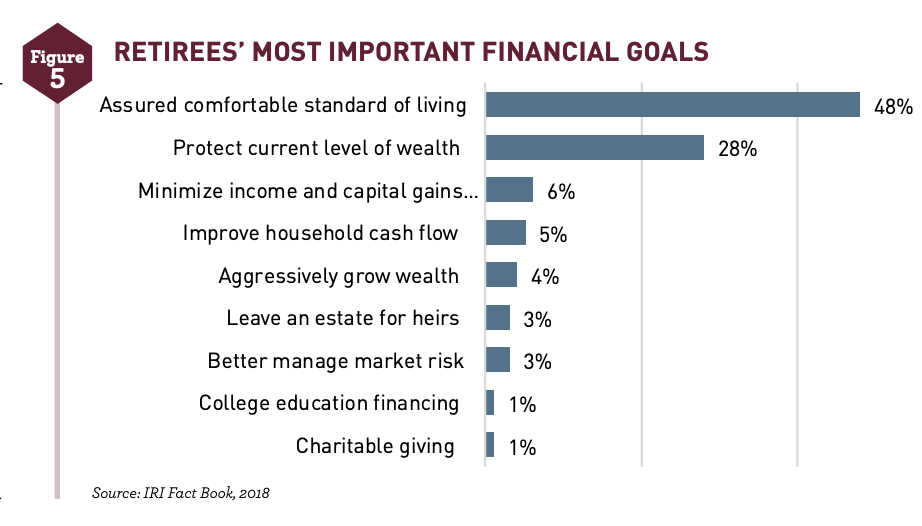
Our most important collective goal is to “assure” a comfortable standard of living. The second goal is to protect the current level of wealth. Basically, we’re afraid we’re going to run out of money and have to eat Alpo in retirement, and we hate to see our retirement account balance decrease. We’d rather die the richest doc in the graveyard than see that number go down. The next two items on the list crack me up too, because they’re polar opposites. Minimizing taxable income seems a reasonable goal when people aren’t even spending all of their taxable income, but improving household cash flow is exactly the opposite. Do you want more spendable money or don’t you? I honestly think some people would rather be poor and live poor than pay any more money in taxes.
Next on the list is to “grow wealth.” Really? Where is “Spend and give as much as I safely can before I die” on this list? Nowhere. Giving is there at the bottom at 1%, but we don’t even want to give anything to our heirs until we’re dead, and even that is only a significant goal for 3%.
Yes, the annuity paradox is partially, maybe even mostly, explained by the decumulation paradox. An annuity is a tool to help you spend your money, but deep down inside, you don’t really want to spend it anyway. You just want it in that account.
How Insurance Companies Try to Overcome These Concerns
Despite all these concerns, insurance companies and their agents still want to sell you an annuity. To deal with these issues, they introduce features (bells and whistles) to their annuities. People are really worried they’ll die before they get their money’s worth out of the annuity, so annuities get sold with death benefits. That way, when you die, your heirs have something left. Some annuities get sold with “period-certain” guarantees, so even if you die after a year, they’ll still pay out to your heirs for five or 10 years. And they get sold with increased payouts each year (although not a true inflation guarantee).
But all these things cost you something. The money to pay for those features HAS to come out of the primary benefit. It can’t come from anywhere else. I suspect you’re usually giving up way too much primary benefit to get those features.
More information here:- The Wrong Annuities Are Being Sold (Bought?)
- Should I Purchase an Annuity for My Child as Part of My Estate Plan?
The Best Deal in Annuities
Of course, the best deal in annuities is to just delay your Social Security to age 70. I’m not saying work until 70. I’m saying spend (some of) your other money before age 70 so you can delay Social Security to 70. If you’re considering buying an annuity, there’s no way you should be taking Social Security early. That’s dumb. Social Security is backed by a very financially strong entity with a lot of aircraft carriers and the ability to tax, and it is indexed to inflation. Plus, everybody gets Social Security, not just healthy people. It is actuarially “priced” for the average person, not just healthy people, so it’s a better deal than an annuity. An annuity is something you add on to delayed Social Security; it’s not something you get instead of delaying Social Security.
Annuities are a great way to deal with SORR. They’re a great way to give yourself some longevity insurance. They’re a great way to give yourself permission to spend and hopefully get past the decumulation paradox. If you want or need to spend (or give prior to death) more than 4% of your portfolio, you should definitely consider annuitizing some of it.
You do need to have a plan for inflation, whether that is something like buying a TIPS ladder, leaving a substantial portion of money in stocks and real estate, or periodically buying additional SPIAs every few years. But JUST a fear of inflation shouldn’t keep anyone from buying any annuities.
What do you think? Why do you think the annuity puzzle exists? Will you buy an annuity? Do you already have one?
Did you find this article helpful? Share it!