I’m really excited to unveil the new White Coat Investor job board, but first let me give you a little bit of background on what this will be and why we’re doing this.
We talk about all kinds of financial topics here at The White Coat Investor. Some topics are sexier than others, of course. Few people get very excited about essential topics like disability insurance and revocable trusts, but everyone likes to talk about early retirement, paying less in taxes, and the latest hot investment. However, the truth is that personal finance and investing are a single-player game; it’s you against your goals. And when it comes to winning that game, some things matter a whole lot more than others.
If we were going to rank those things in order, the list might look something like this:
- Income
- Savings rate
- Appropriate insurance
- Reasonable investing plan
- Sticking with your investing plan
- Asset allocation
- Investment selection
- Asset location and other tax-minimizing techniques
- Estate planning
- Asset protection
Income is right at the top of the list. It’s just a whole lot easier to pay off debt and build wealth when you have more money. We don’t talk about income nearly as much as we should. Part of that is because it can feel gross. Everyone agrees you should control your spending and that you shouldn’t leave a tip to the taxman, but not everyone agrees that trying to earn more is always a good thing. Plus, doctors feel bad about the elephant in the room—some doctors get paid dramatically more than others despite having a similar educational journey. It’s awkward to discuss. But if we really want to make a difference in the financial lives of doctors, we need to be talking about optimizing income just as much as optimizing retirement accounts and tax planning.
We have done this occasionally. We teach doctors to get their contracts reviewed, negotiate, and consider owning their own practice, but we probably don’t spend nearly as much time on this topic as we should. So, I apologize for ignoring what you have been telling us with your internet traffic patterns over the last decade or more. Our posts about income, boosting income, and comparing income are some of the most popular ones on the site. You’re clearly interested in the topic, so we’ll try to address it more frequently.
The Physician Job Search and Recruitment World Was Broken
Part of the issue was that the recruitment world for physicians was broken. Some practices looking for physicians were paying ridiculous amounts to get that doctor. Typically, a physician recruiter would earn a salary of $65,000-$100,000 per year. That seems fine, right? But what if I told you they also earn bonuses of 15%-30% of the hired physician’s first-year salary. Does that seem fine to you? Probably not. If the doc earns $400,000 per year, that’s a $60,000-$120,000 bonus. Per doctor. Now, imagine you recruit just four of them during the year—one every three months. That physician recruiter is now earning as much as the doctors without ever taking call, staying up all night, being threatened with seven-figure lawsuits, or having to sit with a family on the worst day of their lives.
Is it really that hard to connect doctors with good jobs that you have to pay the recruiters as much as or more than the doctors? That doesn’t seem right. We weren’t the only ones to think so. Now, that world is gone, thanks to a company we have been working with for the last year or two. You’ve probably heard of it by now; it’s called Marit Health.
We’ve used Marit’s data in many of our blog posts and just about all of my live and virtual presentations in the last couple of years. It has a fantastic database of physician compensation data that, unlike the previous best source of information (MGMA), is not controlled primarily by the employers. Doximity and Medscape do salary surveys every year, but that information pales in comparison to what is available at Marit. And if you really love MGMA data, well, Marit will give you that for free too, at least for your specialty for a limited time.
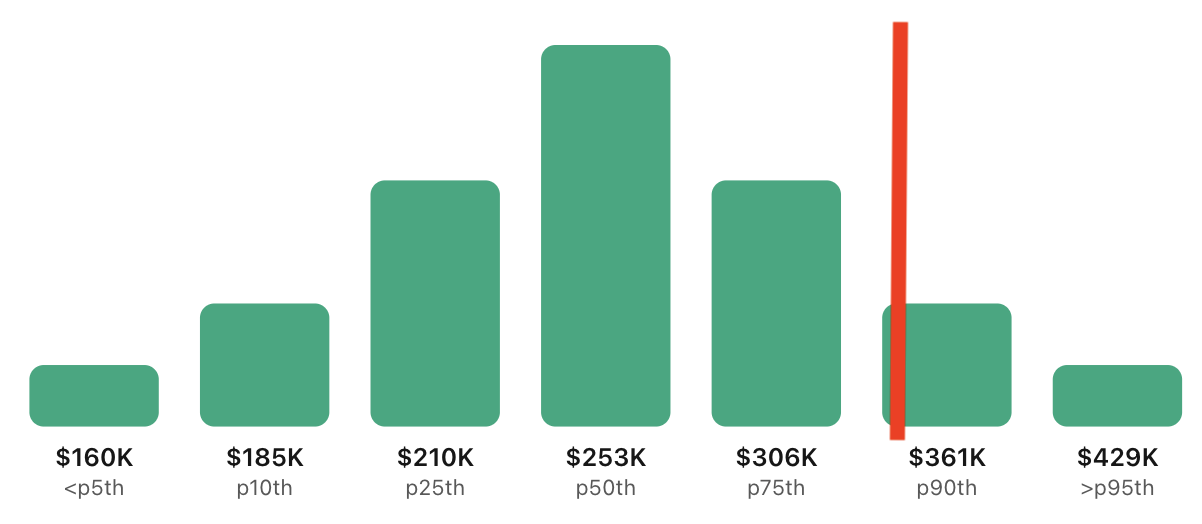
It was a simple proposition for Marit and the doctors. If a doctor shares their salary info with the database, they get access to the entire database. Pretty simple idea, really. It’s crowdsourced compensation data. Why didn’t anyone think of that before? I typically use this data to make the point that there is a huge range of income in every specialty. For example, look at these two charts showing pediatrics and orthopedic surgery incomes:
Pediatrics
Orthopedic Surgery
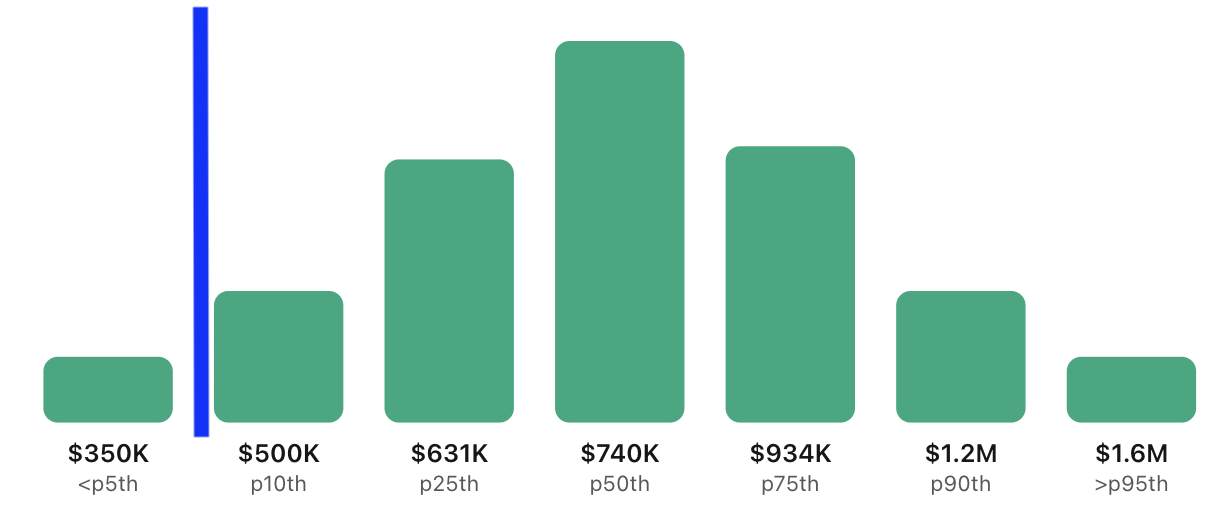
My point when using these charts is that sure, the average pediatrician earns $253,000, but look at that RANGE! Some pediatricians are making 2.7X what other pediatricians are making. It’s the same on the orthopedic surgery chart. The average might be $740,000, but the 95th percentile doc is earning more than 4X what the fifth percentile doc is earning. For the same work! OK, maybe not the exact same work, but at least similar work or work that the fifth percentile doc could be doing if they wanted.
I hope nobody is surprised to learn that orthopods earn more than pediatricians on average, but I bet some of you are surprised that a fair number of pediatricians are earning more than a fair number of orthopedists. The red line on the peds chart represents the fifth percentile of orthopedist incomes, and the blue line on the ortho chart represents the 95th percentile of peds incomes. I know pediatricians making seven figures. I also know full-time orthopedists who are only earning about $200,000 per year (thank you for your service).
Having this data empowers doctors as they negotiate employment and partnership contracts. Being paid fairly makes all the other parts of your financial plan far easier. People like to focus on the middle and higher ends of those charts, but honestly, the people for whom this data is most useful are probably the folks on the lower end of the charts. Taking your income from $160,000 to $250,000 is going to make a much bigger difference in your life than taking your income from $1.2 million to $1.6 million.
Why Is Marit Offering This Data for Free?
When I first became aware of Marit on the WCI subreddit a couple of years ago, some people worried about sharing their data. Hopefully they’re a lot less worried now that we can all see what Marit does as a business. Frankly, what it’s doing is industry-changing (for an industry that needs to be changed), and we want to be part of it. What is Marit doing with the data? First, they’re just giving it away for free to you. Pretty cool, right? But it’s not free to collect and distribute data. A business has to exist there somewhere. Just like WCI might spend most of its time and effort creating content to improve your lives, we have an underlying business that allows us to make payroll and profit. That business is primarily connecting you with the good guys in the industry.
So, what is Marit’s business? It’s connecting good doctors with good jobs. Let me explain how it works.
Recruiters, Job Boards, and Advertisements
Let’s say your employer or your physician group needs a new doctor. How do you find that doctor? You might post the job on a job board or two. You might hire a recruiter. You might buy a few ads in the back of your specialty journal. Sure, some jobs never get advertised (I think our group has hired 15 docs or so in the 16 years I’ve been there without ever advertising, but it’s also a great emergency doc job in a very outdoorsy place). But most job openings will require at least a little effort to fill. Most job boards are tiny. They don’t get very many jobs, so they don’t get very many eyeballs. Docs don’t come because there aren’t very many jobs, and potential employers don’t buy listings because there aren’t very many docs.
Marit fixed this problem.
Guess what the solution was? It’s genius. Just put all the jobs on the job board. ALL the jobs. How do you do that? You don’t charge the employers. In fact, you don’t even talk to them. You just find their public job listing and put them on your job board. Or even better: in the age of artificial intelligence, just like how Google works, you have your bots comb the entire internet every day looking for physician job listings and display them on your job board.
The point is that you get ALL the jobs, so docs don’t have to go to multiple job boards. They certainly don’t have to talk to recruiters. Just like how we trust Google to have all the content on the internet and only use Google to find any information, Marit’s job board is the only place docs need to visit to see all the jobs. Sure, docs might still poke around for unadvertised jobs to see if anything pops up, but this dramatically simplifies the job search. Plus, that $50,000-$100,000 that employers were going to pay recruiters to find them a doc can be paid to the doc as a signing bonus.
Here’s another reason I love this job platform. For years, physician phone numbers and emails have been sold to recruiters and agencies. We are all too familiar with the amount of spam we get all day. Not with this platform. On the Marit job board, physician data is never made available to recruiters. Only when you choose to apply to a job is your information shared with recruiters. Brilliant, right? AI might not kill very many doctor jobs, but it’s certainly going to remove a lot of this spam and make finding the best job much easier
Introducing The White Coat Investor Job Board
WCIers have asked us to make a job board for years, but it never seemed practical for us. Now it is. Our new job board is powered by Marit. We’ve got the physician eyeballs and trust. They’ve got the jobs and an AI-powered matching experience to connect you with the best jobs. It’s a match made in heaven. We get to serve the physician community better than ever before, and while we expect we’ll make some money connecting good docs with good jobs, we expect this change to the industry to mostly just result in more money in physician pockets. We think that’s a good thing.
I hope it’s obvious to you now why we think Marit is the perfect partner for a WCI job board. Our team has been working on this relationship and launch for over a year now. Brett Stevens (WCI COO) and I even took a trip out to San Francisco to sit down with Vikas Sabnani, Marit’s co-founder and CEO, to iron out all of this. What we found was a team that is just as excited about making the financial services industry serve us all better as our team here at WCI is. We are so excited by what Marit is doing that I am joining them as an advisor, and WCI has taken a small equity stake in the company.
We know many of you aren’t looking for a new job. I’m already in my last physician job. But knowing what you are worth is valuable, and this is the best way to see what all of your peers are earning. Transparency is a wonderful thing here. This is particularly important for employees. You might not be interested in changing jobs, but I bet you would be interested in a raise that brought your compensation in line with the going rate for your knowledge, ability, and work. This job board will empower you to do that even if you never change jobs again.
Let’s play around with it for a minute. I’m going to search for emergency medicine jobs in Houston. First, I’ll go to the jobs board using either the “Recommended” tab (look for Physician Jobs) at the top of the WCI site or by typing in whitecoatinvestor.com/jobs. It’ll look something like this:
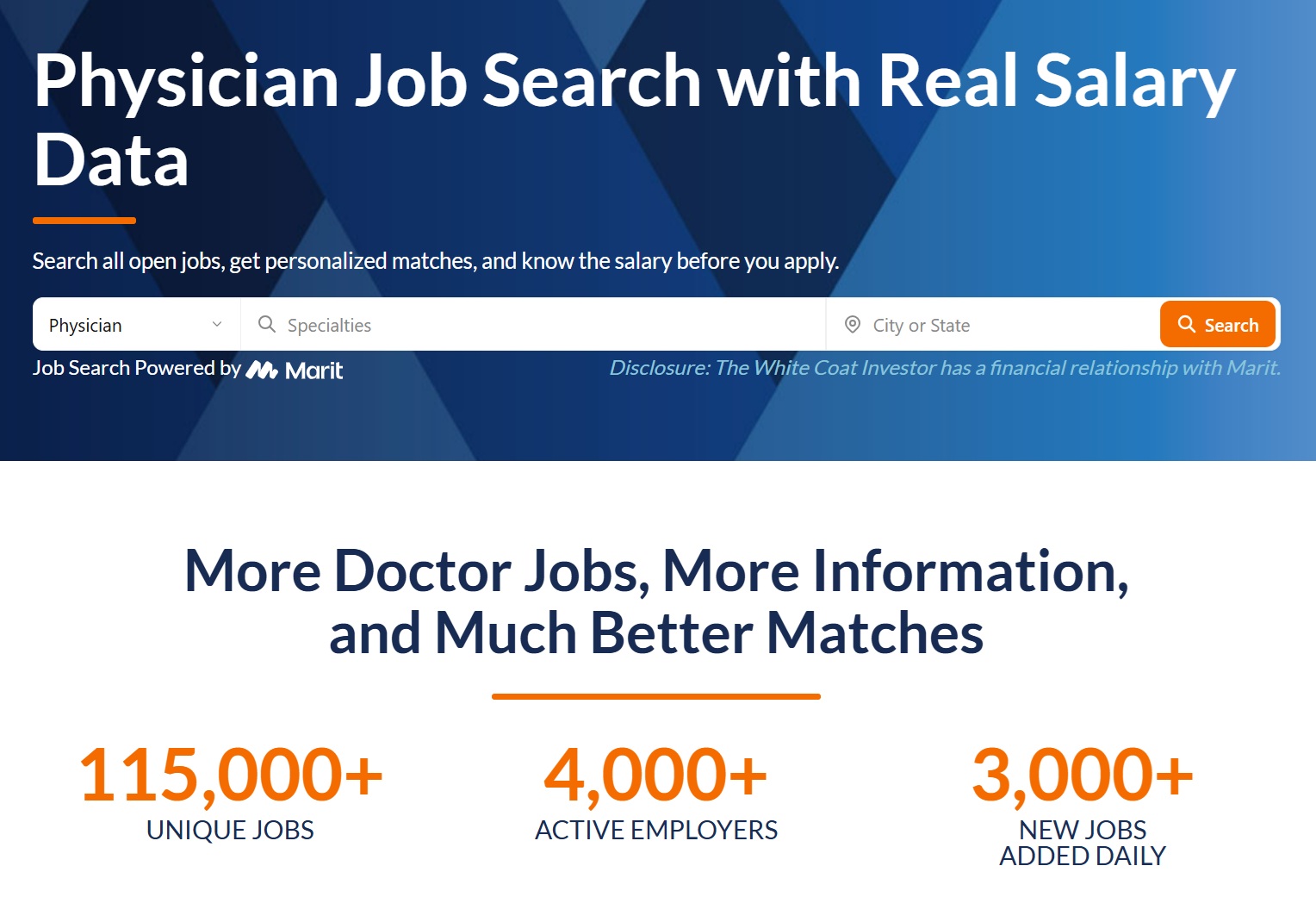
In the middle box, I type in “emergency medicine,” and in the “City, State” box, I put in “Houston, TX” and hit the “Search” button. It looks like this:
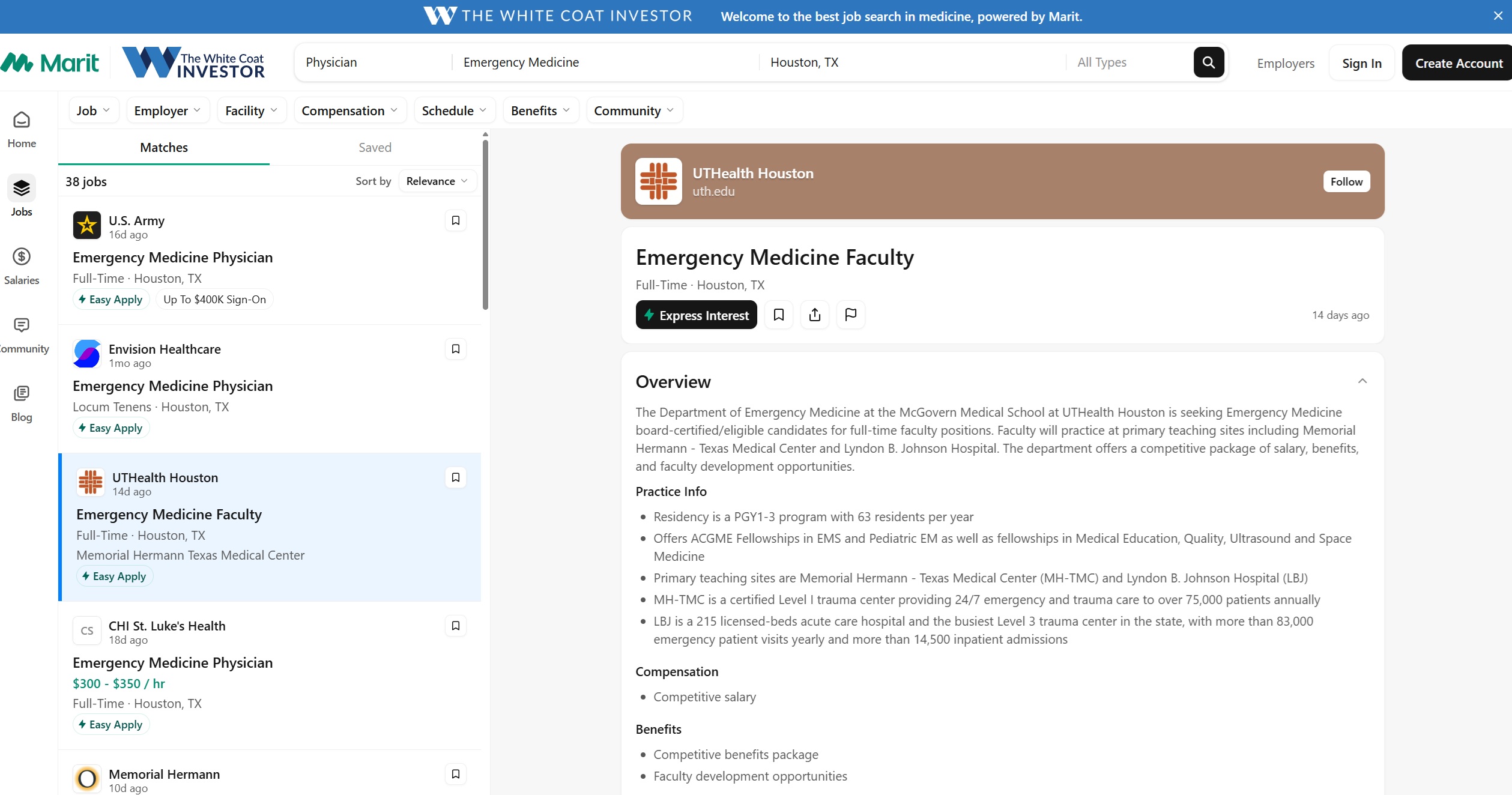
In this case, it gave me 38 jobs. Not too bad to comb through, but if you’re searching multiple states, you might find hundreds of jobs and need to narrow them down a bit. See all those bars at the top left? That’s where you can modify your search.
The “Jobs” dropdown lets you only look at academic or non-academic jobs or jobs where your visa won’t cause you any issues.
The “Employer” dropdown menu allows you to include or exclude government jobs, hospital jobs, private jobs, pharma jobs, and more.
The “Facility” dropdown allows you to exclude multi-site jobs or even only look at jobs that use your preferred Electronic Health Record (EHR).
The “Compensation” dropdown is one of my favorites. You can put in a minimum annual salary or a minimum hourly rate and even exclude job listings that don’t include salary info.
The “Schedule” dropdown is another great one. You can look at only nocturnist jobs or only eight-hour shift jobs or only rotating/flexible jobs.
The “Benefits” dropdown can allow you to look only at jobs offering retirement plans, paid time off, and student loan assistance.
Finally, the “Community” dropdown can allow you to exclude jobs in big cities or rural towns or even cities that don’t agree with your politics.
It’s awesome. You can hit the “Save job” tab, share the job with your partner, and even “Express interest” right in the app. What more could you want in a jobs board? I can’t think of anything. If you can, let us know, and we’ll see if we can add it.
Wait, How Does Marit Make Money?
You might be wondering how Marit is going to stay in business if it lists all the jobs even if the employers don’t pay them. And how is it going to share any revenue with WCI? It turns out that doctors are pretty desirable folks. There are far more good jobs out there than there are docs to fill them. The employers that really want doctors are willing to pay to have their jobs promoted a little more so they can fill them sooner. Those jobs are probably going to show up toward the top of your job list and be promoted in other ways. Again, it’s just like how Google allows advertisers to pay and boost their search results higher up on the page.
Since the AI bots are doing so much of the work, Marit simply doesn’t have to make the money needed to pay thousands of doctor recruiters to have a profitable business. All those savings should indirectly result in higher bonuses to the doctors. See why I’m so excited about this? This product is free to job searchers, and through this partnership and Marit ownership, WCI will even make some money. We can then further our mission. It’s a win-win-win-win proposition for doctors, their employers, Marit, and WCI.
Check out the New WCI Job Board today and let us know what you think. As always, your feedback is critical in helping us to serve you as well as possible.
Did you find this article helpful? Share it!