

I’m not a camping guy. I’m not a backpacking guy. And I’m not really a hiking guy. I always joke to my friends (but it isn’t really a joke) that I’m more of a glamping guy. Perhaps, then, I was more surprised than anybody when I volunteered to be one of the adult leaders on a 12-day backpacking trip to the New Mexico mountains with my son’s Boy Scout troop.
It would be nearly two weeks of doing the kinds of things I don’t normally like to do. But for some reason, I raised my hand in the fall of 2025 and proclaimed that I would go to the Philmont Scout Ranch, a 140,000-acre property in the Sangre de Cristo Mountains, in the summer of 2026. I felt like it was the right time for me to get out of my comfort zone and go on an adventure with my 16-year-old boy.
I’m not a camping guy, but I knew this trip would teach me plenty of lessons. Some of those lessons could be applied to finance. Some could be applied to living your best life. And some could teach me aspects of life that I didn’t even know that I needed to learn.
Here’s everything I gathered while hiking 140 miles at elevation over 12 days in the New Mexico backcountry while at Philmont.
Prepare for Everything You Can—and Let Go of Everything You Can’t Know
I became financially literate over the course of several years. After making the decision to go to Philmont, I had to become backpacking literate in just a few months. I spent plenty of mental energy figuring out what to pack, what I could leave behind, and how I was going to fit everything into my 75-liter pack that was going to add 40-50 pounds of weight on me every time we packed up our tents in the mornings and set out on the trail.
I spent dozens of hours poring over guides, old menus, Facebook posts, Reddit threads, and YouTube videos trying to find the right wool socks (and the right sock liners) that would prevent blisters, testing out two-person tents borrowed from friends, and running and power-walking at 12% on the treadmill at the gym to make sure my cardio was on point.
I did everything I could to be prepared, because I knew that I didn’t know what I didn’t know.
The same could be said of those who are trying to get financially literate. You can’t continuously drink from the firehose of new information that never stops spewing. You have to absorb what you can and then let go of everything else and save it for another day. Otherwise, it’s too overwhelming, and you just might quit the adventure before it even begins.
Besides, once we were at Philmont, we had plenty that we couldn’t have prepared for or known about in advance (two-hour nosebleeds in the dry, thin mountain air and broken trekking poles on Day 1 of the hike and chipmunks, aka minibears, that would ravage your pack if you turned your back for two minutes).
The three adult leaders also had to come to terms with the fact that our middle-aged bodies couldn’t keep up with the youngsters who had 16-year-old legs and lungs. All of us trained hard, and all of us were in shape. But we still lagged behind most of the Scouts who could hike 1,500 feet of elevation over a mile without having to bend over at the waist to suck in oxygen every five minutes like their parents.
At one point, the dads were maybe 90 seconds behind the pack of Scouts, and as they stopped on the trail to wait for us, they found a skeleton of animal bones. When we caught sight of the Scouts again, one of the dads asked his kid, “Did you kill that?” And the kid responded, half-jokingly, “Yeah, we killed it, skinned it, cooked it, ate it, and then waited. That’s how long it took you to catch up to us.”
Yikes.
Just like in your finance journey, prepare as best you can and adjust when you must. And don’t worry about keeping up with the younger kids with better stamina or the wealthy doctors who had a head start on you. Comparing yourself to somebody who is seemingly having an easier time than you usually doesn't turn out favorably. Nature is cruel that way.
More information here:- How to Add Adventure to Your Life
- WCI Travel Club: Momentous Trips to the Appalachian Trail, Washington DC, and Tokyo/Paris
Sometimes You Have to Smile, Even When You Don’t Wanna
The day before we stepped out on the trail, all the adults attended a pre-trek meeting at Philmont’s base camp, where one of the ranch directors gave us the rundown on what happens if you get injured in the backcountry, how to motivate the Scouts who begin feeling homesick after just a few days, and what to do on the trail when you’re not really sure what to do.
He also told us this: sometimes you have to smile, even when you don’t wanna. When the Scouts take too long to pack up their tents in the early morning and you just . . . want . . . to . . . leave . . . camp before it gets too hot, you smile through your frustration. You smile when you’re eating meat sticks for breakfast for the eighth straight day, and you can no longer stand the saltiness. You smile when the outdoor latrines are a little too disgusting. You smile when, while eating lunch, you drop most of your cheese cup (face down!) on the ground—and in my case, you pick up the manufactured cheese product, dust off the pine needles and dirt, and eat it anyway (this, by the way, is not something a glamping guy would ever do).
While I was eating that ground cheese 10 days into the trip, without having showered in recent memory, I thought back to one of my favorite Rikki Racela columns, Yes, Risk Tolerance Can Be Modified: You Just Have to Rewire Your Brain, when he talked about how he had forced himself to get excited when the stock market dropped.
As he wrote:
“During bear markets, I think of falling markets as a game where I don’t sell. In fact, I have fellow white coat investors who I ‘compete’ with to see who can stay invested and not sell. I text my friends bragging that I am not selling during a bear. In fact, I brag about putting more money in! . . . During a bear market, I start performing activities that bring a sense of well-being so that I associate good feelings with the bear. I text my aforementioned WCI friends, ‘Stocks are on sale! This is awesome!’ I go out with my friends to hang out and celebrate. I go out for a nice dinner. I text my wife that I love her. I give my children hugs and kisses . . . Just like Pavlov’s dog, I am rewiring my brain to a stimulus, so now my natural reaction during a bear market is a sense of happiness, excited anticipation, and well-being. I am salivating when I hear the bell, not when I see the food.”
You smile when stocks go down. You smile when the air abandons your lungs on a brutal uphill hike.
But at least once, I took this idea of smiling when you don’t wanna too far, making too many jokes at midnight during a stressful nosebleed situation for one of the Scouts. I thought one of the adults might eventually hit me in the face if I kept going with my late-night shenanigans, and I realized at that moment, hey, maybe I don’t need to smile so darn wide when nobody else wants to see it.
The idea, though, stands. Smiling through the frustration, the pain, and the delicious-but-somehow-disgusting meat sticks can make you and everybody around you feel a little better.
You Can’t Manufacture Bonding Moments
The biggest reason I volunteered for this trip was so I could have an adventure with my son. I didn’t go out of my way to try to bond with him, but we had a few moments that made the entire trip and the training that went into it worthwhile. Our 12-hour drive from Texas to New Mexico was filled with stories and jokes, and us unsuccessfully trying to throw bear bags over the extremely tall bear line that was tied between two trees at one camp was a fun diversion.
But the highlight of the trip came five days into the trek on one of the toughest days we’d experienced so far.
We were at a staff camp that’s known for its cantina and the root beer it sells to thirsty and dusty travelers. The Scouts wanted the root beer experience after dinner, and I tagged along. It was a blast. We paid for eight root beers, sat at a big table in the cantina, listened to some surprisingly good piano tinkling from Scouts in another troop, played some cards (they taught me about the game President), and had some laughs.
As I climbed my way back to our camp that evening, I felt my kid and I had forged a nice bond that night. I hadn’t made a real effort to manufacture a bonding moment. But it had come nonetheless over some cold drinks, a few choice curse words, and a pack of playing cards.
As the troop went through our nightly routine of roses, buds, and thorns before heading off to bed, my son told the nine of us, “We had a tough day here, but then we got some root beer, and that was really fun. Right, Dad?”
That “right, Dad?” slayed me in the best way possible.
Type 2 Fun Is Like Delayed Gratification
Physicians know all about delayed gratification. But a kind of delayed gratification exists on the trail as well. It’s called Type 2 fun.
Here’s a breakdown of all the types of fun you can have at Philmont (and in life), explained to me by a legendary staff member named 9 Pound:
- Type 1 fun: You’re having fun now, and you’ll have fun later when you reminisce about the memory and tell stories about it.
- Type 2 fun: You’re NOT having fun now, but you’ll have fun later when you remember the tough moments.
- Type 3 fun: You’re having a great time now, but your future self won’t appreciate the experience (the kid-friendly example that was explained to me was: “Boy, I’m having fun eating 75 Snickers bars tonight, but I’m not going to be feeling good tomorrow”).
- Type 4 fun: Not fun now, not fun later (falling off the mountain, for example).
Philmont has plenty of Type 2 fun. Even now, writing this column about the hard times at Philmont (and yeah, it was physically and mentally hard) is kind of a blast. It’s something to think about: just because you’re struggling in the moment doesn’t mean you won’t look back and think fondly about the obstacles and struggles you endured.
More information here:- Do What Others Aren’t Willing to Do
- From Road Trips to Bush Planes: Getting to All of the National Parks on an Evolving Budget
Stop and Look Around Once in a While
Most of the trails at Philmont are root-filled and rocky, so you have to look at your feet much of the time to make sure you’re not going to trip and face plant onto a boulder. But I take most of my philosophical cues from Ferris Bueller, and so I constantly told myself to take my gaze away from my feet and absorb the beauty all around me. If you don't stop and look around once in a while, you could miss it.
The night before we left base camp to get on the trail, my son and I attended the nightly Jewish service, and the chaplain talked to us about finding the Selah moment at Philmont. Selah is basically a pause in the middle of a Hebrew prayer. Nobody is 100% sure what Selah means, but scholars have theories that it’s about breathing in and taking in your surroundings, thinking about the joy of the moment, and/or being present in your environment.
Selah is the pause so that you can inhale it all into your lungs, heart, and soul.
“Find the Selah moment at Philmont,” the chaplain told us. It’s why we spent thousands of dollars, drove so far, and trained so hard. The Selah was why we were there. The Selah is what makes life worth it.
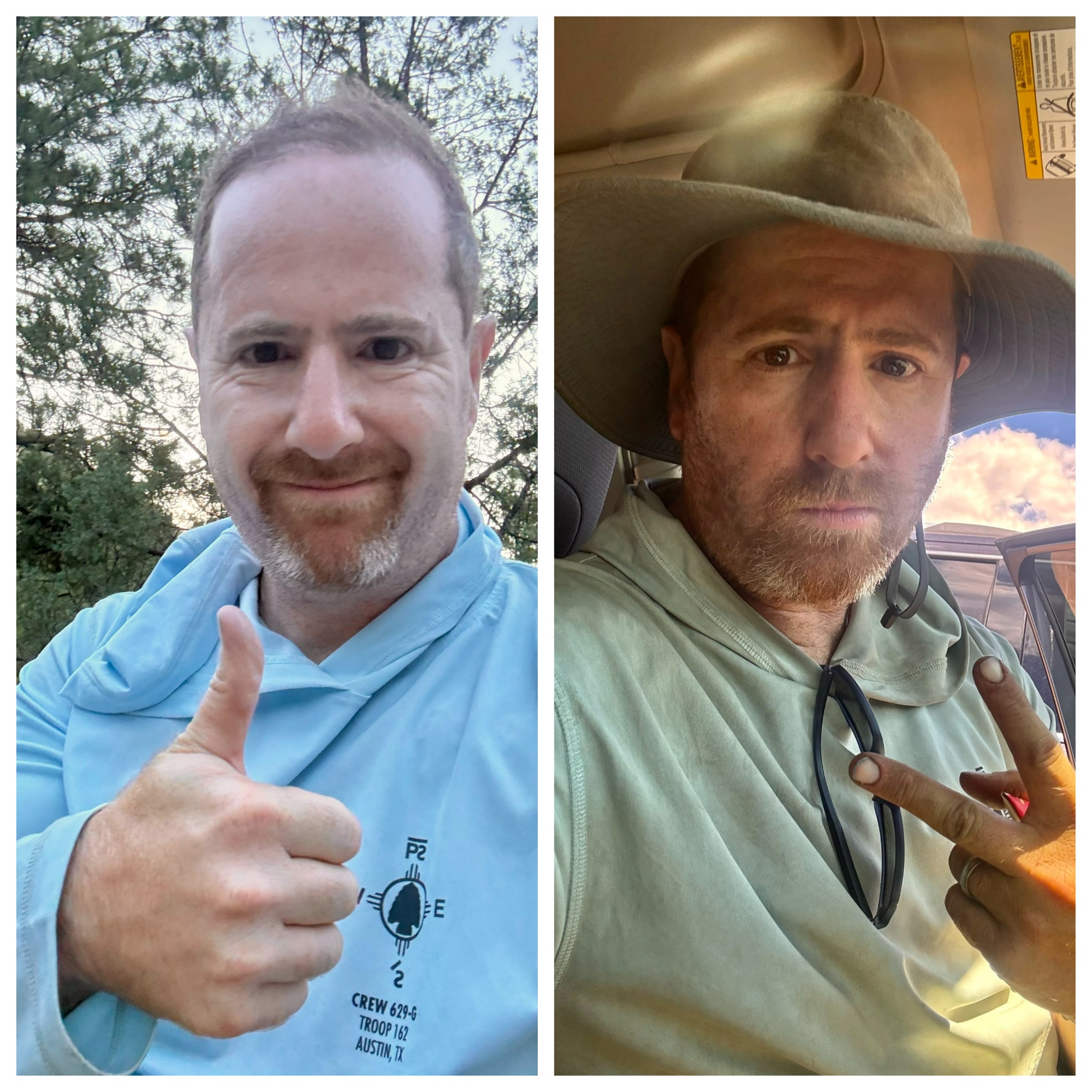
Before and after photos from my Philmont experience. Click to expand the photo to see just how dirty my fingers and face got.
The saying goes that when you leave Philmont’s base camp, you should turn and glance over your shoulder at the famous Tooth of Time peak that looks over the property if you eventually want to return to the Scout Ranch.
The desire to return is abbreviated as IWGBTP (I Wanna Go Back To Philmont). When we took the school bus from base camp to the trailhead at the beginning of our journey, everybody on the bus looked back at the Tooth. We all definitely wanted to return in 12 days, a little smellier, a little dirtier, a little tougher, and a little more adventurous. When my son and I left to start the drive home to civilization after our adventure was complete, I reminded him to look behind us if he ever wanted to come back.
He looked over his shoulder; I kept staring straight ahead. After 12 days of hiking, backpacking, and camping, I had determined that I still wasn’t a hiking/backpacking/camping guy, that I’m still the same glamping guy. And if I never saw the Tooth of Time or ate freeze-dried beef stroganoff for dinner or had to help stop a nosebleed in the middle of the night or didn’t wear the same pair of hiking pants for 12 days straight, that would be fine with me.
Now, we’ve been back for about six weeks, and I’ve had many hours to reflect on what happened in the backcountry. I can understand the appeal of returning. You already forget about the pain in your feet or how bad your shirt reeked or how little sleep you got. Instead, you think about the camaraderie of eating freeze-dried dinners and washing it down with root beer together. You think about the fun of crossing paths with other crews and the stories that you tell each other. You think about the beauty you saw after climbing 12,440 feet to the top of Baldy Mountain. You think about the stories you tell afterward. You think about the Selah of that sacred space.
Do IWGBTP? A month ago, I would have said absolutely not. Today, the pull to return one day is a tiny bit stronger. That's not something a glamping guy would say.
Money Song of the Week
In celebration of having seen Mike Patton, my favorite singer of all time, in concert twice this summer (once with AVTT/PTTN and once with Tomahawk), let’s take a live listen to how the shows ended during his collaboration tour with the Americana duo The Avett Brothers. It’s a cover of a 19th-century church hymn called It Is Well with My Soul, and it is a beautiful piece that was a perfect ending to an adrenalized live show.
And once you know the background, it’s either inspiring or just a little bit horrifying—or both.
The hymn’s lyrics were written by Horatio Spafford, a successful lawyer and real estate investor from Chicago whose riches were destroyed by the Great Chicago Fire of 1871 and who lost all five of his children in a two-year span around that time.
Knowing that, the lyrics of It Is Well with My Soul are almost incomprehensible. As Spafford wrote,
“When peace like a river, attendeth my way
When sorrows like sea billows roll
Whatever my lot, thou hast taught me to say
It is well, it is well, with my soul.”
Oh, and by the way, four of his daughters died in a shipwreck en route from America to England, so that “sorrows like sea billows roll” line is especially poignant.
While this song isn’t necessarily about money (even though Spafford lost a lot of it before he wrote the lyrics), it is about emerging from the dark abyss and allowing the sunlight (and whatever being created that sunlight) to bring you back to health. It’s a powerful and inspirational and spiritual piece of music, which I suspect is why people are still singing it more than 150 years after it was created.
As Scott Avett told CleveRock,
More information here:“It’s been really exciting to see how [It Is Well with My Soul] plays at the end,” he said. “We really do it choir-style where we all just gather around . . . When it comes to the songs, the depth of the melodies that set you up to hear what those words are and involve yourself in the story just pulls us in . . . Mike [Patton] is a huge fan of deep melodies, and with these old hymns, you just can’t deny many of them.”
Instagram of the Week
I love the line from WCI's Content Specialist Miri Avinoam, “Small spending adds up, just the way big spending does. But you also have only one life to live, and depriving yourself of life’s little micro-joys probably isn’t the way to do it.”
Have you done a long backpacking trek? What lessons did you learn? Would you do it again?
Did you find this article helpful? Share it!