

One of my least favorite taxes is known as the Net Investment Income Tax (NIIT). Basically, it is a 3.8% federal income tax applied to all investment income once you have an Adjusted Gross Income (AGI) of $200,000 ($250,000 Married Filing Jointly (MFJ)), a figure that is not indexed to inflation.
What Is NIIT, and Is It Related to Payroll Tax?
NIIT is one of the Obamacare taxes, implemented with the passage of the Patient Protection and Affordable Care Act (PPACA) in 2010. The other PPACA tax is known as the “Additional Medicare Tax,” which is applied to EARNED income once your AGI is over $200,000 ($250,000 MFJ). It is 0.9%. The idea behind both of these taxes was that this money would go toward paying for the tax subsidies involved in purchasing health insurance on the state PPACA exchanges. It is not a coincidence that 2.9% (the Medicare tax rate) plus 0.9% (the Additional Medicare Tax rate) is equal to 3.8% (the NIIT rate).
With these taxes in place, high earners are essentially paying 3.8% in some type of payroll tax (Medicare or health insurance tax) on (almost) all types of income, earned or unearned. The government is doing more, so the tax bill goes up, plain and simple. Essentially, income is being transferred from high earners to low earners who buy their own health insurance—or, since money is fungible, from high earners to the government.
More information here:- 10 Ways to Avoid (or at Least Delay) Capital Gains Taxes
- 20 Ways to Lower Your Taxable Income for High Earners
What Does NIIT Do?
The overall effect of this tax is to increase the taxation of unearned income, such as dividends, rents, and capital gains. It basically adds two new tax brackets to the Qualified Dividend and Long-Term Capital Gains taxes.
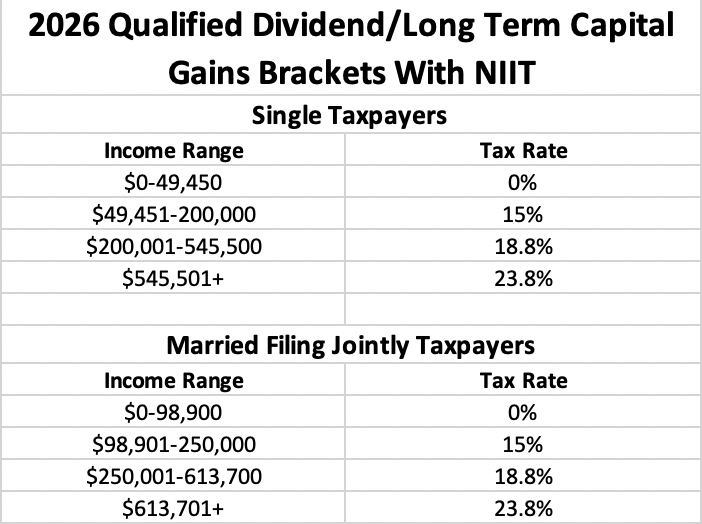
Note that the “20% QD/LTCG Bracket” doesn’t actually exist for anyone. Interestingly, the tax starts at $125,000 for those filing Married Filing Separately (MFS). It applies to all investment income, too—not just qualified dividends and long-term capital gains. The brackets for nonqualified dividends, interest, rents, and short-term capital gains are the same as the ordinary income tax brackets, but they too have this 3.8% tax added on to them starting at $125,000-$250,000.
Why Wasn’t NIIT Indexed to Inflation?
While some might think the lack of inflation indexing was an oversight, I’m a bit more cynical. It was designed right from the start to be a slowly increasing tax on high earners, both on their earned income and their investment income. Today, $200,000 is the equivalent of $134,000 in 2010. Unless NIIT is someday indexed to inflation, it will eventually apply to nearly all income, in effect raising taxes by an absolute 0.9%-3.8%.
How Does NIIT Affect Financial Planning?
Higher tax rates mean that tax planning becomes more valuable and the tax-efficiency of an investment matters more than ever. For example, when calculating whether one should use a taxable bond fund or a municipal bond fund, a high earner should use their federal and state marginal income tax rates and also include an additional 3.8% tax. In Utah, my marginal tax rate is 37% + 3.8% + 4.5% = 45.3%. If a taxable bond fund is yielding 4.31% and a national municipal bond fund is yielding 2.84%, I would do the following calculation to determine which bond fund provides me a better after-tax yield.
Taxable 4.31% × (1-45.3%) = 2.36%
Municipal 2.84% × (1-4.5%) = 2.71%
Using retirement and other tax-protected accounts (529s, HSAs) is now a slightly more effective technique. “Buy and hold” as an investing strategy is now slightly more effective. Charitable and mortgage interest deductions are now slightly more useful. In effect, NIIT just slightly increases tax rates on high earners so every possible tax break becomes slightly more useful. Roth conversions also might be slightly more attractive in some circumstances due to the following factors:
- Keep your taxable income in retirement below the $200,000/$250,000 thresholds.
- Move a larger percentage of your money out of taxable and into retirement accounts.
The most significant thing I realized while writing this post is that making an S election (i.e., being taxed as an S Corp) is slightly more attractive now, since S Corp distributions, unlike almost every other type of income for high earners, are subject to neither Medicare nor PPACA taxes.
More information here:Still Confused?
Perhaps the best way to demonstrate how Medicare and PPACA taxes work is to show which taxes apply to which types of income, as shown in the chart below (click on the image to enlarge it).
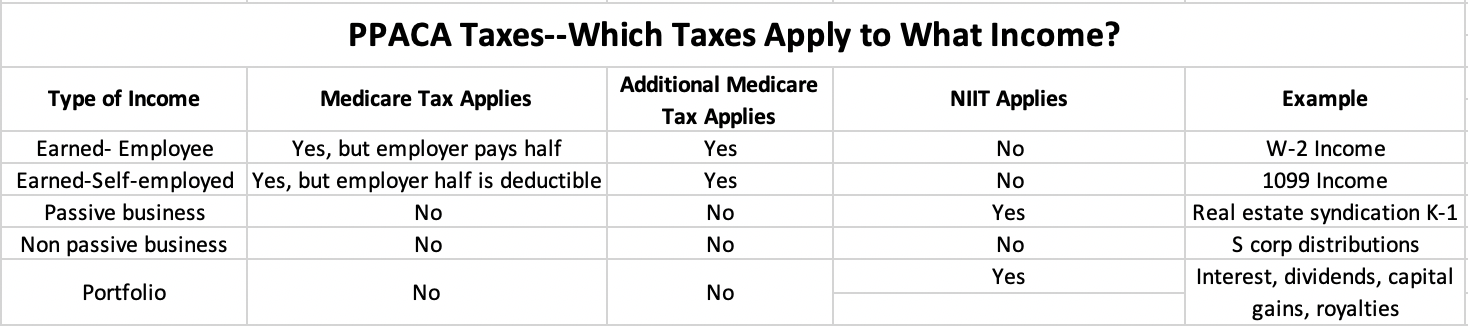
There are a few other types of income to which neither Medicare nor PPACA taxes apply. These include withdrawals from tax-deferred retirement accounts and Social Security income. Of course, income that is otherwise not subject to federal income taxes (Roth withdrawals, municipal bond interest, gains on the sale of your home less than the $250,000/$500,000 exempt amount) is also not subject to NIIT.
Still have questions? Take a look at these resources from the IRS:
What do you think? How has the presence of NIIT changed your tax-planning strategies? Does it make it more likely for you to do Roth conversions or form an S Corp?
Did you find this article helpful? Share it!