I’m always watching WCI social channels to see what questions physicians are asking. Recently, one Reddit post caught my eye. The doctor basically said, “Every day I’m getting hit with disability insurance marketing. I already have coverage, but why are there so many companies and agents selling this stuff to physicians? Is this some kind of grift?” The idea of disability insurance being a scam is really not an unreasonable question.
Physicians are constantly told to buy disability insurance. Buy it in residency. Buy it before your health changes. Buy true own occupation coverage. Compare riders. Talk to an independent agent. After hearing that enough times, it’s fair to wonder whether disability insurance is truly important or whether doctors are just being aggressively sold the idea.
That Reddit thread created a lively debate among WCI readers, and it sent me down a rabbit hole. Are disability insurance companies actually paying claims? Is individual disability insurance different from group long-term disability? Do you have to hire an attorney to get paid on a disability policy? And does the data support the idea that disability insurance is a scam?
The presence of marketing does not prove a product is fake. Sometimes it just means there is a real need—and plenty of people trying to make money filling it.
Why Are Physicians Targeted So Much for Disability Insurance?
Physicians get targeted for disability insurance because they are already being told to buy it by people they trust: chief residents, attendings, professors, mentors, older doctors, and trusted blogs like The White Coat Investor that have seen what happens when a physician’s income disappears.
That advice exists for a reason. Becoming a doctor takes years of training, often comes with student loans, delays saving and investing, and usually means your future income is your biggest financial asset. Don’t you think your largest asset should be insured if possible?
A disability also doesn’t have to be dramatic to be devastating. A surgeon with a hand tremor, a dentist with chronic neck pain, an anesthesiologist with a neurological condition, an emergency physician with serious back problems, or a pediatrician with significant depression can still work in some capacity, but not in the job they trained for or at the income they expected.
A physician’s future income is worth millions. That is why mentors tell doctors to protect it, why insurance companies want to insure it, why agents want to sell it, and why the internet likes to argue about it.
What Is Group Long-Term Disability (LTD) and Why Is It Not Enough for Physicians?
Individual disability insurance is usually applied for through an agent and owned personally. Group long-term disability, or Group LTD, is usually coverage offered through your employer, if your employer provides it.
Both can pay claims, but they do not protect physicians equally.
Group LTD is better than nothing, but physicians should be very careful about relying on it as their only disability insurance. Employer coverage is usually controlled by the employer, not you. It may not follow you when you change jobs, the benefit may be taxable, the definition of disability may be weaker, and the policy may reduce your benefit if you receive other income.
For a physician with millions of dollars of future income at stake, that is not a complete paycheck-protection plan.
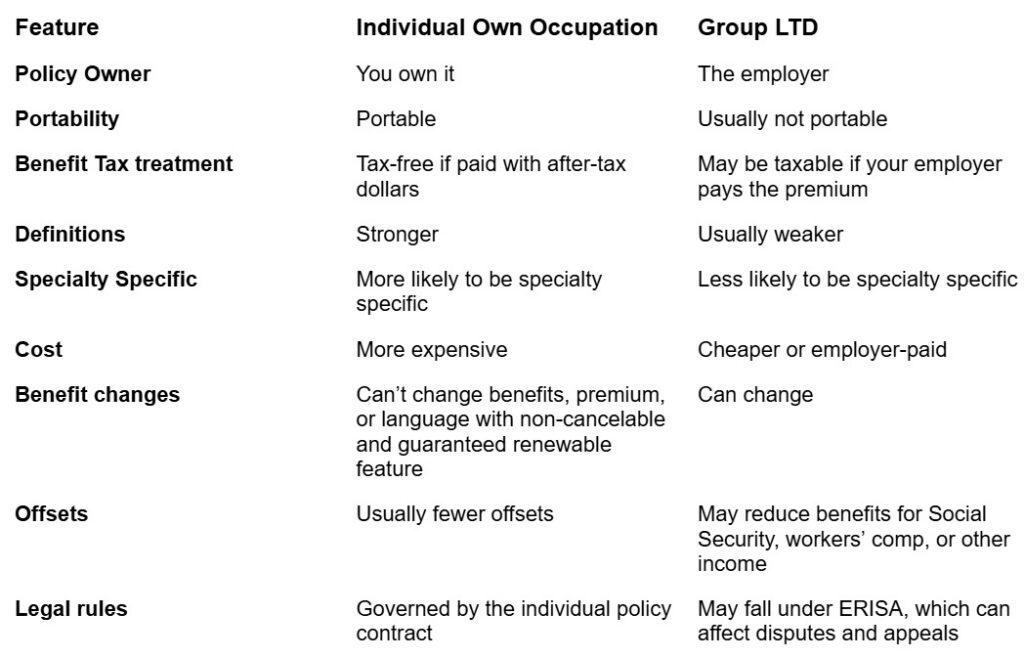
This is why group LTD should usually be treated as backup coverage, not the entire plan. The individual policy is the one you own, control, and take with you.
For physicians, the definition matters. A surgeon, dentist, anesthesiologist, emergency physician, and even non-proceduralists may still be able to work in some capacity after an illness or injury, but not in the exact job they trained for or at the same income level. That is why strong own occupation language matters, even for specialties that do not seem “procedure-heavy.”
This is the key point: group LTD is often a nice employee benefit, but individual own occupation disability insurance is usually the policy physicians buy when they are serious about protecting their income.
More information here:Do Disability Insurance Companies Actually Pay Claims?
The most recent National Association of Insurance Commissioners “NAIC” report uses 2024 data, and 2025 numbers were not available yet as of this writing. I’d expect 2025 to be in the same general range, but for now, 2024 is the best public data I could find. One quick caveat: the NAIC says its data does not capture the entire market. Some insurers and plans, especially some employer self-insured plans, may not file the same way with state insurance departments. So, this data is very useful, but it is not perfect.
In 2024, individual long-term disability insurance companies collected about $5.25 billion in premiums and paid or set aside about $3.69 billion for claims. That is a 70.25% loss ratio. In plain English, individual disability insurance is not fake coverage. Real claims are being paid, and real money is being reserved for future claims.
A loss ratio is the percentage of premium dollars an insurance company pays out or sets aside for claims. Take the above number as an example. A 70.25% loss ratio means that for every $1 collected in premium, about 70 cents went toward current or future disability claims in 2025. Insurance companies watch this number closely because if the loss ratio gets too high, the product becomes less profitable, and carriers may raise rates, reduce benefits, tighten underwriting, or leave the disability marketplace. When you see a high loss ratio in disability insurance, it is a reminder that claims happen.
This data also shows how much disability claims have shaped the individual disability insurance market over time. The NAIC individual long-term disability table lists 106 carrier groups/companies that collected individual LTD premiums in 2024 and reported claims or reserves. But that does not mean 106 companies are actively selling new individual disability insurance today. Many of those are old blocks of business where policies are still in force, premiums are still being collected, and claims are still being paid or reserved.
That’s significant because the number of companies willing to sell strong individual disability insurance has shrunk over time. The number willing to offer high-quality, physician-focused, own occupation coverage is even smaller. This is not some fake product nobody uses. The claims have been real enough—and expensive enough—that many carriers have either left the market, stopped selling new policies, tightened underwriting, raised rates, or reduced benefits. That should tell physicians something. Individual disability insurance exists because the risk is real, and not every company wants to take that risk anymore.
Only about 20 appear to still be actively selling some form of new individual disability insurance, and the number selling strong physician-focused own occupation coverage is less than that.
Group LTD also pays claims, but that is not the same question physicians should be asking. The better question is whether your employer-owned group policy would protect your specialty, income, tax situation, job changes, and future earning power the way an individual own occupation policy can (more on that below).
Do Doctors Need Attorneys to Get Paid?
One Reddit commenter said disability insurance can feel like a grift if the company refuses to pay and you have to hire a lawyer. That is a fair concern.
Some claims are denied, delayed, disputed, or terminated. Attorneys sometimes get involved. I am not saying that never happens. But individual bad claim stories do not prove the whole product is a scam, especially when billions of dollars are being paid or reserved for claims. A bad claim experience is real. It is also not the same thing as proving disability insurance itself is fake, useless, or not worth owning.
The better takeaway is that buying the strongest contract you can reasonably afford, understanding the language before you buy it, and working with someone who knows physician disability insurance are the best options for a doctor.
More information here:What Is the Actual Math for Physicians?
One Reddit commenter asked a fair question: what is the actual math? Not just “everyone says it’s worth it,” but what are the real numbers?
The hard part is that I have not found public physician-specific actuarial tables showing exactly how often doctors file disability claims by specialty, age, health history, benefit amount, or policy design. Carriers use that kind of data to price policies, but they usually do not publish it publicly. We do have broader data, though. The Social Security Administration says a 20-year-old worker has about a 1-in-4 chance that sickness or injury will prevent them from working before reaching full retirement age. That does not tell us the exact risk for a surgeon, dentist, anesthesiologist, or radiologist, but it does show disabilities are very common. It’s certainly common enough to insure against if the price to do so is reasonable.
It is also important to remember for whom these individual disability policies are usually built. The major physician-focused carriers (Guardian, Principal, MassMutual, Ameritas, and The Standard) are generally insuring white-collar and “white coat” professionals—doctors, dentists, attorneys, executives, business owners, and other higher-income professionals. This is not mainly a blue-collar disability insurance market. When we look at individual disability insurance claims paid by these carriers, we are looking at a market that includes many people whose income depends on their ability to do specialized professional work.
I also found some useful carrier-specific numbers. The Standard, one of the Big 5 physician disability insurance carriers, says it paid $170.1 million in total benefits to individual disability insurance policyowners in 2025, $788.1 million over the past five years, and $1.407 billion over the past 10 years. It also says physicians buy more than half of all individual disability insurance policies sold by The Standard.
Berkshire Life, which operates as a wholly owned stock subsidiary of Guardian, says it had 358,937 individual disability policies in force, received $908 million of direct in-force disability premiums, and paid $491 million in individual disability income benefits in 2025.
I also spoke with someone at MassMutual, another Big 5 white-collar disability insurance carrier, who shared that MassMutual paid $318 million in individual disability insurance claims in 2025 and collected $436 million of in-force IDI premium for 2025.
We do not have the full actuarial math sitting in a public spreadsheet. But we do have enough to know real claims are being paid, the numbers are not small, and physicians are a major part of the individual DI market. You may not know the carrier’s full actuarial model, but you can know whether losing your income would blow up your financial life or how dependent your family and financial plan are on your income.
If losing your paycheck would blow up your life, the exact industry-wide physician claim rate is not the main issue. The main issue is whether you have enough of the right coverage in place before your health changes.
Claims Being Paid by Disability Insurance Companies
I found this data from one of The Standard’s marketing pieces showing physicians on disability.
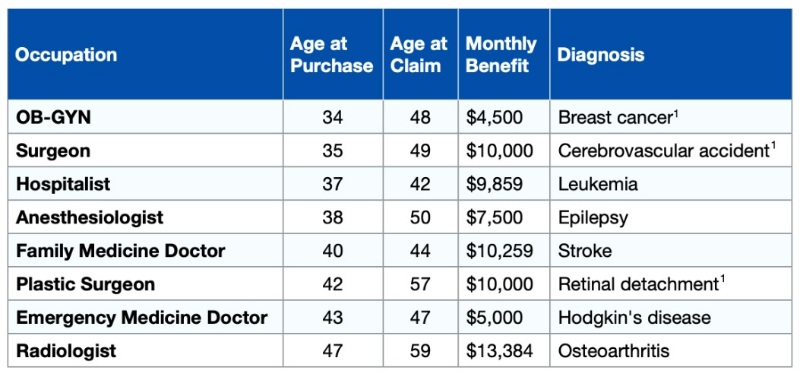
This chart shows physicians currently collecting individual disability benefits. Carriers really do pay claims. And the right contract can matter a lot when a doctor can no longer do the specific work they were trained to do.
Are Commissions a Conflict of Interest?
Yes. Commissions and referral fees are conflicts of interest. Let’s just say that out loud.
Insurance agents usually get paid when someone buys a policy. WCI also gets paid when someone uses a WCI-recommended agent. That should be disclosed, and physicians should know compensation is involved.
But a conflict does not automatically make the advice wrong. Dr. Jim Dahle will also tell you that not enough physicians are buying disability insurance. Every year, when we look at the number of disability policies sold across the industry compared to the number of physicians who probably need coverage, the gap is frustrating. Too many doctors are going without protecting their income.
WCI does not care where you buy your policy. Use a WCI-recommended agent, use another independent agent, or use someone else you trust. The important thing is to get good disability insurance in place while you can still qualify. Once your health changes, your options may get worse or disappear completely.
More information here:- When Is It OK NOT to Buy Disability Insurance?
- Why I Dumped My Disability Insurance Policy at 43 Years Old
When Should Physicians Drop Disability Insurance?
Early in your career, disability insurance matters because you likely have debt, limited savings, young kids, and decades of future income to protect. Later, the math can change. Once you are financially independent, with enough assets to support your lifestyle without working, it may make sense to reduce or drop coverage.
Here’s the simple test:
“If I had to stop working today because of a serious disability, would my financial plan still work?”
If the answer is yes, you may not need disability insurance anymore. You don’t need to own disability insurance forever. The goal is to become wealthy enough that you no longer need it.
So, Is Disability Insurance a Scam?
After looking at the data, you can decide for yourself. The takeaway is pretty clear: doctors do get disabled, individual disability insurance does pay real claims, and group LTD often does have gaps that can leave physicians exposed. Disability insurance is not an investment, and the goal is not to own it forever. The goal is to protect your income until you are financially independent enough that you no longer need it. If losing your paycheck would wreck your financial plan, you probably still need personally owned, portable, strong own occupation disability insurance.
What do you think? Do you think disability insurance is a scam? What was the math you used to decide if and how long you needed disability insurance?
The White Coat Investor may receive compensation from White Coat Insurance Services, LLC; licensed in all states including MA and DC; CA license #6009217; NY license #1758759 (exp. 6/2027); Registered address: 10610 S. Jordan Gateway, #200 South Jordan, UT 84095. This does not affect the cost or coverage of insurance.
Did you find this article helpful? Share it!