

Physician partnership track positions can offer significant long-term financial upside, but understanding how they are structured is essential before signing a contract. In this episode, we break down what to evaluate when considering a partnership opportunity and discuss how these arrangements can shape your career and wealth-building potential. We also answer listener questions on tax strategy vs. tax preparation, teaching kids to invest, using locums instead of employees, financial priorities for new attendings, and managing a large financial windfall.





How Physician Partnership Tracks Work
“I have a question I wanted to ask. It’s something I’m having trouble finding much information online about. I’m finishing residency in 2027. I’m starting to look at jobs down the line. After a recent interview, I’m being offered a partnership track position and a three-year salary guarantee with an option to buy into both the practice and the real estate, something I’m strongly considering. It’s near the area I grew up in, reputable practice, seems to be doing well, etc.
But I have multiple questions as to how this works. I understand every single structure in partnership is a little different. That’s the key lesson here, by the way. But from the few people I’ve spoken to, there seem to be some general principles that are true with each partnership. For example, there is a separate LLC for the practice and another one for the real estate. I’ve commonly heard that the practice LLC rents from the real estate LLC. I’m having trouble understanding the actual tax and income implications to this. I also understand that a Schedule K is issued for the partnership income every year, but is that treated as overall practice business income, or personal business income, like a 1099?
I’m also having trouble understanding how the different models of actually paying for the buy-in take place. I believe the offer I’m being given involves me using my bonus distributions that are given quarterly as a partner to pay for the practice and the real estate buy-in. But I’ve also heard of other models where you have to go out and get a loan. I’ve also heard of some hybrid models. I’m just curious if you could possibly go over what general mechanisms like this may work. I’m also curious about how my finances will be after the three-year base salary.”
Most physicians today are employees, so partnership track jobs are less common than they once were. Still, for doctors who have the opportunity, they can offer higher long-term compensation and ownership. Every partnership is structured differently, but there are a few common principles that can help you understand how these arrangements work before signing a contract.
Many physician groups separate the medical practice and the real estate into different LLCs. This provides an extra layer of asset protection because each entity has its own liabilities. It also allows the practice to pay rent to the real estate LLC, which can convert some earned income into rental income. That rental income is not subject to payroll taxes, and it can often be offset by depreciation. While there are other ways to structure ownership, using separate LLCs for the practice and the building is a common and legitimate approach.
Once you become a partner, you will typically receive a Schedule K-1 instead of only a W-2 or 1099. K-1 income is generally treated much like self-employed income. You still owe income and payroll taxes, but the reporting is more complex. One important difference is that partners usually participate in the partnership’s retirement plans rather than opening their own solo 401(k). While some physicians elect S Corporation taxation to reduce Medicare taxes, many partnership structures simply pass income through on a K-1.
Practice buy-ins can be structured in several ways, so there is no single standard model. Some physicians pay a lump sum, some finance the purchase with a bank loan or a loan from the practice, and others earn ownership gradually through reduced compensation or bonus distributions. As ownership increases, compensation often rises as well, and many partnerships also include a buyout when you eventually leave the practice. Before accepting any partnership track position, have an experienced attorney review the contract. Spending a few hundred dollars upfront can help you avoid costly mistakes and negotiate better terms that could be worth hundreds of thousands of dollars over the course of your career.
More information here:- Is Physician Equity Ownership Still the Goal?
- Who Owns the Doctor Jobs?
- Our 5-Year Update After Starting a Medical Practice
Short-Term Saving vs. Long-Term Goals
“Hi, Dr. Dahle. I’m a 30-year-old dentist in Texas, just under two years out of residency. I plan to get married next year, and I will likely need to purchase a home within the next three or four years. I may also want to purchase or start a dental practice in the future. Currently, I have a six-month emergency fund in a high-yield savings account, and I’m maxing out my 401(k), my HSA, and Roth IRA. I’m also paying down about $4,000 per month toward my student loans. I have paid off about $60,000 so far, but I still have just under $300,000 remaining.
My challenge is that after living expenses, car payment, retirement contributions, and student loan payments, I have very little left over to save for a home down payment or a future practice ownership. I understand that investing money needed within a few years in a broad market index fund carries risks. However, I’m also concerned that keeping these funds in cash in a high-yield savings account may not provide enough growth to help me reach those goals on the above timeline. Given a 3-4 year horizon, would it be reasonable to invest some of my home or practice savings in a broad market index fund rather than keeping everything in cash? Or do you recommend keeping these funds in a high-yield savings account?”
For someone saving for a home or practice purchase within the next 3-4 years, the priority should be preserving the money rather than maximizing returns. A broad market index fund is likely to outperform a high-yield savings account over long periods, but it also carries the risk of significant short-term losses. If a market downturn occurs just before the money is needed, it could delay the purchase of a home or practice. For goals on a relatively short timeline, cash, money market funds, CDs, or other conservative investments are generally the better choice. Investors with a little more flexibility can consider taking a modest amount of risk with a small allocation to stocks or bonds, but they should only do so if they are prepared to postpone their plans if markets perform poorly.
The more important issue is not choosing the perfect investment but deciding how to allocate limited cash flow among competing priorities. New physicians and dentists often have a long list of financial goals that includes paying off student loans, building an emergency fund, maximizing retirement accounts, buying a home, replacing a vehicle, getting married, and eventually purchasing a practice. The best way to manage these competing demands is to create a financial waterfall that ranks each goal in order of importance. Money flows to the highest priority until it reaches its target, then moves to the next. This intentional approach prevents trying to accomplish everything at once and helps create steady progress, even when it feels slow during the first few years after training.
For dentists in particular, practice ownership deserves careful consideration as one of the highest priorities because it has the potential to substantially increase income. Unlike buying a home, which adds another financial obligation, purchasing a successful practice can create significantly more cash flow that makes it easier to pay off debt, invest for retirement, and eventually afford the home you want. While practice ownership involves additional debt, management responsibilities, and business risk, many practice owners earn considerably more than associates. In many cases, delaying a home purchase for a few years to focus on acquiring a practice can produce a much stronger long-term financial outcome.
It is important to remember that over a three-year period, wealth is built primarily through saving, not investment returns. Even exceptional market performance only reduces the amount that must be saved by a relatively small margin, while introducing the possibility of losing a significant portion of the money at the worst possible time. Rather than searching for a shortcut, focus on increasing income, spending intentionally, following a written financial plan, and working through priorities one at a time. Those consistent decisions, combined with patience, are what ultimately create long-term financial success.
More information here:What to Do with Extra Money from the Sale of Your House Post-Residency
“Hey, I am graduating from orthopedic surgery residency later this week. We bought a house during residency, and we will be able to make about $100,000 after closing fees. My question is, what should I do with the money? I will be doing a one-year fellowship and then plan on renting a house for at least a year once I start my attending job. I have $250,000 in student loans, three kids, and a wife who works. But just kind of wondering what your strategy would be with that amount of money?”
The amount of money you receive from selling a home does not determine what you should do with it. Whether it is $50,000 or $500,000, the right answer comes from your written financial plan and your financial priorities. Every new dollar should flow through your financial “waterfall” and be directed toward the highest priority goal first. That could mean building a fully funded emergency fund, paying down high-interest student loans, maximizing tax-advantaged retirement accounts, or saving for a future home. The source of the money does not change the process. If you do not yet have a written financial plan, creating one should be the first priority before making any major decisions.
For someone finishing training, common priorities include establishing an emergency fund and tackling student loans. If an emergency fund is not already in place, setting aside 3-6 months of living expenses in a money market fund or other cash equivalent is a reasonable first step. After that, excess cash can be directed toward student loans if they carry relatively high interest rates, unless the borrower is pursuing Public Service Loan Forgiveness or another forgiveness program. If those goals have already been addressed, the next step is typically maximizing available retirement accounts before investing additional money in a taxable brokerage account.
In this situation, however, the proceeds from the home sale will likely be needed for another down payment within a couple of years. Because the investment horizon is so short, preserving the money is more important than trying to maximize returns. Keeping the funds in cash, a money market fund, or a short-term CD is generally the most appropriate strategy. Investors who have some flexibility in their timeline could consider taking modest risk through short or intermediate-term bond funds or a conservative balanced fund, but they should only do so if they are comfortable delaying a home purchase should markets decline. Putting all of the money into a single stock, cryptocurrency, or even a 100% stock portfolio exposes the funds to unnecessary risk for a short-term goal.
The key takeaway is that every financial decision should begin with clearly defined goals. Rather than asking what to do with a lump sum of money, first determine what that money is intended to accomplish and when it will be needed. Once those goals are established, the appropriate investment becomes much clearer. For money needed in the near future, safety and liquidity usually outweigh the possibility of higher returns, while long-term goals, such as retirement, can remain invested for growth.
To learn more from this episode, read the WCI podcast transcript below.
Sponsor
Today’s episode is brought to us by SoFi, the folks who help you get your money right. Paying off student debt quickly and getting your finances back on track isn’t easy, but that’s where SoFi can help—it has exclusive, low rates designed to help medical residents refinance student loans—and that could end up saving you thousands of dollars, helping you get out of student debt sooner. SoFi also offers the ability to lower your payments to just $100 a month* while you’re still in residency. And if you’re already out of residency, SoFi’s got you covered there, too.
For more information, go to sofi.com/whitecoatinvestor
SoFi Student Loans are originated by SoFi Bank, N.A. Member FDIC. Additional terms and conditions apply. NMLS 696891
Milestones to Millionaire
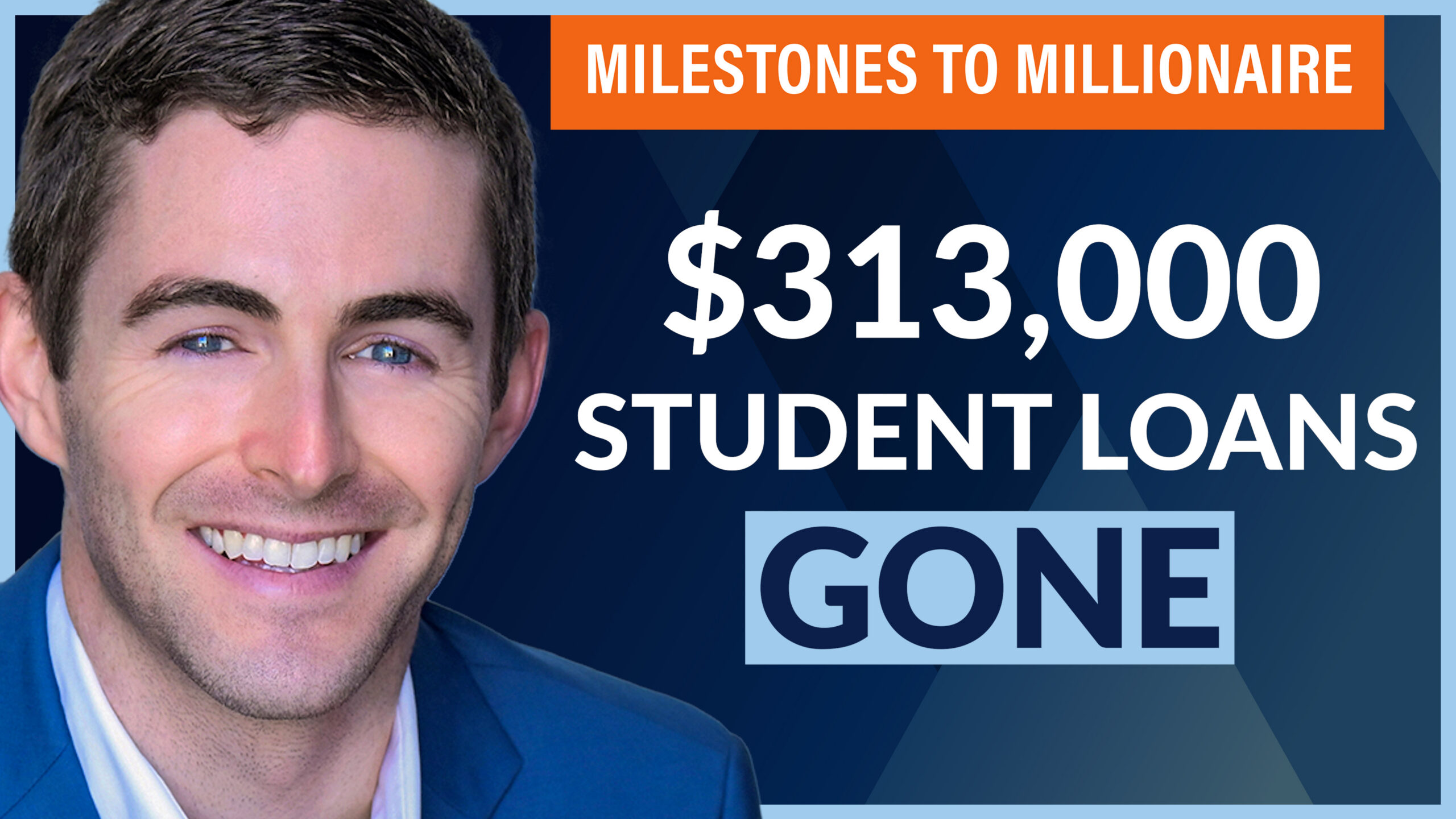
#284 – How This Doctor Paid Off $313,000 in Student Loans in One Year
Paying off more than $300,000 in student loans just one year after residency takes more than a high income. Today we talk to Jake, who shares how increasing his earning power, building multiple income streams, and making intentional financial decisions helped eliminate his debt and accelerate his path to financial independence. He also reflects on the investing mistakes and money lessons that shaped his journey.
To learn more from this episode, read the Milestones to Millionaire transcript below.

Sponsor: Protuity
Financial Boot Camp Podcast
Financial Boot Camp is our new 101 podcast. Whether you need to learn about disability insurance, the best way to negotiate a physician contract, or how to do a Backdoor Roth IRA, the Financial Boot Camp Podcast will cover all the basics. Every Tuesday, we publish an episode of this series that’s designed to get you comfortable with financial terms and concepts that you need to know as you begin your journey to financial freedom. You can also find an episode at the end of every Milestones to Millionaire podcast. This podcast will help get you up to speed and on your way in no time.
Refinancing Your Mortgage
Refinancing your mortgage can be a smart financial move, but only if the savings outweigh the costs. It generally doesn’t make sense if you’re planning to sell your home in the next few years, if refinancing would increase your interest rate, or if the new loan comes with less favorable terms. Before refinancing, calculate how long it will take to recover the closing costs through lower monthly payments. If you’re planning to stay in your home for the long term and can significantly reduce your interest rate, refinancing will often save you thousands of dollars over the life of the loan. It’s also worth considering shortening your loan term or continuing to make your previous payment amount so you can pay off the mortgage years earlier.
Not all refinance offers are created equal. A true no-cost refinance, where the lender covers the closing costs in exchange for a slightly higher interest rate, can make sense if you don’t expect to stay in the home much longer. That’s very different from a no-cash refinance, where the fees are simply rolled into the loan balance and you’ll eventually pay interest on them. Likewise, don’t be fooled by advertisements about “skipping a payment” during the refinance process. You’re not getting a free month of housing—the interest is simply added to your loan. If you’re planning to stay in your home for many years, paying closing costs or even paying points upfront may result in a lower interest rate that more than pays for itself over time.
If you’re comfortable managing your own finances, avoiding an escrow account allows you to keep your money invested until property taxes and insurance are due instead of letting it sit interest-free with the lender. Your credit score only needs to be high enough to qualify for the best rates. If you are generally around 740 or higher, you are set. Chasing a near-perfect score usually isn’t worthwhile. Shopping around can make a significant difference, as mortgage rates and lender fees often vary more than borrowers expect. One of the biggest mistakes homeowners make is simply ignoring their mortgage after closing. When interest rates fall meaningfully, taking the time to evaluate a refinance can save thousands of dollars over the life of the loan.


WCI Podcast Transcript
INTRODUCTION
This is the White Coat Investor podcast where we help those who wear the white coat get a fair shake on Wall Street. We’ve been helping doctors and other high-income professionals stop doing dumb things with their money since 2011.
Dr. Jim Dahle:
Welcome back to the White Coat Investor podcast.
Today’s episode is brought to us by SoFi, the folks who help you get your money right. Paying off student debt quickly and getting your finances back on track isn’t easy, but that’s where SoFi can help. They have exclusive low rates designed to help medical residents refinance student loans. That could end up saving you thousands of dollars, helping you get out of student debt sooner.
SoFi also offers the ability to lower your payments to just $100 a month while you’re still in residency. And if you’re already out of residency, SoFi’s got you covered there too. For more information, go to sofi.com/whitecoatinvestor.
SoFi student loans are originated by SoFi Bank, N.A. Member FDIC. Additional items and conditions apply. NMLS 696891.
All right. Let me rant for just a minute. This is a rant and a promotion. The promotion is for our tax strategist partners. You can find them at whitecoatinvestor.com/taxes. This is the most frequent service that is requested from White Coat Investor, as far as people send them emails or comments or whatever. People want help with taxes. And so, we go out there, and we find people who can help them with taxes.
And over the years, we’ve recognized there are really two services being offered here. One is tax preparation. They just don’t know how to fill out the forms. The forms are complicated. They don’t want to do it. You know, I get it. My tax return last year, I think I filed in nine states. We file a trust return, and we’ve got a business return. It’s complicated. We spend thousands and thousands of dollars on tax preparation.
So, that is one service people want. They just want help with their taxes. Everybody thinks it should be way cheaper than it is. Everyone thinks, “Oh, for $200 someone ought to prepare your taxes.” I got news for you. It’s not $200. Nobody’s going to do it for $200. Unless you have the most simple tax return possible and you walk into the little H&R Block booth at Walmart or something, maybe you get it for $200 there. But if you’ve got a physician-type tax return, even a really simple one, you’re not going to get it for $200.
And the interesting thing is, people who want tax preparation for $200 also expect this very high level of advice to go with it. And the truth is, you’re not going to get that for $200. You’re probably not even going to get that for $2,000.
That service, which we call tax strategizing, is significantly more expensive. It’s about paying a financial advisor, a financial planner and an investment manager. That’s about what you spend on a tax strategist. So, recognize this. That this is not an inexpensive service.
And so, I’ve tried to include notes on the page where we recommend that we have these partners listed at whitecoatinvestor.com/taxes, so people understand that this is not an inexpensive service if you want a strategist.
And it’s a lot more inexpensive just to get a tax preparer. But if you want a tax strategist that is actually going to work with you through the years and go through your business structure and is going to go through your tax situation and suggest some changes in how you live your financial life, that’s going to cost you thousands. So, be aware of that.
Yes, a lot of this can be done yourself, just like everything else in personal finance and investing. You can learn to be your own financial planner. You can learn to be your own investment manager. You can learn to be your own tax preparer. I prepared my own taxes, including a corporate tax return, for many years. It is possible to do this. You’ve got to be kind of into it. It’s got to be a little bit of a hobby for you, but you can do it, and you can be your own tax strategist.
The tax code is not secret. You don’t have to get a CPA. You don’t have to get some sort of license to be able to read the tax code. You can learn how to read the tax code. It’s not that easy of reading. Maybe it’ll help you go to sleep at night, but you can do it, and you can learn a lot of this stuff yourself.
But if you want some help with it, there are folks out there who’ll help you with it, and they may save you quite a bit of time. And it doesn’t take much, if you have a complicated financial life, you’re a self-employed physician, you’re getting a dozen K-1s, you’re filing in multiple states, you’ve got LLCs, you’ve got some complicated asset protection plan. It doesn’t take that much for them to pay for themselves. So, it’s entirely possible that they might.
Part of the issue is a lot of people out there, including a lot of physicians, including a lot of White Coat Investors, think the secret is just to get the right tax guy. If you just change the way you filed your taxes, you’d be saving tens of thousands of dollars. That’s not the way it works. You’re probably not mistakenly filing your returns in the wrong way and leaving thousands of dollars on the table.
The way you really reduce your tax bill is by living your financial life differently. Being self-employed instead of employed. Being married instead of single. Having kids instead of not having kids. Giving money to charity instead of not giving money to charity. Saving for retirement instead of not saving for retirement. Becoming a professional real estate investor instead of not being a professional real estate investor.
Even within real estate, things like doing a cost segregation study to get more depreciation earlier in the life of the investment. You’re doing something differently, not just filing your tax return differently.
These are the sorts of things that people talk to you about when you come into a tax strategist. They’re like, “Well, you have this 1099 income. Do you have a second 401(k) besides the one at your job? Have you considered a personal defined benefit plan? If you’ve got some real estate investments, how are you taking the depreciation? How are you using the depreciation?”
The complaints we get about tax strategists, one is the cost. People are going in there thinking it costs $200 and it doesn’t. It costs thousands. They’re like, “Well, I don’t feel like I got as much value as what I paid for.” Well, okay. Learn to do it yourself. This stuff is DIYable. That’s a relatively easy one to get over, but we’re trying to make our partners be a little bit more transparent about pricing, at least going in, what it’s going to cost. And then after a year or two, you might have to decide if the value’s there for you or not.
The second complaint we get is when people aren’t matched up well with their level of aggressiveness. Some people want to be pretty aggressive with how they file their taxes. There’s a fair amount of gray area in the tax return. And some people are like, “Well, if it’s gray, I’m going call it my favor.” And they’re okay with that.
There’s a lot of stuff that hasn’t been nailed down exactly in tax court or in the tax code. And you get out there far enough, and it just becomes an audit lottery. You’re just hoping you don’t get audited and most returns don’t get audited. And so you kind of get away with it. Obviously I’m not talking about just pure tax evasion and just lying on your tax return and that sort of thing. I’m talking about these fairly aggressive techniques.
Other techniques are pretty standard ones, and you just didn’t know about them, that all kinds of people are using all the time. Doing a backdoor Roth IRA, for instance. Even though it’s called backdoor, this way to contribute to your Roth IRA indirectly is very standard. Congress has blessed it, the IRS has it blessed, et cetera. Millions of us are doing it every year. It’s no big deal. It’s not particularly aggressive. It’s pretty conservative. But if you didn’t know about it, well, that’s a way to save some taxes.
And so, you have to match your level of aggressiveness with that tax strategist. And you have to have this discussion about their recommendations. If they’re like, “Well, this is one thing you could do.” You talk about it, “Well, how aggressive is that? How likely am I to be audited? How much would it bother me to be audited? How likely, if I do get audited, is this to be disallowed? What’s one of the tax court cases say about this?”
And they think it’s interesting. This is what they do. They love to have these discussions with you, but you got to have these discussions with them and decide what you’re comfortable taking and what you’re not. So, you’re still in the control seat here. You don’t just turn everything over to them and they hand you a tax return at the end of the year, but you got to engage with them.
Anyway, if you want a tax strategist, if you want to try one of these firms, go to whitecoatinvestor.com/taxes and check that out.
WHEN AN INVESTING LESSON FOR YOUR KID GOES WRONG
Dr. Jim Dahle:
Okay. Let’s have a discussion about an email I got recently. Here’s the email. “I wanted to share this story with you in the event you have any tips or wish to use it to dissuade others from making the same mistake. I put this in the category of lessons I did not learn. When our children were younger, on a trip to the Grand Canyon, we had occasion to stay at a large Las Vegas casino. The kids were in awe of the casino, which we needed to pass through to get to our room. So, I decided to show them the dangers of gambling by putting $5 in a slot machine while explaining the machine would simply take my money, confident that that was what would happen.
As the machine was spinning, I had the instant fear that if I should win anything, this would be the worst lesson. And at their age, I would likely have ended up with kids hooked on the promises of games of chance. Luckily, the spin was not a winner and the kids grew to know how foolish I was to waste my $5.
Having escaped the potential negative consequences of my poor decision at that time, I proceeded to make a similar mistake a few years later when I entered into a competition with my son, then 10, to extol the virtues of using broad-based indexing instead of selecting individual stocks.
He had learned about individual stock selection in a school project, and I wanted to show him the value of a broad based index fund. So we each invested $1,000 of real money, with his money equally divided among four individual stocks of his choosing based on products he knew and used as a 10-year-old. Apple, Procter & Gamble, Amazon, Walmart, and mine all in a total market index fund.
Eight years later, the index funded well enough with a return over the eight years of 143.2%. But after years of explaining to my son that the index fund would eventually outperform his individual stocks, his four selections have a return of 419% over the same period.
This time, the slot machine paid out. I’ve been mostly avoiding the discussion at this point. The 275% difference is too large to explain as accounting for risk. At this rate, I’m not sure I’ll live long enough to have my predictions come true. Is it possible my then 20-year-old will be in the 10% of managers overperforming an index at the 10 year mark? Is this just a case of unknowingly sticking with blue chips and not overthinking it? Any tips on reversing the impression my son will have from this?
The current plan is to delay the discussion until he is likely to have a better understanding of risk and the value of time not spent managing funds. Discussing this with an invincible teenager is unlikely to be productive. Perhaps the best that can come of it is a warning to others not to embark on such a poorly designed lesson with such an obvious chance that the wrong lesson is learned.”
I’m not a fan of the stock market game. This is a project that kids do in school in some poorly thought-out personal finance class, where at the beginning of the month or the beginning of the semester, they pick a bunch of stocks and then they follow in the paper throughout the semester. At the end, whoever picked the stocks that did the best gets a prize.
Well, if you’re doing that for some short period of time, the secret is to just gamble. Only one person’s getting the prize and the person who does that is going to pick something that goes through the roof. So, that’s the secret, is find the most volatile thing you can and hope you get lucky.
And sometimes people do get lucky. That’s really the only lesson here. Even speaking about an index fund versus picking stocks, there is no guarantee that an index fund can’t be beaten. It gets beaten all the time by professional managers. Perhaps 40%, 45% of active managers beat an index fund in any given year.
But over a long time period, that percentage drops to something like 5% to 10% before tax. But it’s still 5% to 10%. There are people out there who beat index funds over relatively long periods of time. The data suggests that they’re impossible to identify in advance. And even once they beat the index fund for quite a while, that outperformance does not persist.
And so, if you have to bet your life savings on it, the way to go, of course, is to just buy all the stocks in the index. But there’s no guarantee you’re going to win over the long term by doing that. You’re more likely to win, but there’s no guarantee you will win.
So of course, you do worry that the worst thing that can happen to an investor is their first few stock picks pay off. And they assume they’re the next Warren Buffett. And who knows, maybe your kid is the next Warren Buffett, but it’s probably just luck.
The real question isn’t, what about Warren Buffett? The real question is, where are all the other Warren Buffetts? Because by statistical chance, there should be a lot more people that have outperformed the market over the long term than there actually are.
Interesting discussion, interesting thing to think about. I don’t know how much you can teach somebody by putting $5 in a slot machine. I don’t know how much you can teach them by playing the stock game with them. Sometimes you’re not going to come out ahead.
Now, part of it, of course, is the last few years, 5, 10, 15 years, whatever, these well-known stocks, blue chip stocks, whatever you want to call them, large tech growth US stocks have outperformed the rest of the market. There are times that small value stocks outperform, there are times that mid-caps outperform, there are times that real estate stocks outperform. And guess what? There are times these big tech companies, right now the trend is these big AI companies, do outperform the rest of the market, sometimes for relatively long periods of time.
Now, this particular experiment was run for eight years. Well, what’s done well over those eight years? Well, these big companies that have all this tech and this AI. Now, am I going to bet that they’re going to be the winners over the next 30 years? I don’t know that I’d bet that way, but I have no idea. My crystal ball is very cloudy.
Congratulations to your son on winning the contest, but let’s keep in mind what happened here. He gets 400%, you get 143%. So, you turned your money, your $1,000 into $2,500, and he turned his $1,000 into $5,000. $5,000 doesn’t change anybody’s life.
And if this is really the way you’re going to bet your life savings, maybe it works out well for you. I do know people for whom it has worked out well, and they’re convinced they’re great stock pickers.
But if you are a great stock picker, why in the world would you only be managing your own money? Do you have any idea how much the world will pay you for this skill you have? You should be managing billions and billions of dollars and getting paid 2 and 20 for it. And that would be far more valuable than just investing your own money in these stocks. But people do it, and it’s not the way to bet, but that doesn’t mean you can’t win doing it. It is possible. So, keep that in mind. I hope that’s an interesting discussion for you.
HOW PHYSICIAN PARTNERSHIP TRACKS WORK
Dr. Jim Dahle:
Let’s move to a different topic. This is also coming from an email coming from one of you. And let me just read it. “I have a question I wanted to ask. It’s something I’m having trouble finding much information online about. I’m finishing residency in 2027. I’m starting to look at jobs down the line. After a recent interview, I’m being offered a partnership track position, three-year salary guarantee with an option to buy into both the practice and the real estate, something I’m strongly considering. It’s near the area I grew up in, reputable practice, seems to be doing well, et cetera.
But I have multiple questions as to how this works. I understand every single structure in partnership is a little different. That’s the key lesson here, by the way. But from the few people I’ve spoken to, there seem to be some general principles that are true with each partnership.
For example, there is a separate LLC for the and another one for the real estate. I’ve commonly heard that the practice LLC rents from the real estate LLC. I’m having trouble understanding the actual tax and income implications to this. I also understand that a Schedule K is issued for the partnership income every year, but is that treated as overall practice, business income, or personal business income like a 1099?
I’m also having trouble understanding how the different models of actually paying for the buy-in take place. I believe the offer I’m being given involves me using my bonus distributions that are given quarterly as a partner to pay for the practice and the real estate buy-in.
But I’ve also heard of other models where you have to go out and get a loan. I’ve also heard of some hybrid models. I’m just curious if you could possibly go over what general mechanisms like this may work. I’m also curious about how my finances will be after the three-year base salary. Thanks in advance.”
Okay. So many docs in this situation. Not the majority anymore, though. The majority of docs now are employees. Something like 77% of docs are employees. They don’t own their jobs. They’re not partners. They’re not sole practitioners. They’re employees. So they don’t have to deal with these issues.
I think they’re talked about a little less commonly among docs than they used to, just because it’s a smaller percentage of docs doing this. There have always been employee docs. There have always been self-employed docs. It’s just the numbers of them are different now than they were 10, 20, 30, 40 years ago.
So, here’s the way it works. First of all, let’s talk about having the practice, LLC, and the real estate LLC. Yes, it’s common to split that up for a few reasons. Asset protections, one reason. If just one of the LLCs gets sued, well, the other one can’t lose their assets. That’s a good reason to separate things out. They’re both toxic assets. The practice can be sued.
The real estate can be sued. Somebody slips and falls on the property or whatever, burns to the ground, and somebody gets injured. Who knows? There’s all kinds of liability that can come from both of those entities. So, it’s good to put them in something like an LLC and split them up.
But the idea here is that you can control the LLC separately from the practice, which is helpful. You could sell the practice, but not the LLC, for instance. Plus the practice now pays the LLC rent. So in this way, you’re kind of turning active earned income into more passive unearned income. And there’s some advantages to passive income. For example, you don’t pay payroll taxes on rent. That income that comes in as rent can also be sheltered from taxes by depreciation. So, these are kind of the benefits.
Now, even if the practice owns the real estate, you can still depreciate the real estate. You don’t necessarily have to have it in a separate LLC just to do that. But that’s kind of what they’re trying to do here by separating these out. And it’s very common. There’s nothing untoward about doing this. It’s a very common structure. And so, I wouldn’t worry about that whatsoever. They have good reasons to do that. And it’s probably better to do it that way than to not do it that way. I wouldn’t worry about that.
Yes, in a partnership, and also including things like an S-corp, you get a K-1. You can be paid on a W-2, meaning at the end of the year, you get a W-2 form from the employer. This means you’re an employee. And when you get paid on a W-2, the employer is responsible for paying for everything. They got to pay for the place you work. They got to pay for the tools you use. They got to pay for your benefits. They got to pay the employer half of Social Security and Medicare taxes. You’re an employee. You’re W-2.
The next category is usually a 1099. You’re paid on a 1099, meaning at the end of the year, you get a 1099 tax form from your client, not your employer, because you’re the employer. You’re self-employed. So you get a 1099 from each of your clients. If you only have one client, you only get one 1099. And that’s the way a lot of doctors are set up.
But you’re in business for yourself. And you could have five different hospitals that are your clients, and they could all send you a 1099 at the end of the year. The simplest structure to use if you are self-employed is a sole proprietorship, which is probably fine, honestly, for most 1099 doctors with no employees.
Everyone’s always wondering, “Should I get an LLC?” No. When you’re a doc and you have no employees, there’s not a lot of business liability here. The only liability you have is malpractice. And an LLC or a corporation doesn’t protect you from malpractice. So, it’s probably fine to be a sole proprietor. It keeps your business situation relatively simple. You still need a business bank account and a business credit card. And you need to keep the finances separate from your personal finances. You run your business like a legitimate business, but you don’t need to do some complicated structure.
Now, sometimes there are some benefits to forming an S corporation and maybe saving some Medicare tax, those sorts of things. But liability-wise and tax-wise, a lot of times it makes sense to just be a sole proprietor. So, you file Schedule C on your personal taxes every year. You put all your income for the business on there. You put all your expenses for the business on there and a certain amount of its profit. And guess what? You pay taxes on the profit. That’s 1099.
Now, if there’s more than one owner, it’s no longer a sole proprietorship. It is a partnership. And a partnership files a Schedule K and distributes a part of that, the K-1 to each of the partners.
And so, from your partnership, like my physician partnership sends me a K-1 every March. I think they’re supposed to have them distributed by March 15th. A lot of times they don’t make it, but March 15th is when it’s supposed to be distributed to you by. So you typically get your 1099s. You typically get your W-2s at the end of January. The K-1s, just these partnership returns take longer to prepare. You typically get those in March.
And it looks a little more complicated than the 1099. It looks a little more complicated than the W-2, and it is. And so, getting K-1s for a lot of people is when they run to hire a tax preparer, because they’re just like, “Oh, this is over me now. I’m done with this.” And they get a tax preparer.
But the K-1 income mostly functions the same as 1099 income. It’s kind of self-employed income that way. There are some differences. One of the big ones that sometimes gets docs confused is if you’re in a partnership, you have to use the partnership retirement plans. You can’t go out and open a solo 401(k) and a personal defined benefit plan and use your K-1 income to fund those. Can’t do that. Sorry.
But otherwise, mostly it functions about like 1099 income. It’s just a more complicated tax form that comes to you, a little more complicated return you end up having because of that.
I hope that explains how K-1 works. But it’s earned income still. You generally do still have to pay not only income taxes on it, but payroll taxes on that K-1 income. And that’s why sometimes people elect to be taxed as an S-corporation, maybe save a little bit of those payroll taxes. You got to decide whether the expense and hassle of forming the corporation is worth what you’re saving usually in Medicare tax. And typically if you’re calling at least a $100,000 distribution instead of salary, it makes sense to form that S-corporation, but that is an option.
Okay. The last thing you brought up was the buy-in. The partnership has some value, even an emergency medicine partnership has some value. My emergency medicine partnership owns no real estate. We really don’t have any assets. We don’t own any equipment we use. That’s all owned by the hospital. The accounts receivable is about the only asset. Aside from maybe some goodwill or something, but there’s not that much of that in emergency medicine anyway.
And so, there’s lots of different ways that the buy-in can be structured. The more valuable the practice, the more complicated and the more expensive the buy-in generally. So this is, I don’t know, ENT partnership, and there’s all kinds of equipment in the clinic, and there’s a building, that the clinic has run out of, and maybe they have an OR. Then there’s all these things that you’re buying into. You might buy into the real estate separately. You might buy into the ambulatory surgical center differently. You might buy into the practice differently.
But then the nice thing about some sort of an ownership situation like that is you tend to get paid a little bit more. It’s more work and a little more risk over the long term, but generally you get paid more than if you’re an employee.
But also there’s some sort of buyout at the end. Even in my emergency medicine partnership, there’s a little bit of a buyout at the end as I get my share of accounts receivable. And so, you got to buy into that, and the buy-in can be structured in a lot of different ways.
Maybe the most simple is that you just got to bring a lump sum of cash, and you’re buying out the partner that’s leaving, or that cash is distributed among the current partners when this new partner comes on. And then when you leave, you get bought out by the remaining partners, and so you get a lump sum of cash when you leave. And so, that’s nice.
So it can be a lump sum of cash. The problem is doctors at the beginning of their careers and they’re establishing a practice, they don’t have any cash. We’ve got very little money and all kinds of good uses for our income, one of which might be a practice buy-in.
So, they start structuring things in other ways because they recognize that early career docs don’t have a lot of cash. For example, you might borrow the money. Well, docs are used to doing this. They’ve had student loans, now they got a mortgage, they’re going to take some sort of practice loan and borrow the money from a bank or somebody else.
Sometimes the practice itself loans you the money. They act as the banker. Another option is that the practice just has you buy-in as you go, some type of sweat equity situation. Maybe it’s your bonuses, your quarterly bonuses go toward the buy-in until you’ve paid for the buy-in, and you get paid a little bit less until then. That’s the way my partnership worked. It’s a sweat equity buy-in, you got paid as an employee for two years, you made less money than the partners do, then once you make partner, you get paid the same as everybody else does. And that’s a common setup as well.
So, lots of different ways that can be set up, but that’s the basic way it works. It’s just new to you as a doc because you’ve never done it. It’s really not that complicated. Probably the most important thing when going into a situation, whether it’s an employment situation or whether it’s a partnership situation, is get the contract reviewed.
We have folks that we recommend review your contracts. If you go to whitecoatinvestor.com under our Recommended tab, you’ll see Contract Review, and those folks will even help you negotiate your contracts if you want.
Because a lot of times people sign bad employment contracts, they sign bad partnership contracts. If nothing else, this discussion for a few hundred dollars will at least help you understand what you’re signing. But oftentimes, they can help keep you from making a mistake that might cost you hundreds of thousands of dollars down the road. And if nothing else, they will suggest you change this, negotiate this, and maybe get a little bit better contract than you would have otherwise.
It’s very easy for them to pay for themselves. They generally charge you a few hundred bucks is all. And with a physician employment or partnership contract, it’s very easy to provide a few hundred dollars of value. So, it’s pretty much a no-brainer that everybody, especially if this is your first physician job, should get your contract reviewed.
All right, let’s get into some Speak Pipe questions. This first one comes from David.
IS HIRING LOCUMS WORKERS GOOD FOR YOUR PRACTICE OR HOSPITAL?
David:
Hey, Dr. Dahle. Thanks for all you do. I wanted to hear your opinion on what you think about when hospitals or healthcare groups opt to hire locums or temporary workers at a significantly increased cost in lieu of negotiating with their current employees for a raise that is a fraction of the cost compared to what they’re paying the locums or temporary workers.
Just seems to be a phenomenon I’m noticing in healthcare, and didn’t know if you had any perspective on that. You are a health provider at a private practice and have been in healthcare for long enough to kind of witness some of this stuff happen. Thank you.
Dr. Jim Dahle:
Okay, good question. Yes, it does happen. It happens surprisingly frequently. Maybe the most common example, one of the more egregious examples I noticed during COVID. We had this need for nurses. And so, hospitals started hiring traveling nurses to come in and augment their current staff.
What happened? Well, here in Utah, all the Utah nurses realized you could get paid quite a bit more as a travel nurse. And so they went to Idaho and worked as a travel nurse. First, they just went up there for a weekend. And then after a while, they’re like, “Well, I can just do this kind of full-time.” And so they all went to Idaho and worked as travel nurses.
And our hospital started getting short as well. And we hired travel nurses and they came down from Idaho to work in our hospital. Now all the Utah nurses are working in Idaho, all the Idaho nurses are working in Utah and all the nurses got paid more. And yes, it’s very short-sighted. The employers ought to just pay the current nurses they have a little bit more to keep them around, but they often don’t do that because maybe they’re not that good of business or whatever.
Sometimes the locums money comes out of a separate pot of money, but usually it’s just short-sightedness. They’re not planning well, and they end up spending a lot more for their labor than they otherwise would. And this happens with docs as well.
Sometimes they just do calculations and realize, “Okay, we’re going to come out ahead this way by paying the guy who’s willing to live in this small town less. And since we need two docs, we’ll pay the locums more, but we’re better off doing that than paying this guy who’s willing to work for less in our small town than paying him more and trying to recruit somebody else to come to the small town. It’s not going to come until we’re paying the locums type of prices. Now we’re paying locums-type prices for two docs rather than just one doc.”
And so, sometimes it’s up to the individual doc or nurse or whoever to recognize that they’re worth more than they’re currently being paid. And yeah, if you look around and the people you’re working with, your peers in the hospital are getting paid 50% more than you, that’s on you. Get out there and negotiate and get a better deal. I think that’s really all there is to it.
QUOTE OF THE DAY
Dr. Jim Dahle:
Our quote of the day today comes from Peter Lynch. He said, “Know what you own and know why you own it.” That’s so true. Be careful not becoming a collector of investments.
All right, let’s take another question off the Speak Pipe here.
SHORT-TERM SAVING VS. LONG-TERM GOALS
Speaker:
Hi, Dr. Dahle. I’m a 30 year old dentist in Texas, just under two years out of residency. I plan to get married next year and will likely need to purchase a home within the next three or four years. I may also want to purchase or start dental practice in the future.
Currently I have a six month emergency fund in a high yield savings account and I’m maxing out my 401(k), my HSA and Roth IRA. I’m also approximately paying down about $4,000 per month towards my student loans. I have paid off about $60,000 so far, but still have just under $300,000 remaining.
My challenge is that after living expenses, car payment, retirement contributions and student loan payments, I have very little left over to save for a home down payment or a future practice ownership.
I understand that investing money needed within a few years in a broad market index fund carries risks. However, I’m also concerned that keeping these funds in cash in a high yield savings account may not provide enough growth to help me reach those goals on above timeline.
Given a three to four year horizon, would it be reasonable to invest some of my home or practice savings in a broad market index fund rather than keeping everything in cash? Or do you recommend keeping these funds in a high yield savings account? Please provide your insight. Thank you.
Dr. Jim Dahle:
Okay, great question. Wow, everybody out there. Thanks for what you’re doing. This work is not easy. That’s why you get paid well. I’ve said it many times. I’m going to say it again. If nobody told you thanks for what you’re doing today and thanks for dealing with the financial life you have, I’m talking mostly to students, residents, new attending level type, physicians, dentists, et cetera. Thanks for doing that. It matters. You’re doing important work and we appreciate you dealing with that.
Okay, this is the classic issue where people come out of residency and you have a dozen good uses for money and not enough money to do them all. You want to do it all. I get it. You want to buy the big fancy doctor house or any house at all these days. You want to buy a practice. You want to pay off your student loans. You want to save for retirement. You want to have an emergency fund.
Maybe you want to do a Roth conversion for money from residency or something. You got to beef up the emergency fund and you got to replace the beater car and you want to get married and you want to go on a honeymoon. You have all these things and you can’t afford them all. You can afford anything you want, but not everything you want.
And so, what happens in these first few years out of training is that you slowly start working down that list of 12 things until there’s two things on it. But it takes time. It literally takes years to knock some of those things off the list. And it’s cool. You get a sense of accomplishment as you go along, but man, you’ve already been in school forever. Eight years of school, a year of residency, and now you’ve been out for a couple of years and you still feel like you’re not making progress.
Well, I don’t want to say my condolences, but I have empathy for you because I’ve been there. I came out of residency. I was making $120,000 a year as a military doc, and we didn’t have money for everything. We got a place. Yeah, it wasn’t nice. There was a shooting out front. There was a drug dealer two doors down. It wasn’t a great place.
The car I was driving cost $1,800. I bought it at an auction and then realized, “Oh, I didn’t check the AC before I bought it. The AC doesn’t work.” And I didn’t fix the AC. I drove to work without AC. Well, I had AC. I had 440 AC. Roll down the four windows and drive 40 miles an hour. That was the AC I had in Southeast Virginia, driving to work for four years in that car before we sold it for like $1,500.
I get it. Those first few years, the money is tight. A few things to address, and we’ll include answering the question you actually asked. But the most important thing to do at this stage of life is prioritize. You’re making what we call around here a waterfall. And you’re basically prioritizing your financial goals, your financial priorities.
This list looks different for everybody. Maybe at the top of the list, maybe when you were in residency or just before you got into residency or when you’re moving to your job or something, maybe you racked up some credit card debt. It’s 25%. It’s really a high priority. It’s truly a debt emergency. So, maybe that’s your first pool in your waterfall. So, your money goes toward that until that’s paid off. And maybe it’s $6,000. And so, it gets paid off in a month or two. Great. It’s wonderful. That thing’s gone. That pool’s full.
And then the water flows over. What’s the next priority? Well, maybe you only had a one-month emergency fund and you wanted a three-month or four-month or six-month emergency fund. So, your money flows over until that’s full. It doesn’t go anywhere else until then. It doesn’t go into the 401(k) or the 403(b) or the it doesn’t go toward a house down payment fund. It doesn’t go toward buying a practice. It doesn’t go toward any of this other stuff until that pool is full.
And maybe you say, “Well, I’m going to pay off $2,000 a month on that.” And so, once it hits $2,000, your money flows over into the next pool. And maybe the next pool is maxing out your Roth IRA, or maybe the next pool is maxing out your 401(k), or maybe your next pool is $1,000 a month toward your 401(k).
You get to define each of these pools. And of course, you made the minimum payment on your student loans, but maybe pool number four is putting $3,000 a month extra toward the student loans. So, once you hit that $3,000, then you go to the next thing.
Well, the bottom line is you got 12 pools in a row you’ve set up, and you run out of water in pool six. That’s it. You go to next month. And the next month, you start over at pool one, or maybe pool one’s done, and you start pool two that month. And your money flows down. And that month, you also only got to pool six. Well, the next month, maybe you’ve paid off another pool, or you made a little more money or whatever, and you got to pool seven now. You’re only four months out of residency, and you’re already working on pool seven, but you haven’t touched 8, 9, 10, 11, or 12.
You just have to prioritize. And try to be patient with yourself and recognize that this is the way it is for everybody. You can’t do it all at once. You have to prioritize where your money is going to go. And for some people getting the house is going to be a real big priority. For other people, getting the practice is a really big priority. Other people, you know what? You got an $1,800 car, and it’s about to die. Replacing that is a big priority.
I’m not going to judge your priorities. Maybe one of your priorities is a well-deserved vacation to Mexico. I don’t know. But make the list, be intentional, and work your way down. And don’t get frustrated when it takes a while to get there. That’s probably the biggest thing I can talk about when I’m talking to a brand new dentist doing this.
The second thing I want to talk about, particularly with dentists, is I want you to give very serious consideration to owning your job, to actually getting a practice. And I would encourage you to put this thing relatively high in your waterfall. Because the benefit of a new practice, unlike getting a house, or unlike paying off your student loans, or whatever, is it increases your income. There’s more water flowing down your waterfall. So, this is a good thing.
Obviously, you need to watch your cash flow, and it needs to work getting into owning a practice. And obviously, if you don’t run the practice well, you would have been better off being an employee. But as a general rule, getting a practice, owning a practice, being in business for yourself, being self-employed is a good thing.
I suspect if we look at averages, the average dentist that owns their practice is getting paid 50 to 150% more than a doc that is an employee. And yes, they’d put some money down. Yes, there’s some additional hassle. Yes, there’s some additional risk. Yeah, you have to borrow some money.
But when you double your income, it’s well worth it, because you can do so much more, even after paying the additional taxes, and even after the additional hassle and work and risk and all the additional expenses, it’s still worth it, because you end up making more money. And it’s just way easier to pay off debt and invest and buy a house and have the financial life you want and you deserve when you make more money when you’re getting paid fairly.
If you’re a dentist associate, and you’re getting paid $160,000 a year, and you’ve got $400,000 in student loans, and you need an $800,000 practice loan, and you can’t find a house in your town for less than $1.2 million, this does not work out well. You just can’t do those sorts of numbers with that ratio of income to debt or income toward what you want to buy, you’ve got to get your income up.
So, prioritize the practice purchase. In fact there’s three big debts for most new dentists. Student loans, mortgage, and the practice loan. And way too often, people and particularly their partners or spouses, they prioritize that mortgage more than the practice loan, I’d rather see you go live in an apartment. Okay, you got to live in an apartment for a couple of years, while you save up money for the practice loan and get into the practice and try to get the practice underneath you.
But you know what? Then you move into a really awesome doctor house, rather than a place like the one I own, as a brand new attending with a shooting out front. Ownership is good, but owning anything is not necessarily the goal. You want to make progress toward what your actual financial goals are.
Now the question you actually asked was, “Can I have my money do some of the heavy lifting here? Should I put it in index funds?” It’s hard to watch. I know if I Google VTI right now, as I’m sitting here, I see that it’s 10% year to date, not even counting dividends, two dividends have been paid out already. So, it’s probably 10.5% year to date. And the money market fund is paying like 3.5%. So, you’re up 1.75% per year. And if you were up 10.5%, instead of 1.75%, you’d obviously have more money. I get it. I get it.
And if you knew the future, if you knew what was going to provide the best returns in the next two, three, four years, you just put all your money in that. Maybe it’s Bitcoin. Maybe it’s Nvidia. Maybe it’s small value stocks. Maybe it’s real estate. I don’t know. If you knew that, you just put your money there, but you don’t know that. And so you have to consider risk.
The truth is, risk is two things. The first is the likelihood of you doing well. And the likelihood of getting more money in stocks than in a money market fund is significant. You’re probably going to make more money in stocks, but about one out of three years, stocks have a negative return. And sometimes it’s really negative. And so, you also have to consider not just the likely outcome, but the consequences of the less likely outcomes.
For example, let’s say you need exactly $150,000 three years from now. And it’s a big deal if you don’t have that $150,000. Well, if you put that money in stocks and let your money do more of the heavy lifting than your brute force savings does, there’s a chance at the end of those three years that there’s a 40% drop in the stock market.
And now instead of having that $150,000, you thought you were going to have you a $70,000 or $80,000 or whatever it is. Now it’s like, you can’t buy that practice or you can’t buy that house or whatever you’re going to buy with it. Now you got to save up for another year and a half. And if that’s a big deal to you for that particular goal, then you should be taking less risk with the money.
As a general rule, when you’re saving up money for a year or two, cash is the place to have it. If you’re going to be saving up for two to five or six or eight years, you can start taking a little bit of risk with that money. Maybe use some short-term bonds or some intermediate term bonds, or maybe you put 80% of the money into bonds and 20% into stocks. You can start inching up the risk a little bit, but when you only inch the risk up a little bit, you’re only boosting the return a little bit.
The truth is, if you need a bunch of money in three years, almost all of it’s going to come from brute force savings. And the way you get the money is by earning more money and spending less money. There’s no other way around it.
Even if you’re trying to save $150,000 in three years, if you got no return, you’d have to save $50,000 a year. If you can make 3% off it, you still got to save whatever, $45,000 a year. And maybe if you got 10% return off it, you only have to save $42,000 a year. You still have to save almost all of it anyway. It’s only helping a little bit.
So, keep in mind, especially in the beginning, compound interest just doesn’t contribute that much. A lot of it is brute force savings. Don’t look for a shortcut here. Make your priorities, put your plan together, work your plan, try to boost your income, try to make sure you’re spending very intentionally on the things that matter most to you and not just leaking money out of your budget. Be on a real written spending plan, a real financial plan, and you’re much more likely to reach your financial goals.
Be patient out there. This is going to work out fine, but you got to work the plan for a few years. You made that commitment when you enrolled in dental school. And now you’re just following up on that commitment, working it out. This is the way it works when you’ve decided to be a high-income professional, because you got to deal with this kind of early career stuff.
All right. Let’s take on our next question. This one’s from Taylor.
WHAT TO DO WITH EXTRA MONEY FROM SALE OF HOUSE POST RESIDENCY
Taylor:
Hey, I am graduating orthopedic surgery residency later this week. We bought a house during residency, and we will be able to make about $100,000 after closing fees. My question is, what should I do with the money? I will be doing a one-year fellowship and then plan on renting a house for at least a year once I start my attending job. I have $250,000 in student loans, three kids, a wife who works. But just kind of wondering what your strategy would be with that amount of money?
Dr. Jim Dahle:
I always find these questions interesting. And sometimes you see it on Reddit or you see it on the WCI forum or Facebook group, “I have $400,000. What should I do with it?” As though the amount of money changes something. The answer would be different if it was $50,000, or the answer would be different if it was $700,000 versus $400,000 or $100,000. It’s not any different.
When you have a written financial plan, it tells you what to do with money, whether that money comes from money you earned or an inheritance you receive or money from the sale of a house, etc. You put it into your waterfall, basically, and it starts flowing down through the pools, like we mentioned earlier, and you start ticking off these financial goals.
I know almost nothing about your financial life, Taylor, and I know none of your financial goals, so it’s kind of impossible for me to tell you what to do with $100,000. But let me give you a few options. Maybe you don’t have an emergency fund. Well, it’s probably a good idea to have something like three months worth of your spending sitting in cash in a money market fund paying you 3 or 4%. So, if you don’t have that, maybe you spend, I don’t know, $8,000 a month. Put $24,000 into a money market fund and you’ve just filled that pool. You’re done with that goal.
I don’t know, maybe you have student loans at 6% or 7%. Maybe that’s your next pool. So, you just take the other $76,000 of your $100,000 and you put it towards your student loans. And now your student loans are somewhat paid off.
Now, obviously, if you’re going for public service loan forgiveness or something, that’s not going to be your goal number two in your waterfall. Maybe you’ve really checked off a whole bunch of your goals and you’re relatively low on there and the only thing to put this towards is your retirement.
Well, then you start going “Did I already max out every available tax protected retirement account that is available to me? I’ve already maxed out a Roth IRA for myself and my spouse. I’ve already maxed out my 401(k) and my wife’s 403(b).” Well, now you just got invested in a taxable account.
I think for a lot of people that got money out of the sale of a home, they’re just moving that money to their next home. You mentioned that you’re planning to not have a home during this one-year fellowship and probably rent for a while as an attending, which maybe that’s because at some point in the last year or two, you realized, “Hey, maybe it’s not a great idea to own a home for just a few years.” Well, that’s usually the case. That’s true. You made out well because you owned a home during a period of time when home prices just went through the roof and that’s great for you. You got an extra $100,000 you wouldn’t have had otherwise that you can use toward these other financial goals.
But chances are, you’re probably going to need that money for a down payment in a couple of years. So, again, like the last question, two years away, what are you going to do with it? I’m probably leaving it in cash. Maybe I’ll buy a two-year CD and I’ll make 4% instead of 3.5%. Maybe if you’re not exactly sure when you’re going to buy the home, maybe you can take the risk that you’d see in a short-term or even intermediate-term bond fund or even a balanced fund with 20% or 40% stocks in it. You can take that sort of risk if you’re okay, maybe not having the money in two years when you need it.
But to put it all in NVIDIA or put it all in Bitcoin or even just put it all in 100% stocks, I know pretty much no informed financial planner or do-it-yourself investor that would recommend that approach.
You got to start any financial plan with a list of your goals. And if you’ve never written down any financial goals, I guess I’d take that $100,000 and I’d stick it in the Vanguard Federal Money Market Fund and I start working on a written financial plan. That’s what I’d do.
SPONSOR
Dr. Jim Dahle:
As I mentioned at the beginning of the podcast, SoFi could help medical residents like you save thousands of dollars with exclusive rates and flexible terms for refinancing your student loans. Visit sofi.com/whitecoatinvestor to see all the promotions and offers they’ve got waiting for you.
SoFi student loans are originated by SoFi Bank, N.A. Member FDIC. Additional terms and conditions apply. NMLS 696891.
All right. I mentioned in the beginning, if you need some help with your taxes, whether that’s preparation or the more expensive, but more comprehensive service strategizing, go to whitecoatinvestor.com/taxes to check out those resources.
Thanks for those of you leaving us a five-star review. It’s a weird thing, but this is how podcasts work. To spread the word about your podcast, you need lots of five-star reviews. A recent one came in. It was titled Advice That Pays. “I found WCI when I was a resident and followed Dr. Dahle’s advice to live like a resident after graduating from fellowship. We made a written financial plan with the help of Fire Your Financial Advisor course. After three years, I was able to pay off my student loans. Now that our finances are in order, I’ve cut back to 0.8 FTEs to have more time with my wife and kids. Thank you, Dr. Dahle and team.” Five stars. That comes from Jay Rockdoc.
Thanks for that great review. And more importantly, thanks for actually drinking. You can lead a horse to water, but you can’t make them drink. You actually drink. You did it. You went out there, you put a plan together, used whatever resources from WCI that were helpful to you. And now you’re living this awesome financial life. You’re working 0.8 FTE. You’ve got no financial worries. It’s great for you. Thanks for leaving that review.
All right, everybody else, keep your head up and shoulders back. You’ve got this. The whole White Coat Investor community is standing behind you to help you achieve the success in your life you’re looking for, both in your career and your finances and within your family and with everything else you’re pursuing. Thanks for what you’re doing. See you next time on the podcast.
DISCLAIMER
The White Coat Investor podcast is for your entertainment and information only and should not be considered financial, legal, tax, or investment advice. Investing involves risk, including the possible loss of principal. You should consult the appropriate professional for specific advice relating to your situation.
Milestones to Millionaire Transcript
INTRODUCTION
This is the White Coat Investor podcast Milestones to Millionaire – Celebrating stories of success along the journey to financial freedom.
Dr. Jim Dahle:
Welcome to another episode of the Milestones to Millionaire podcast.
This podcast is sponsored by Bob Bhayani of Protuity. He is an independent provider of disability insurance and planning solutions to the medical community in every state and a long-time White Coat Investor sponsor. He specializes in working with residents and fellows early in their careers to set up sound financial and insurance strategies.
If you need to review your disability insurance coverage or just get this critical insurance in place, contact Bob at whitecoatinvestor.com/protuity, by emailing [email protected] or by calling (973) 771-9100.
Okay, those of you buying houses, there are doctor mortgages, physician mortgages, sometimes you can get them if you’re a dentist or even a physical therapist or a nurse practitioner or something else too. But you can learn more about those by going to whitecoatinvestor.com/mortgage.
The benefit, of course, is you’re putting down less than 20% but still not paying private mortgage insurance. They’ll just look at your contract. It’s a little harder if you’re a 1099 doc, but they’ll just look at your contract rather than asking for tax statements from past years or looking for your statements from your employer after they pay you. They’ll just accept the contract and they’ll only look at the student loan payments you have to make rather than your total debt. So, it works out very well for lots of docs buying their first home. You can check out the options for your state at whitecoatinvestor.com/mortgage.
INTERVIEW
Dr. Jim Dahle:
All right, we’ve got a great guest for this podcast. Let’s get him on and hear his story.
Our guest today on the Milestones to Millionaire podcast is Jake. Jake, welcome to the podcast.
Jake:
Thank you, Jim. Excited to be here. Honored to be here. I’ve been a fan of the show for years, I’m just so excited to jump in and celebrate the milestones.
Dr. Jim Dahle:
Well, it’s your chance. You’re the next guest on The Price is Right, right? Come on down. Tell us what you’ve accomplished.
Jake:
Yeah, my wife and I paid off $313,000 in medical school student loan debt in less than one year after graduating from residency.
Dr. Jim Dahle:
Wow, that’s something. Okay, give us the background. What do you do for living and what part of the country you are in? What your wife do?
Jake:
I’m a private practice psychiatrist. My wife is a primary care physician. She works at the VA. We met in med school, first day of med school, and then we both graduated together in 2021 from med school. We went in couples matching to residency together. I finished psychiatry residency June 30th, 2025, which is funny because today as of this recording, it’s June 30th, 2026, so full circle moment. One year later, I’ve been running this practice for about a year now, and we live in San Diego. We trained in Miami, and now we live in San Diego.
Dr. Jim Dahle:
Very cool. Did she come out the same year as you, or did she come out a year earlier?
Jake:
In internal medicine, three years. She came out one year earlier, so this is now her second year as a PCP.
Dr. Jim Dahle:
Okay, and how did she pay for med school?
Jake:
Fortunately, she had zero med school debt, and that’s such a blessing. I took out, obviously, full loans. If we would have had her loans on top of mine, this would be a whole different picture.
Dr. Jim Dahle:
Yeah, it would have taken you two years instead of one. Okay, well, tell us about, I’m assuming you got started paying these off before a year ago. Is that not the case? You didn’t pay anything toward these until the last year?
Jake:
No, we didn’t. This is brand new.
Dr. Jim Dahle:
What did you guys do with her income the first year that she was out, is my question.
Jake:
Yeah, that’s a good question. So, I was still in residency. She was in her first year of attending hood. We really got aggressive with the investments. We basically saved up the down payment for our home. That’s a big one.
Dr. Jim Dahle:
Okay, so you invested it. You saved up the down payment, and you’re like, “These are your student loans, buddy. We’re waiting until your income comes in, and then we’re paying them off.”
Jake:
In our marriage certificate, it says, “I, Ariana, do therefore claim to pay 50% of the medical school loans to my loving husband, Jake Goodman.” Now, this has always been a team effort, and we just decided once the COVID restrictions came off and my loan is going at 6%, we’re like, “All right, let’s kill this thing.”
Dr. Jim Dahle:
And you guys did. Okay, combined income for the last year, how much did you guys make?
Jake:
2025 income looks about $700,000.
Dr. Jim Dahle:
$700,000, and you sent $313,000 plus of it to the lender.
Jake:
So, that’s the unique part. And this goes into the story. First of all, for anyone that’s listening that lives in the state of Florida, there is something called FRAME. Jim, have you ever heard of this?
Dr. Jim Dahle:
I have not, but we just got done recording a podcast that I think actually will run after yours of a doc in Texas who got some help with their student loans.
Jake:
Yeah, probably a similar story. I’m in my second year of residency, and I get an email from Florida’s FRAME department. FRAME stands for Florida Reimbursement Assistance for Medical Education. So, I receive this email, and it basically says, look, if you are a medical provider in the state of Florida, and you work in an underserved area, the state of Florida may take a portion of your principal off your loan for serving a sort of safety net hospital.
I’m reading this email. I’m like, “This seems too good to be true.” So, I call them, and I’m like, “Hey, I’m a resident doctor. Does this apply for residents?” And they’re like, “Oh, yeah, sure. It’s for dentists and veterinarians and everybody.” So, I’m like, all right. So, I fill out the whole application. It was a really challenging application. Actually, it took me like 10 hours in total to complete. I submit the thing, and then a year later, I get $17,000 knocked off my principal.
Dr. Jim Dahle:
Hey, it’s better than kicking the teeth.
Jake:
Exactly.
Dr. Jim Dahle:
That’s a pretty good rate of return for 10 hours of work, I’d say.
Jake:
100%. And then a year later, another $15,000. And then a year later, $70,000 off of my principal.
Dr. Jim Dahle:
Wow. And was that the end of it, or would it have kept going?
Jake:
Oh, then we moved. I probably could have kept going. I don’t know the limits. You guys should search this if you live in Florida. But if I didn’t see that email all those years ago, I would have to pay $313,000 off myself. But it came out to be about $213,000 that we actually had to pay.
Dr. Jim Dahle:
Yeah, they paid about $100,000 of it off for you. That’s way better than kicking the teeth.
Jake:
100%.
Dr. Jim Dahle:
Okay. But you still paid off $200,000 in a year.
Jake:
Yeah. So, that’s where I think the story comes into play here. Back in 2020, I just finished my third year of med school, and I decided to start posting on social media. My goal was pretty simple at that point. I just wanted to help future doctors. And I’m the first doctor in my family. The road to med school is super confusing and overwhelming. So I just wanted to share the advice that I learned along my journey to future doctors.
I had no idea what I was doing when I first started. Truly, I started from zero. My OG followers were like my mom and my dad and my sister and my girlfriend at the time, now my wife, and a couple friends. And this app called TikTok came out. And I was curious about it. So I downloaded it and I started making some videos. Previously, I was just on Instagram.
And then over time, the account started to grow. Eventually, some brands reached out to me and said, “Hey, we want to pay you to promote our products.” I remember the first brand deal I got was like $1,000 to promote an MCAT prep course. And I remember just thinking like, “Oh my gosh, I just made $1,000 from a video.” I’m a med student, $1,000 for a med student is like $50,000 for an attendant.
At that point, I’m like, “All right, there’s something here.” And I decided, okay, I’m going to really take this seriously. This is a business. And I got serious about it. I started creating more content. I started partnering with more companies, like USMLE, test prep companies, scrub companies, healthcare brands.
By the time I graduated med school, this was a full-fledged business making about six figures. And then I started residency. The content really evolved at that point. I was in psychiatry residency. I was immersed in mental health every single day. So I started to do a bit of a rebrand of my content to really focus on mental health. So, mental health education, mental health awareness.
And this is the part where the mission of the social media account became way more personal. So, during my first year of residency, I experienced depression for the first time in my life. And that was a super challenging and difficult time for me. And I decided to just share my mental health journey just openly online. Just about going to therapy, about seeing a psychiatrist, about taking medication for my mental health.
Because I wanted other docs, other healthcare workers, other med students to feel less alone in what they’re going through. And that really changed the whole direction of my work. Because then it really came to be not just helping people get into medicine, but like, how do I help people in medicine feel less alone? And how do I help them get the support that they need?
The long story short, as the years went on, the work that I was doing on social opened up all these doors that I never expected in a million years. I ended up giving a TEDx talk about how to change the culture of residency. I started doing all these public speaking gigs across the country, consulting work, nonprofit consulting.
At one point, this sounds really wild to say out loud, but this actually happened. I was invited to the White House by then Vice President Kamala Harris to help spread the awareness about national mental health initiatives that they were doing, like the 988 campaign, which is the National Mental Health Crisis Line.
I just say that because I was living kind of like a double life when I was in residency. I was training full time as a psychiatry resident, and then I would get home from work and I was building a business around content and speaking and brand partnerships.
Each year, that income grew. And by the time I was in my last year of residency, I don’t think I’ve ever said this out loud before, but I was making more than my attendings, probably.
And the last piece of this whole puzzle, before I finish my TED talk here, is that when I graduated residency one year ago today, I launched my own psychiatry private practice. And I decided to specialize in caring for doctors and other healthcare workers. And that practice has grown a lot and has become a major part of this overall picture.
In summary, three revenue streams, my wife, she crushes it, she’s a primary care physician at the VA. My private practice, which is new, I’m one year into practice now, and then my media company.
Dr. Jim Dahle:
Yeah, you add all that up and it adds up to $700,000-ish.
Jake:
Yes, yes. And the thing is, we were making a decent living in our first year of residency. So that allowed us to kind of enhance the trajectory of our career.
Dr. Jim Dahle:
How reproducible do you feel like your business as an influencer is?
Jake:
Yeah, going into this podcast, I kept saying to myself, my goal is not for people to hear this and be like, “I want to be an influencer, too.” If that’s what you want to be awesome, like you’ll crush it, you can do great. It’s totally possible.
But the goal is your degree, your expertise, you can do anything with that. You can become the White Coat Investor, you could become Dr. Jim Dahle and open up your own business talking about personal finance. You can do real estate, you can do content creation, you can do consulting. If you want to just see patients, that’s awesome. You can make an amazing living doing that. But you can do so many things that are sort of outside the traditional path. And that’s sort of the overall message here.
To answer your question, it’s possible for sure. I think I got lucky in a few areas like TikTok came out and then we hit a pandemic and then everyone jumped on their phones and started scrolling. So, there are some things working in my favor, but it can be done.
Dr. Jim Dahle:
Yeah, very cool. Okay, so what’s next for you guys? You’ve still got these three sources of income. Now your student loans are gone. Where’s the money going to go next year?
Jake:
That’s a great question. We’re kind of talking about that now. A couple things. We were building an ADU, an accessory dwelling unit. I didn’t know what that meant until this year. But it’s an in-law’s suite in the backyard so that my parents and my wife’s parents can come stay. And we have an almost 10-month-old baby. This is the joy of our lives. I guess he’s an infant at this point. And we just want grandparents to be around. We want the whole family to be together. That’s something that we’re saving for right now.
We keep things pretty frugal. I’m looking to get another raised garden bed so I can continue to garden. I’m looking to get some chickens. My wife is not a huge fan of that, but we’re going to get some chickens in the backyard. Ari, if you’re listening to this, it’s too late. I’ve already made the purchase. And then just vacation and travel and enjoy our lives.
Dr. Jim Dahle:
Okay, all right. Well, the vacation and travel might make some sort of a dent in that $700,000. I can’t imagine the chickens are going to make a very big dent.
Jake:
The chicken coop, you’d be surprised. The chicken coop is pretty pricey.
Dr. Jim Dahle:
Yeah, those are expensive eggs. Well, if you like your child as an infant, wait until they’re five and you get into those magical years. So, congratulations to you both on your success. Well done.
We talk a lot about the importance of frugality, and it is important. And we talk about the importance of managing your money well, and that is important. But boosting income makes this all a lot easier. It’s just way easier to pay off debt faster. It’s way easier to become financially independent when you make more money. And you’ve given a good demonstration of how a family can work together to make more money.
When you find some sort of side gig that’s working, you stick with it for a little bit. And it can be pretty amazing what it does. So congratulations to you both. Well done. Thank you for being willing to come on. Do you have any last minute parting advice for others who are listening to this?
Jake:
Sure. I would say two things. First of all, it’s okay to make mistakes. And I definitely made some mistakes early on. First year, I was able to do a backdoor Roth IRA. I was super stoked to be able to do that. And I put the $7,000 in there. I did the traditional, and then I converted it to a Roth and followed all the steps. I came back a year later, this is going to be probably $8,000. I check it, $7,000. I didn’t invest it.
Dr. Jim Dahle:
It happens a lot, actually. Okay. What was the other mistake?
Jake:
Mistake number two, I got too bullish, as they say, into cryptocurrency. I think I made some of those mistakes early on that some docs make when they become attendings, because I was making a little bit more than the average intern. And so, I was like, “I got some extra money. This crypto thing is pretty interesting.”
And look, people are listening to this. They might have made a million dollars off of crypto, and that’s awesome. I’m not coming on here to hate on crypto. But I got way too overconfident and I was not prepared for the volatility of living in the crypto market. And I just kept putting money in and crypto just kept going down and down and down and down.
I got to a certain point where my wife was like, “Hey, did we max out our Roths this year?” Maybe this was like halfway through the year. Normally, I’m trying to do it first thing. And I was like, “Not yet.” She’s like, “Well, let’s do that.” And I was like, “I need some cash on hand.” I sold all the crypto and I had almost one Bitcoin, which you can go back and see what Bitcoin was worth. Today, compared to when you hear this podcast, compared to six months ago, it was a whole roller coaster, but it was a sizable chunk of money and I sold it for a loss and that sucks. I guess the lesson there is like, if you’re going to play the crypto game, you got to hold out and wait for the cash out.
Lastly, I hired an asset under management advisor, I think a bit too early in my career, maybe not too early, but just like I wasn’t super comfortable with it. And some of these advisors are super savvy in the way they talk to young docs. I just didn’t really like the way that I didn’t like someone basically taking 1% of my assets. And I stayed in that for maybe six to eight months and then eventually fired him. And now I work with a financial advisor, a fiduciary financial advisor. I made mistakes, but I made them early and I learned from them and none of them, thankfully, were catastrophic.
Dr. Jim Dahle:
Yeah, for sure. Make your mistakes early and often and recover from them quickly and try to make them with as little amount of money as you can. So, well done. Congratulations to you on your success and thank you for being willing to come on the Milestones to Millionaire podcast to share it with others.
Jake:
Thank you so much for having me.
Dr. Jim Dahle:
I hope that was helpful to you. What happens, I think, when people hear these stories about influencer making it big as they go, “Well, I should do that.” It kind of reminds me of back in 2016, 2017 ish, when there were 100 physician financial blogs. Well, there’s like five right now. And most of them don’t make very much money.
So, keep in mind, it’s actually pretty hard to be a successful social media presence, influencer, blogger, podcaster, etc. And actually have it make enough money to not only change your life as a doc, but to be able to hire people to help you and carry on your mission. It’s harder than it looks, I assure you. But don’t be afraid to get started.
Obviously, it worked out great for this doc. But probably just as importantly, he paid attention to everything else. So, even if it didn’t work out, his finances were going to work out fine either way, which is actually the case of with our family and White Coat Investor. Even if White Coat Investor had never done anything good financially, we still would have been fine. And I’d still be working part time at this point at 51. And we’d still be multimillionaires at this point and certainly closing in on financial independence either way.
FINANCIAL BOOT CAMP
Dr. Jim Dahle:
One of the most common questions we get is what does a good financial advisor look like? Or what should we look for when we’re hiring a financial advisor? And the truth of the matter is you shouldn’t start this search or this question by asking about the advisor. You should start it by asking about yourself and knowing yourself and what you need and what you’re looking to have done.
In my experience, there’s basically three kinds of investors. There are do it yourself investors. And my guess is this is something like 20% of doctors. These are people that do it themselves in lots of things in their life. Sometimes they’ll watch a YouTube video and fix a little thing on their car. They’ll often mow their own lawn or shovel their own driveway or they tend to maybe prepare their own taxes. Those sorts of things. They’re do it yourself type people.
They tend to be fairly fee-sensitive and don’t mind learning new things. They’re not afraid to make a few mistakes and they view finances as one of their hobbies. They like learning about this stuff. They like reading financial books. They like listening to the White Coat Investor podcast or reading the White Coat Investor blog or they’re members of our communities on the subreddit or the WCI forum or the Facebook group.
Those are the sorts of people that tend to do well as do it yourself. And it’s very reasonable if you’re willing to learn how to be your own financial planner and be your own investment manager to do this yourself. That is not crazy at all. But it’s not for everybody. So I figure the do it yourself are about 20%.
On the other end of the spectrum are people that the industry refers to as delegators. These are people who are not financial hobbyists. They’re not that into this stuff. They don’t want to read financial books, certainly not more than one of them. They want a financial person to help them. They want to outsource all these tasks. They want to outsource acquiring this knowledge to somebody else. They hire somebody to do their taxes. They hire somebody to mow their lawn. Why wouldn’t they hire somebody to also do their financial planning and manage their investments?
I figure this is probably about 30% of doctors that are delegators. And the good news is the financial services industry is very well set up to take care of delegators. And there’s a lot of great people that we can send you to. If you go to the recommended list of whitecoatinvestor.com that can serve delegators very, very well.
Unfortunately, that leaves 50% in the middle between the do it yourselfers and the delegators. We call these people validators. Maybe you can call them consultants, people that want to consult with somebody from time to time that want some financial services, that want some financial advice, that want some financial assistance.
But they don’t necessarily want to pay for a full service financial advisor that’s going to do all their financial planning, that’s going to do all their investment management. Maybe they’re a little more fee sensitive than a typical delegator might be. And they look at the price of financial advice and go, “Wow, that’s a lot of money. I bet I could learn to do some of this myself to save that money.” They’re not necessarily hobbyists, but they’re usually willing to learn a little bit if it’s going to save them a bunch of money.
And the problem with the validator spectrum is there’s a whole bunch of different kinds of validators, some who are willing to do quite a lot, some who are only willing to do a little bit. And finding a financial advisor that matches exactly what you want to do as a validator is actually pretty challenging.
The good firms offer some sort of option for validators. Maybe they will just do financial planning with you and help you put together a financial plan, then you’ve got to implement it and maintain it. Maybe they just consult with you for an hour about one subject, like student loans. Maybe they are available to meet hourly, for an hourly rate to answer your questions.
Now, a lot of people think they can ask their questions in about three minutes and get answers in about five more minutes. The problem with that approach is the advisor actually has to know a whole lot more about you to give you the right answer. So even what you might think is a simple question might require three or four hours of financial advisor time. And at $200, $500, $800 an hour, that’s not necessarily super cheap either.
The common questions we see out there is, “Should I do this Roth conversion? Should I make Roth or tax deferred contributions? Should I invest this money or use it to pay down debt?” These all sound like simple questions, but it turns out they’re the most complicated questions out there. And nobody can do a really good job answering them without really getting to know you well and your financial situation. That just takes time. The main problem with validators is they think the services they want should be a lot cheaper than they actually are to provide those services.
But whether you’re for a financial advisor as a delegator or whether you’re looking for a financial advisor as a validator, the key is to know what you want, what services you value enough to pay for them, what services you need, what you’re not good at, and make sure the financial advisor is going to be providing those services.
But as you look at financial advisors, some of the things to look for is you want to have a financial advisor that is a fiduciary. What that means is they’ve agreed to act in a Hippocratic manner, to put your needs and desires ahead of their own. So, to do the right thing for you, even if it’s not necessarily the right thing for their pocketbook. We’re talking about people who are fee-only advisors, meaning they just get paid to give you advice, to do service for you. They’re not getting paid commissions from somebody else. They’re not a salesperson masquerading as a financial advisor.
This is part of the issue with the financial advisor industry. There’s no legal definition of financial advisor. Somebody that is an insurance agent can call themselves a financial advisor. Someone who is a mutual fund salesman can call themselves a financial advisor. And so, it’s difficult to distinguish the real financial advisors from those who are just masquerading as one, especially if you’re not particularly financially literate yourself.
The second thing you ought to be looking for in a real financial advisor is an up-to-date academic understanding of the field. If they don’t have any idea what the papers in the financial journals are saying, you probably don’t want to be taking advice from them.
For example, one of the biggest issues out there that there’s very good evidence for is that index funds are generally the preferred way to invest in stocks. And so, if you have a financial advisor that’s recommending another way, you got to really wonder about their actual understanding of the academics in finance.
A third thing that’s nice to see in financial advisors is some sort of meaningful designation. Most common one out there is a CFP, Certified Financial Plan. It requires three years of some sort of experience, often that can be in a sales position, unfortunately, and it requires them to pass a test. And that test typically requires a couple hundred hours of studying or so.
Now, a couple hundred hours might not sound like a lot to somebody who’s been through a medical residency and worked 80 plus hours a week, but it’s better than what a lot of people out there calling themselves financial advisors have.
Some of the other more high level designations include a CFA, Chartered Financial Analyst, although don’t expect to see this in a lot of people working as a financial planner. A CHFC is often somebody who came through the insurance industry and now wants to do real financial planning. And so, those are the more meaningful designations in the field.
Personal Financial Specialist, PFS, is something you often see that’s similar to that from people coming from the accounting field. Somebody with a CPA may also have a PFS, and those are generally the meaningful designations. But there’s another hundred other designations out there, some of which take only a weekend course to acquire.
So, keep in mind there’s often lots of letters after the names of financial advisors, just like there are after nurses. And don’t be impressed by the number of letters unless you know what the letters actually mean.
In general, you want an advisor that works with clients that are, at least some clients that are like you. If you’re a doctor, there are a few, not a lot, but a few unique financial things in your life. Big debt burden, some asset protection concerns, maybe a complicated retirement account situation, a late start. High tax bill. These are some of the doctor specific stuff. It’s nice if you’re a doctor looking for a financial advisor, if they have at least a few other clients that are doctors like you are, because that means they’ll have been through some of the concerns that you’re likely to have.
I mentioned earlier about the importance of them having an academic understanding of the field. You want them to have a reasonable investing strategy, and they need to be putting your money into things like stocks and bonds and real estate and those sorts of things, not some crazy strategy involving options on crypto assets, sold short with high amounts of leverage or something crazy like that.
You want a reasonable investing strategy. Preferably, I like to see them using fixed or static asset allocations or mixes of investment types and using low cost, broadly diversified index funds. If that’s the mainstay of the portfolios they’re putting together, you’re probably in good hands.
You want your financial advisor to be unbiased. I mentioned they need to be fee only. You can’t have somebody who’s got a duty to somebody else. They might be putting in front of you. You don’t want them to be thinking, “Boy, I’d like to tell them the right thing to do, but I got to send my kids to college and put food on my table too.” You want them to be true fee only, unbiased, or at least minimally biased. Anytime money changes hands, there’s some biases, but minimally biased advisors.
My mantra over the years for financial advisors has been good advice at a fair price. Unfortunately, there are all kinds of prices being charged for financial advice and services. I think it’s worthwhile understanding what a fair price looks like. What that typically looks like is something between $5,000 and $15,000 per year. The fewer services you need, the closer you are to that $5,000 mark. The more you need, the closer you are to that $15,000 mark.
My point is it shouldn’t be $50,000. It shouldn’t be $100,000. This often happens when you’re paying an “industry standard” 1% asset under management fee. It’s a very fair price when you have $200,000. That’s only $2,000 per year. It’s a very unfair price when you have $20 million. 1% per year of $20 million is an awful lot of money, way more than you need to pay to get financial advice.
It’s also helpful if the financial advisor is tied in with other services you might need. For example, if you have a need for tax strategizing, tax preparation, and they can also provide you at least good recommendations for people who can do that, if not bring them in-house as well, that might also be something that you consider valuable with a financial advisor.
If you need help selecting a good advisor, know that we do some vetting for you. We have a recommended list at whitecoatinvestor.com under the recommended tab that will help you to sort through what a good financial advisor looks like. You can just go down that list and find the person that looks like they will work best for you, knowing that we’ve already taken a look at them and their required filings with the government and had other White Coat Investors working with them for many years.
Certainly, if we get complaints, we take people off that list. If something changes, we take them off that list, but if you want to shortcut this process, that’s a great shortcut, recognizing that we’ve already taken a look and tried to line you up with good financial advisors.
I hope that’s helpful to you. Good luck out there figuring out who you are, most importantly, and what you need, but also connecting with somebody that you can trust and work with long-term to help you reach financial success.
SPONSOR
Dr. Jim Dahle:
This podcast was sponsored by Bob Bhayani at Protuity. One listener sent us this review. “Bob has been absolutely terrific to work with and has always quickly and clearly communicated with me by both email and or telephone with responses to my inquiries usually coming the same day. I have somewhat of a unique situation and Bob has been able to help explain the implications and the underwriting process in a clear and professional manner.”
Contact Bob at whitecoatinvestor.com/protuity today. You can email [email protected]. You can call (973) 771-9100. Either way, make sure you get your disability insurance in place ASAP.
All right, that’s the end of our podcast. Keep your head up, shoulders back. We’ll see you next time on the Milestones to Millionaire podcast.
DISCLAIMER
The White Coat Investor podcast is for your entertainment and information only. It should not be considered financial, legal, tax, or investment advice. Investing involves risk, including the possible loss of principal. You should consult the appropriate professional for specific advice relating to your situation.
Financial Boot Camp Transcript
Dr. Jim Dahle:
It can often make sense to refinance your mortgage, but you need to be able to look at this from the big-picture view as well. There are times when it doesn’t make sense to refinance a mortgage. For example, imagine you’re going to sell your home six months from now, and you’re considering refinancing the mortgage. The fees to refinance it might be thousands of dollars, and you’re never going to recoup those fees from the lower interest rate you get over the course of those six months before you sell the home. That would simply not make sense. Likewise, refinancing into a higher interest rate mortgage wouldn’t make sense. Refinancing into terms you don’t want, such as going from a mortgage without a prepayment penalty to one that has a prepayment penalty, might not be a good move either. There are plenty of times when refinancing doesn’t make sense.
For the most part, though, when people want to refinance, it’s because interest rates have fallen or because their debt-to-income ratio or credit score has improved dramatically since they bought the home. As a result, they can qualify for a lower interest rate. Having more of your payment go toward principal instead of interest is a good thing. It helps you spend less overall on housing and, if done correctly, helps you pay off your mortgage sooner.
One of the first things you should keep in mind when refinancing is what it’s going to cost you. If there are a lot of fees associated with refinancing, you’ve got to make sure you’re going to save more than those fees, adjusting for the time value of money over the period you’ll still own the home. As a general rule, if you’re planning to move within the next year, two years, or even three years, refinancing usually doesn’t make sense. That’s not always the case, but most of the time, it isn’t worth it.
On the other hand, if you expect to stay in your forever home and you can reduce your interest rate by 2%, refinancing almost certainly makes sense. When you refinance, though, as a general rule, you should consider shortening the term of the mortgage. Imagine you’ve been paying on a 30-year mortgage for two years and then refinance into another 30-year mortgage. If you do that, you’ll actually pay off the house in 32 years instead of 30.
That’s why many people refinance from a 30-year mortgage into a 20-year or 15-year mortgage, shortening the time until they’re mortgage-free. But even if you refinance into another 30-year loan, you can still pay it off sooner by making extra principal payments. If you’ve already paid on the original mortgage for two years, you can continue making payments large enough to finish in 28 years, or even keep making your original payment amount and pay the loan off in 25 years instead. Consider doing that when refinancing so you shorten the amount of time you carry the mortgage.
It’s also important to understand the difference between a no-cost refinance and a no-cash refinance. If you’re only going to be in the home for a relatively short period after refinancing, I highly recommend looking at a no-cost refinance. It might mean accepting a slightly higher interest rate than you could otherwise get, although hopefully it’s still lower than your current rate. The advantage is that you don’t have to pay closing costs because the lender covers them.
A no-cost refinance also makes it much easier to compare offers because different lenders charge different fees. If every lender gives you a no-cost refinance quote, you can compare them almost entirely based on the interest rate.
Be careful, though, because some lenders advertise what they call a no-cash refinance. In that case, you don’t bring cash to closing, but the refinancing fees are simply rolled into your new loan balance. That means you’ll eventually pay those fees, plus interest on them. Most of the time, that’s not nearly as good a deal as a true no-cost refinance.
Many lenders also like to advertise that you’ll “skip a payment” when you refinance. Since mortgage payments are made in arrears, they’ll tell you that you don’t have to make a payment for a month. They make it sound exciting, but in reality, the interest is simply added to the loan. You’re not getting anything for free. There’s no free lunch. Skipping a payment just means you’ll stay in debt longer and ultimately pay more interest. The bank certainly isn’t making your payment for you.
It’s also important to understand insurance and property tax escrow accounts. Many mortgages include an escrow account where you pay a portion of your annual property taxes and homeowners insurance each month. The lender collects that money and then pays those bills when they’re due.
Keep in mind that the money sitting in that escrow account is still your money. It’s designated for insurance and property taxes, but you’re generally not earning interest on it while it’s sitting in the lender’s account. If you’re comfortable budgeting and managing your finances, you’re usually better off not using an escrow account. Instead, you can keep that money invested, even if it’s just in a money market fund earning 3% or 4%, until it’s time to pay your taxes or insurance yourself.
Also recognize that a no-cost mortgage might not be the best deal if you’re planning to stay in the home for a very long time. In that case, it may make sense to pay the closing costs yourself in exchange for a lower interest rate. This is the same concept as paying points on a mortgage.
A point is generally 1% of the mortgage amount. On a $300,000 mortgage, one point would cost about $3,000. In exchange, you might receive a lower interest rate. If you stay in the home long enough, the interest savings will more than make up for the upfront cost. The downside is that you’re assuming you’ll keep the mortgage for many years. If you pay points and then refinance again a year later because rates fall even more, you’ll probably never recover the money you spent.
I often see people worrying about their credit scores, but the truth is you generally only need a score around 740 to qualify for the best mortgage rates. Improving your score from 782 to 793 isn’t going to make any meaningful difference. So unless your credit score is particularly low, don’t lose sleep over it.
Fortunately, getting into the 740-plus range is fairly straightforward. Simply make your required payments on time for a few years, whether that’s student loans, credit cards, or even a gas card that you charge a couple hundred dollars to each month and automatically pay off from your checking account. That’s usually enough to qualify for the best mortgage rates available. It’s also important to shop around when you’re getting a mortgage. I’m always surprised by how much rates and fees can vary between lenders. You might see a quarter-point or even half-point difference in interest rates, and the fees could vary by thousands of dollars. Over the life of a mortgage, that adds up to real money.
You can either shop around yourself or work with a broker who compares lenders on your behalf. Also remember that your best new mortgage may not be the same type as your old one. Maybe you previously had a 7/1 adjustable-rate mortgage and now a 15-year fixed mortgage makes more sense. Or maybe you had a fixed-rate mortgage before and now an adjustable-rate mortgage fits your plans. Different mortgage types serve different purposes, so don’t assume you should automatically replace your old mortgage with the exact same kind.
Ultimately, the biggest mistake people make is failing to refinance when it actually makes sense. Interest rates fall, but they leave their mortgage on autopay and never pay attention to it. We saw this repeatedly between about 2010 and 2022, when mortgage rates generally trended downward. During that period, many homeowners refinanced multiple times.
If you reached 2021 and were still paying 6% or 7% on your mortgage, you were paying thousands of dollars in unnecessary interest. By then, many people were refinancing into mortgages with rates around 2.5% to 2.75%. Paying 6% during that period simply didn’t make financial sense. So don’t ignore your mortgage. When interest rates fall significantly, perhaps by 1% or more, it’s worth spending the time and effort to evaluate whether refinancing makes sense. And if you need help, we have a list of recommended lenders at WhiteCoatInvestor.com under the Recommended tab who can help you refinance your mortgage.
The White Coat Investor Podcast is for your entertainment and information only and should not be considered financial, legal, tax, or investment advice. Investing involves risk, including the possible loss of principal. You should consult the appropriate professional for specific advice relating to your situation.
Did you find this article helpful? Share it!