

I recently added a new section to our recommended books list here at WCI. Most of the books on that list are books about how to get rich. There are tons and tons and tons of these books out there, and the list gives you the ones that other WCIers and I think are most useful. Books about how to GET rich are very common. But you know what topic isn’t usually covered in those books? How to BE rich.
I expect most WCIers, at some point in their investing journey, to BE rich. I expect them to have so much money they no longer have to work for money, aka to be financially independent. For the 14% of WCIers who are still working despite being financially independent, they will not only have “enough,” but they’ll have “more than enough.” They don’t need more tips on how to get rich. They need someone to teach them how to be rich. And I’m still learning just as quickly as I can.
In the meantime, here are some books that will help those who are already rich to do it better.
[AUTHOR’S NOTE: All the links on this page (as well as our recommended book page) are affiliate links. If you buy something from Amazon after clicking on one of these links, WCI will get something like 4% of the value of what you buy (don’t you think you need a new big screen TV?). That’s right, spend $15, and we’ll get more than half a dollar. That might even add up to $50 for this post. That might buy three of us lunch at our next staff meeting. No, this isn’t how WCI makes most of its money, but we think disclosure is important.]
Die With Zero
The first book is my new favorite book for those who are having trouble spending money. The book isn’t perfect, and I’ve already discussed some of my problems with it. But I still think it is well worth reading by ANYONE who is already financially independent or even getting close. It’s not a first-year attending kind of book, but it is a fifth-year attending kind of book, especially for those finishing up their “Live Like a Resident” phase. It’s an insta-classic in the personal finance space. If your spouse is a cheapskate, give it to them.
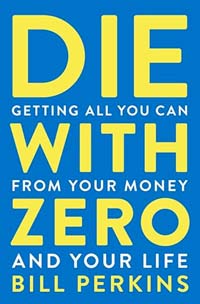 You’ve heard and believe that you don’t want to be the richest person in the graveyard. This book will help you achieve this goal. You can find that tricky balance between saving for the future and enjoying life as you go along. There are chapters to our lives, and if you miss an activity that belongs to a certain chapter, there is no going back. The author, Bill Perkins, points out that most people receive inheritances when they are about 60 (i.e., when their parents die), despite the fact that most people think the best time to get an inheritance is between ages 26 and 35. He suggests we do something about that. He also suggests that we realize that our ability to turn our money into awesome experiences declines throughout our lives. He’s pretty serious about literally dying with zero, too—even if that’s nearly impossible, of course. Every dollar you die with is time you spent at work when you didn’t need to do so. You better really love your work to spend so much of your life doing it that you miss out on so much of what life has to offer.
Here’s a quote:
More information here:“I hope my message has at least jarred you into rethinking the standard and conventional approaches to living one’s life—get a good job, work hard through endless hours, and then retire in your 60s or 70s and live out your days in your so-called golden years. But I still ask you: why wait until your health and life energy have begun to wane? Rather than just focusing on saving up for a big pot full of money that you will most likely not be able to spend in your lifetime, live your life to the fullest now: Chase memorable life experiences, give money to your kids when they can best use it, donate money to charity while you’re still alive. That’s the way to live life.”
What Happens When You Get What You Want
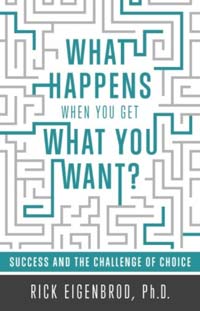
Our next book is a book I’ve previously reviewed on this blog that is 100% focused on being rich. Don’t expect anything actionable out of this book. What you will get is a philosophical mindset shift instead. Being financially successful might be a good problem to have, but that doesn’t mean it isn’t still a problem.
Rick Eigenbrod wants you to realize that you are far better prepared to pursue success than to have it. He points out why success, along with gain and achievement, also brings loss and disruption. He points out that we’re all subconsciously living “The Grand Narrative of Success,” and we need to knock it off, recognizing that this narrative is a false narrative. Once you realize the “agony of victory,” you’re going to encounter the challenge of choice. Welcome to the existential dilemma I’ve been dealing with for the last eight years since hitting FI.
Here’s a quote from the book:
“You can become your own author if you want to, and you don’t have to know where you’re going before you get started. You just have to know that you’re ready to listen to yourself . . . Even though the choices we have made eventually make us, they don’t make us in stone. We also need to realize that unless we find a new framework for choosing, we will take what’s easy and familiar because it’s easy and familiar. We need to see our choices as expressions of our lives at the moment. Life requires of us a constant process of making choices that are current, free, and enlightened. We are all works in progress . . .
We assume that success will change our circumstances but not ourselves. So we try to put our life back together much the way it was and so miss a tremendous opportunity to not only redesign our life structures, the externals, but also to change our sense of who we are, which is the essence of individual development.”
More Than Enough
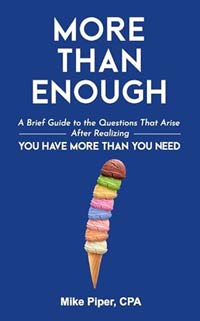 This one by Mike Piper (who we interviewed on the podcast about the book) does contain the actionable financial steps you’re looking for once you have more than you’re going to need. I love the subtitle: It is just as short as Mike’s other excellent books on various topics. Well-researched, clear, and concise, it will tell you everything you need to know about managing your money once you hit enough. Take a look at the chapters in the book:
- Do you have more than enough?
- Who gets the money?
- Talking with your kids or other heirs
- Giving and spending during your lifetime
- Learning to spend and give more
- Impactful charitable giving
- Impactful investing
- Reassess your asset allocation
- Trusts
- Asset protection
- Qualified Charitable Distributions
- Donating appreciated taxable assets
- Deduction bunching
- Donor Advised Funds
- The Roth question(s)
- State estate taxes
- Develop a workable plan
- Working with an attorney
- Working with a financial planner
- Conclusion: Mission accomplished. Now what?
Now, a quote from the intro:
“This book’s goal is to help you answer those questions that arise when you realize you have accumulated—or are on track to accumulate—more than enough. It often makes sense to start a book with the easy topics first. Pick the low-hanging fruit, allow the reader to build some confidence, and then move on to the more challenging topics. Unfortunately, the approach doesn’t work very well in this case. The financial strategies and tactics are the easy stuff, relatively speaking. But we can’t really talk strategies and tactics until you’ve done the harder work of determining exactly what your goals are.”
Isn’t that the truth?
From Strength to Strength
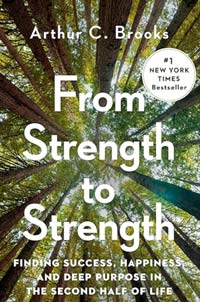 Arthur C. Brooks, the long-time New York Times columnist, uses this book to point out that the second half of life is different from the first half. If you try to live it the same way, you are unlikely to find happiness or success. For instance, the first half of your life is about doing, and the second half is about teaching and mentoring. I first read this one as I was approaching 50, mid-career for a typical doc. I thought it was filled with gems. I’ve written posts before based on some of the ideas in the book, such as the importance of pursuing both hedonia (pleasure) and eudaimonia (purpose).
Brooks describes it this way:
“Over the years, I have endured many graduation ceremonies and have observed that there are two basic types of speeches from commencement speakers. The first can be summarized as ‘Go find your purpose.’ The second is ‘Find work you love and you’ll never work a day in your life.’ Which one is better advice—not just for graduates, but for all of us? . . . This is an example of the age-old debate over two kinds of happiness that scholars refer to as hedonia and eudaimonia. Hedonia is about feeling good; eudaimonia is about living a purpose-filled life. In truth, we need both. Hedonia without eudaimonia devolves into empty pleasure; eudaimonia without hedonia can become dry . . . I think we should seek work that is a balance of enjoyable and meaningful. At the nexus of enjoyable and meaningful is interesting. Interest is considered by many neuroscientists to be a positive primary emotion, processed in the limbic system of the brain. Something that truly interests you is intensely pleasurable; it also must have meaning in order to hold your interest. Thus, ‘Is this work deeply interesting to me?’ is a helpful litmus test.
Neither work after FI nor retirement can be 100% pleasure seeking if you want to be truly happy. You’ll need to build in some purpose, too.
The Purpose Code
 Good news, though. Former WCICON keynote speaker Dr. Jordan Grumet will help you get the purpose right. A major message of this book is that you need to quit thinking that purpose has to be some world-changing event. That’s “Big P Purpose.” He suggests you find a lot more “Little P Purpose,” and you’ll be happier (and more successful) doing so.
Jordan says:
“Little P purpose, on the other hand, is the true creator of the wonderful health and longevity benefits that all those researchers have proven with their studies. It focuses not on the destination or the outcome, but rather on the path or process. Because of this, it lacks glamour. It is even considered downright unsexy. And most people do whatever it takes to avoid this petite purpose in favor of something they believe will be more substantial . . . Why do we fall for this fallacy? . . . We focus on uniqueness: the idea that each of us is special, and that this specialness will set us apart in important ways. Indeed, when we use the term unique today, what we are really talking about is success . . . What we really crave is not just to be different, but to be exceptional . . . The problem with this is that it places too much importance on big audacious dreams . . . instead of being thoughtful about what actually fits a person’s personality . . . Not everyone’s purpose needs to be outsized.”
Once you’re FI, especially if you’re still working, you’ll likely still be seeking purpose, and this book can help you find it.
More information here:- What We Can Learn About Work-Life Balance and Retirement from the French
- Life After Financial Independence: Two Perspectives
Outlive: The Science and Art of Longevity
 Yes, there has been controversy surrounding the author, physician Peter Attia, based on his inclusion in the Epstein Files. But this book is still worth reading. It’s much less financial than most on this list. The truth is that FI people have already won the money game. They should really be focusing on other aspects of life, at least when it comes to self-improvement.
Though it is so much easier to double down on what we’re good at, there are four limited resources in our lives: money, time, health, and motivation. When money is no longer the most limited of those, maybe you should focus more on increasing your time and health. Compressing morbidity is worth work and effort in our lives, even if you don’t really want to live longer than anyone else. Attia notes that:
“In 1900, life expectancy hovered somewhere south of age 50, and most people were likely to die from ‘fast’ causes: accidents, injuries, and infectious diseases of various kinds. Since then, slow death has supplanted fast death. The majority of people reading this book can expect to die somewhere in their 70s or 80s, give or take, and almost all from ‘slow’ causes . . . the odds are overwhelming that you will die as a result of one of the chronic diseases of aging that I call the Four Horsemen: heart disease, cancer, neurodegenerative disease, or Type 2 diabetes and related metabolic dysfunction. To achieve longevity, to live longer, and live better for longer, we must understand and confront these causes of slow death . . . One of the main obstacles in anyone’s question for longevity is the fact that the skills that my colleagues and I acquired during our medical training have proved to be far more effective against fast death than slow death . . . We are intervening at the wrong point in time, well after the disease has already taken hold, and often when it’s already too late . . . Longevity demands a paradigm-shifting approach to medicine, one that directs our efforts toward preventing chronic diseases and improving our healthspan—and doing it now.
One of the things I most appreciate about Attia’s writing is that he points to the evidence, and he isn’t afraid to say when there is no evidence to support popular practices. It turns out weight training throughout your life may be one of the most important habits you ever pick up.
Once you become rich, focus more on the books that helped you be rich rather than the ones that helped you get rich.
What do you think? Which of these did you enjoy and why? What other books belong on this list?
Did you find this article helpful? Share it!