

Today, we talk about the pressure many physicians feel due to inflation and rising housing costs. Despite those pressures, high income still provides an enormous opportunity to build wealth. We discuss the importance of keeping financial challenges in perspective, building wealth on a physician’s income, and making smart choices with money beyond a fully funded 529.





Is the Physician Financial Dream Dead?
“Where’s the dream? A million [dollars]this year is $600,000 in 2019. What are we talking about? Physician making $200,000-$250,000 might as well be a middle manager. It would have required 1/10 of the work. Even $700,000 now is like not worth it. I’ll make $700,000-$800,000, and I feel broke. I’m living in a crappy house in a crappy state in a crappy small town with no frivolous expenses. And literally I’m looking at this . . . like 30 more years and maybe I’ll be able to guiltily afford a beach house. What’s the point?”
Inflation, rising education costs, and physician incomes that have not always kept pace can make the financial payoff of medicine feel less impressive than it once did. That frustration is understandable, particularly for someone contemplating $300,000, $400,000, or even $500,000 of professional school debt. But earning $600,000, $700,000, or $800,000 a year is still an extraordinarily high income. The median American household earns about $83,000, while the average physician income is a little under $400,000. Even within individual specialties, there is a broad range of incomes, and many physicians will never earn $700,000 a year.
Medicine is also a difficult path to justify if the primary goal is simply maximizing income. Becoming a physician requires years of education and training, substantial opportunity cost, long hours, and often significant debt. There are other careers in finance, technology, law, entrepreneurship, and business where a highly intelligent, hardworking person could earn more without going through medical training. Physicians should expect to earn a good living, but money alone may not be enough to sustain someone through the difficult parts of training and practice. Something about the work itself should make the sacrifices worthwhile.
Feeling financially constrained on a $700,000 income also deserves some perspective. A large portion of that income may disappear to taxes, retirement savings, debt repayment, and other financial goals, which can make cash flow feel tighter than the headline salary suggests. But that is very different from actually being broke, particularly when compared with households earning a fraction as much. Physicians who genuinely struggle to make financial progress can consider geographic arbitrage, additional income through side gigs, or eventually pursuing other business opportunities. The physician financial dream has not disappeared, but expectations matter. A physician earning several times the typical household income still has an enormous opportunity to build wealth, and practicing medicine while earning even a median physician income remains both financially rewarding and a privilege.
More information here:- There Was No Golden Age of Medicine (at Least for Physician Incomes)
- A Deep Dive into the Salaries of New Grad Physicians
Can Physicians Still Afford to Live in High-Cost Cities?
“This is literally impossible for anyone finishing training in a major metro. A three-bedroom, two-bath fixer-upper in a mediocre school district starts around $1.4 million here. That’s closing in on $10,000 per month on the mortgage alone. Add up all the other miscellaneous home ownership expenses, and that $170,000 low-end budget is 100% spent on just owning that modest house you speak of.
Factoring in the essential expenses of having two children, no private schools or fancy camps, two Toyotas for you to commute and the wife for kid moving groceries, I can’t see a world where anyone spends less than $240,000 per year, roughly my burn rate. The majority of humans live and have families in metro areas; at least try to be realistic here.”
Housing affordability is a real challenge, especially for physicians finishing training in expensive metro areas. A $1.4 million fixer-upper with a mortgage approaching $10,000 a month can consume an enormous portion of even a physician’s income, and housing costs have risen substantially even in traditionally lower-cost parts of the country. But a $240,000 annual spending budget is still nearly three times the median American household income of about $83,000. High housing costs and inflation do not change the underlying math. Physicians have to build their financial lives around the income, debt, and cost of living they actually have. That may mean earning more, practicing geographic arbitrage, buying less house, or choosing not to buy at all. In markets where a home costs $10,000 a month to own but perhaps $4,000 to rent, renting and then investing the difference can be a perfectly reasonable path to building wealth.
The early years after training may also require accepting that a physician’s income does not immediately buy every part of the attending lifestyle. A new attending may still need to drive an inexpensive car, live in a modest house, pay off student loans, and postpone luxuries such as expensive travel or a second home. The key is to save first, decide what you truly value, spend intentionally on those things, and be rigorous about cutting spending elsewhere. Someone earning $400,000 or $700,000 who consistently carves out a significant portion of that income for saving and investing can accomplish an enormous amount over a decade. Wealth generally builds gradually, and compound growth becomes increasingly powerful as more capital accumulates. The beach house may not be realistic two years out of residency, but disciplined saving and investing can make goals that initially seem out of reach much more attainable later in a career.
Ultimately, a young physician is primarily earning money through labor, and one of the major financial goals should be converting some of that income into capital that can eventually work alongside them. Federal tax policy has also affected the balance between income from work and income from capital. For example, the 2017 Tax Cuts and Jobs Act reduced the top individual marginal income tax rate from 39.6% to 37%, and legislation enacted in 2025 extended the reduced individual rate structure beyond 2025. There are competing policy views about how heavily labor, investment income, and wealth should be taxed, but the personal finance takeaway does not depend on resolving that debate. Physicians can improve their own position by maximizing the value of their work, controlling spending, consistently investing the difference, and accumulating enough capital that an increasing share of their financial life is supported by their investments rather than their labor. The sooner that process begins, the sooner work becomes less financially necessary.
More information here:- How Doctors Should Deal with the Housing Crisis
- Is Renting Better Than Buying? Why We’re Financially Independent and Renting
How Should You Save for Your Kids Beyond a 529?
“I am a neurosurgeon in Arkansas. I have a question about savings for my kids. I had a goal of $100,000 for their 529s, and have reached that for each of them just recently. I have kids that are pre-teen to teenage years. What do you suggest next? I’ve looked at UGMAs and Trump accounts; we’re just starting a separate brokerage account for each of them. We’re probably leaning more toward UGMAs. We aren’t huge fans of making large retirement accounts for them. Seems harsh to type that, but we really want that to be something they work for. We would like to save for a wedding or maybe a down payment for a house.”
The best account for saving for a child depends first on what the money is intended to do. For education, a 529 is generally the obvious choice. An HSA can eventually be used to help a child build healthcare savings, particularly during the window when an adult child is no longer a tax dependent but can remain on a parent’s high deductible health plan. For a child with a disability, an ABLE account can provide tax-advantaged savings, with a special needs trust potentially becoming appropriate for additional assets. The account should follow the goal rather than choosing an account first and figuring out what to do with the money later.
Retirement savings have their own options. A child with earned income can contribute to a Roth IRA, and a parent can essentially replace the contributed money with a gift so the child still gets to enjoy the money they earned. For children without earned income, the new Trump accounts, aka 530a accounts, provide another way to begin accumulating retirement assets, with contributions generally limited to $5,000 per year. Those assets can potentially be converted to a Roth IRA later, with the timing of the conversion requiring attention to the child’s tax situation. An annuity can also provide tax-deferred growth for long-term retirement savings, although it comes with ordinary income taxes on the gains when withdrawn and generally makes less sense when the goal is something other than retirement.
For flexible goals—such as a wedding, honeymoon, car, travel, or a future house down payment—a UTMA is likely the better fit. A UTMA is simply a taxable custodial account belonging to the child, generally coming under their control around age 21 depending on state law. Dividends and realized capital gains are taxable, and the kiddie tax can apply while the child remains a dependent. But investing tax-efficiently can make a UTMA useful for a substantial amount of savings. Parents who want to maintain complete control can instead keep the money in their own taxable brokerage account, sacrificing some potential tax advantages in exchange for maximum flexibility over whether, when, and how much to give the child. For parents who have already adequately funded education and want to build a flexible “20s fund” for major early-adulthood expenses, a UTMA can be a good next step.
To learn more from this episode, read the WCI podcast transcript below.
Sponsor
Today’s episode is brought to us by SoFi®, the folks who help you get your money right. Paying off student debt quickly and getting your finances back on track isn’t easy, but that’s where SoFi can help—it has exclusive, low rates designed to help medical residents refinance student loans—and that could end up saving you thousands of dollars, helping you get out of student debt sooner. SoFi also offers the ability to lower your payments to just $100 a month* while you’re still in residency. And if you’re already out of residency, SoFi’s got you covered there, too.
For more information, go to sofi.com/whitecoatinvestor.
SoFi Student Loans are originated by SoFi Bank, N.A. Member FDIC. Additional terms and conditions apply. NMLS 696891
Milestones to Millionaire
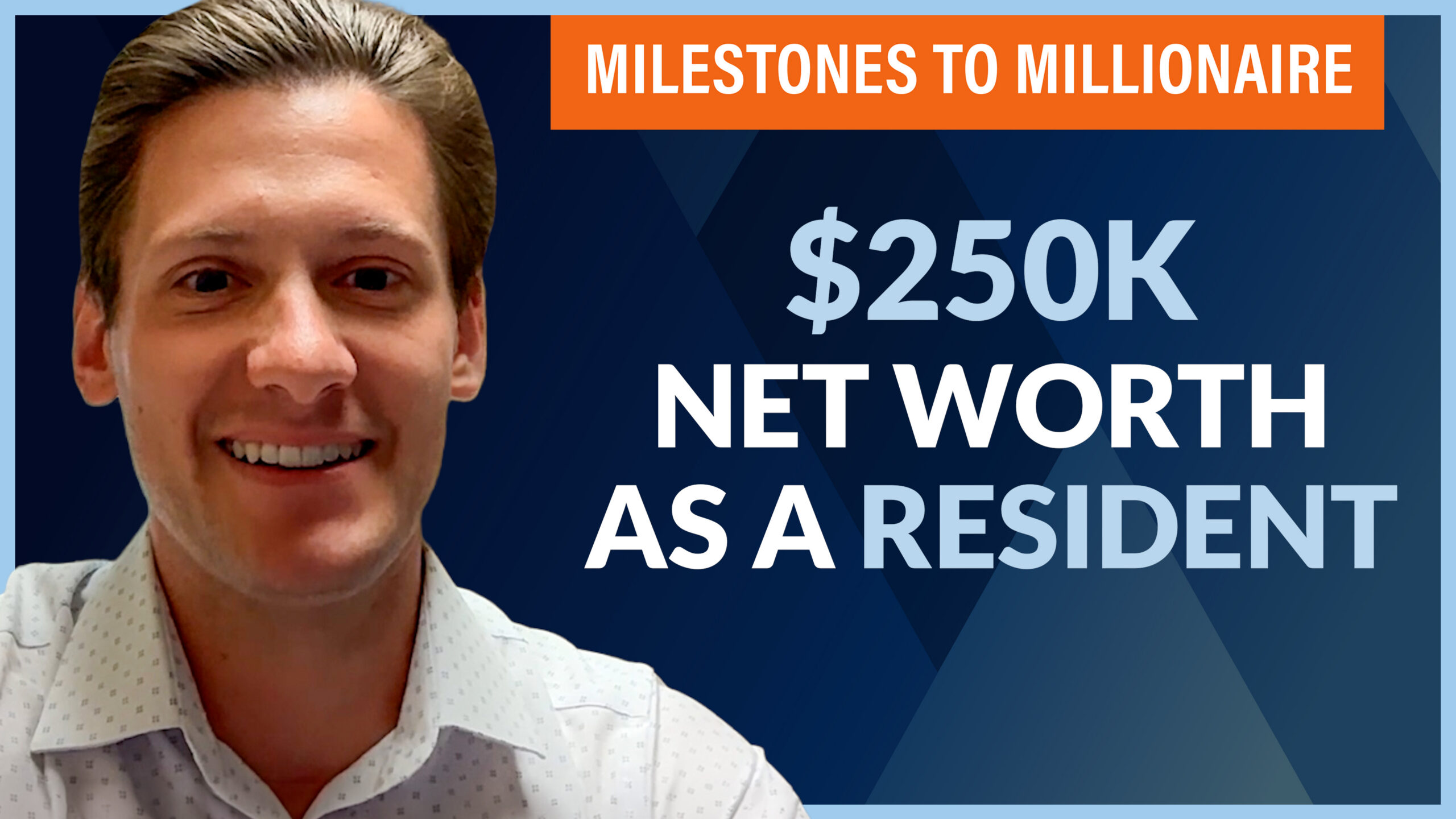
#293 — A $250,000 Net Worth During Residency
This orthopedic surgery resident has built a net worth of more than $250,000 before finishing training. Early investing, keeping medical school costs down, disciplined financial habits, and some good fortune have helped him get an impressive head start. He also shares why he chose to keep renting during residency and how he is thinking about money as he prepares for the transition to attending life.
To learn more from this episode, read the Milestones to Millionaire transcript below.

Financial Boot Camp Podcast
Financial Boot Camp is our new 101 podcast. Whether you need to learn about disability insurance, the best way to negotiate a physician contract, or how to do a Backdoor Roth IRA, the Financial Boot Camp Podcast will cover all the basics. Every Tuesday, we publish an episode of this series that’s designed to get you comfortable with financial terms and concepts that you need to know as you begin your journey to financial freedom. You can also find an episode at the end of every Milestones to Millionaire podcast. This podcast will help get you up to speed and on your way in no time.
Traditional IRAs
A traditional IRA is an individual retirement account that you open and control yourself rather than through an employer. If you qualify to deduct your contribution, you receive a tax break in the year you contribute, the money grows tax-protected, and withdrawals get taxed as ordinary income in retirement. That can be particularly valuable if you contribute during peak earning years and withdraw the money later at a lower tax rate. IRAs also offer meaningful asset protection from creditors. Contributions generally require earned income, although a nonworking spouse could contribute to their own IRA based on the working spouse’s income through what is commonly called a spousal IRA.
High earners with a workplace retirement plan may not be eligible to deduct traditional IRA contributions, which makes a nondeductible traditional IRA less attractive on its own. However, it can serve as the first step in the Backdoor Roth IRA process. A high earner can make a nondeductible contribution to a traditional IRA and then convert that money to a Roth IRA, where future growth and qualified withdrawals can be tax-free. The process is relatively straightforward but needs to be done correctly. In particular, investors need to understand the pro rata rule if they have existing money in traditional, SEP, or SIMPLE IRAs and properly report the transaction on Form 8606.
Traditional IRA money is intended for retirement, and withdrawals before age 59 1/2 generally come with income taxes plus a 10% penalty. However, numerous exceptions exist to the early withdrawal penalty, including certain withdrawals related to disability, domestic abuse, and a first-home purchase. Early retirees can also access IRA money using Substantially Equal Periodic Payments (SEPP) under Rule 72(t), provided they follow the requirements for the withdrawals. The bigger mistake is often avoiding an IRA because of concerns about accessing the money early and investing in a taxable brokerage account instead. When IRA space is available for retirement savings, taking advantage of its tax-protected growth and asset protection is generally preferable to unnecessarily investing those dollars in a taxable account.
To learn more about traditional IRAs, read the Financial Boot Camp transcript below.


WCI Podcast Transcript
INTRODUCTION
This is the White Coat Investor podcast where we help those who wear the white coat get a fair shake on Wall Street. We’ve been helping doctors and other high-income professionals stop doing dumb things with their money since 2011.
Dr. Jim Dahle:
Welcome to the White Coat Investor podcast.
Today’s episode is brought to us by SoFi, the folks who help you get your money right. Paying off student debt quickly and getting your finances back on track isn’t easy, but that’s where SoFi can help. They have exclusive low rates designed to help medical residents refinance student loans. That could end up saving you thousands of dollars, helping you get out of student debt sooner.
SoFi also offers the ability to lower your payments to just $100 a month while you’re still in residency. And if you’re already out of residency, SoFi’s got you covered there too. For more information, go to sofi.com/whitecoatinvestor.
SoFi student loans are originated by SoFi Bank, N.A. Member FDIC. Additional items and conditions apply. NMLS 696891.
All right. Welcome back to the podcast. This podcast is about you. It is to serve you. It is to help you to become financially literate, financially disciplined, to help you find financial success so you can quit worrying about money. So money becomes a tool in your life to help you find happiness and to build relationships that matter and to find your own purpose in life and quit worrying about the money.
And so, we’re going to try to do that today. But before we do that, I want to talk about an issue we had this week. Now, when I say this week, I meant a month ago because we’re recording this at the very end of August. And I know it’s not going to drop until September 24th.
But we had an email come in to us this week from a med student in Puerto Rico. And it was kind of a little bit of an interesting story. It’s a little bit of a mea culpa. And let’s talk about it for a minute. Here’s the email. And I don’t have permission to share this email, so I’m going to anonymize it. But basically, it’s a very nice email.
It says, “I hope this email finds you well. My name is blah, blah, blah. I’m a medical student in Puerto Rico. I was recently sent this scholarship option by my mentor, a doctor here on the island who’s also looking to invest in your cause.” They’re talking about the White Coat Investor Scholarship.
“As I reviewed all the details, I realized the only LCME-accredited schools in the United States that are barred from applications are Puerto Rico schools. I’m reaching out to inquire about this consensus because I believe it would be unfair for someone like my mentor to invest money into a scholarship she would have been barred from applying to when she was a medical student and her own mentee now cannot apply to.
I want to understand the reasoning not just for my own benefit, but for all the endless students here on the island that go weeks and even months without electricity or water, considering students here suffer from extensive infrastructure devastation or morale injuries.
I continue to see students here rise to the occasion and carry through school. I feel as those students here are immensely deserving of a scholarship so large and crucial to their lives. This is a place full of resilience and bright young physicians, even in the face of moral strangulation. So I’d appreciate knowing the reason why we can’t apply, yet our physicians can invest into the scholarship. Kindest regards and best wishes.”
First of all, it’s great if people want to contribute to the White Coat Investor Scholarship. Not very many of you do in PR or anywhere else. So we do appreciate if you do that. It’s almost entirely funded from WCI profits and from the sponsors of the scholarship that you hear about. Just FYI, where the money comes from, there’s no endowment behind the scholarship. We’re literally just writing checks to the 10 winners every year.
Okay, but the is good. Why can’t Puerto Rico students apply for the scholarship? Well, I saw this come in and I actually got a call from our social media person because Instagram was apparently blowing up with people asking this question, not nearly as kindly as this email came in. Funny how people anonymously on social media are not quite as nice as they tend to be when they send an email from their personal email address, especially when they include their name.
But the question was, “Why can’t Puerto Rico students apply?” And I’m like, “Puerto Rico students can’t apply?” And sure enough, I went to the scholarship page and it said right on there that Puerto Rico students couldn’t apply. And I’m like, “Why is this?”
So, the whole company had a very brief discussion over Slack. And I’m like, “Can anybody remember why Puerto Rico students can’t apply to the scholarship?” And nobody could. And so, we changed the policy about four minutes later. So, Puerto Rico students were able to apply. We announced that on social media. And I know a number of you have applied to the scholarship. I wish you best of luck in the competition for winning the scholarship. Thanks to those of you who are right now serving as judges for the scholarship. I know some of you are reading essays from Puerto Rico students.
We’re not really sure why that policy was ever in place. We think it might’ve been carried over from our Champions Program. The White Coat Investor Champions Program is where we try to give away free books to first year medical students. And that program involves sending books out to a champion who then distributes them to their students.
Well, for those of you, and I know you Boricuas know this, for those of you who’ve ever tried to ship something to Puerto Rico, it is not cheap. It’s probably cheaper for me to pay a WCI staff member to fly out there with the books and hand them out personally than it is to ship them there. It’s really expensive to ship to Puerto Rico. So I think we may have had a policy that kept us from including Puerto Rico schools in that Champions Program, just because we couldn’t get the books there from Amazon in any sort of a cost-effective way.
That might be where it came from, but honestly, we couldn’t figure out why that policy was in place in the first part. So, the people who are eligible for the White Coat Investor Scholarship are people at a brick or mortar school in the U.S. And Puerto Rico is in the U.S., so you qualify for the scholarship. We have removed that phrase from the scholarship page and won’t have that on there again. I apologize to you and wish you “Buena suerte en tus estudios” in Puerto Rico.
IS THE PHYSICIAN FINANCIAL DREAM DEAD?
Dr. Jim Dahle:
Okay, next issue we want to talk about. Cost of living and some of the frustration that young people going into medicine are having. We try to get the word out there about finances and about helping docs to become financially successful, but it can be frustrating these days to be young and to be staring at maybe borrowing $300,000 or $400,000, maybe $500,000 to go to dental school and looking at inflation the last few years and getting a little bit bummed about it.
So, let me read this comment that came in on TikTok. Yeah, we have TikTok now. I don’t know if we have a huge TikTok following, but we have enough that when we get a really good video out there from this podcast or somewhere else, it gets watched by a lot of people.
So, this person says, “Where’s the dream? A million this year is $600,000 in 2019. What are we talking about? Physician making $200,000 to $250,000, might as well be a middle manager. It would have required a 10th of the work. Even $700,000 now is like not worth it. I’ll make $700,000 to $800,000 and I feel broke and I’m living in a crappy house in a crappy state in a crappy small town with no frivolous expenses. And literally I’m looking at this shiz like 30 more years and maybe I’ll be able to guiltily afford a beach house. What’s the point?”
Okay. I get it because I’ve been in the physician lounge. This is just somebody venting a little bit. And I get it that we’re venting and it’s okay to vent sometimes. The social media works really well for venting, especially if you’re able to do it anonymously. And I get that inflation since 2019 has been significant, mostly in that 2022 time period when interest rates were cranked up to try to get it under control. But our government gave out an awful lot of money to try to solve economic issues associated with pandemic. And they probably didn’t dial it back in as quickly as they should. There are other reasons for inflation as well, but that’s probably the main one. And it’s true that in those years, it did not feel like physician incomes kept up with inflation.
But to say that $600,000 or $700,000 or $800,000 is not worth it, it might be going a little too far. Let’s keep in mind what the median American household income is. It’s $83,000 a year. That’s the household. That might be two people earning. It might be three people earning. One of the reasons I occasionally listen to the Dave Ramsey show is because I just want to hear from people that are making $35,000 a year. And there are a lot of them out there.
So, to say $700,000, treat it like it’s not a high income is just crazy. It is a high income. Lots of doctors never make anywhere near that. The average physician income is a little bit lower than $400,000 right now. And it tends to go up a little bit year to year with inflation. But the range of incomes in any given specialty is quite broad. So, there certainly are docs making $200,000, $250,000. I make less than that clinically, but I’m also only working 0.4 FTEs. And I’m only working day shifts.
There are reasons why my physician income is not that high. And there are certainly middle managers that make as much money as I do working clinically. We have staff members at White Coat Investor that are making more than I make clinically. And so, I get that sentiment.
But to pretend that none of this is worth it, I think is a little disingenuous, number one. Number two, I hope you didn’t go to college and medical school and residency primarily to make money. You can be really unhappy in medicine if that’s the case. I can remember as an intern sitting there looking at a trauma patient and two or three limbs and splints and a chest tube in and had a head injury and a bunch of lacerations and looking at them at about 07:00 o’clock one morning while rounding going, “I need that bed more than you do”, because I’d already been there for 25 hours.
It is hard to be in medicine. And just a desire to make money is not going to sustain you through what you need to have, what you need to get through in order to be an effective doctor. There’s got to be something else. Nobody expects to be poor from being a doc. And I’m trying to stamp that problem out as best I can.
But if your goal is to make a lot of money, and you’re a very intelligent, hardworking person, you might want to consider some other fields, finance maybe. Maybe you want to open your own business. Maybe there are jobs in tech or law or some other places where you might be able to make more money than you can make in medicine.
And so, please evaluate your motivation for it. And if money is really the highest thing on the list, maybe medicine isn’t for you. It doesn’t mean that doctors can’t have a great income. Lots of doctors make a great income. I’ve run a surprising number with seven figure incomes. And certainly that’s easier in some specialties than others.
But let’s be honest about what’s going on here. As hard as it is for you living in a crappy house in a crappy state in a crappy small town with no frivolous expenses, it’s way worse for the median person in your town. Go down the street, talk to them for a little bit, and you’ll realize maybe you have it pretty good.
I know sometimes it feels like you’re living hand to mouth on $700,000 a year, but the truth is probably a fair chunk of that is going into retirement accounts. And obviously a lot of it goes to tax.
And if you really are in an area where it’s very hard to get ahead as a physician, despite having a pretty good physician income, maybe it’s time to consider some geographic arbitrage. But as a general rule, if you are already in a small town, you’ve probably already done that. And you’re probably making dramatically more than people around you.
Remember that $83,000 median household income figure includes everybody living in New York and everybody living in the Bay Area and everybody living in Washington, DC, everybody living in Seattle, everybody living in Park City or wherever you’re at. There’s a whole bunch of people in your small town in a crappy state, wherever that is, who are making a whole lot less than $83,000 a year.
So, if the thing most important to you is to be able to afford a beach house, maybe look into some other things. Maybe look into some side gigs. Maybe you’re one of those people that’s going to move on from medicine at 35 or 40 or 45 into managing a real estate fund or something like that. I have no idea.
But I think this was probably just somebody venting a little bit. Let’s step back for a minute and remember that it is a privilege to practice medicine, number one. And it certainly feels privileged to be privileged to be making even the median physician income. And this person’s apparently making twice that.
CAN PHYSICIANS STILL AFFORD TO LIVE IN HIGH-COST CITIES?
Dr. Jim Dahle:
Okay. A similar rant also came in on TikTok that was titled, “Housing is unaffordable”, saying “This is literally impossible for anyone finishing training in a major metro. A three-bedroom, two-bath fixer-upper in a mediocre school district starts around $1.4 million here, which is closing in on $10,000 per month on the mortgage alone. Add up all the other miscellaneous home ownership expenses and that $170,000 low-end budget is 100% spent on just owning that modest house you speak of.
Factoring in the essential expenses of having two children, no private schools or fancy camps, two Toyotas for you to commute and the wife for kid moving groceries, can’t see a world where anyone spends less than $240,000 per year, roughly my burn rate. Maybe this, I think they’re referring to a budget on TikTok, works for a specialist in Alabama, but the majority of humans live and have families in metro areas, at least try to be realistic here.”
Okay. Again, a median household income in America is $83,000 per year. Your low-end budget, this no frivolous expense budget is $240,000 per year, almost three times as much. Imagine how out of touch that sounds to somebody living in the median American household. Many of which, yes, are in these high cost of living areas.
I fully understand how cost of living works. I fully understand how inflation works. I fully understand that if you get a $1.4 million mortgage, it’s going to eat up a whole lot of an income. You’ve still got to make the math work. Just because you’re doing something good with your life, just because you’re being a doc or a nurse practitioner or a PA or an attorney working in public service, whatever, you don’t get a pass on math. The math still has to math. There is nobody riding in on a white horse. The cavalry is not coming to save you.
And so, recognize you have to work with what you have to work with. Some people inherit money. Some people don’t. So, if you didn’t inherit money, you got to work with that. Some people make $500,000 a year. Some people don’t. Whatever you make, you have to work with that. Some people live in more expensive areas than others. That is not set in stone, by the way. You can change that. You can go to less expensive parts of the country where doctors are often paid more and generally do pay less in taxes.
If you want a 4,000 square foot house on half an acre, that is available for doctors. It might not be available for doctors in Manhattan. It might not be available for doctors in some big city in Connecticut or Rhode Island or somewhere else, but it is available in some parts of the country. So, geographic arbitrage is an option for you.
Secondly, there is no requirement that you buy a house. There are people who rent their entire lives and that’s okay. You do not have to own a house to be financially successful. Now, as a general rule, if someone’s going to be there for longer than five years, I think they usually come out ahead of owning a house, but there are areas of this country and they’re all metro areas where I’m not sure that’s the case.
If you are paying $10,000 a month for your mortgage and you can rent the same place for $4,000 and invest that $6,000 difference, I think there’s a good chance you may come out ahead. So yes, it’s fair. I understand what people are feeling. I understand it is a challenging time to buy a house. The housing crisis is universal. Even in low cost of living areas, they are dramatically more expensive than they used to be. Inflation sucks and housing is definitely more expensive.
So, I do feel empathy for you, but you don’t get a pass on math. You don’t get the option to live in a different time period. This is your time period. So stick to the basics. Do what you can to boost your income. Consider geographic arbitrage. Save first. The Warren Buffett quote is, “Don’t save what is left after spending, spend what is left after saving.” A lot less stuff. You got a lot less leftover for the fun stuff. And so, you’ve got to have less fun stuff. That’s it.
Guess what? When I came out of residency, I was making $120,000 a year. And no, I didn’t buy a super expensive place. It cost $138,000. It was not nice. It had three bedrooms, two baths. We had a shooting out front while we lived there. And there was somebody dealing drugs two doors down. It wasn’t an awesome neighborhood.
So, I get it. I have been a physician that did not feel like he was making a killing. I was driving a car that literally cost me $1,850. I bought it at an auction. I didn’t test the AC before buying it. The AC did not work. I did not fix it. I drove it without AC for four years in Southeastern Virginia. It was kind of hot sometimes, but thankfully many of my shifts started at 06:00 AM or ended at 10:00 PM. And that wasn’t too bad with my 440 air conditioner.
So I get it. It’s not fun sometimes, but if you will take care of business from the beginning, you will become wealthier every month and every year. Yeah, occasionally it will go a little bit backwards when there’s a big bear market, but for the most part, you get wealthier every year. And if you’re really making $400,000 or $700,000 and you can continue to get paid what you’re worth as inflation goes up, continuing to increase that income, you’ll be shocked at what you can accomplish over a decade if you manage your money appropriately.
And that might mean that you don’t get to fly Delta One to Europe when you’re in your thirties. But if you take care of business, you’ll be able to do it in your 50s. And you can’t get the beach house two years out of residency. You’re still paying off student loans for crying out loud. Can you get the beach house eventually? Yes, but not the day you walk out of residency.
So, start when you’re fresh out of training, live on a written budget, figure out what you value and spend on those things. And then be very rigorous about not spending on other stuff and recognize that compound interest is your friend. You want to become a capitalist and to do that, you have to get capital. And for most of us, the only source of capital is our income. So, the more of that that you can carve out on, the faster you can become a capitalist and live on your capital.
And that’s part of the issue of our housing crisis. Part of it is just not enough housing got built for a number of years after the global financial crisis. But part of it is that in our society over the last 10 or 15 years, the pendulum has swung toward capital and away from labor. And part of that’s the result of the two tax plans, really the second one’s just kind of making permanent the first one that came out of the Trump administration. It’s a lowering of tax rates. We went from 39.6 to 37% in the top bracket.
And people talk about a wealth tax and that sort of stuff. A wealth tax is not very practical. If you really want to tax the wealthy, just raise the income tax. But recognize that that hits people like doctors pretty hard. But that is the way you keep people from building wealth too quickly. You want them to have less wealth? Well, tax their income. They still have some income. It might be qualified dividends. It might be capital gains. They’re still in some income. Tax that income. Vote for people who are going to raise tax rates if you want to see more equality there.
But right now, the pendulum has swung pretty hard away from labor and toward capital. And guess what a doc in their 30s is? Your labor. That’s why your employer treats you as labor. They may not feel like they’re treating you very well. And so what happens when docs get treated as labor? They start acting like labor. They form unions so they can get better benefits packages so they can get better salaries. But recognize that is what happens. So the sooner you can move from labor to capital, the better off you’re going to be. And the secret to doing that is making as much as you can, carving as much of it out as you can, and putting it to work alongside you. Let your money work with you. And eventually, you’ll be able to live on just your money. Hope that’s helpful to you.
One of our sponsors is Boldin. Boldin is so much more than just a retirement calculator. It’s really a robust financial planning software. The quality of the financial plan, it generators actually higher than what I’ve seen come from some people who call themselves professional financial advisors.
And if you combine it with a financial literacy course, like our Fire Your Financial Advisor course, this could be a powerful tool for someone looking to bridge the gap between DIY financial planning and paying thousands to a financial advisor.
Boldin’s got some new features. You can get a single document style view of an entire financial plan you can download. They’ve got a social security benefit toggle that allows you to look at how a potential decrease in benefits could affect your financial plan. And they’ve got a risk tolerance survey to help you figure out what your risk tolerance is. Check that all out at whitecoatinvestor.com/boldin.
HOW SHOULD YOU SAVE FOR YOUR KIDS BEYOND A 529?
Dr. Jim Dahle:
Okay, I’ve got a question now. This is probably not somebody in a really expensive metropolitan area because not only are they doing okay, but they’re trying to save for their kids. So, this comes in by email.
“I am a neurosurgeon in Arkansas. I have a question about savings for my kids. I had a goal of $100,000 for their 529s and have reached that for each of them just recently.” Well done.
“I have kids that are pre-teen to teenage years. What do you suggest next? I’ve looked at UGMAs, Trump accounts, we’re just starting a separate brokerage account for each of them. We’re probably leaning more toward UGMAs. We aren’t huge fans of making large retirement accounts for them. Seems harsh to type that, but we really want that to be something they work for.
We would like to save for a wedding or maybe down payment for a house. Thank you for all the work you put into the White Coat Investor. It has helped me and my wife tremendously, especially the recent podcast about sabbaticals.”
Okay. Well, I wrote a blog post about this not long ago. You should read it if into reading blog posts. I think the title on it on the website is “Trump accounts versus UTMAs”, or “How to Save for Your Children (UTMA vs. Trump Account)”.
It actually hasn’t run out on the blog yet. It takes us time to get blog posts out. I’m often six months out on these things, but it’s published so you can see it and we’ll put a link to it in the podcast notes. We’ll get it published soon so those of you who are reading the blog posts on your email can read it.
But I kept getting questions like this and so wrote a big beefy blog post all about it with all the detail you could want. And I responded in the email to this person with a link to this post. But what the post does is it compares accounts you can use to save for your children and which one you should use.
Let’s walk through this for a minute. The first thing you want to do in saving for your children and trying to decide what account to use is what is the money for. The purpose of the account. And that actually helps you more than anything else decide what account to use to save for your child.
For example, if you are saving for their education, you should use a 529 account. Done. It’s that easy. There’s no more decision to make for that. Okay. What if you are saving for their healthcare? Well, you should use a health savings account for that. Be aware that you can’t save for them until they’re in the health savings account, except once they become financially independent of you for tax purposes, but they’re still on your high deductible health plan.
You can give them some money and they can make their own family size high deductible health plan contribution. I guess if they’re on a HSA or something with an employer later in their life, you can do this later, but it’s kind of a cool trick between ages 19 or so and 26 that you can help them build an HSA pretty quickly that might last them their entire life.
What if you want to save something for your child that’s disabled? Well, you should use an ABLE account, at least up to the first $100,000 or so. Beyond that, you might need a special needs trust, but an ABLE account is the account that’s designed for that.
What about retirement? Well, you’ve got three choices there. You used to have two, now you have three because Trump accounts or 530A accounts have come along. So your real question here, if you’re looking to help them save for their retirement, this person isn’t, I get that, but if you’re trying to help them save for retirement is do they have any earned income? Because if they have earned income, they should put that into a Roth IRA. You can give them a sum equal to that and they can spend it.
So, they get to have their cake and eat it too, but they have to have earned income to use a Roth IRA. So if they have earned income and you want to help them to save for retirement, you can help get their earned income into a Roth IRA and give them a gift that’s equivalent to it.
If they don’t have earned income, the best place to save is a Trump account for $5,000 per year. Now that account can be converted to a Roth IRA at some point in their twenties. You usually want to wait until they’re no longer your tax dependent. So the kiddie tax doesn’t apply, but before they start making a lot of money and they’d have to pay taxes on that Roth conversion at a relatively high rate.
And then you just let that Roth IRA sit until they’re 65. And I think last time I ran the numbers at 10%, it’s like $20 million. If you put $5,000 a year in there from age zero to age 18 and just let it ride until age 65 and earn 10% on it, I think it’s 20 million.
Now you probably ought to adjust that for inflation. Let’s adjust it down 3% for inflation. It’s still like $4.2 million. You could pay for your kid’s entire retirement just with a 530A account, which would be a nice gift to get. I don’t think this particular emailer was interested in that.
The other account you can use for retirement is an annuity. And this was what people who didn’t have earned income but wanted to save for their kid’s retirement used before the Trump accounts came along. And it grows in a tax protected way. And when it comes out in retirement after age 59 and a half, you do have to pay ordinary income tax on it. So, it’s a little bit different than a Trump account that gets converted to a Roth IRA.
But that is another option to consider if you’re looking to save for the retirement. But you don’t want to use an annuity if they want to save for something else. You don’t want to use that for education or healthcare or anything else.
If you want something that they can use for more flexible purposes, what we call at my house, a 20s fund. This is something you can use for missions or weddings or honeymoons or a car or summer in Europe or whatever. The best place for that is a UTMA. That’s just a taxable account for your kid. It’s custodial in most states until they turn 21. But it’s just a taxable account.
So, you have to pay taxes on the dividends as they’re kicked out. If you buy or sell anything in there and generate capital gains, you got to pay taxes on those capital gains. There’s a little bit of a tax break up to a certain amount. And then while they’re still your tax dependent, they got to pay kiddie tax on any amount above that.
As a general rule, well, if you invest it really tax-efficiently, you can get up to about $100,000 into a UTMA and it actually makes sense. But if you want maximum flexibility, you want to be able to spend this money yourself or give it to your kids or buy something for your kids, the place to save that is your taxable account.
Super flexible, you’re totally in control, you can use it whenever you want, no real tax breaks for using it, and you still can tax loss harvest in it, and you can donate appreciated shares to charity, you can get qualified dividend rates and long-term capital gains rate. But basically, it’s getting taxed as it grows, so it’s going to grow a little bit slower, but it’s super flexible. That’s the beautiful thing about a taxable account.
And if you’re sure you don’t want to help them for quite a while until they’re into their middle-aged period or even their later years, you can just save it in your retirement accounts because you’re going to be able to get to those without any sort of penalties after age 59 and a half, or even at your death, and you leave it to them, that’s kind of a good place to save for money for them later in life.
But really, that’s where you start, you start with the purpose of the account. And in your case, it sounds like you want a flexible purpose. And so, where do you save for that? You save for that in a UTMA account. I hope that’s helpful. But again, if you want to check out that blog post, it’s called “How to Save for Your Children.” You search that term on the blog. You can see that if you just go to the show notes, we’ll have a link for that.
QUOTE OF THE DAY
Dr. Jim Dahle:
Our quote of the day today comes from Warren Buffett, who said, “Someone is sitting in the shade today because someone planted a tree a long time ago.” I love that quote. So true. Let compound interest work in your life.
Okay, let’s take a question about investing for teens.
FIDELITY TEEN ACCOUNTS
Speaker:
Hey, Dr. Dahle, thanks to you and your team for all the great work that you continue to do. I have a question about account options for investing for teens. I’m familiar with the UTMA or UGMA accounts, but it seems that Schwab and Fidelity both offer teen accounts that are structured differently. Could you speak a little bit about the pros and cons? Thanks.
Dr. Jim Dahle:
Okay, great question. We did not use any of these for my kids. We’re not using any of these for my kids now. They have UTMA accounts. UGMAs is kind of an older thing. There’s still a few UGMAs out there, but for the most part, they’re all UTMA accounts. My kids have Roth IRAs, my kids have 529s, but two of my kids have Trump accounts.
Yeah, life isn’t fair is what I told the older ones, and I mean it when I tell them that. But for the most part, what I mean when I tell them that is it’s not fair in your favor. You’re getting way more than the average kid does already, so don’t sweat it that you didn’t get exactly the same amount as your sibling or cousin or whatever.
We have not done any of these Fidelity youth accounts or Schwab. I don’t know what Schwab’s calling their product, but Fidelity calls it the youth account. So let’s talk a little bit about it. I did publish a blog post on this in October of 2025.
What is it? Well, it’s a fully taxable brokerage account owned by a 13 to 17-year-old. You can open it with as little as $1. There are no fees to open it. The parents have to open the account. They can add money to the account, but interestingly, the parent cannot withdraw money from the account, and the parent has to have an existing account with Fidelity themselves. So maybe this is a marketing ploy by Fidelity, gets you to move your money there so you can have a Fidelity youth account. I don’t know.
The teen then controls the account, but parents, well, technically one parent gets visibility into what they’re doing in the account, and the teen can essentially invest in most of what a brokerage account is typically invested into. You invest in a government money market fund, pays a little less than the Vanguard one, but it’s still a pretty good one. The account can have a debit card associated with it.
At age 18, it becomes a regular brokerage account. Note that that’s earlier than a typical UTMA account, which is usually in most states age 21. This thing’s theirs at age 18. There is a $30,000 annual limit on contributions, and it seems like the way most people do those is transferring from the parent’s Fidelity account, but you can actually deposit checks there. Your direct deposits from your kid’s job can also go there.
So that’s kind of cool. The teen cannot gift money from the account though, and daily debit card transaction accounts are limited. There are some guardrails, but it’s pretty much your team doing whatever they want with the account.
So what are they allowed to invest in? They invest in Fidelity mutual funds, most US stocks, some ETFs, REITs, some international equities, but they can’t invest in third-party mutual funds, corporate bonds, muni bonds, CDs, treasuries, convertibles, leveraged and inverse ETFs, cryptocurrency, some Philly insurance products, penny stocks, or foreign currencies.
They can’t do options, they can’t do margin trading, they can’t do short selling, they can’t participate in a company’s IPO. Again, some more limitations on that. Most ETFs are allowed, but not leveraged or inverse ones. Bitcoin ETFs are specifically excluded. You can buy those in a UTMA, but you can’t in a Fidelity youth account.
Okay, that’s how it works. It’s kind of a cool account, I guess, if you want to teach your kids how to invest, I think it’s fine to put a few thousand in there. I don’t think I’d put $100,000 in there. I’m not too comfortable with my 13-year-old managing $100,000. It’s up to you, though, you could put $30,000 a year in there, and 13, 14, 15, and it’s probably $100,000 by the time they’re 15. So, it’s your choice if you want to do that, I guess. I’m not super comfortable with that.
The first question people ask is, “How is this different from a UTMA?” Well, the main difference is ownership and control. The UTMA is a custodial account, so the money belongs to the minor, you can’t spend it on yourself, but the minor has no control over it until age 21 in most states.
With the Fidelity account, the parent has limited control over it, but can’t actually transact in the account or withdraw money from it. So, it’s the teen’s account now instead of later, like with the UTMA.
The parent is allowed to close the account completely and cancel the debit card. So they do have the nuclear option, but not like any of the small stuff. And of course, the investment options are more limited in the youth account. So again, I think it’s fine for a few thousand dollars, let the youth get used to trading stocks, and buying a few ETFs and reading some account statements.
But I think, frankly, I sit down with my kids and teach them all that using UTMAs and Roth IRAs and 529s. So I don’t think you have to have a Fidelity youth account to be able to teach those sorts of principles.
The account taxation works basically exactly like a UTMA. Kiddie tax applies, gift tax limits apply, etc. It also comes with an app. No surprise. There’s a Fidelity app and a Vanguard app anyway. The teen can put that on their phone, they can do all their transactions with the app. They can request money from their parents in the app, if you like to, it has to come in from the parent’s Fidelity account. And this is kind of a cool feature, the parent can also use the app to make regular allowance transfers to the teen. So that’s all pretty cool.
So, what are the pros? Well, it’s probably a more effective teaching instrument than a UTMA. The kids are going to learn better how to invest if they can and have to do everything themselves or maybe feel a little more trusted or a little more in control of their own money. And of course, they’re going to make more on their savings than they would at the local bank or credit union.
What are the cons? Well, aside from the fact that their frontal cortex isn’t fully developed until they’re 25, young people do stupid things, especially teenagers. How much money do you really want a 14-year-old to be able to control, especially when their actions not only affect their tax bill, but yours?
Plus, it’s just one more financial account to manage. If you’re going to do a UTMA too, well, now this is another account. So I guess if you’re deciding between the two, because you’re only going to put a little bit of money in the UTMA, fine. But now it’s like, “Oh, now I got a Roth IRA and an HSA and a UTMA and a 529 and now a Fidelity Youth Account too.” Well, at a certain point, you got to ask if the complexity is worth it.
The other thing to keep in mind is teenagers are teenagers. They tend to ignore things that are not important to them. And they might learn some really painful lessons in their teens about investing they’re going to carry over the rest of their life. So, no supervision on their investing doesn’t seem entirely wise to me.
Why does Fidelity offer this? Why does Schwab offer this? Well, I think they want your money there. They want your kids’ money later to be used there. And customers are sticky, so they can get them in early, they get to keep them long-term. I think it’s fine to use these; just recognize they have some limitations, and maybe not even as many limitations as you would like them to have.
I hope that’s helpful for you. I don’t have all the ins and outs of the Schwab account, but I’m sure it’s very similar. But take a look at those if you’re interested in giving your kids a little more hands-on experience with money, you might want to check out those accounts.
Thank you out there for those of you listening to this on the way home from a difficult day at work or out walking the dog or out for a run or at the gym or whatever. Your work’s important. It matters. Thank you for doing it.
SPONSOR
Dr. Jim Dahle:
As I mentioned at the beginning of the podcast, SoFi could help medical residents like you save thousands of dollars with exclusive rates and flexible terms for refinancing your student loans. Visit sofi.com/whitecoatinvestor to see all the promotions and offers they’ve got waiting for you.
SoFi student loans are originated by SoFi Bank, N.A. Member FDIC. Additional terms and conditions apply. NMLS 696891.
All right. Don’t forget, I mentioned our partnership with BoldIn. This is financial planning software. Maybe between Fire Your Financial Advisor and this BoldIn software, you can get away teaching yourself how to be a DIY investor and save financial advisory fees. You can check that out at whitecoatinvestor.com/boldIn.
If that is not working for you, maybe check out White Coat Planning. We started that for people that want a little bit more professional guidance walking through building and implementing and maintaining a financial plan.
Thanks for those of you leaving us five-star reviews. A recent one came in saying “The best financial podcast for high earners and everyone else. This podcast and website have transformed how I manage my finances through clear, unbiased explanation of fundamental concepts that apply to novices and experts alike. I don’t think there’s a better personal finance podcast available anywhere. If there was, you’d learn about it here.” Thanks. That’s nice of you to say. I appreciate that five-star review.
Okay. That’s it. We’re at the end of the podcast once more, but we’re going to be back next week teaching you to be financially literate, teaching you to be financially disciplined, helping you overcome burnout, helping you to be successful in your life so you can be a better physician, a better parent, a better partner, better at everything you do. Let’s make money a tool in your life so that financial freedom helps you to be better at who you are rather than a source of worry in your life. Thank you everybody out there for what you do. It is important work. We’ll see you next time on the podcast.
DISCLAIMER
The White Coat Investor podcast is for your entertainment and information only and should not be considered financial, legal, tax, or investment advice. Investing involves risk, including the possible loss of principal. You should consult the appropriate professional for specific advice relating to your situation.
Milestones to Millionaire Transcript
INTRODUCTION
This is the White Coat Investor podcast Milestones to Millionaire – Celebrating stories of success along the journey to financial freedom.
Dr. Jim Dahle:
Welcome to the Milestones to Millionaire podcast.
Since April 2021, more than 650 physicians in the White Coat Investor community have invested over $300 million with DLP Capital, a 12-time Inc. 5,000 honoree that offers four private real estate investment funds, one of my favorite ways to invest in real estate.
If you’re eager to achieve success as a private real estate investor, DLP’s impact-focused sponsored funds offer the potential to earn double-digit returns while making an impact on America’s affordable housing crisis. Interested in learning more? Head to whitecoatinvestor.com/dlp today.
Welcome back to the podcast. This is the podcast where we celebrate what you have done, and we use it to inspire others to do the same. There are milestones in our financial lives. Maybe one of the first ones for most docs is just getting back to broke since so many of us start our careers in a pretty big hole, but there are other milestones. It might be paying off a car, paying off a house, or paying off your student loans, or becoming a half a millionaire or a decamillionaire. We want to celebrate those with you. If you’d like to come on the podcast as a guest, you can apply at whitecoatinvestor.com/milestones.
By the way, one of my favorite things that we do every year is give away copies of the White Coat Investor’s Guide for Students. I wrote this book a few years ago. We try to keep it updated as best we can, but I wrote it to give it away. We do sell some of these. Some people do buy it on Amazon. It’s worth your money. Don’t get me wrong if you buy it off Amazon, but I wrote it to give it away.
My goal is to give it away to every first-year medical, dental, and other professional student in the country every year. And we will do so. All we will require is a champion in that first-year class. All you have to do to be the champion is pass out the books. That’s it. That’s the whole job description.
You got to tell us, well, how many people are in your class? We got to make sure you’re actually in the class and not just planning to sell these books on Amazon or something. If you pass them out and take a picture with a few of your classmates, we’ll even send you some WCI swag.
Literally, that’s really all we need to know is that you’re in the class and what your mailing address is, and we’ll send you enough for everybody in your class to pass them out to everybody.
If no one in your first-year class has handed you yet the White Coat Investor’s Guide for Students, please volunteer as the champion. You’d be surprised how hard this is to give away books sometimes. We only managed to get them to about 70 percent of the first-year students each year. That’s still a lot of people.
We’re giving away tens of thousands of books every year, but we’d like to give it away to everybody because we know getting this information, becoming financially literate at the very beginning of your career not only helps you make better financial decisions in med school and residency, but will help you to be a better doctor later. You’ll be a better partner, parent, and physician if you keep your finances in their proper place in your life. They’re a tool to help you have freedom to be able to concentrate on things that really matter in life.
We want to get it into your hands as early as possible. We do so by making this totally free. We pay for the printing of the books. We pay for the shipping of the books. All you got to do is pass them out. Apply to be the champion for your school, your class at whitecoatinvestor.com/champion.
INTERVIEW
Dr. Jim Dahle:
All right, we’ve got a great guest today. Let’s get into the interview. Our guest today on the Milestones to Millionaire podcast is Aaron. Aaron, welcome to the podcast.
Aaron:
Hi, thank you for having me.
Dr. Jim Dahle:
Tell us a little bit about yourself, where you’re at in life, where you are in your career, what your spouse does, and what part of the country you’re in.
Aaron:
Yeah, I’m a current third-year orthopedic surgery resident. I live in Louisville, Kentucky. I originally grew up in Evansville, Indiana. From around the Midwest, and then went to undergrad there, met my wife there. And then we got married, moved out to Phoenix for medical school, lived out in Phoenix for four years. I had our first daughter my fourth year of medical school, and then decided for residency when to come back, be closer to family. So, I came back to Louisville, to be close.
My wife, she’s worked throughout residency. She got her degree initially in accounting, and then started working in accounting. Eventually transitioned more to the loss prevention finance side. So now she works for a corporate office and has been working full time for the past, I guess it would be seven years now.
Dr. Jim Dahle:
Very cool, very cool. Sounds like she’s been along for the ride the whole time.
Aaron:
Yeah, she’s been along for a long time. So it’s been great. Very, very lucky.
Dr. Jim Dahle:
Very cool. Well, let’s talk about what milestone we’re celebrating with you today. What have you accomplished?
Aaron:
Yeah, I guess the reason we’re chatting today is we recently hit our net worth as being north of $250,000.
Dr. Jim Dahle:
Yeah, quarter millionaires.
Aaron:
Yeah.
Dr. Jim Dahle:
You’re only halfway through residency. So, that’s pretty awesome because most people halfway through residency have a net worth of minus a quarter million dollars. So you’re dramatically better than that. Obviously, you have someone helping along the way, which is never a bad thing. But tell us the journey. Tell us a little bit about your financial life and how you’ve gotten to the point you’re at now.
Aaron:
Yeah, I would say even in high school and towards in the middle of college. I didn’t really have a unique job throughout high school and college. I worked at a power plant for multiple summers throughout college.
Dr. Jim Dahle:
I thought you were a clown or something. I didn’t know what was coming out after that.
Aaron:
Well, I did do inflatables. So I guess you could say it’s a glorified, yeah, carnival. But so throughout college worked. I started my IRA back in when I was 18, after my first semester of college. I think that summer I lived at home, helped paid for some of college, but I think I had to put away a couple $1,000 into the market. That was kind of my first time investing. And then even before my wife and I got married, she had her IRA. So she was investing. She worked throughout college, worked at Chick-fil-A, did internships. She also worked throughout college and saved money then and got started.
Early on, I knew I wanted to go to medical school when I was in college. I’ve always been interested in finance, economics, the way money works. Initially, I almost went to college for economics and investing and that route, decided not to do that. But that being said, I’ve always had an early interest in it.
And then through that, I think you’re always interested in investing, how markets work. And then when I found the White Coat Investor, and I knew I wanted to go to medical school, I started reading that early and often. And I think that helped too, just having that early mindset of saving, investing time in the market.
Then one of the things I want to talk about today is how much time in the market and how it really quickly compounds after five, 10 years, it really starts taking off at a rapid pace.
Dr. Jim Dahle:
Yeah, especially the last few years, if you’ve had any money in large cap stocks, for sure. Listening to your story, I feel kind of old, because I realized the White Coat Investor was around for five or six or seven years before you started college. And I think of it as something we just started yesterday. And it’s pretty wild to think that it’s been there for your entire journey in relatively mature form, which is pretty wild to think about.
Okay, so you had this interest in finance, but you still had to go to medical school. How’d you pay for medical school?
Aaron:
Luckily, at University of Arizona, where I went to medical school, basically, if you had a state income tax, the Board of Regents would qualify you as an in-state resident. So their in-state tuition, I think was probably different now, but back then it was, I think, $20,000 to $25,000. So, after the first year of work, or after the first year of medical school, we qualified for in-state residency. And so, our tuition dropped from I think it was $45,000 a year to $20,000 a year.
And then on top of that, my wife was working and we basically lived off of her income, and then took out debt for the tuition. And then in my third year of medical school, I think something that really helped as well was I did… Essentially, long story short, it was a rural medicine third year to where Arizona would actually pay you to go and do your rotations in different parts of Arizona that needed doctors. I think that was $1,200 a month at that time. So that helped a little bit too. And then throughout this time, saving and investing.
And then one thing, full transparency too, is I did have my grandfather pass away in medical school. And so, he did have a little bit of inheritance. It was around $100,000. And that helped. I think my debt prior to that was like $130,000. So, right now it’s a $30,000 debt, but we did use that money to pay off the higher interest rate loans.
Dr. Jim Dahle:
Pretty cool. If you had called up Dave Ramsey at the start of medical school and said, “I’m going to borrow money for med school”, he would have told you not to do it. How do you feel now kind of on, not quite on the back end, but pretty close to the back end of that. You’re only halfway through residency. And thanks to that inheritance, you really don’t have much medical school debt at all. Do you think that was a bad decision to borrow some money to go to medical school?
Aaron:
No, I think if you’re smart with your money, obviously it’s much easier if you’re married, you have essentially a dual income or someone to help offset those costs and finances. Because I didn’t have to take out debt for my cost of living. I think that being said, I still think medicine is worthwhile from a debt to income ratio, particularly over the course of your lifetime, if you’re smart with your money. I do think that equation is changing with inflation and with just kind of economic factors at play that are outside this discussion.
But that being said, I think for most people, it’s going to make sense to take on the debt. Because if you’re smart with it, and you don’t live outside your means as a medical student and a resident, then I do think you can pay it back very quickly.
Dr. Jim Dahle:
All right, let’s run down your balance sheet. Tell us what are your assets? What’s on the positive side of the ledger here?
Aaron:
Yeah. Right now, I think we have around $50,000 in cash as an emergency saving fund. And then my wife’s IRA. She has her IRA. I should mention, she maxes out her 401(k) every month. She’s been doing that for the past seven years. We have a brokerage account and we have my IRA.
Unfortunately, my residency doesn’t offer a 401(k) or I think it’s a 403(b). They do but they don’t match. So, we had our two kids who decided not to do that and just max out her 401(k) and IRAs.
But that being said, I think we have right around $250,000 in investments in the stock market. And that’s been split up between large cap ETFs. One of the ways we did cross that $250,000 threshold is very early on post COVID. This is not recommended by most people who are in personal finance, but I did over…
Dr. Jim Dahle:
Is it Bitcoin or NVIDIA? Which one is it?
Aaron:
It was a gold mining stock.
Dr. Jim Dahle:
It worked out well.
Aaron:
Yeah.
Dr. Jim Dahle:
Gold miners. Okay.
Aaron:
Yeah. We re-divested in that. But yeah, that did pay off very well. But again, that’s something I think was more of a thought process I had that I didn’t see how they wouldn’t pan out. And so, I think if you’re going to invest and you want to take a little bit of a risk, my opinion was at the time of we’re young, we already have a good amount in savings. So, why not take a risk? And yeah, it paid off. But I wouldn’t say that’s what people should do coming out, getting right invested into the market.
Dr. Jim Dahle:
Okay. So, what about the other side of the ledger? What do you got over there for debts?
Aaron:
Yes. We have right around like $30,000 in medical school loans. We have no undergraduate loans. Both my wife and I basically went to undergraduate for free. She went for completely free. Her cost of living and tuition was covered. I had some cost of living like $2,000 a semester, but through working and that sort of thing, I didn’t have to take out loans for that. And then we have, I think, like a $20,000 or $30,000 car loan, but we’re paying that off. It should be paid off here within like a year or two.
Dr. Jim Dahle:
Very cool. Very cool. Okay. Well, you guys are crushing it for being halfway through residency. What tips do you have for others? Do you feel like, “Man, these are the things we really did well. And this is why we’re sitting in such a good position.” I know you’re not going to say inherit money. Obviously that helps a little bit when that sort of thing happens, but what do you guys do well? What do you think you guys are really killing it with?
Aaron:
I think both of us just being on the same page. People are always going to tell you invest early time in the market. And I think that all is completely true. One thing I do think is maybe different for our situation is that we’ve been married for a while now. She’s been working for a while. And we’ve always been on the same page with money. We don’t really fight in general. We have a very good marriage, but we have disagreements.
But that being said, I think having a spouse that’s on the same page financially with you, I don’t feel pressured when we graduate residency and move on to buy a $2 million home or something insane. We don’t really buy nice clothes. We’re very normal. I think we’ve always had the same mentality of how we spend our money, how we save our money. I think for us, that’s been very, very beneficial because then it allows us to save money, allows us to invest and really takes a lot of pressure off of our family.
Dr. Jim Dahle:
Now, you’re renting now. You don’t own your home?
Aaron:
Nope, we don’t. And that was another decision. I have a lot of co-residents, a lot of people I know that buy their home and I think it’s a massive money pit for five years, particularly with interest rates being where they’re at prices of homes.
But for me, if I’m going to invest $10,000 and replace my roof or call the HVAC guy and replace my AC unit, because we’ve rented and we’ve had several problems like that, that would be cash that’s not available to invest in my opinion.
Dr. Jim Dahle:
I get this question all the time from people going, “What do you think? Am I an exception to this general rule that residents should be renting?” You’re in a five-year residency. You’ve got a spouse with a real job. If anybody could have justified, you have some money sitting around. If anybody could have justified it, you could have justified it, but you chose not to anyway.
Aaron:
Yeah. I think you could make the argument like, “Oh, could I make money off of buying a home and sitting with it for five years and reselling it?” And probably.
Dr. Jim Dahle:
At the time, you could.
Aaron:
Yeah. But my response to that would be as well, given the economic environment, like we’ve talked about with inflation and stuff, is like, you can invest and you’re going to have as much or more of a return and you’re not going to have the headaches of, “I’m on call on Friday and Saturday and our water bursts or our HVAC unit goes out.” And that’s happened where my wife calls me and says, “Hey, the house is 90 degrees.” And I’m on call. My response, luckily, is, “All right, let our landlord know they’ll call somebody.” Whereas if you own that home, now you’re busy at the hospital, your wife and kids are having to find somewhere else to stay.
Yes, I think there are people that could be exceptions to the rule. But I think for 99.9% of people, it’s much easier and financially smarter to rent for residency where you don’t know what’s going to happen after residency. You might stay in the area, but you might not. So, you’re not going to lose anything, in my opinion, by renting. But I think you could lose in the long term if you bought and were in a bad situation.
Dr. Jim Dahle:
All right, what was your biggest money fight?
Aaron:
Biggest money fight? Probably just the clothes we buy our kids. I don’t know.
Dr. Jim Dahle:
You want the nice ones, she wants the dumpy ones or vice versa?
Aaron:
Vice versa. Yeah. But I’m kind of like, yeah, you do your thing. She’s such a great mom. So it’s like, yeah, if that’s the one hill she’s going to die on, I’m okay with that.
Dr. Jim Dahle:
The beautiful thing about that sort of a fight is it’s a very low dollar amount. And so, if that’s the only disagreement you have, you guys are crushing it. What’s next for you and your financial goals? You got what? You are PGY-3 now, so you’ve got most of three years left at least, then maybe a fellowship on top of that. What are you looking forward to in your life?
Aaron:
I think staying consistent, investing. I think most looking forward to is probably just the freedom that money brings you. I think everyone talks about how medicine is changing, all those sorts of things. And one thing that I think having money saved and all that does give you freedom to transition to do different things. If you’re wanting to pursue something else, then you can do that.
I think for me, it’s more so about freedom and not necessarily about a specific dollar amount or anything like that, just being able to provide for my family and being happy and being able to come home and have the freedom to do what I kind of want to do with my time and my kids.
Dr. Jim Dahle:
Very cool. Well, congratulations to you, Aaron, on your success. You guys should be very proud of yourselves. You are smacking it out of the park and we appreciate you coming on the podcast to inspire others to do the same.
Aaron:
Yeah. Well, thank you for inspiring me. It’s funny. It seems like I’ve been reading The White Coat Investor for a long time. It also seems like just yesterday, I opened up my IRA at your recommendation. So, I appreciate everything and really have made a big difference in my life. So thank you.
Dr. Jim Dahle:
You’re very welcome.
I hope you enjoyed that. It’s fun to do all the different milestones. I like talking to people that are multi-deca millionaires. It’s fun. We can talk about asset protection, estate planning, and how to give to your kids without ruining them, and how to start charitable foundations and that sort of stuff.
But let’s be honest about why White Coat Investor was started. White Coat Investor started to get people off on the right foot in the beginning and to help those even in mid-career, late career retirement who are struggling. That’s where we’re going to make the big difference.
Surveys, I think the last time they actually broke the question out by age in the Medscape annual physician net worth and debt report was 2019. But when they did that, they discovered that 25% of doctors in the survey had a net worth of less than a million dollars in their 60s. This is not all doctors. This is just doctors in their 60s. 11% to 12% of them had a net worth of less than half a million dollars.
Now, those numbers have probably gone up some with inflation. I hope they’ve gone up some with all the work we’re doing here at White Coat Investor to try to get this message of financial literacy and financial discipline out among docs.
But even so, it demonstrates that not all doctors are ending up, I don’t want to say where they should be, but in a place where I’d like to see them. And there’s all kinds of reasons for that. Bad things happen to people. Sometimes there’s disabilities and deaths of a spouse or divorces, those sorts of things. But that doesn’t explain 25% of docs who have made $8, $10, $12, $15 million during their careers, not even having one of them left at the end. The only reason that happens for so many docs is they’re just spending the money as they go along. They’re not paying attention to what’s going on.
So, be like Aaron. Pay attention from the beginning. You don’t have to do everything perfectly. There’s no dogma here. It’s not a White Coat Investor religion. You ought to put a little bit of money into gold mining stocks, knock yourself out.
The key is you need to be saving some money, making sure you’re getting paid clearly, investing your money in some sort of a reasonable way, sticking with your plan for one or two or three decades. And you’ll be shocked how much wealth and financial freedom you acquire along the way.
So, I appreciate Aaron coming on and sharing his story. It might not be the same as someone who has $2.5 million or $25 million, but $250,000, the first $250,000 is the hardest $250,000. I can tell you that. And after that, your money is working alongside you and earning money just like you are. And you’ll be shocked what you can do together with your money.
FINANCIAL BOOT CAMP: REFINANCING YOUR MORTGAGE
Dr. Jim Dahle:
It can often make sense to refinance your mortgage, but you need to be able to look at this from the big picture view as well. There are times when it doesn’t make sense to refinance a mortgage. For example, imagine you were going to sell your home six months from now, and you’re considering refinancing the mortgage, but the fees to refinance it might be thousands of dollars. And you’re never going to recoup those fees from the lower interest rate that you get from refinancing over the course of those six months before you sell the home. That would just not make sense whatsoever.
Likewise, refinancing the mortgage into a higher interest rate mortgage wouldn’t make sense. Refinancing it into some sort of terms that you don’t want, like going from a mortgage that doesn’t have a prepayment penalty to a mortgage that has a prepayment penalty might not be a good move. So, there are plenty of times when it doesn’t make sense to refinance a mortgage.
But for the most part, when people want to do it, it’s because interest rates have fallen or their debt to income ratio or credit score have dramatically improved from the time they bought the home, and now they can get a lower interest rate. And having more of your payment going toward principal instead of interest is a good thing. It helps you to spend less overall on paying for your housing. It helps you to pay off the mortgage sooner if done right.
A few things that you should keep in mind when refinancing a mortgage. The first one is to pay attention to what it’s going to cost you to do it. If there’s a bunch of fees that are associated with refinancing it, you’ve got to make sure you’re going to gain back more than those fees, adjusting for the time value of money in the time that you’re still going to be in the home.
As a general rule, if you’re leaving in the next year or two or even three, it probably doesn’t make sense to refinance your home most of the time. That’s not always the case, but most of the time if you’re going to be leaving soon, it doesn’t make sense to refinance.
On the other hand, if you expect to be there forever, this is your forever house, and you knock 2% interest rate off the mortgage, it almost surely is going to make sense to refinance the home.
But when you do so, as a general rule, make sure you shorten the term on the mortgage. So, imagine you’ve been paying on a 30-year mortgage for a couple of years, and now you refinance to a new 30-year mortgage.
Keep in mind if you do that, you’re now going to pay off that house in 32 years total, not 30 years total. A lot of times people refinance from a 30-year to a 20-year or to a 15-year. And of course, most of the time that’s going to shorten the amount of time until your mortgage is free, until you’re debt-free.
But you can still do that with a 30-year if you’ve been paying on it for two years, and you decide to refinance to get a lower interest rate. You can just pay enough extra every month that it still gets paid off in 28 years. Or you can even pay a little bit more than that a month. You can make the same payments you’ve been making, and now maybe you get to pay it off in 25 years. So, consider doing that when refinancing, you can actually shorten the amount of time that you have the mortgage.
It’s also important to realize there is a difference between a no-cost refinance and a no-cash refinance. Now, if you’re going to be in a house only a relatively short period of time after refinancing, I highly recommend you take a look at a no-cost refinance. It might mean getting a little bit higher interest rate than you could otherwise get, and hopefully still lower than what you have. But it might be worth it because you don’t have to bring anything to the table for a no-cost refinance. The lender pays all the fees. You just get a lower interest rate. And so, that can make a lot of sense if you’re not going to be in the house very much longer.
It also makes it a lot easier to compare mortgages because all these different lenders have got different types of fees and different amounts of fees, and so it’s hard to compare apples to apples. But if you make them all give you a no-cost refinance offer, then you can just shop purely based on the interest rate.
Be careful though because some of them call them no-cash refinances, and you don’t have to bring any cash to the table, but they just take those fees for refinancing and lump them into your loan. So, you end up paying them eventually and interest on them as well. And so, that’s not nearly as good of a deal most of the time to take that no-cash refinance as taking a true no-cost refinance.
A lot of lenders like to talk about a skipped payment. When you come in and you refinance your loan, well, now you don’t have to pay for a month. Because you pay in arrears on your loan, and they’re really excited about that. Well, most of the time they’re just adding that cost, the interest on that money to the cost of your loan. You’re not getting away with something free here. There’s no free lunch or refinancing just because you skipped a payment. It just means you’re going to be in debt longer and pay more interest. The bank’s not going to make the payment for you that month.
It’s really important as well to understand insurance and property tax escrow accounts. A lot of times if you have a mortgage, there’s an escrow account. And all that is, is you pay a relatively small amount each month toward your property insurance and toward your property taxes. And that gets added up month after month after month until it’s time to pay the property taxes once a year. And then the lender takes the money out of the escrow account and pays the property taxes, or takes the money out of the escrow account and pays the insurance premium for the property insurance.
And that’s all an escrow account is. They might require you to have it, they might not. But keep in mind, that’s what the account is. It’s your money that’s going to go toward insurance. It’s going to go toward property taxes. They’re not going to pay you interest for having to sit in that escrow account.
And so, in general, if you know how to manage money and you know how to budget, you’re better off without escrow accounts. Because then you just pay the property taxes yourself when they come up, or you just pay the insurance yourself when it comes up. And you can, in the meantime, keep that money invested, at least in a money market fund, earning three or four percent or something like that. Whereas if it’s sitting in that escrow account at the lender’s bank, you’re probably not earning anything on it.
Recognize that a no-cost mortgage might not be the best deal for you. If you’re going to be there for a long time, it might make sense to actually pay those closing costs yourself in order to get a lower interest rate.
This is the same thing people do when paying points on a mortgage. A point is usually a percentage of the value of the home or the amount you’re taking out in the mortgage. So, a point might be one percent of the mortgage. It’s going to be a $300,000 mortgage. One point might be a $3,000 fee. But by paying that, maybe you get a half lower interest rate. So, if you’re in there long enough, that’s going to more than pay for what you paid in points.
But the problem with paying points is it’s assuming you’re going to be in there for a long time. If you paid a bunch of points, then you’re refinanced again when interest rates fall a year from now, you’re probably not going to make that money back in that period of time that you paid in points.
I often see people worried about their credit scores. And the truth is you probably only need a score of something like 740 to get best rates on mortgages. Improving your mortgage or improving your credit score from 782 to 793 is not going to make a significant difference. So, don’t lie awake at night worrying about your credit score unless it’s a particularly bad score.
But you can get your score into the 740 plus range pretty easily, basically by just doing what you said you were going to do. You make your payments on time, the required payments for a few years on any sort of debt, student loans, credit cards, whatever. Even if it’s just a gasoline card, you put $200 on a month and just have it automatically paid out of your checking account. That’s probably enough to have a credit score good enough to get the very best rates you’re ever going to get on a mortgage.
It’s also important to shop around for your mortgage. I’m surprised how big a difference there can be between one mortgage and another. It could be a quarter percent or even half a percent difference on the interest rate. And it could be thousands of dollars different in the fees. And that can really add up over time. So, be sure to shop around or work with a broker that’s shopping around on your behalf.
And keep in mind that the best new mortgage might not be the same type of mortgage you had before. Maybe you had a 7/1 ARM before. Maybe you’re going to a 15-year mortgage now. Maybe you had a fixed mortgage rate before, now you’re going to an adjustable one. There’s lots of different reasons why we’d use different types of mortgages, but recognize you might not be getting the exact same type you had the first time.
But if you look at all of those principles, the biggest mistake that people make is just not refinancing their mortgage. Interest rates go down, they just keep paying the same old mortgage, they lock it in on auto payments and they don’t pay any attention to it. We saw this a lot when interest rates went down over the period of time from 2010 to 2022 or so.
Interest rates were constantly trending down and it made sense to refinance multiple times if you were a homeowner in that time period. If you got to 2021 and you still had a six or seven percent mortgage, you were paying thousands of dollars in interest that you didn’t need to be paying.
By 2020 or 2021, most people were refinancing their mortgages at 2.75% or 2.5%. And so, it was silly to be paying 6% at that time period. So, don’t make that mistake of completely ignoring it. When interest rates do fall significantly 1% or more, you’ve got to be spending the time and effort to actually refinance your mortgage.
And if you need help doing this, we have a whole list of lenders at whitecoatinvestor.com under our Recommended tab that can help you to refinance your mortgage.
SPONSOR
Dr. Jim Dahle:
Trusted by more than 3,500 accredited investors in all 50 states, DLP Capital’s strategic focus on attainable workforce housing in fast-growing Sunbelt markets gives you the potential to earn consistent monthly income, diversify away from stocks and bonds, and generate double-digit returns.
DLP’s current offerings include both private credit and equity strategies, making it easy to find the right fit for your risk tolerance and investment goals. And don’t forget DLP offers lower investment minimums exclusively for White Coat Investors. Discover more at whitecoatinvestor.com/DLP.
Okay, keep your head up, shoulders back. You’ve got this. We’re here to help. We’ll see you next week on the Milestones to Millionaire podcast.
DISCLAIMER
The White Coat Investor podcast is for your entertainment and information only. It should not be considered financial, legal, tax, or investment advice. Investing involves risk, including the possible loss of principal. You should consult the appropriate professional for specific advice relating to your situation.
Financial Boot Camp Podcast
Dr. Jim Dahle:
When it comes to saving for retirement, you’ve probably heard the term IRA. This stands for an individual retirement arrangement, and the beautiful thing about this is that first word is individual, meaning it’s specific to you. You don’t share one with your spouse. It doesn’t have to come from an employer. You can open it anytime you want, anywhere you want, and you can control what’s in there and when the money comes out of it. You’re in the driver’s seat. That’s what people like about IRAs.
It is a type of retirement account, and because the government wants you to save for retirement, it gives you some tax breaks associated with those accounts. When it comes to a traditional IRA, some people are able to actually deduct the amount they put in there from their income each year. And so if you put $5,000 in there and your marginal tax rate were, you know, 40%, well, you would get a $2,000 tax deduction for putting $5,000 into that account, and you still have all the money in the account. So it’s a beautiful thing.
And then it grows for 10 years, 20 years, 50 years, whatever, in a tax-protected way. So it grows without any tax drag that you would have in your taxable, non-qualified brokerage account. It grows faster because it’s in there. Plus, most states protect it from creditors, and even the federal government has some protection from creditors for that money. So, in the event that you had some terrible above-policy-limits judgment and you had to declare bankruptcy, you actually get to keep what’s in your IRA, which is a pretty cool benefit. And so, I think they’re great places to save, especially if you’re saving for retirement.
So, the way a traditional IRA works is you get the tax break up front. It grows in a tax-protected way, and when it comes out on the back end, you have to pay taxes at your ordinary income tax rates. But typically in retirement, most people are in a lower tax bracket than they were during their peak earnings years, and so there’s also this arbitrage between your tax rate now and your tax rate later. And so that can be another really great tax advantage of investing in a traditional IRA.
One of the requirements of investing in these is you have to have earned income, or at least your spouse has to have earned income in an amount sufficient to justify the contribution. You can’t contribute more than you earn, and so this is not for somebody who just wants to move some unlimited amount of money in there. This is not for somebody who’s not working to use. A general retiree cannot make contributions to a traditional IRA. You can’t put money in there for your kids, right? It has to be earned income that goes in there, but it can be earned by your spouse. That’s often called a spousal IRA. It’s not a separate type of IRA. It’s just somebody else’s traditional IRA that happens to be your spouse, and the contribution can be justified from your earnings.
You’ve probably heard of Roth IRAs. These are a little bit different from traditional IRAs. Instead of getting the, instead of paying taxes at the end when you take the money out of the account, you pay taxes at the beginning when you put the money into the account, and then it grows tax-free. And when the money comes out in retirement, it comes out completely tax-free.
And deciding between those two, if they’re both available to you, is one of the hardest things to do in personal finance and investing. So, if it seems really complicated, know that you’re not alone and that it’s a hard decision. Sometimes it’s obvious, but oftentimes it isn’t. Console yourself with the fact that if it isn’t obvious which one you should use, it probably doesn’t matter all that much which one you do use.
Keep in mind, for high earners who have a retirement plan available to them at work, like a 401(k) or a 403(b), they often cannot deduct their contributions to a traditional IRA. They still grow in a tax-protected way, and when the money comes out on the backside, the contribution amount comes out tax-free, but all the earnings are still taxable.
That’s not nearly as good a deal as if you got a deduction up front for it, but in some situations might still be worth it. Just recognize that that is a different animal.
But what a lot of high earners do because of that, and because they’re also not allowed to contribute directly to a Roth IRA, is they do what’s called a backdoor Roth IRA, and they contribute to a Roth IRA, but they do it indirectly. They first put money into a traditional IRA. This is money they earn. They don’t get a tax deduction for it because they earn too much and they have a plan available to them at work. And then the next day they convert that traditional IRA money to a Roth IRA. They move it from the traditional IRA to the Roth IRA. Because they never got a tax break on putting the money in, there’s no tax cost to convert it. And now not only does that principal come out tax-free when you withdraw it in retirement, but all of the earnings do as well.
That’s called the backdoor Roth IRA process, and you can look on the White Coat Investor website. We have a very extensive tutorial to walk you through that process.
One of the things that people worry about with a traditional IRA is the age 59 1/2 rule. And this is a rule that says basically, if you pull money out of your IRAs before age 59 1/2, you have to pay any taxes due, and you have to pay a 10% penalty. And so, in general, this is money designed for retirement. It’s designed for money that you’re going to be spending in your 60s and 70s and 80s and 90s, and it’s best to just leave it in there until then. You can pull it out and pay that penalty, but generally you want to avoid doing so.
What nobody tells you very often, though, is there are all kinds of exceptions that let you pull that money out before age 59 1/2, such as death or disability or even domestic abuse. There are all kinds of these reasons that you can take money out. Buying a first home is one of them. Your money can come out penalty-free as well. It doesn’t even have to be your first home. It can be your kid’s first home.
And one of the exceptions that people don’t realize is early retirement. This is often called the substantially equal periodic payment rule, or the 72(t) rule. But basically, as long as you take withdrawals for at least five years and at least until you turn 59 1/2, you can take an equal amount of money out each year penalty-free from your IRA.
So just because you want to retire early is not a reason to not use retirement accounts or a traditional IRA. You should still use it. You can still get your money penalty-free before age 59 1/2.
So mistakes that people make with traditional IRAs, well, the main one is just not using it. Right? They’re investing in a taxable account when they could be investing in an IRA and having their money grow faster in an asset-protected way. That’s a mistake.
Likewise, they may be thinking they get a deduction for contributing to a traditional IRA and not realizing till the end of the year that they do not. Or maybe they know about the backdoor Roth IRA process but don’t complete it correctly. Right? They get messed up by what’s called the pro rata rule because they still have some money in a traditional or SEP or SIMPLE IRA at the end of the year they did the conversion step of that backdoor Roth IRA process on, or they fill out the tax form, Form 8606, wrong.
These are ways in which you create some problems with your backdoor Roth IRA each year, but for the most part, these rules are not that complicated. You can work with them, and your money grows faster, and it’s asset-protected. So when you can save more money in an IRA, whether a traditional IRA or a Roth IRA, you should do so. It is definitely preferable to investing in a regular old brokerage, taxable, non-qualified account.
DISCLAIMER
The White Coat Investor Podcast is for your entertainment and information only and should not be considered financial, legal, tax, or investment advice. Investing involves risk, including the possible loss of principal. You should consult the appropriate professional for specific advice relating to your situation.
Did you find this article helpful? Share it!