

I’m a PGY-29 emergency physician who has spent nearly my entire career with the same hospital group, other than a two-year sabbatical from 2012–2014. I am also the sole income earner for my family, a mother of three young adult children, and an endurance athlete who has completed 11 iron-distance triathlons (including two Kona world championships), the 200+ mile Unbound Gravel bike race, and several open-water marathon swims, up to 25 kilometers.
For most of my life, parenthood, emergency medicine, and endurance athletics have been equal parts of my identity. But as I entered my mid-50s, I found myself wondering whether I could continue to practice medicine at the pace I had for decades and still pursue the physically demanding adventures that bring me joy.
Last year, an injury and a chance conversation forced me to confront that question directly.
The Spark: A 4,000-Kilometer Bike-Packing Adventure
Two years ago, I developed a meniscus injury during a Thanksgiving turkey trot. During a visit with my orthopedist friend, he casually mentioned NorthCape4000, a 4,000-km (2,500-mile) self-supported bikepacking adventure from Rovereto, Italy, to Nordkapp, Norway. Riders have just 20 days to reach the finish.
I was instantly captivated. But there was one glaring problem: getting that much time off from work, especially in July and August, would be very difficult. My options were:
- Wait until I retire to do the ride (and hope my body cooperates).
- Retire now.
- Go per diem or do locum tenens.
- Go half-time.
At age 56, I didn’t want to wait until retirement. I love being an emergency physician, and I wasn’t ready to leave entirely. Also, as the sole breadwinner, my husband and adult children rely on my employer-sponsored health insurance.
If I wanted this adventure and future ones like it, half-time was the best option that balanced identity, purpose, health, finances, and family security.
More information here:The Financial Complication: Financially Independent, But Not Fully Liquid
On paper, we had already reached our FI number. But the reality was more nuanced. We always invested extra money in real estate rather than a taxable account. About half of our net worth was tied up in illiquid real estate, including:
- Primary home, remaining mortgage $53,000 at 2.325%.
- Lake house, remaining mortgage $131,000 at 2.25%, rented to our son and roommate.
- A cabin in Norway, eventually to be passed to our children.
- Two duplexes, recently sold with seller financing, and approximately 80% of the proceeds locked up for 2-5 years as delineated in the promissory note.
For decades, we treated real estate as “forced savings,” initially through appreciation and later through illiquidity. Ironically, retiring completely would have given us more spending money, because I could access my 457 and, if needed, certain early retirement distributions. Remaining employed, especially part-time, meant less disposable income.
My Financial Upbringing
I didn’t grow up with wealth or a financial roadmap. My father was a resourceful sanitation worker with endless side gigs and a couple of rental properties that he and my mother managed. My mother, a stay-at-home mom, taught me frugality, how to save money, and live within my means.
Fortunately, throughout my life, I managed to combine my father’s resourcefulness and my mother’s savings strategy and frugality.
I was the first person in my family to attend college and, ultimately, medical school. Because of my family’s low income, I qualified for scholarships, student aid, and work study. I have wanted to be an emergency physician since I was 5, so not getting into medical school on my first (or second) try was a bit of a blow. I enrolled in a master’s program to boost my GPA, and the following year, I took a job as a unit secretary in the emergency department. When I finally got accepted into medical school on my third try, I had been in my secretarial job at the affiliated hospital for a year and had earned a lot of first-year medical school course credits from my master’s program.
I continued my full-time work as a unit secretary during my first year of medical school—which qualified me for free tuition, an amount equivalent to my annual salary. I managed to graduate from medical school in 1997 with less than $100,000 in debt (total), which was my goal from the start.
How We Reached FI by Our Mid-50s
- We controlled lifestyle creep and prioritized savings for decades by consistently 1) maxing out retirement accounts, 2) living below our means, and 3) using “forced savings” (real estate and short, 15-year or less, mortgages) to build net worth through appreciation).
- We invested in primary real estate for over two decades. By managing the properties ourselves, my husband, on occasion, qualified as a real estate professional, which reduced our taxes. Now, as empty nesters, we house hack by renting our children’s bedrooms to visiting medical students. This small income stream increases our flexibility and further reduces the need for a higher clinical workload.
- We spend intentionally on experiences, not things. We do not drive expensive cars. We have, however, always prioritized: travel with our children, endurance races, and annual trips to Norway to visit my in-laws. The major exception to things on which we spend our money is my husband's antique wooden boat restoration hobby. For him, however, it is an experience to take a wooden runabout boat from the 1940s or 1950s and expertly restore it to its original beauty. This also requires travel to boat shows and a whole other level of “keeping up with the Joneses.”
The Adventure of a Lifetime
In our group, half-time is seven 8.5-hour shifts per month, which created the flexibility I needed for NorthCape4000 and for future endurance experiences. With the support of a colleague (who also purchased our duplexes and offered to cover shifts), I committed to the race.
I completed NorthCape4000 in 18 days, averaging 145 miles per day, entirely self-supported. I learned how little “stuff” one really needs, since I had to carry everything on my bike. I reused the same Ziplock bag for two weeks!
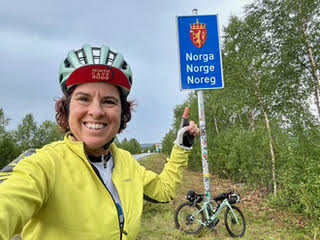
The experience was so meaningful that I registered for the next challenge: The Final Frontier Patagonia in March 2026, a nearly 3,000-kilometer bike-packing route through Chile and Argentina that I expected to be more remote and more extreme than NC4000.
Financial Takeaways for Physicians Considering Cutting Back
- Financial independence (FI) is a spectrum, not a finish line. Reaching FI doesn’t require retiring. It gives you a number of options, including working less.
- Illiquidity matters. Real estate builds wealth, but this wealth may not be readily accessible except through a home equity line of credit (HELOC) or refinancing.
- Benefits (such as tuition benefits and health insurance) may be as valuable as income.
- Be intentional about lifestyle inflation. Every unnecessary dollar spent in your 30s is a decision you make for your 50s.
- Identity matters. If you love your work, consider scaling back rather than walking away. One should always retire to something rather than from something.
- The best financial decisions are often the ones aligned with your values, not always the ones that maximize net worth.
- 8 Things to Do with Financial Independence Besides Retire Early
- Life After Financial Independence: Two Perspectives
Finding the FIRE/YOLO Balance
With rare exceptions, one should not live only for today or only for tomorrow. Since we rarely know what the future holds, it is important to balance now with the future. We built our nest egg slowly—through discipline, frugality, real estate, and paying ourselves first—but not with deprivation. Our goal was always to be somewhere in the middle of the FIRE/YOLO spectrum.
Going half-time wasn’t the most financially optimized decision on paper. But it was the most life-optimized decision I could make. I am still an emergency physician. But now I have the time to pursue the adventures that help create my identity.
“If you have lived a life that you can recall with joy, you have lived two lives.” — Unknown
Epilogue
In March 2026, I participated in the inaugural Final Frontier Patagonia self-supported bike-packing adventure that started in Puerto Montt, Chile. Rather than having two starting points to choose from like NorthCape4000, there were four possible “gates” at which to finish. Those with enough time aimed to reach the end of the world: Ushuaia, Argentina, at the southernmost tip of South America, 1,875 miles along the prescribed route from which one could not stray. Others who could not bike 18 hours per day or devote three or more weeks to reach the ultimate goal could stop earlier.
With a large portion of the route on desolate gravel roads, I knew the terrain would be more difficult than the asphalt across Europe. I had 18 days, which amounted to 104 miles per day, plus one day of wiggle room before I had to fly home to work my shifts.
However, I underestimated the un-bikeable 40% grade roads with loose gravel, the intense headwinds, bone-numbing rain, sleepless nights with snoring roommates, and potentially hantavirus-infected mice that chewed through my waterproof bags and ate my rations in Patagonia National Park. I fell behind my schedule. I made it to the second gate at El Calafate, and instead of taking a rest day to visit the Perito Moreno Glacier, I decided to take advantage of good weather and bike 131 miles the next day to get back on track. If I utilized my extra day and averaged 105 miles over the next five days, I could make it to Ushuaia.
The headwinds the next day were brutal. I was biking through the breathtaking Torres del Paine National Park and having to constantly remind myself that I love biking and nature and to be grateful that I am healthy. A strong wind gust then knocked me over. I struck my left knee but got up and continued. After taking a rest break a short while later, my knee stiffened up, and I could no longer bike up steep inclines. As I exited the national park, I had only biked 57 miles, and it was already 5pm. A huge hill loomed in front of me. It was at that point that I accepted the fact that I would not be making it to Ushuaia by bike. I threw in the towel and was fortunate to hitch a ride with the audio-visual team to my next planned stop 50 miles along the route.
During my 12-hour bus ride to Ushuaia, I had plenty of time to reflect. Yes, there was some disappointment in not reaching the goal that I had set, but I made wonderful friends and memories along the way and saw more of Patagonia than most people ever would. After 1,350 challenging miles on my bike, I still love biking, and that is enough.
Where do you stand on the FIRE/YOLO spectrum? Have you cut back at work? What's been your experience? Are you still making it work financially?