

It’s 4:30am, and I’m an anesthesiologist on night float. I’m in a twin-sized bed with hospital blankets, pondering if I should try to get a few hours of sleep before shift change or just turn on the TV in the call room and see what happens.
It’s been a typical night. I’ve seen most of the usual suspects: a neurosurgery case that started as a “quick” scan from the ICU, an emergent C-section for fetal distress, and a trauma activation in the ED. Neurosurgeons, OB-GYNs, and EM physicians are some of the only physicians I see at night when something unfortunate rolls through the doors. Believe it or not, I actually moved to this schedule willingly. I had co-founded Marit Health, the community-powered salary transparency and jobs platform for medicine, and the only way I could fully commit to the purpose was to make the change to working only nights. It offers more time off, more flexibility, and actually more money.
Somewhere between cases, working nights quietly changed how I think about work. Compensation and fulfillment, I’ve learned, are really about control over time. In medicine, that time is often borrowed from the rest of your life. Healthcare happens day and night, on weekdays and weekends, on holidays and birthdays. All those lost opportunities, missed family meals, and kids' soccer game absences slowly add up. And when those missed opportunities get too painful or the sacrifice feels too much, most physicians quietly scale back or leave clinical practice if they can.
Physicians consistently report that a lack of control over their time is a major driver of burnout. Yet when we talk about specialties, we mostly see salary charts. You rarely see objective data on hours, calls, schedule quality, or PTO, even though those are the variables that actually determine whether you get to live the life you want with the people you care about.
So, we decided to quantify it using the physician salary data on Marit.
We Built a Lifestyle Balance Index
We analyzed tens of thousands of anonymous salary submissions from verified clinicians on Marit and calculated a Lifestyle Balance Index at the specialty level.
Here’s the basic idea. For each specialty, we calculated:
- Average weekly hours
- Schedule quality, based on the percentage of jobs that are weekday- and day shift-only and use eight- or 10-hour shifts (instead of 12- or 24-hour blocks)
- Call burden, using the same Call Burden framework we wrote in this blog post to capture how often call is required and whether it's at-home or in-house
- Percent clinical time, giving credit to roles that include protected admin or teaching time
- Average PTO, measured in weeks
We normalized each factor (so that the average across all specialties is 1.0) and then combined them into a single Lifestyle Balance Index. With that framework in place, the rankings basically wrote themselves.
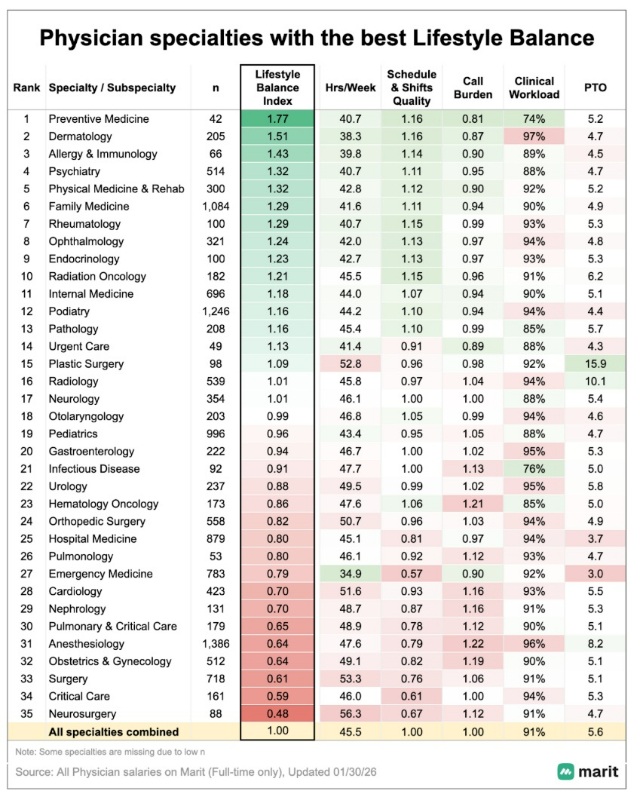
Specialties That Quietly Win on Lifestyle
The top of the list looks exactly like the wishful thinking you hear on rounds, just with numbers attached.
Preventive medicine ranks at the top of the list with a lifestyle balance index of 1.77, and dermatology is No. 2. Dermatology is clinic-heavy with almost no emergencies and minimal night work, and national lists of “happiest specialties” routinely put that specialty near the top. That’s also reflected in current dermatologist jobs on Marit: clean blocks of outpatient time, minimal call, and plenty of PTO.
Next is allergy & immunology. It has quietly become a lifestyle giant. A recent Medscape survey found that allergists and immunologists were the most optimistic of any specialty regarding work-life balance, with more than 90% saying physicians in their field can have a happy, balanced life.
Psychiatry and PM&R round out the top 5. They all provide you with plenty of patient contact and complex decision-making, without requiring that your body and calendar operate on a 24/7 emergency clock.
More information here:
Which Medical Specialties Are the Most Burned Out?
How My Burnout Led to Rage That Could’ve Ended My Career
Specialties That Are Toughest on Lifestyle
The lowest-scoring specialties on the Lifestyle Balance Index are the same ones I often work alongside on night float.
In addition to anesthesiology, some of the lowest scores are found in neurosurgery, general surgery, OB-GYN, critical care, and emergency medicine. These are the teams responding to emergencies with me while the hospital mostly sleeps.
Neurosurgery sits at the very bottom, with average hours well over 50 per week, frequent in-house call, and only modest PTO. The toll on lifestyle starts early, with surveys of neurosurgery residents showing burnout rates at nearly two-thirds.
General surgery and OB-GYN are not far behind, thanks to long days in the OR, clinic squeezed in around urgent cases, and a call schedule that can dominate your calendar. The result is a workflow that leaves minimal actual downtime and little control over when your day actually ends.
Finally, there is emergency medicine. On paper, emergency doctors report working fewer hours per week than most other specialties, but the timing of the hours is uncertain, with very little recovery time between shifts. With nights, weekends, and holidays dominating the schedule, it’s not surprising that emergency medicine has led national burnout charts in recent years, with burnout rates around 60%.
What Are the Specialties with the Best Lifestyle for the Money?
Since this is a White Coat Investor blog post, we also looked at how all of this impacts doctor pay. We plotted the Average Hourly Total Comp vs. Lifestyle Balance Index for each specialty.
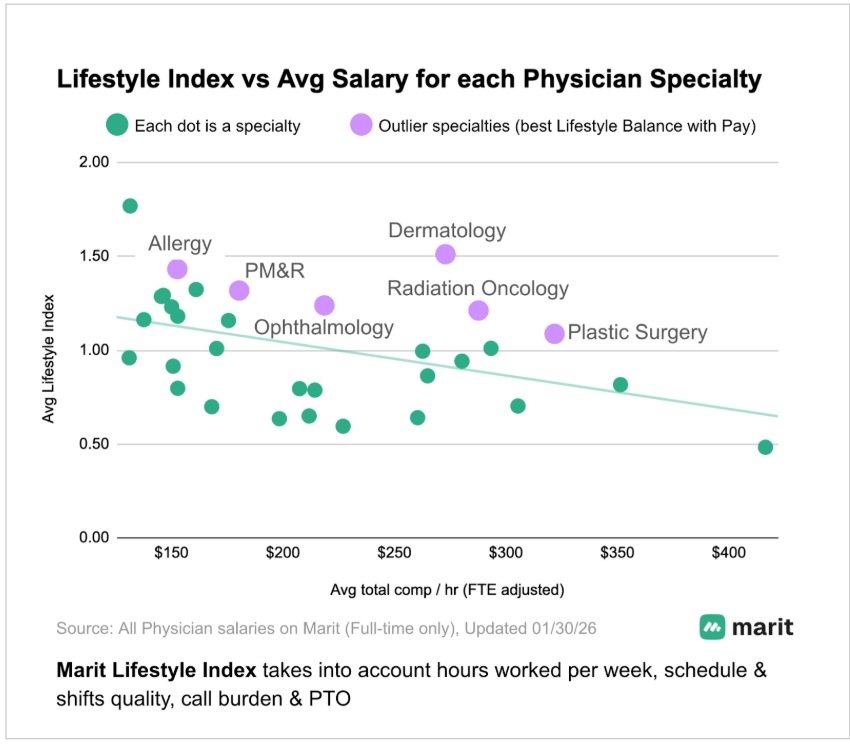
Unsurprisingly, the correlation is negative: higher hourly pay is often tied to lower lifestyle scores. Yes, those higher salaries come with a lifestyle toll.
But the outliers above the line are the interesting ones—these are specialties with a better lifestyle than you would expect for their pay, and therefore they have much higher compensation satisfaction. The top ones based here are dermatology, radiation oncology, ophthalmology, PM&R, and allergy. They all tend to offer much better work-life balance and schedules, relative to their pay.
More information here:
What We Can Learn About Work-Life Balance and Retirement from the French
Beyond Salary: Weighing the Value of Your Schedule
At Marit, we have sought to answer the question, “Am I paid fairly?” using the rich data shared by the community. But, “Is the schedule worth it?” is an entirely different question. You can always save a bit more, move to a lower-cost area, or actively build side income to boost your finances within any specialty. Money is an adjustable variable, and financial freedom is a goal you can achieve through various paths.
However, it is much harder to recover those special Christmas mornings or missed milestones that were squandered while you were required to be in the hospital. The freedom of time and control over your life outside of the hospital represents a form of success that no salary chart can adequately measure.
For me, the demanding schedule has always been worth the sacrifice. My choice of anesthesiology provides me with substantial compensation, professional satisfaction, and the privilege of having a daily positive impact on patients' lives. I continue to be fulfilled by the clinical challenges, the procedures, and the teamwork required to care for sick patients.
Yes, the hours can be difficult, and I have missed special family events because of the call schedule. But I know that rarely does anything meaningful in life—and especially in medicine—come easy. Ultimately, the calculation involving specialty, schedule, compensation, and lifestyle is uniquely personal, and the ultimate choice of what is “worth it” is uniquely ours to make.
Does this resonate with your lived experience? Any surprises in the specialty rankings? Do you have any feedback or suggestions for Marit?