

Contribution limits for 401(k)s, 403(b)s, 457(b)s, IRAs, Roth IRAs, HSAs, FSAs, SIMPLE IRAs, and SEP-IRAs are all indexed to inflation. While the retirement contribution limits do not go up every year, and while every account does not use the same formula for when there will be an increase, you will generally see an increased contribution every year or two.
Although inflation exploded in 2022, meaning the 2023 contribution limits increased in a relatively significant way, it's mostly been tamed in the past four years (though it's perhaps beginning to creep up again). As a result, the increases in those limits for 2027 are relatively normal. If you know the latest inflation numbers, it is possible to calculate the increase even before the IRS announces it in October or November (in 2025, the IRS officially released its figures on November 13).
Note that 2022's Secure Act 2.0 changed catch-up contributions in significant ways. The 401(k)/403(b) catch-up for those 50 years old or older has always been indexed to inflation. But the law stated that, starting in 2024, if you have Social Security wages of $145,000+ (indexed to inflation), those catch-up contributions would now have to come on the Roth side. In 2026, the Social Security wage threshold rose to $150,000+, and in 2027, it will rise again to $155,000+. That means tax-deferred catch-up contributions are no longer allowed for these high earners.
Also remember that beginning in 2025, catch-up contributions were increased even more for those who are 60-63 years old (it'll be the larger of $10,000 or 50% more than the regular catch-up contributions).
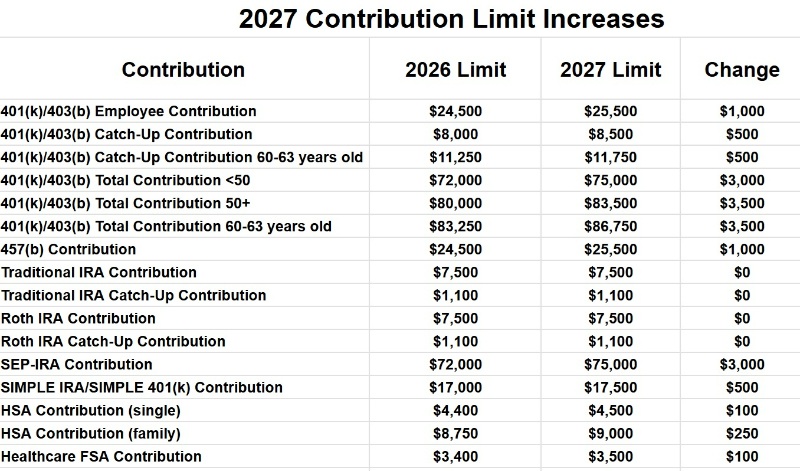
All that said, here are the limits for 2027 retirement plan contributions.
2027 401(k) and 403(b) Employee Contribution Limit
The total employee contribution limit to all 401(k) and 403(b) plans for those under 50 will go up from $24,500 in 2026 to $25,500 in 2027. The catch-up contribution limit will rise from $8,000 in 2026 to $8,500 in 2027, so if you're 50+, your 401(k) employee contribution limit will be $34,000 in 2027.
But if you are aged 60-63 by the end of 2027, your catch-up contribution will be $11,750, meaning you can contribute a total of $37,250.
2027 401(k)/403(b)/401(a) Total Contribution Limit
The total of all employee and employer contributions per employer will increase from $72,000 in 2026 to $75,000 in 2027 for those under 50. With the catch-up increasing to $8,500, the total contribution for those 50+ will be $$83,500. If you're 60-63, that contribution increases to $86,750.
Note that the 401(a) limit is separate from the 403(b) limit. So, you could theoretically get $75,000 into each of them.
2027 457(b) Contribution Limit
457(b) contribution limits will increase from $24,500 in 2026 to $25,500 in 2027. 457(b)s have unique catch-up contribution rules, so consult with your plan administrator if you are interested in putting more in your 457(b).
2027 Traditional and Roth IRA Contribution Limits
IRA contribution limits will stay at $7,500 in 2027 for the second-straight year. The catch-up contribution limit will also remain the same at $1,100 in 2027.
2027 SEP-IRA Contribution Limits
SEP-IRA contribution limits will increase from $72,000 in 2026 to $75,000 in 2027.
2027 SIMPLE IRA and SIMPLE 401(k) Contribution Limits
The SIMPLE IRA and SIMPLE 401(k) contribution limits will increase from $17,000 in 2026 to $17,500 in 2027.
2027 Health Savings Account (HSA) Contribution Limits
For single people, the HSA contribution limit will increase from $4,400 in 2026 to $4,500 in 2027. Family coverage will increase from $8,750 to $9,000. The $1,000 catch-up contribution for those 55+ remains the same.
2027 Flexible Savings Account (FSA) Contribution Limits
Healthcare FSA contribution limits will increase from $3,400 in 2026 to $3,500 in 2027. Note that there are other types of FSAs (such as dependent care FSAs) with different limits.
Other Interesting Increases
The 401(a) compensation limit (the amount of earned income that can be used to calculate retirement account contributions) will increase from $360,000 in 2026 to $375,000 in 2027. This is always 5X the maximum 401(k) plan total contribution limit.
The deductibility phaseout for IRA contributions for those with a retirement plan at work increases from $81,000-$91,000 in 2026 for singles to $83,000-$93,000 in 2027, and it'll move from $129,000-$149,000 in 2026 for those Married Filing Jointly to $133,000-$153,000.
The Roth IRA Direct Contribution Limit phaseout will increase from $153,000-$168,000 in 2026 for singles to $158,000-$168,000 in 2027 and from $242,000-$252,000 in 2026 for those Married Filing Jointly to $250,000-$260,000. If your MAGI is above that, you'll need to contribute indirectly via the Backdoor Roth IRA process.
While Social Security benefits increased by 8.7% for 2023, the bumps for the past three years have been much more modest. For 2027, the increase will be about 3.5%, the biggest increase since 2023.
The definition of a highly compensated employee will increase from $160,000 in 2026 to $170,000 in 2027.
While it feels like all of these are increases, they are really just keeping up with inflation. On a real (after-inflation) basis, they're basically the same as this year.
What do you think? Are you surprised by any of these? Are you glad they're indexed to inflation?
Did you find this article helpful? Share it!