One of the most fun things about WCI over the last couple of years has been the WCI subreddit, the growth of which has outpaced both the WCI Forum and the WCI Facebook Group. I find myself spending more and more time there. Two recent Reddit discussions about real estate, however, left me feeling like it’s time for a blog post.
In the first, a redditor asked a very reasonable question:
“As a new attending physician, I’m considering the potential of real estate as a part of my investment strategy. With a salary that allows for some flexibility, I’m curious about the best ways to enter this market. Should I start with a rental property, or is it wiser to consider REITs? What factors should I consider regarding location, financing options, and managing properties? Additionally, I’d like to know how to balance this investment with my other financial goals, such as retirement savings and paying off student loans. I appreciate any insights or experiences you can share about successfully investing in real estate, especially in high-cost areas.”
A few people tried to answer it, but most people literally responded with a one-word answer: “Why?”

Literally, that was 12 of the 28 responses. Another five responses said the same thing in different words. I thought it might be worth a post to answer the question. Incidentally, I also responded to the question on Reddit, mostly by posting links to all the ways WCI has tried to help the redditor figure out how to get into real estate, including:
- A blog post (free)
- A live webinar (free)
- A masterclass (free)
- An online course (not free, but risk-free and far more comprehensive)
Real Estate Investing Is Optional
The first thing to know about real estate investing, of course, is that it is NOT mandatory. So, the answers given by so many redditors were, in that respect, entirely appropriate (although maybe not that helpful after the seventh time). Another thread on the subreddit somewhat addressed that issue:
“I’ve had so many friends go down the real estate investing path thinking it’s ‘passive income,’ but none of them ever made any money without putting a lot of time and work into it. And even when you do due diligence, you can still find yourself renting to a guy running guns and dealing fentanyl like the author of the latest blog post. All this to not work as a physician? What are we doing?!!”
The observation is astute. The most passive income I know about comes from index mutual funds. Literally, it’s 3o seconds to buy them, nearly zero research is needed, and there’s no need to monitor or maintain them for decades afterward. Certainly, the “default” method of building wealth (get a great job, save 20% of gross for retirement, invest it in a small handful of index funds across various asset classes, and stick with it for two or three decades) works and works well. No matter how you invest in real estate (well, VNQ may be an exception), it’s going to take more work AND involve more risk than that.
More information here:Top 6 Reasons to Invest in Real Estate
Why does anyone invest in real estate? What IS the point of that additional work and risk? Should you take it on just to have this asset class in your portfolio? Let’s talk about it.
#1 High Returns
Part of the reason people were “rebelling” against real estate in late 2025 on the subreddit was simply recency bias. The US stock market has had returns of 26% (2023), 25% (2024), and 17% (2025). If you can get your money to grow at 25% a year, a simple doctor saving $100,000 per year will be worth $261 billion after 60 years.
=FV(25%,60,-100000) = $261 billion
That’s basically the market capitalization of the entire Norwegian stock market. (And you’ll own the entire world not long after that.) Why would anyone feel the need to invest in anything else? The reason is because those aren’t “normal” stock returns. “Normal” stock returns look much more like how small value stocks have done in the last three years (16%, 12%, 10%). Even that’s a little high.
As a stock investor, I expect returns in the 5%-7% “real” (after-inflation) range long-term. However, that’s also about what I expect out of an unleveraged (or at least reasonably leveraged) real estate investment. I expect similarly high returns. And when building a portfolio, having two asset classes with high returns is a good thing, not a bad thing. So, I think a fair amount of the “Why do anything but stocks?” bias is simply that: recency bias.
Look at real estate returns over the last few years as measured by Vanguard’s real estate index fund: -26% (2022), 12% (2023), 5% (2024), and 3% (2025). Nothing to write home about there. In fact, it’s a cumulative negative return over the last four years. No wonder short-term thinkers have lost interest.
What do long-term real estate returns look like? Over 30 years, the Vanguard real estate index fund has returned 8.8%. NAREIT notes that public real estate investment trust (REIT) returns have been in the 9%-10% range. Returns are similar on the private side, as noted by Bluerock.
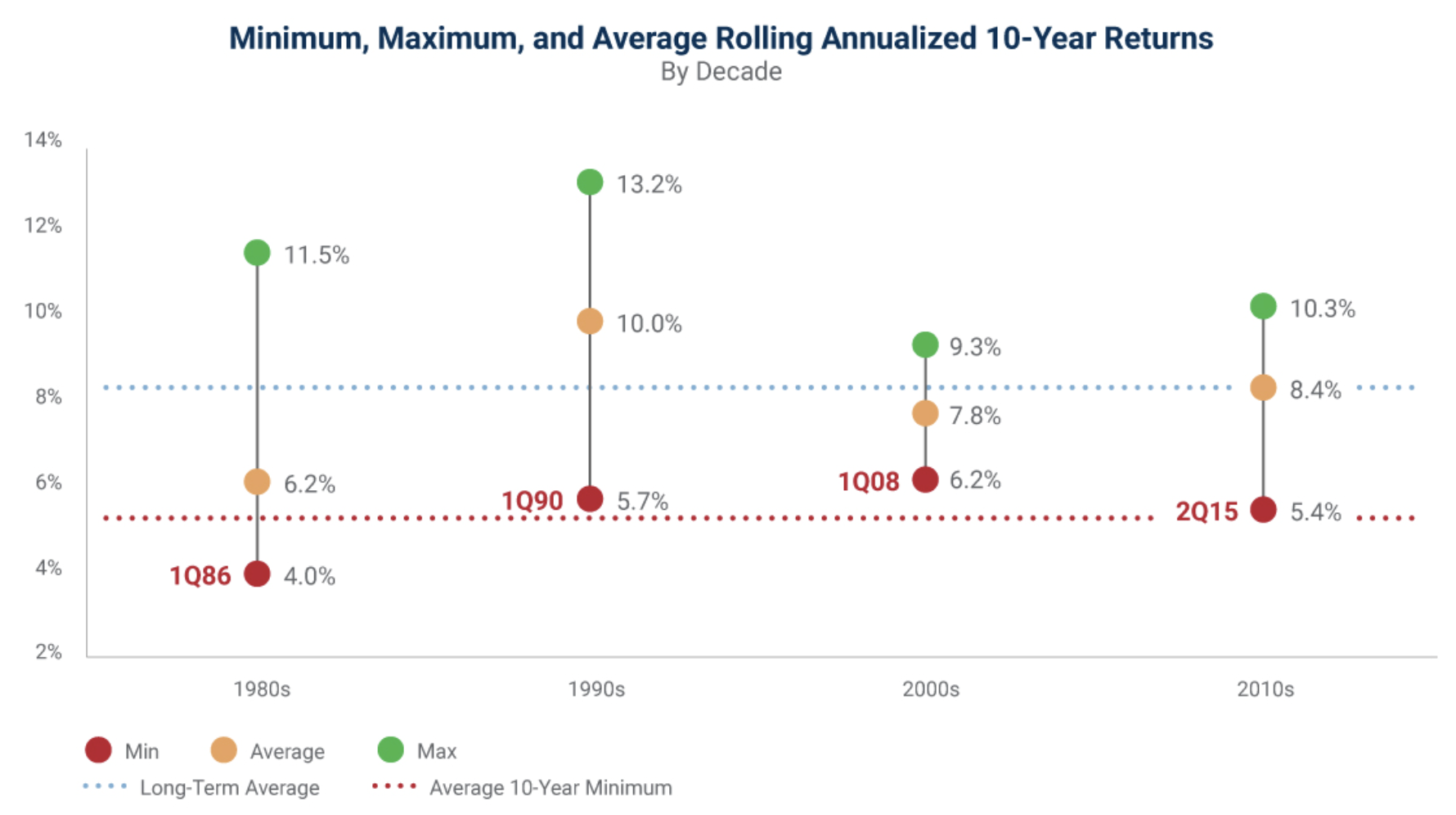
Those are rolling 10-year returns, averaging 6.2%-10%, with a range of 4% to 13%. Those are good returns, and they can be a valuable part of a portfolio.
#2 Low Correlation
Not only do you want high returns, but you want the various asset classes in your portfolio to have low correlation with the others. That’s the whole point of having bonds in the portfolio, even though their expected return is lower. What do correlations look like when it comes to real estate? Obviously, correlations change over time, but the data is reassuring that the correlation between stocks and real estate and bonds and real estate is relatively low.
Remember, a correlation of 1 means two asset classes are perfectly correlated, a correlation of -1 means they are perfectly inversely correlated, and 0 means they are completely uncorrelated. Here’s some long-term data on correlation between asset classes:
- US stocks to international stocks: 0.5-0.94
- US stocks to US bonds: 0.1 (1972-2021)
- US stocks to public REITs: 0.45 (1994-2018)
- US stocks to private real estate: 0.17 (1998-2017)
See what I mean? Most people think adding international stocks to a portfolio is a great move, but adding real estate seems far better when it comes to correlations.
#3 Tax Benefits
I’m not sure if Congress is full of real estate investors or what, but when it comes to tax benefits, real estate has some pretty sweet things going for it. Lower long-term capital gains tax rates apply to real estate just as much as stocks, and while there are no lower “qualified dividend” tax rates on real estate, the rest of the rules more than make up for it. Take a look.
- Depreciation-sheltered income (more on this in a moment)
- Bonus and accelerated depreciation
- Cost segregation studies
- Depreciation recapture tax cap of 25%
- REPS and STR loophole allowing depreciation to be used against ordinary income
- 1031 exchanges
- Step up in basis at death (not unique to real estate, but very powerful when combined with exchanges)
- Opportunity zone funds
- $250,000 ($500,000 married) exemption on personal residence capital gains
When you add all of this up, it’s pretty unfair. I mean, what else can you buy, watch it appreciate, and not have to pay capital gains taxes on it when you sell it if you’re willing to live in it? Nothing. You can’t put stocks in opportunity zone funds, only real estate. You can’t exchange a mutual fund for a similar one without paying capital gains taxes either.
But the big kahuna here is depreciation. Depreciation is simply recognition by the IRS that buildings wear out over time. You can’t depreciate the land, but you can depreciate the structure. That’s reasonable, but it’s way, way too generous. For example, you typically depreciate a single-family home over 27 1/2 years. Well, take a look at a 27 1/2-year old house. Is it worthless? Of course not. That’s at least twice as fast as depreciation should be. And many investors are getting their valuable depreciation “paper losses” far faster than 27 1/2 years. Using bonus and accelerated depreciation, cost segregation studies, and some leverage, I’ve had a real estate investment give me 60%+ of the value of my investment back in depreciation in the year I bought it!
It’s even better if you can use those depreciation losses against your ordinary income, like some real estate investors can. A dual high-income (two-doc) couple has a pretty big shovel, but a doc married to a stay-at-home parent who qualifies as a real estate professional may be an even better financial combination. Imagine how quickly you could build wealth if 20%-33% of your income wasn’t going to the IRS every year? That’s possible with a “properly” assembled financial life that includes a rapidly growing real estate portfolio and the ability to use passive losses against active income.
#4 Income
“Passive income” is a bit of a buzzphrase. As I mentioned before, the most passive income possible is that coming from index funds and similar investments. However, one characteristic that many real estate investors like is that a higher percentage of the return on a real estate investment, when compared to stocks, comes from income rather than appreciation. When investing on the debt side, the entire return is income, but even on the equity side, half or more of the return can be from income.
This is very important if you’re trying to live off the investment because it’s much harder to “declare your own dividend” with a rental property than with an index fund. But some people just really like this aspect. So much so that they feel comfortable spending the income, even if it’s 6% or more (way more than the “4% safe withdrawal rate guideline” would suggest). So, they treat the income like Social Security or a pension in retirement rather than part of the portfolio from which only a certain “safe withdrawal rate” can be withdrawn each year. That income is particularly nice when it comes tax-free due to depreciation. It’s not the same thing as a Roth IRA withdrawal, but it sure can look similar from a tax perspective.
#5 Inflation Resistant Investment
One of my favorite aspects of real estate investing is that it seems so well positioned against inflation compared to other investments, particularly long-term nominal bonds. Inflation is one of the “four horsemen of the investing apocalypse” that investors battle. If your portfolio was not constructed with inflation as a chief concern, you probably did it wrong. Real estate is particularly good against inflation, at least in the long term. You have a property that appreciates in value with inflation, and the income from it (rents) can be increased with inflation as well. Most real estate investors use some leverage (debt) at least some of the time when investing. Long-term, non-callable, fixed interest rate debt may be the best inflation hedge out there.
Imagine having a 4% mortgage interest rate when inflation is running at 9%. After 20 years of that, you’re paying back that mortgage with dollars that are worth only 15% of the ones you were given two decades earlier.
#6 Add Value
One of the real bummers about stock investing is the difficulty of beating the market. It’s so hard to do (because active managers are so talented) that the right move for just about everybody is probably to just avoid playing that “loser’s game.” Charlie Ellis is famous for comparing investing in stocks to amateur tennis. Amateur tennis games are lost (due to mistakes) rather than won (by good shots). Make fewer mistakes, and you’ll win by default. The stock market may not be perfectly efficient, but it’s efficient enough that the right move is to act as though it is perfectly efficient.
That’s not the case with your local real estate market. There’s nothing you can personally do to add value to your Apple stock investment. But you can add a basement bedroom to your rental, increase rent by 25%, and increase the value of the property substantially. It stinks that successful real estate investing requires more expertise and effort than successful stock investing, but it’s pretty cool that the expertise and effort actually matter.
More information here:- I Want to Invest in Real Estate, But I Also Want to Be Totally Lazy About It: What Are My Options?
- Truth, Lies, and Hype: Sorting Through the Messaging Around Real Estate Investing
3 Tracks to Wealth
There are three tracks to wealth that physicians and other high earners ought to consider. You can actually use more than one of them.
Track #1 – The Default Pathway
This is what we’ve been preaching here at WCI for more than a decade. It’s pretty boring, but at least it’s simple and relatively easy. You just get a great job; work hard; carve out 20% of your gross income to invest for retirement; and invest it in a simple portfolio of stock, bond, and maybe real estate index funds. After 10-30 years (depending on income and spending), you become a financially independent multimillionaire.
Track #2 – The Real Estate Pathway
Another alternative is to start building a rental empire. While there is a spectrum of passivity on which this can be done, it’s all going to take more effort and require more expertise than track #1. However, with a reasonable amount of leverage and work, becoming a financially independent multimillionaire could happen significantly faster than in pathway #1. Perhaps it could happen in 5-20 years. In fact, I’m convinced that assembling and self-managing a handful or two of short-term rental units is the fastest reasonably reliable pathway out of medicine for those who discover at 35 that this isn’t really what they wanted to spend their life doing.
Track #3 – The Entrepreneur Pathway
It’s possible to get rich even faster, although it’s nowhere near as reliable as the real estate pathway, much less the nearly guaranteed default pathway. It’s pretty hard for me to tell people not to chase side gigs given that my side gig now employs 19 of us at WCI and allows us to buy whatever we want while being ridiculously generous. You might want to keep in mind that, at one point, something close to 100 physician financial blogs existed and fewer than five ever made enough money to justify the time their creators put into them.
Other entrepreneurial pursuits are similarly risky. But if you do it right, you don’t have to leave Pathway #1 (+/- Pathway #2) to pursue Pathway #3.
More information here:- The 60+ Worst Mistakes You Can Make in Real Estate Investing
- The 7 Worst Ways to Invest in Real Estate
Choose Your Own Adventure
You may read all of this and still conclude that you do not want to invest in real estate. That’s fine. As I said, it’s optional, since it certainly involves additional hassle and risk. But hopefully you won’t be left wondering why someone else might choose to do it.





What do you think? Do you invest in real estate? Why or why not? How do you do it? What benefits have you seen from it?
Did you find this article helpful? Share it!