

When doctors consider disability insurance, it’s important to understand how much the right coverage can matter—not just for protecting income, but also for reducing financial stress during a difficult time.
Let me share an example from my professional encounters that brings this point home. A physician client experienced the heartbreaking loss of his partner to terminal brain cancer, a tragedy that struck shortly after the birth of their daughter. Amid their search for treatments across the western United States, he never imagined how crucial his decision to obtain disability insurance during his residency would become. Following his partner’s death, this insurance became his lifeline, providing financial relief and the invaluable time needed to grieve, emotionally heal, and be there for his daughter during this incredibly difficult time.
This experience emphasizes the invaluable role of disability insurance for physicians. As doctors explore what to look for in a disability insurance policy, the key here is to consider policies that offer robust support—including own occupation coverage, flexible benefit periods, and comprehensive coverage for injuries and illnesses (including mental health events). Such features make sure that, in moments of adversity, they have the resources they need to recover fully, allowing them to focus on healing and family without the added burden of financial worry.
In this post, we’ll explore the Big 5 disability insurance carriers that independent agents can offer (Ameritas, Guardian, MassMutual, Principal, and The Standard). We’ll explore how to build a good policy with features every physician should consider and why each is important.
Building a Policy for a Physician
Elimination Period
Ask yourself, “How soon do you want to get paid?”
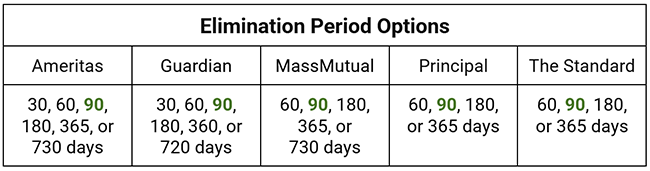
The elimination period in disability insurance is the waiting time before your coverage kicks in while you’re unable to work due to illness or injury. It’s the initial stretch, say 60 or 90 days, where you’ll need to manage your financial responsibilities without the insurance providing income replacement. Opting for a longer elimination period can help reduce your insurance premiums (the cost to you), but it requires careful planning to ensure you can handle your commitments during that waiting period. You’ll need to put together a good emergency fund to get through those first few months before disability benefits kick in.
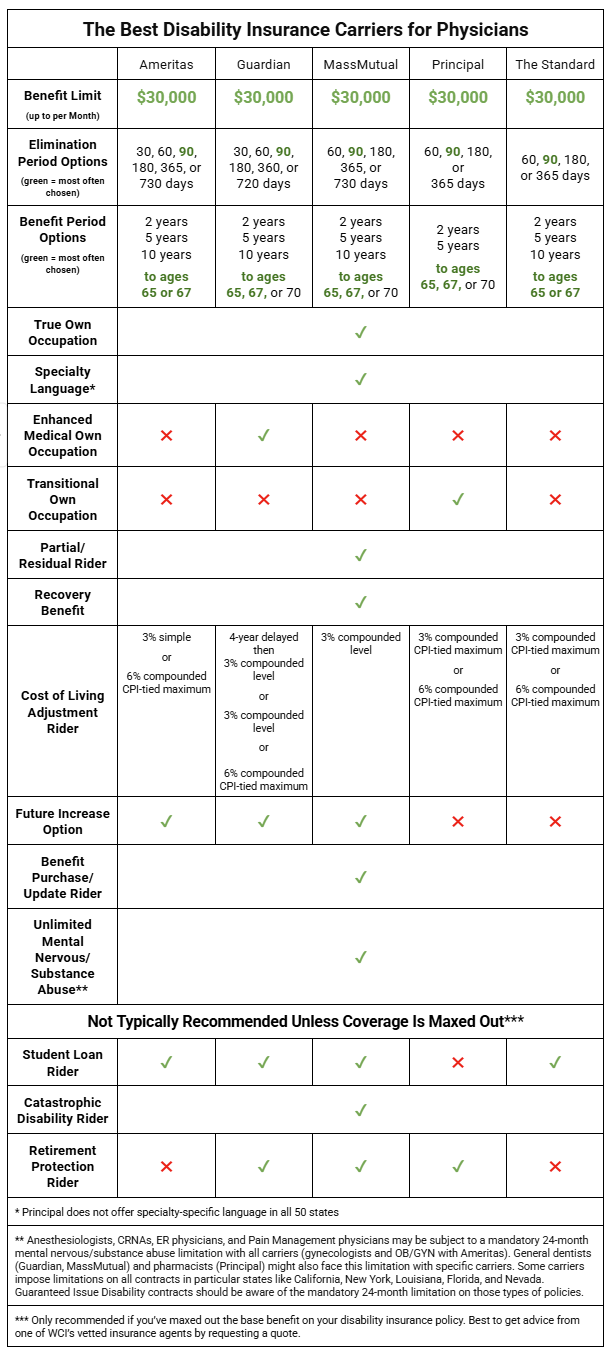
Notice below that elimination periods can be as short as 30 days, but it will cost almost double what a 90-day wait would cost. Many physicians opt for a 90-day waiting period when purchasing disability insurance; however, it’s worth understanding that the first benefit check won’t be received until 30 days after whichever elimination period is chosen. In this case, the 90-day wait period would pay on Day 120, as disability benefits are paid in arrears.
Benefit Period
Ask yourself, “How long do you want to get paid?”
The benefit period in a disability insurance policy determines the duration for which the insurance company will provide disability benefits after the elimination period—as long as you meet the definition of disability (more on that below). This critical component offers various options, including two, five, or 10 years per occurrence up to age 65. More common, though, are the longer benefit periods to age 65, 67, or 70. The significance lies in the fact that this decision directly affects the length of time an individual receives financial support in the event of an inability to work due to illness or injury. Opting for a shorter benefit period may result in lower premiums, but it limits the duration the benefit may pay in the event of an irrecoverable disability. Conversely, choosing a benefit period that’s to age 65 or longer insures against a disability that may last longer.
Most physicians will buy coverage until either age 65 or age 67. With that being said, this decision involves a thoughtful balance between comprehensive coverage, budget considerations, and individual circumstances. The bottom line is to buy something even if it’s a shorter benefit period.

Benefit Amount
Ask yourself, “How much do you want to get paid?”
Given the substantial earning potential of physicians, the benefit amounts in disability insurance can vary significantly. During residency, for instance, a medical professional may qualify for benefits of $5,000 a month with the potential to increase substantially when they become an attending to $30,000 a month or more when combining coverage with multiple carriers.
Choosing the right benefit amount is important because you want your coverage to match your income and lifestyle. Final-year medical students and residents may qualify for up to about $5,000 per month, while fellows could potentially get as much as $8,000 per month without traditional financial underwriting. Attending physicians who qualify financially may be able to secure up to $30,000 per month in benefits, depending on the carrier, specialty, and existing coverage. Ameritas, for example, may offer different maximums for different medical specialties. A WCI-vetted agent can help you see what each carrier will allow. It also makes sense to buy as much coverage as your budget allows and include a future increase rider so you can raise your benefit as your income grows.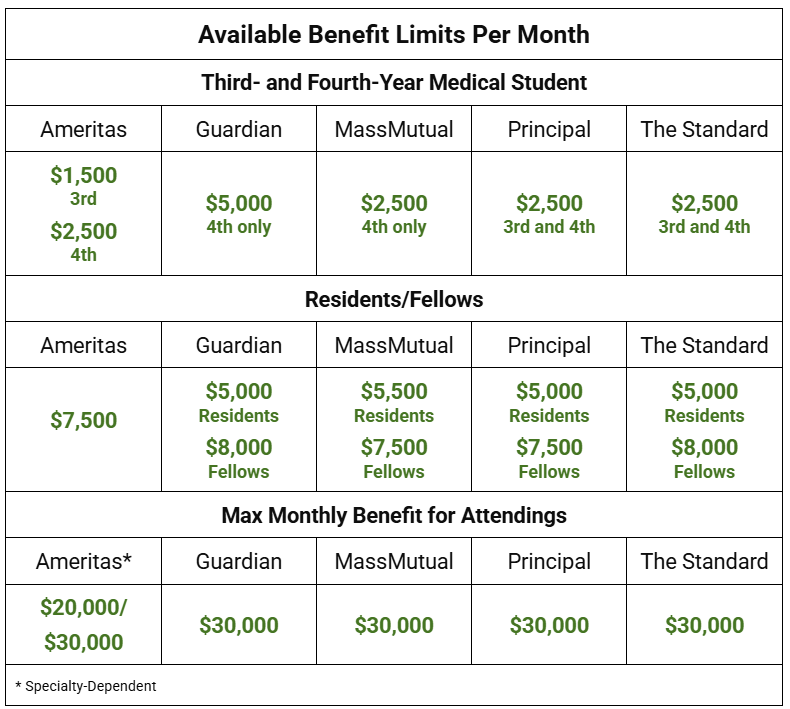
True Own Occupation
For physicians, true own occupation coverage is one of the most important parts of a disability insurance policy. Medical specialties can have very different job duties, so the definition of disability matters. If an illness or injury keeps you from doing the main duties of your specialty, true own occupation coverage may allow you to receive disability benefits even if you can work in another job or medical field. Without this type of coverage, some policies may require you to be unable to work in any occupation before full benefits are paid. For physicians who have spent years training in a specific specialty, that difference can be significant.
Every one of the Big 5 (Ameritas, Guardian, MassMutual, Principal, and The Standard) offers true own occupation coverage.
Specialty Language
Most of the major disability insurance carriers take the definition of disability a step further by recognizing a physician’s medical specialty. All of the Big 5 offer some form of specialty-specific language, although availability can vary by state and product. If a disability keeps you from performing the main duties of your specialty, the policy may treat that specialty as your occupation. With true own occupation with specialty language coverage, you still could work in another medical field and earn income without reducing your disability benefit, as long as you continue to meet the policy’s definition of total disability.
While Principal offers specialty language, it is not available in all states. Check with one of the WCI-vetted agents to see current availability.
Other Available Carrier Variations of Own Occupation
Enhanced Medical Definition of Disability
Guardian Life Insurance Company offers a medical definition of disability. It is detailed and tailored, specifically for MDs and DOs. If more than 50% of income comes from surgical procedures or hands-on patient care, Guardian considers an individual to be totally disabled if they can’t perform such procedures or duties due to injury or sickness, even if they can continue to do other duties in their specialty. It’s a quicker way to qualify for total disability benefits. None of the other Big 5 companies offers this option.
Transitional Own Occupation Rider
Transitional own occupation insurance, which is offered only by Principal, ensures coverage up to your pre-disability income level. If you can’t work in your specialized field and start earning income elsewhere, your total net income (including benefits) can’t surpass what you earned before your disability. Essentially, this policy allows you to pursue a new career while receiving benefits, with the company bridging the gap between your previous and current monthly income. This definition of disability will cost less than a “true own occ” definition of disability.
Optional Riders
Non-Cancelable
For physicians, a non-cancelable disability insurance policy guarantees that critical aspects of the policy, such as premium rates and coverage benefits, can’t change. They’re locked in. Premium rates won’t vary with this feature even if the carrier experiences multiple claims. The insurance company can’t go in and change the terms or pricing of the contract as long as the physician continues to pay the premium. Even if you choose a graded premium structure with the carrier, a non-cancelable contract can predict what the premiums will do over time.
Every one of the Big 5 offers the non-cancelable language.
Guaranteed Renewable
The insurance company retains the authority to adjust your premiums based on changes in the health of a class of individuals. Premium rates can go up, but if they do, they’ll go up for an existing class of policyholders who have guaranteed renewable policies. Choosing a guaranteed renewable-only contract will shave some premium dollars off a policy, but there is a risk your rates could go up in the future. However, as long as you fulfill your obligation by paying your premiums on time, the insurance company is bound to renew your guaranteed renewable policy, irrespective of any alterations in your health or disability status. Know the risks of choosing this contract before purchasing a guaranteed renewable-only contract by talking to one of our vetted insurance agents. Of the Big 5, only Ameritas and Standard offer Guaranteed Renewable contracts.
Partial/Residual Rider
One of the most important riders to consider is the partial or residual disability rider. Disabilities do not always leave you completely unable to work. You may still be working full time, but health problems could slow you down, reduce the number of patients you can see, or lower your income. Even major life events and the stress that follows can affect your ability to work at the same level. A partial or residual disability rider can help provide benefits when your income drops but you are still able to keep working.
All of the major carriers use an income loss threshold, commonly 15% or 20%, for residual or partial disability benefits, but the requirements differ by rider. Some riders may only require a loss of income after the elimination period, while others also require a loss of duties, reduced work hours, or both. Because these definitions can materially affect a claim, the policy language should be reviewed.
While all carriers offer some form of partial or residual disability rider, the riders are not identical. Business owners and self-employed physicians may place greater value on a rider that only requires a loss of income, since their income may remain reduced well after they return to full duties and hours. A W-2 physician may be comfortable with a lower-cost rider that also requires a loss of duties or time, since returning to full-time work is more likely to restore pre-disability earnings right away. The right choice depends on employment structure, future business-ownership plans, budget, and the exact rider language.
Recovery Benefit Rider
When it comes to returning to work after a disability, the journey goes beyond just physical or emotional recovery—it’s about rebuilding financial stability. This is especially true for professionals like attending physicians who own their practices. While returning to a W-2 job might alleviate some financial strains, the narrative changes for those managing their own clinics.
For practice owners, bouncing back to pre-disability income levels could be a lengthy process, spanning months or even years, depending on the duration of the illness or injury. Patients may seek care elsewhere during the absence, and regaining their trust and patronage can be challenging, leading to a loss of income for a disabled doctor who has recovered.
A recovery benefit can be especially valuable for business owners and self-employed physicians because income may remain below pre-disability levels even after they return to full duties and hours. When available, a recovery benefit that can continue for the full benefit period may provide stronger protection for that extended income loss. W-2 physicians may also benefit from recovery coverage, although a shorter recovery period may be sufficient if earnings are more likely to return to normal quickly after returning to work.
All five of the major disability insurance carriers offer some form of recovery benefit, but the provisions and duration can vary. The key is to understand how your policy defines recovery, how much income loss is required, and how long benefits may continue. This can be especially important for business owners and self-employed physicians, but it can also provide useful protection for W-2 employees whose earnings do not immediately return to pre-disability levels.
Guardian and The Standard both offer added flexibility during the elimination period with certain enhanced partial/residual riders. For example, if a physician has a 90-day waiting period but returns to full duties before the 90 days are complete and continues to experience a qualifying income loss because of the disability, that income loss may still help satisfy the remaining elimination period under the applicable rider language. The Standard’s Enhanced Residual Disability rider specifically allows the benefit waiting period to be satisfied through a loss of income, duties, or time due to injury or sickness. This can be particularly valuable for self-employed physicians and practice owners, whose income may remain reduced even after they return to full duties and hours. Other carriers may require the insured to continue meeting their definition of total or residual disability during the elimination period before recovery benefits become available, so the exact rider language should be compared.
Cost of Living Adjustment Rider
When it comes to must-haves, the cost of living adjustment rider, often known as the “COLA” rider, deserves a place right next to the partial/residual rider, especially if you’re under 45. Let me break it down for you. Have you noticed the spike in grocery prices lately? It’s a real concern as our buying power is gradually slipping away.
A few years back, a client of mine called to express his gratitude for introducing him to this rider, emphasizing its importance. He recounted attending a seminar where a disabled dentist, on disability claim for over two decades, chose not to buy COLA. As a result, that dentist was stuck with the same monthly disability benefits he had been receiving since his disability began long ago. His purchasing power had taken a substantial hit, underscoring the critical role of having COLA in my client’s policy.
In essence, this isn’t a rider to be skipped over; it should be seriously considered. With prices rising and the value of our money diminishing, having the COLA rider can make a significant impact on maintaining financial stability, making it a key element in your insurance strategy.
There are differences between what is offered in the marketplace, as noted below.
Simple COLA
With a simple COLA, the benefit amount increases by a fixed percentage each year. However, the increase is based on the original benefit amount. For example, if your benefit is $1,000 per month and your simple COLA is 3%, your benefit will increase by $30 each year. After 10 years, your benefit would increase to $1,300 per month. This is the least expensive COLA option.
Compounded COLA
A compounded COLA increases your benefit each year based on the previous year’s adjusted benefit amount. Using the same example, if your benefit starts at $1,000 per month with a compounded COLA of 3%, the first year it would increase to $1,030. The next year, the increase would be 3% of $1,030, and so on. Over time, this leads to significantly higher benefits compared to a simple COLA because each year’s increase is larger. Expect to pay more for a compounded COLA option because, over time, the benefit can grow even more substantially.

This chart shows a person who goes on a disability claim receiving a $ 10,000-a-month benefit over a 20-year period and the difference in a 3% level simple COLA, 3% level compound COLA, and having no COLA. The first three months in the first year of the claim would not be paid because of the elimination period. This is for example purposes only.
Consumer Price Index (CPI)
The Consumer Price Index (CPI) is a measure of inflation and reflects changes in the cost of goods and services. Some disability benefit increases are based on actual inflation rates, while others offer level percentages. This allows the benefit to adjust in line with inflation, helping with purchasing power. Tying the CPI to the COLA will vary the results of the chart above because the percentage received on a COLA will be determined by the CPI.
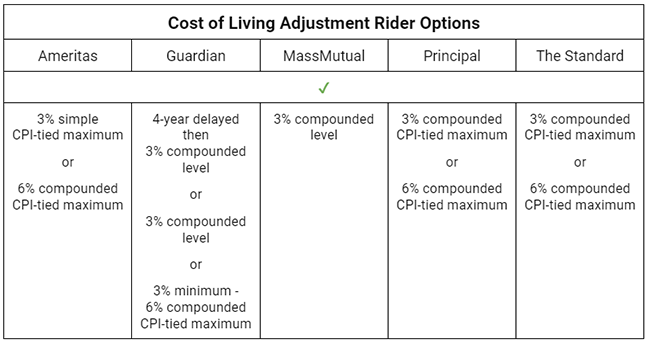
In the chart below, you can see which companies offer different types of COLA. As mentioned, a simple COLA generally comes at the lowest cost, followed by a compounded COLA. Companies offering level COLA options tend to be more expensive compared to those tied to the CPI, except when purchasing the 6% maximum CPI-tied COLA rider. However, CPI-tied COLAs often include a cap on the maximum percentage increase. For example, Ameritas offers a CPI-tied COLA with a 3% cap, meaning that even if the CPI rises above 3%, the benefit increase is limited to this maximum percentage.
Future Purchase/Increase Option/Benefit Purchase Rider
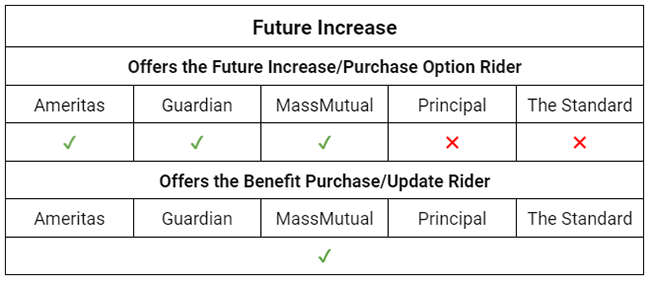
The future increase option (FIO, FPO, etc.) and the benefit update rider (BUR, BPR, etc.) should be prioritized, especially for those with high earning potential like young physicians and dentists. These riders play an important role in securing financial protection by allowing policyholders to increase their benefit amount without the hassle of proving their health.
The FIO rider, despite being an additional expense, brings valuable flexibility to the table. It enables annual adjustments, giving you control over decisions to accommodate income increases. This flexibility remains important even if you transition to a riskier profession, ensuring robust income protection.
On the flip side, the BUR (BPR), often included at no extra cost, operates on a stricter schedule, requiring exercise every three years. While it comes with a lower to no cost, its stricter exercise rules should be carefully considered. In most cases, it must be exercised every three years or the rider falls off the policy. If you forget about the rider, you’re out of luck.
For young physicians, the decision between flexibility and cost-effectiveness is important when selecting the future increase rider that aligns best with their career trajectories and financial goals. Choosing the right rider helps make sure your coverage can keep up as your income, career, and financial needs change.
Mental Nervous/Substance Abuse Benefit
In a 2025 survey by The Physicians Foundation, the well-being of physicians—both current and future—was found to be distressingly low. In fact, the study revealed that 54% of physicians reported often experiencing burnout—down from 60% in recent years, but still well above the roughly 40% reported in 2018.
Given the urgency of this issue, it’s important to dive into the mental nervous/substance abuse benefit. Many carriers limit this benefit to 24 months and offer a 10% policy discount for doing so. However, declining this discount ensures that benefits persist for the entire benefit period—whether it’s up to age 65, 67, or 70—in the case of disabilities stemming from mental, nervous, or substance abuse issues.
At present, all of the Big 5 insurance carriers provide unlimited mental nervous coverage for most physicians. Yet, certain specialties—including anesthesiologists, CRNAs, ER physicians, and pain management physicians—may be subject to a mandatory 24-month mental nervous/substance abuse limitation with all carriers (gynecologists and OB/GYN with Ameritas). General dentists (Guardian, MassMutual) and pharmacists (Principal) might also face this limitation with specific carriers.
Note that some carriers impose limitations on all contracts, in particular states like California, New York, Louisiana, Florida, and Nevada. Furthermore, those considering a Guaranteed Issue Disability Contract (GSI) should be aware that most have a mandatory 24-month limitation on GSI policies. Considering the state of mental health today, this benefit is something not to be taken lightly.
Other Riders to Consider But Not Required
Student Loan Protection Rider
The student loan protection rider is designed to assist with student loan payments in the event of total disability, operating within a specified maximum duration or term. Typically, it aligns with the contract’s definition of total disability, such as true own occ/specialty language. Keep in mind that most of the Big 5 carriers that offer this rider do not pay student loan disability benefits on partial or recovery claims except for Ameritas. If you decide between opting for this rider or increasing your base benefit, prioritizing a higher base benefit is advisable.
However, if you’ve already reached the maximum limit of your base benefit, considering this rider may be beneficial, particularly if you have significant student loans. The rider offers benefits ranging from $100-$2,500 per month with a fixed term between five and 15 years. It’s helpful to understand that this is a fixed-term benefit, not a benefit period that lasts to a certain age. Depending on the carrier, the rider may remain in force for 5-15 years from the time the policy is issued, after which the student loan benefit ends. While the basic concept is similar across carriers, the available terms, benefit amounts, and claim provisions can differ.
Among the Big 5 carriers, Principal’s current Income Protector product does not list a student loan rider, while Ameritas, Guardian, MassMutual, and The Standard do.
Catastrophic Disability Benefit Rider
The catastrophic disability benefit provides extra financial support if you suffer a very severe disability that leaves you needing significant help with everyday activities. This could include things like paralysis, permanent loss of a limb, or a serious cognitive impairment. The additional benefit can help offset the higher costs that often come with a major disability, such as ongoing care, rehabilitation, home assistance, and other day-to-day needs.
This rider won’t come into play for most people, but if you ever need it, the extra benefit can be significant. Whether it’s worth the added cost depends on your budget and how much base disability coverage you already have. If you haven’t maxed out your base benefit, putting those premium dollars toward more base coverage may make more sense first. If you add this rider, read the details closely because each carrier may define catastrophic disability differently. Some pay if you can’t do two or more daily activities, while others require a more serious loss—such as sight, hearing, or use of a limb. The key is to know what triggers the benefit and decide if the extra cost is worth it.
Every Big 5 company offers this rider.
Retirement Protection Rider
Retirement protection disability insurance is designed to substitute the retirement contributions that would typically be made if an individual is not disabled. This insurance option is available either as a standalone long-term disability policy or as a rider on an individual disability policy. However, go for maximizing your base benefit rather than buying this rider. It’s crucial to note that for this rider or policy to pay, you must be totally disabled and not working. The reasoning behind this is that once you resume employment, you are likely eligible to make retirement contributions again.
Guardian, MassMutual, and Principal offer this rider.
The Best Disability Insurance Companies
When it comes to the best disability insurance companies for doctors, Ameritas, Guardian, MassMutual, Principal, and The Standard top the list. Each of these providers offers unique features tailored to different medical specialties. Specializing in serving the medical, dental, and white-collar sectors, all five companies deserve consideration when seeking income protection options.
These carriers generally share similar definitions of “true own occupation,” and all offer “specialty-specific language,” with Principal not offering specialty-specific language in a few states. Guardian, for instance, stands out with its enhanced medical specialty language, expediting total disability qualification—a valuable feature for those involved in procedures or hands-on patient care.
When designing a policy, all riders should be considered. Partial/residual coverage is a must, as disabilities often start gradually, and recovery disability becomes important for those returning to work but experiencing continued income loss. Cost-of-living protection is equally important, allowing benefits to keep pace with inflation during a disability and maintaining one’s ability to afford living expenses.
Another critical factor is the flexibility to increase benefits without medical underwriting in the future. This shows the significance of options like the future purchase/increase option and the benefit update rider, particularly beneficial for individuals (such as those in residency) anticipating rising incomes in the coming years.
Something that should not be passed over is the importance of mental nervous coverage in disability insurance. Many carriers limit disability benefits to 24 months and offer a discount for this duration. However, declining the discount ensures benefits for the entire benefit period, whether until age 65, 67, or 70—particularly in cases of mental, nervous, or substance abuse-related disabilities. While major carriers presently offer unlimited mental nervous coverage, certain medical specialties may encounter mandatory 24-month limitations. The intricacies of this benefit highlight its significance in safeguarding the well-being of healthcare professionals facing the growing challenges of burnout and mental health concerns.
Lastly, for individuals who have already maxed out their base disability benefit, the student loan protection rider can help with student loan payments during a total disability. In some cases, Ameritas may also provide benefits on partial claims. This rider can make sense for someone with significant student loan debt who has no room to increase their base benefit. Benefits generally range from $100-$2,500 per month for a fixed term of 5-15 years, so it’s important to understand that the rider ends when that term is over.
Similarly, the catastrophic disability benefit may be worth considering once you have maxed out your base benefit. It can provide extra money for a very severe disability, but the cost and benefit details vary by carrier. Retirement protection disability insurance is another option for someone who has maxed out their base benefit. It is designed to help replace retirement contributions while you are disabled. In most cases, it makes sense to maximize your base benefit first, since retirement protection only applies in certain claim situations and is meant to replace contributions you can no longer make.
The best choice depends on what matters most to you and how each carrier’s options work.
Financial Strength
When it comes to benefits and riders, Ameritas, Guardian, MassMutual, Principal, and The Standard are all similar. When it comes to financials, however, there may be things to consider.
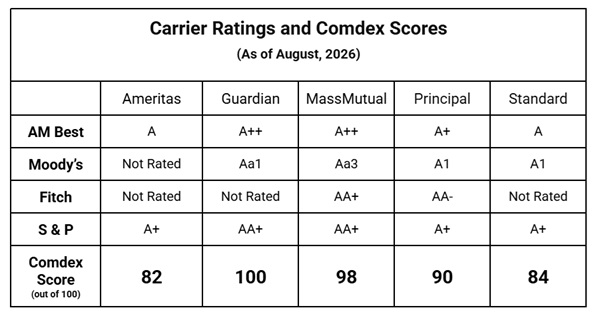
Some carriers may be better positioned financially to weather a bad financial downturn. When considering a disability insurance carrier, the financial strength of the company is important, and the Comdex ranking serves as a key metric in evaluating this aspect. The Comdex score, consolidating assessments from various credit rating agencies, offers a comprehensive view of the insurance company’s overall financial robustness and assigns a score between 1 and 100 (with 100 being the highest). This score shows that a carrier is well-capitalized and possesses a good financial foundation and that it’s well-positioned in its position to fulfill claims—particularly concerning disability benefits—in tough economic times.
With that being said, states diligently regulate insurance companies, with all 50 states implementing protective systems for policyholders in the unfortunate event of an insurance company going out of business. This regulatory framework makes sure that individuals are not left stranded if their insurer faces financial challenges. Despite stringent regulations, insurance companies can still fail due to various reasons, such as underpricing and high claim rates. The state’s guaranty system comes into play to safeguard policyholders, and every state has guaranty associations covering disability insurance policyholders. But their guarantee has its limits, and it is capped depending on the state. Still, it’s smart to limit your risks, assess insurance companies’ financial strength through independent agencies like AM Best, and utilize tools like the Comdex score to make well-informed decisions when buying disability insurance.
How Much Should You Expect to Pay?
The cost of a quality individual disability insurance policy can vary based on several factors—such as age, state of residence, gender, occupation, chosen benefit amount, and benefit period duration. As a general guideline, for every $100 of gross income you wish to cover, anticipate paying between $3-$5, or roughly 3%-5% of your income if covering 100% of your gross pay.
If your annual income is $300,000, expect annual premiums to range from $9,000-$15,000 for comprehensive income protection coverage. While this might initially appear steep, recognize that disability insurance frequently pays out benefits, particularly during one’s working years, with statistics showing that slightly more than 1 out of 4 working adults experience a disability before retirement.
What About Northwestern Mutual and New York Life’s Disability Offerings?
Northwestern Mutual and New York Life are two well-established mutual insurance companies offering individual disability insurance to physicians. Both boast strong financial ratings. However, their disability insurance products are exclusively sold only through captive agents, meaning independent agents cannot sell these policies. Additionally, there are several important factors to consider regarding their disability insurance contracts, especially for physicians seeking comprehensive coverage.
Northwestern Mutual
Northwestern Mutual has been a longstanding player in the disability insurance market, but its offerings have certain limitations. While it provides an option for a medical specialty definition of total disability, there are some questions about how it would pay in a claims scenario. In Northwestern Mutual’s policy, even though physicians and dentists can be covered under a variation of its true occupation definition of disability, there are nuances in how partial and total disabilities are handled. For instance, Northwestern Mutual’s partial disability benefit rider only offers coverage if the insured suffers a 20% loss of income due to disabling sickness or injury and is not working full time. Plus, its recovery benefit is only for 12 months, which can be too short in certain scenarios. Additionally, it has a mandatory two-year limitation on benefits for mental/nervous disorders and substance abuse.
New York Life
New York Life, after a hiatus, reintroduced individual disability insurance a few years ago with its My Income Protector policy. Although it offers true own occupation coverage for medical professionals, its policies can be more costly compared to the Big 5 carriers. While New York Life offers strong protection with true own occupation language, this sometimes comes at a higher price, especially when adding the true own occupation feature compared to other options available to physicians. Like Northwestern Mutual, New York Life also mandates a two-year limitation on mental/nervous disorders in all contracts. However, its recovery benefit is a little longer at 18 months compared to Northwestern Mutual’s contract.
If considering either New York Life or Northwestern Mutual, it’s a good idea to get a second opinion from one of WCI’s recommended independent agents.
The Bottom Line
There is no single disability insurance policy that is best for every physician. The right policy depends on your specialty, income, budget, and the risks you want to protect against. Focus on the definitions and riders that matter most, compare options from multiple carriers, and make sure you understand what you are buying before you sign.
Which disability insurance companies have you used? Have you been satisfied? What were the most important factors that you used to make your choice?
[This updated post was originally published in 2024.]
The White Coat Investor may receive compensation from White Coat Insurance Services, LLC; licensed in all states including MA and DC; CA license #6009217; NY license #1758759 (exp. 6/2027); Registered address: 10610 S. Jordan Gateway, #200 South Jordan, UT 84095. This does not affect the cost or coverage of insurance.
Did you find this article helpful? Share it!