

One of the most important lessons that a successful investor must learn is to quit performance chasing. Performance chasing is when you invest your money into whatever has done best recently. It's a superficial way to select an asset allocation (mix of investment types) and an even more superficial way to choose individual investments to fulfill your asset allocation. There's a reason that every investment prospectus will contain something like:
“Past performance is no guarantee of future results.”
I know unsophisticated investors understand that statement. The problem is they don't believe it. Or perhaps more importantly, they don't actually know how to properly select an investment or an asset allocation, so they default to the only thing that makes sense with the information readily available to them—picking whatever has the best performance numbers attached to it.
Why You Should Not Performance Chase
Let me give you a couple of examples of what performance chasing looks like. This one is from an internet forum:
To Sell All Bonds or Not
I am 73 and have been retired for 16 years. I have about $600,000 (30%) in the Vanguard Total Bond Index Fund. With bonds not doing too well in recent years, I am not sure whether to sell all of the bonds and put them into some mutual index stock funds. I am basically a “buy-and-hold” investor. I do move some funds around but not someone who tries to judge the stock market. I know the Vanguard founder said to buy and hold and not to try and beat the market. It has worked well for me over the 20+ years I have been with Vanguard. I am wondering what other investors have done with their bonds; have they kept with [the] normal basic idea of having stocks and bonds?
Here's an investor—and there are many—who just realized that interest rates went up rapidly in 2022, resulting in poor bond performance that year. Despite the fact that their bond yields and corresponding expected future return are now higher, this investor is now considering moving their money elsewhere. Classic buy high, sell low behavior. When steak goes on sale, you buy more, not less. Yet when bonds go on sale, you don't buy more but you actually sell what you have? How does that make any sense?
Here's another example from my email box:
TSP S Fund vs. C Fund
I am trying to understand the potential for growth in the S Fund which I understand is a completion US stock market fund with everything besides the S&P 500. My hypothesis is that while there is volatility in the S Fund, there is tremendous potential for growth over time since it contains what hopefully will someday be large market cap companies and future powerhouse US companies. Charts from the TSP show that the return for the S Fund is much lower than the C Fund. The TSP website shows that some years, the S Fund outperforms the C Fund and vice versa.
- Has the S Fund really outperformed the C Fund over time? I’m not sure this is true.
- Does it make sense to invest heavily in the S Fund now with the hope that there will be potential for more growth in the S Fund than in the C Fund?
- How would you divide your investments between the C Fund and S Fund?
- Is it wise to hold a larger percentage of S Fund than C Fund shares and think about the potential for supposedly greater growth over the next 20-30 years?
This investor is at a deeper level of understanding than the prior example, but they are still having difficulty resisting the siren song of performance chasing. Part of the problem is that the investor is using the wrong tense, a common problem. Instead of saying:
“Charts from the TSP show that the return for the S Fund is much lower than the C Fund. The TSP website shows that some years, the S Fund outperforms the C Fund and vice versa . . . “
One should say
“Charts from the TSP show that the return for the S Fund WAS much lower than the C Fund [over such and such time period]. The TSP website shows that some years, the S Fund OUTPERFORMED the C Fund and vice versa.”
Doing so will help you to remember the truth about past performance; that's it in the past.
More information here:
Investing: That Thing Rich People Do
The Nuts and Bolts of Investing
150 Portfolios Better Than Yours
The Winners Are Always Changing
It is also important to understand the concepts of expected return and return to the mean and the cyclical nature of relative investment returns. Spending a few minutes with a chart like this one can often do wonders:
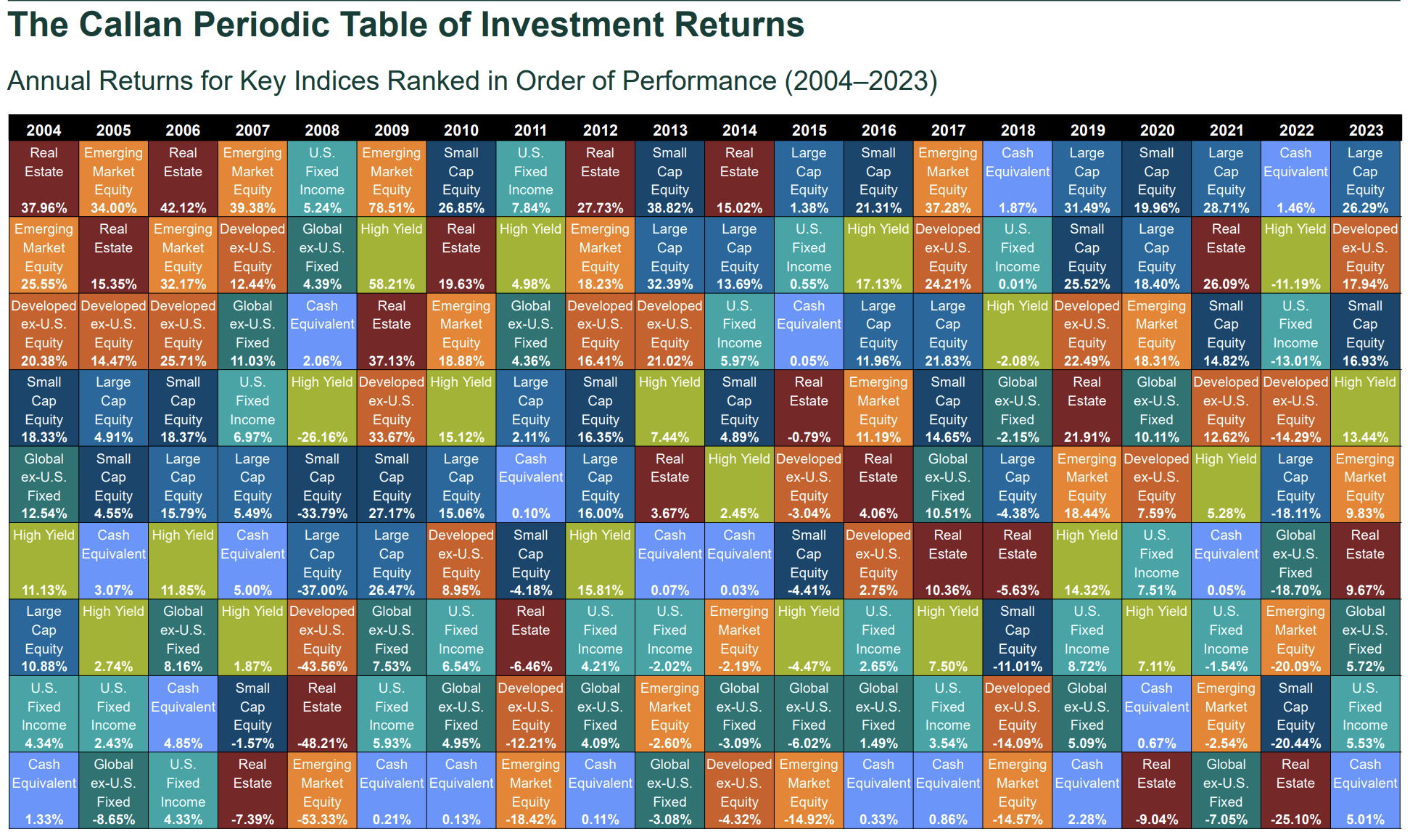
The lack of persistence year to year in relative investment returns is strikingly and memorably displayed. Imagine how disappointed you would be in 2008 if you had put all your money into emerging market stocks and real estate because they had the best returns for the prior three or four years? Or what if you put all your money into cash in early 2019 because stocks had done so poorly the month before? The pendulum swings, but if you chase it, you'll always be missing out on the best performers.
When looking at past performance, try to get to a deeper level of understanding. Try to understand WHY one investment outperformed another in the past. Ask yourself if the reason for that outperformance is likely to persist, disappear, or even reverse. Recognize your limited ability to predict the future accurately.
Perhaps most importantly, write down a static asset allocation you can stick with long term, implement it, and rebalance back to it every year or so. (By the way, if you're a new reader, I go to the trouble to insert links into my posts like those in the prior sentence for a reason. Please use them.)
Eliminate your need to constantly look at investing news. Eliminate your need to divine the future to be successful. Change your approach from a gambling-focused approach to an investing-focused approach. Boring investments are good investments. This stuff isn't that hard. You can do it!
What do you think? Why is it so hard for investors to avoid performance chasing? Have you successfully stopped yourself from chasing performance?