

My wife and I have decided to start spending our Health Savings Account (HSA) money. I’ve been writing and thinking about HSAs for a long time now, since even before we were first eligible to use one in 2012. HSAs are awesome. I mean, they’re probably not so awesome that you should pay for an HDHP you wouldn’t otherwise get just to have an HSA, but they’re still great. I love them.
In fact, our first investment dollars each year go into our HSA. The reason why is that it is a triple tax-free account. You get an above-the-line (no phaseouts) tax deduction worth thousands of dollars in saved tax when you put in the money. It grows tax-free like your Roth IRA and 401(k). When you take out the money, it comes out tax-free (like a Roth IRA or 529) as long as it is spent on healthcare.
It gets even better, though. What if you don’t need the money for healthcare? In that case, you can just pull it out after age 65 and spend it on whatever you want with no penalties. You would have to pay taxes on it, but that’s no different than a 401(k) or any other tax-deferred account. In that respect, it’s basically a Stealth IRA.
But wait, there’s more. You don’t even have to pull out the money in the same year you spend it. You can keep the receipts, hold them for years, and then pull out an amount of money equal to the receipts you have decades from now tax-free, and spend it on whatever you like.
Despite all that, we started spending our HSA dollars in 2025. Frankly, we started too late. I first wrote this post in December 2016 but never ran it because we had not yet actually started using HSA dollars. Here are four reasons why we finally started spending our HSA dollars as we go and why you should probably do the same.
#1 The Hassle Factor
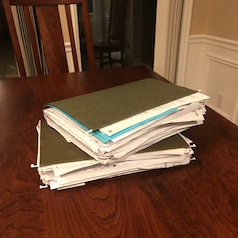 Our strategy prior to 2025 was to pay for all our healthcare needs using post-tax money and save our receipts so we can pull out that money after a few decades of tax-free compounding. However, that requires us to actually save the receipts. Some people take pictures of those and save the pictures or scan them in and keep them in a file. What do we do? If we’re lucky, the receipt makes it into a folder in the file cabinet. We have two big fat file folders full of receipts and other insurance and healthcare crap. How many times do you think I’ve been through those folders in the last five years to scan/photo receipts, catalog them, etc.?
That’s right. Not once. Why not? Because it’s a pain in the you know what. In 2016, when this post was first written (but not published), it had been a chore hanging over my head for two or three years. Even now, nine years later, I still haven’t scanned all those. I’m not even exactly sure where they are. And the ink is probably all faded now anyway. We did change to an electronic method a few years ago (when we wisely decided to have Katie keep track of them instead of me), but guess what? We lost a bunch of those receipts due to a computer issue. To be fair, there are better tools to do this than what we’ve used. And a really hardcore optimizer can probably use them and maybe even come out ahead with the “save receipts” strategy. But we apparently can’t, and I think we’ve proved that to ourselves. It’s just not worth it to us. I’ve got better things to do with my time, and if I keel over, I can assure you Katie is even less of an optimizer than I am.
More information here:#2 We’re Going to Have a Huge HSA
This post was funny to go back and review before actually publishing it. In 2016, we had a $42,000 HSA. At the start of 2025, before we had ever spent anything from it, we had a $229,000 HSA. At the end of 2025, as I write this, we have a $272,000 HSA, even after withdrawing from it all year. It’s literally now growing faster than we can spend it. We expect to continue to contribute the max ($8,750 for a family [2026 — visit our annual numbers page to get the most up-to-date figures]) every year in the first week of January. I generally encourage you to do the same. We also invest it aggressively (as I think you should, at least any amount over 2-3 years of your max out-of-pocket).
Our HSA has been 100% stock for the last five years, although we now keep a few thousand in cash starting this year. It’s probably going to keep growing faster than we’ll ever spend it on healthcare. Lots of people retire with nest eggs smaller than our HSA and certainly smaller than our HSA can grow to before we hit age 65, even if we didn’t spend from it. I think the maximum out-of-pocket for our health insurance right now is something like $7,000 per person/$14,000 per family. We could spend that every year between now and age 65 and still not have enough receipts to pull out all this money tax-free. Now, if you’ve got a $3,000 HSA or you don’t fully fund it each year or you’re a lot older than I am, then maybe this plan isn’t the best one for you, but it certainly is for us.
Remember, you have basically seven ways to use your HSA. Let’s divide them into three categories.
The Great Ways to Use Your HSA
- #1 Spend it on healthcare (including some but not all long-term care expenses) in retirement.
- #2 Spend it on healthcare before retirement.
- #3 Spend taxable money on healthcare before retirement, and keep receipts so you can pull an equivalent amount out in retirement tax-free.
- #4 Leave it to charity at death.
The Good Way to Use Your HSA
- #5 Pull it out of the HSA after age 65, pay taxes on it, and buy a sailboat.
The Bad Ways to Use Your HSA
- #6 Pull it out of the HSA before age 65, pay taxes and a 20% penalty on it, and buy a sailboat.
- #7 Leave it to your heirs, where it instantly becomes a taxable investing account with the entire thing fully taxable to the beneficiary in the year of death. (i.e., no stretch HSA).
If you can do one of the top four options, it doesn’t matter all that much which of them you do. But the top four are WAY better than #5, and #5 is WAY better than #6 and #7. The goal is really to avoid #5, #6, and #7 as much as possible. Spending it as we go along (#2) to reduce the hassle in our lives is certainly a reasonable option since it is one of the “great” choices. Of course, we’ll do some #1 too, but whatever is left at death will be used for #4 since we plan to leave more than that to charity anyway. We should have never bothered with #3. Oops.
#3 Receipts Aren’t Adjusted for Inflation
The problem with strategy #3 (saving receipts) is that the receipts are not adjusted for inflation. A $1,000 receipt now will end up being worth much less than $1,000 when you use it to pull money out of your HSA in a few decades. Let me use some fancy math to illustrate. We’re really deciding between #2 and #3 here.
Imagine you spend $1,000 on healthcare now. You have two choices—keep the receipt and pull out the money in 30 years or pull out the money now.
Let’s assume the money grows at 8% nominal and inflation is 3%. You’re going to liquidate it all in 30 years at a marginal rate of 30% and a capital gains rate of 15%. Which will give you more money after tax?
First option: Keep the receipt
If your $1,000 grows at 8% nominal, it will be worth $10,063 in 30 years. You get to pull out $1,000 tax-free. If your marginal rate is 30%, then you get to keep 70% of the next $9,063, or $6,344, for $7,344 total.
Second option: Pull it out of the HSA and invest it in taxable
If you pull out your $1,000 and invest it in the same investment, which grows at 7.7% instead of 8% due to tax drag (2% yield, 15% LTCG/dividend rate), it is worth $9,257 after 30 years. That same $1,000 comes out tax-free, and the rest has a 15% LTCG rate applied to it. So, $1,000 + $8,257 * 85% = $8,018, or $674 more than if you kept the receipt (9% more). Due to the fact that dividends are reinvested at higher share prices, the tax burden will actually be lower than that, but that just makes the example look even better.
The bottom line is that I am likely to get a lot more money out of the HSA tax-free if I take it out earlier, before inflation reduces the value of the receipts in my file folders. That more than makes up for the additional tax drag on the taxable investment. Obviously, you have to invest the money pretty tax-efficiently for this to work. Also, the lower your capital gains/dividend rate, the better you’re going to do pulling out that money earlier.
More information here:#4 I Think This Loophole Will Close
I wrote that section headline back in 2016 and I’m pretty proud of it, given that Congress is now (finally) actively discussing limiting the “save receipt” strategy to just two years. This whole “save the receipt” thing has always been, in my opinion, a total loophole. Nobody thought about this in advance and said, “Let’s make people hold on to their receipts for 20 years.” It’s just they didn’t put in a requirement to take out the money the year it’s spent (or the year after, to give people some time). In 2016, I wrote that “I think at some point in the next 2-3 decades, someone in Congress is going to close that little loophole.” Well, that time appears to be coming sooner rather than later. I suspect nobody is going to be grandfathered in, but hopefully the receipt savers will get some warning to pull out all that money before the law takes effect, but I’m not sure it’s worth the risk for a relatively minor advantage.
The only other objection I could come up with to paying as you go is that when I pay for medical care out of my taxable account, I generally put it on a 2% cash back credit card. If I used my HSA debit card, I wouldn’t get that or the advantage of “the float.” But that’s a relatively easy objection to overcome. Just put it on the credit card, and then when your statement comes, you can move the same amount of money from your HSA to your checking account. It probably doesn’t matter much for a $20 co-pay, but that extra hassle is probably worth it if you just paid the hospital bill for a delivery.
If we can find the time to do it, we’ll probably even add up all the old receipts we can still find and pull out all that money now, too.
What do you think? How are you using your HSA? Are you spending it as you go or just investing it? Are you keeping receipts? Why or why not?
Did you find this article helpful? Share it!