

I’m beginning to get a little uncomfortable with how often I see ads for prediction markets like Kalshi and Polymarket. I’m beginning to feel slightly feverish when I see news like this:
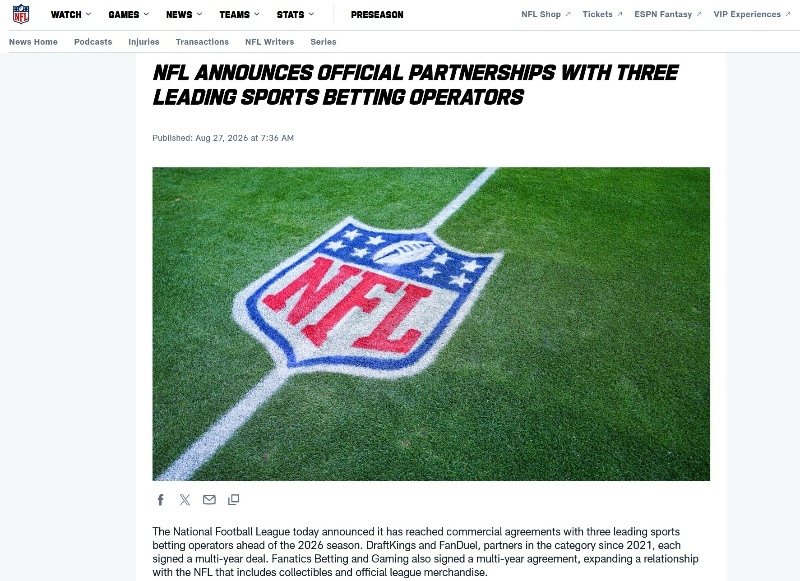
Or this:
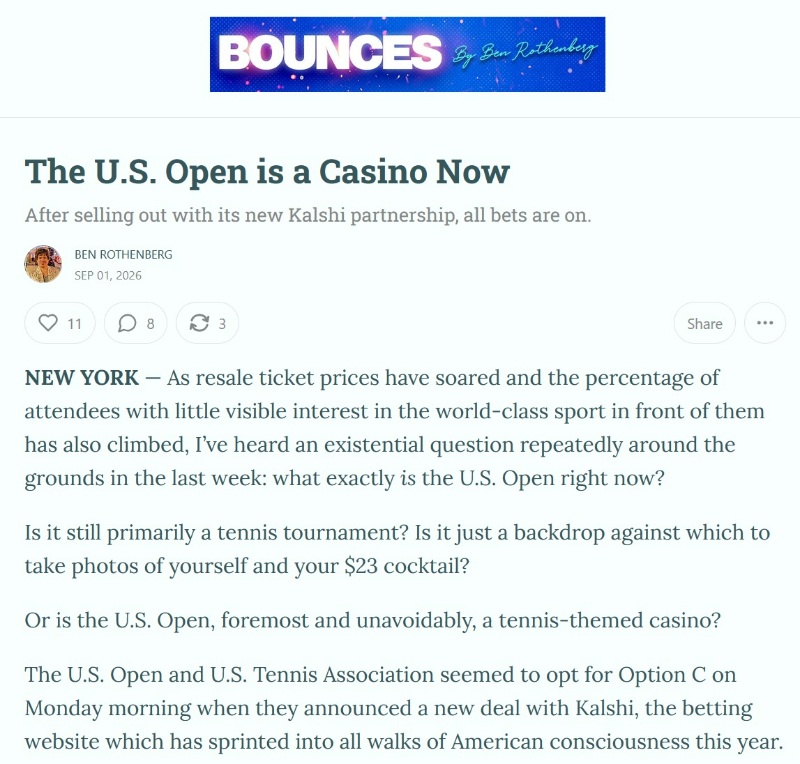
I’m no puritan when it comes to gambling. I’ve talked about my experience losing several hundred dollars in college while betting on offshore sports gambling sites. I’ve sweated hard in smoky casinos all night long just to get back to even in blackjack. I’m always up for a good poker game. I even wrote weekly articles for Forbes about the best way to gamble on upcoming boxing matches.
I’m all for (responsible) legalized sports gambling in every state, trips to Las Vegas, and fantasy football that pays out good money for winning the league.
But the constant pounding of sportsbook sites and prediction markets online, on TV, and in the news is beginning to worry me, especially since they’ve become an ATM machine for professional and non-professional sports leagues at the expense of people who can’t afford to lose that money.
And here’s one reason why. According to Betterment’s 2026 Retail Investor Survey, 26% of Gen Z investors are using sports gambling as a “deliberate, ongoing part of their long-term financial strategy.” Literally gambling with your investing money is on par with throwing money at NFTs, buying high and panic-selling low, and putting all of your money into your checking account. It’s not just a bad idea. It’s a horrendously bad idea.
The Growth of Public Gambling on Sports
In 2018, sports betting was a $400 million industry. In 2026, Betterment says, it’s grown into a $17 billion business. And it’s never been easier to get action. Thirty-nine states and Washington DC have legalized sports gambling, and 30 of those states allow you to do it via smartphone apps or websites. Eventually, all 50 could cave and allow you to put your money on everything from Monday Night Football to the smallest professional tennis tournaments in Uruguay.
Which is fine. Live and let live and all that. Do with your money what you will.
I can lose $500 playing poker at the Venetian in Las Vegas, and it won’t affect me financially. But some people take money earmarked for their 401(k) and place it on which film star will win the Oscar for Best Supporting Actor or if the highest temperature in Miami today will exceed 90 degrees.
It’s not just Gen Zers who are content to gamble with their investing money. Yes, 52% of respondents from that generation told Betterment that they had taken investing money and used it for sports betting, but 14% of Millennials and 6% of Generation X survey-takers—a higher percentage than I would have assumed—also said gambling was part of their investing strategy (only 1% of Baby Boomers admitted to doing so).
Perhaps some feel they can beat the system this way if they’re especially knowledgeable about a certain subject. But I know more than most about boxing, and I’m not sure I would have actually made any money if I wanted the action.
“When I’m talking to my friends, [they say] ‘Oh, I know this football team, so I’m probably going to make money [on a bet],’” Steven Wang, the founder of the investing app Dub, told CNBC. “They genuinely go into the bet in a way that they think they’re going to win, but we know from all the statistics that’s usually not true.”
The Dunning-Kruger Effect, where people overestimate their intelligence or abilities in certain areas, might be at play here, and the built-in advantage that sportsbooks have (making you bet $110 to win $100, the mastery of the oddsmakers, etc.) also contributes to the house usually prevailing.
But the most frightening part for me is the mindset at play here. Perhaps these young investors are not simply gambling for fun. They’re gambling because they feel like they don’t have a choice.
More information here:- The Perils of Using Prediction Markets Like Kalshi and Polymarket — And How They Could Wreck You
- Financial Lessons Learned from Playing Poker
Is the ‘American Dream’ Dying?
The American Dream of moving out of your parents’ house, earning a good living, purchasing your own property, and eventually retiring to a life of comfort and security seems to be slipping away for the younger generations. Buying your own house probably seems impossible. Worrying about whether AI is coming to take your job is stressful. Calculating if you can afford groceries and gas has to be stomach-churning. Heck, even living your own financial life independent of your parents has become more difficult.
A 2026 Northwestern Mutual study found that 72% of Gen Z adults and 53% of Millennials still receive financial support from their parents and that 20% of adults said they don’t ever think they’ll ever be financially independent from their folks.
A big part of that is housing costs. This came from a paper written by economists Lee and Woo out of Chicago.
“Housing affordability has declined sharply in recent decades, leading many younger generations to give up on homeownership. Using a calibrated life-cycle model matched to US data, we project that the cohort born in the 1990s will reach retirement with a homeownership rate roughly 9.6 percentage points lower than that of their parents’ generation. The model also shows that as households’ perceived probability of attaining homeownership falls, they systematically shift their behavior: they consume more relative to their wealth, reduce work effort, and take on riskier investments.”
A study from the University of San Diego that included more than 700,000 people over a five-year period showed that 96% of them lost money in online betting (compare that to the idea that a huge percentage of those who invest in index funds, if not basically everybody, will eventually make money in the stock market).
But if younger investors are “giving up,” that’s worrisome. As Larry Swedroe wrote on his Substack, “The tragic irony is that sports betting carries deeply negative expected returns (sportsbooks are profitable because bettors lose), making it about the worst possible substitute for actual investing.”
The Bottom Line
The other day I was watching a World Series of Poker vlog from poker star Daniel Negreanu, and for a few seconds, he plugged his financial relationship with Kalshi, one of the two biggest prediction markets around. Keep in mind that Negreanu has made $60 million in live earnings during his career, and he’s one of the most recognizable stars in poker, meaning that he (I assume) makes tons of money from sponsors and other media appearances.
“I’ve never been into the stock market or anything like that or having a portfolio,” he said. “The only actual portfolio I have is a Kalshi portfolio. Which I think is pretty cool.”
It might be pretty cool for him, a man who almost certainly will never be in want of money for the rest of his life and who built a successful career by understanding how to win at gambling. But for the Gen Z investor who is thinking about giving up, it’s the opposite of cool. It could be tragic.
More information here:“When a prediction market or sportsbook starts to feel like a retirement strategy, we have a problem,” Sarah Levy, CEO of Betterment, said. “These products are designed to keep people seeking the next quick score, not to help them build toward the next decade.”
[AUTHOR’S NOTE: If you think you might have a gambling problem, call 1-800-MY-RESET or visit The National Council on Problem Gambling.]
Money Song of the Week
Earth, Wind & Fire is a band I wish I could have seen live in its absolute heyday. The 1970s funk band was a force of nature, with Philip Bailey’s soaring falsetto, an electric horn section, a plethora of percussion, and fun band choreography (especially when they just pretended to play while still dancing for real).
Even today, when I saw EWF open for Lionel Richie last month, the band (which still has three original members, all in their mid-70s) puts on an impressive show. To honor its funky sound (and the fact that one dude in the band can crash his cymbals with jump kicks), let’s travel back to 1987 when EWF released Money Tight.
I had never heard the song until just now, but sadly, the tune is stuck in a 1980s time warp that doesn’t sound much like what made EWF one of the most popular bands of the 1970s. While songs like Shining Star, Boogie Wonderland, and September from the 1970s are pure gold (even though you know exactly in what era they were created), this song sounds hopelessly outdated.
Regardless, the message of Money Tight is a universal one: love is more important than money. As EWF sings:
“Money tight don’t feel right/Richest man has no fight all alone/Material things don’t matter/If your heart don’t get that patter in your bones/Money’s tight with me/Your love’s all I need.”
I can’t find any proof that EWF ever played Money Tight live. Which is just as well. EWF with the classic ’80s synth is not the EWF I want to hear.
More information here:Reel of the Week
My in-laws are in their early 80s, and they went with us on a European cruise this past summer. It wasn’t easy for them, but they still managed to get off the ship and explore Italy, Greece, Croatia, and Malta. While their days of boarding international flights are coming to a close, they also traveled extensively when they were younger. They certainly did it right and saw just about everything they wanted to see.
Be more like them.
Are you or do you know any young investors who have “given up?” Are they into sports betting? What can be done to limit the potential damage of gambling for a young person?
Did you find this article helpful? Share it!