

Congratulations to Dr. Sea Chen et al., who recently published a study based on 971 surveys filled out by “clinically inactive” physicians. The study shows that the reasons doctors are leaving medicine are different from what they were 20 years ago.
Twenty years ago, doctors were likely to cite one or more of the following reasons for leaving practice:
- Personal health issues
- Hassle factor
- Rising malpractice premiums
- Lack of professional satisfaction
Now, burnout is a far greater component, as is retiring to care for other family members. Most significantly, the average age at which these docs leave medicine has fallen from 57 to 48.
Why Are Doctors Leaving or Cutting Back Earlier?
Doctors are leaving medicine earlier than they used to for four reasons.
#1 Burnout
Burnout rates have skyrocketed during my career. Surveys now routinely show more than half of doctors have burnout symptoms at any given time, and for something like 1/3 of them, it is having or has had a huge impact on their lives and careers. Plenty of factors—both institutional and personal—contribute to burnout, and serious efforts to reduce it are worthwhile to maintain an adequately staffed and healthy physician workforce.
More information here:- Burnout Is Expensive: The Financial Case for Prioritizing Mental Health
- Financial Planning: An Important Part of Beating Burnout
- How My Burnout Led to Rage That Could’ve Ended My Career
#2 Care for Family
Compared to prior generations, doctors are now far more likely to reduce their clinical hours or leave completely so they can care for children or other family members. The elephant in the room is the increasing percentage of women in medicine. Two-thirds of the respondents to this survey were women. More than 50% of current medical school classes and, thus, future residency classes and presumably future attendings are going to be women. Why does that matter? Because women are dramatically more likely to go part-time or leave completely for the following reasons:
- Care for other family members (7.9% vs 0.6% for men)
- Care for young children (21.7% vs 4.2% for men)
- Due to health concerns (13.8% vs 3.8% for men)
- Because it was too stressful (31.7% vs 12.9% for men)
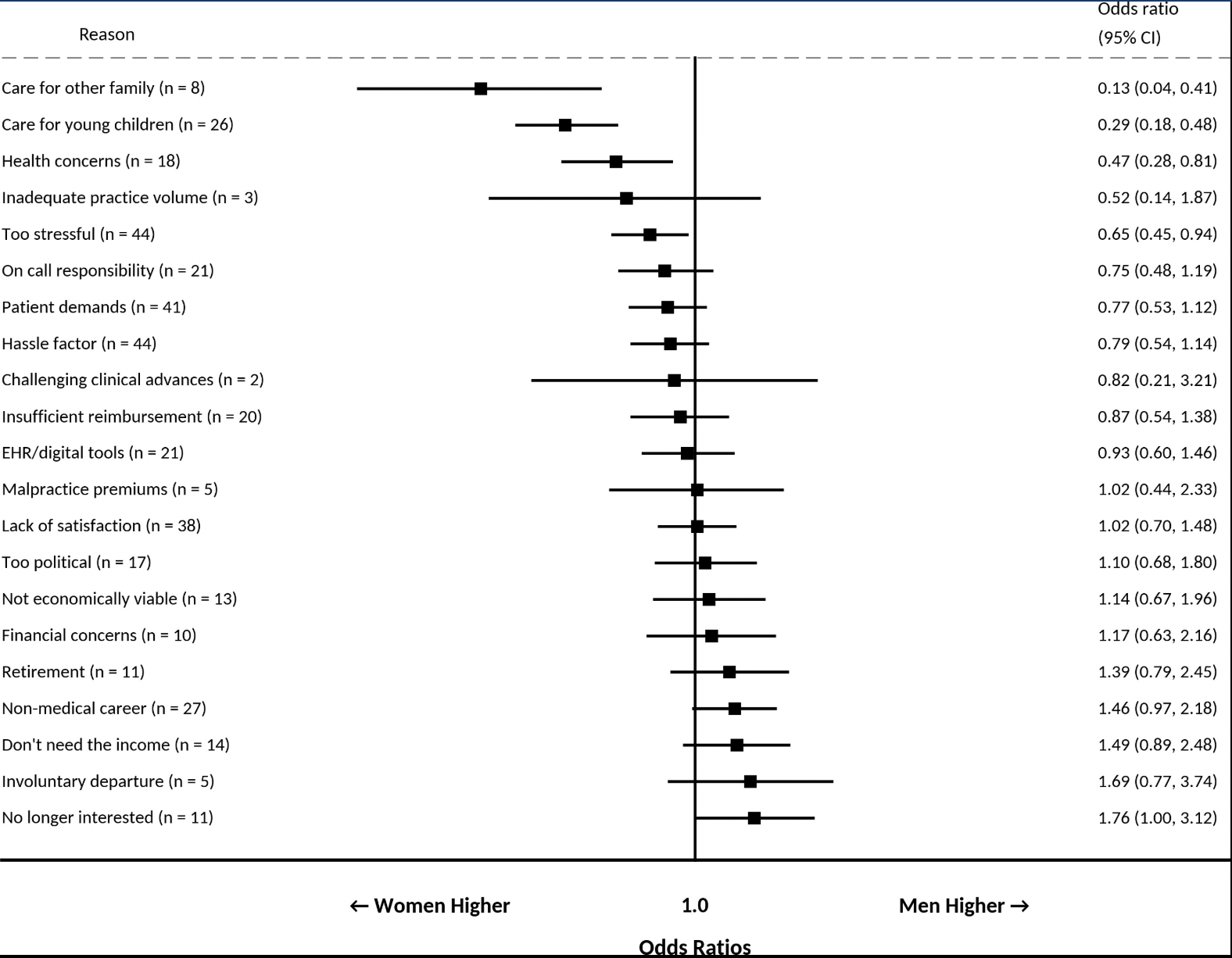
The phenomenon of docs leaving earlier isn’t only on women, of course. Newer generations, no matter their gender, are far more likely to value lifestyle considerations, like time with family and recreational pursuits, over a high-flying career. Docs now are less likely to have their identity tied up in being a doctor. That psychologically makes it easier to step away.
#3 They Can Afford to Do So
Medicine and many other professions are a blend of calling and job. The ratio is different for every doc, but we shouldn’t be surprised to see people work less or stop completely when they can afford to walk away. Simply put, more wealth exists in the world, and it tends to be more concentrated in the hands of the wealthy (including docs who can manage money). I run into early- and mid-career docs all the time who already have enough money to retire. We shouldn’t be surprised to see some of them actually do it.
There is a gender gap here, too: female docs are far more likely to marry another high earner than male docs. Thus, they have far more ability to go part-time or quit completely, simply because they can live on their partner’s earnings or because the two high-earner couple simply built wealth faster.
More information here:- Living Our Lives in a Dual-Physician Income Household
- Is Financial Planning Different for Dual-Income Couples?
#4 Lack of Ownership
The ratio of employed doctors to self-employed doctors has been climbing every year for the last few decades. Employees are far more likely to quit than owners. It’s easier. You give two weeks notice, and you walk away. No need to worry about selling the practice or taking care of your employees or whatever. So, the fact that more doctors are employees means more doctors are going to leave medicine.
The Workforce Implications of These Changes
What’s the big deal? I mean, FIRE has been popular, and every time a doc (or anyone else) retires, it opens up a slot for someone else, no? Well, the big deal is the doctor shortage. While the real issue is doctor maldistribution, there’s probably a bit of a shortage, too. The study says:
“This study highlights the importance of considering the age of physicians when they leave practice, given that a key parameter in physician workforce supply projections is the average retirement age. Any changes in this parameter can greatly change workforce estimates. For example, in the latest Association of American Medical Colleges physician workforce projections, a decrease in the average retirement age by two years would result in a decrease of the projected physician supply in 2036 by approximately 40,000.”
If this relationship is linear, as I would assume, decreasing the average retirement age by 10 years would eliminate more than 20% of physicians. That’s a pretty big deal since we were already short (and severely maldistributed) before.
But what do we do about it? The obvious answer is to get more doctors. Medical school seats are growing rapidly, but residency slots aren’t. It does little good to create more unmatched doctors, but it’s just easier to put 10 more students into your medical school class than to create 10 more residency positions.
Some cynical folks might suggest discriminating against women since they are more likely to go part-time or retire early. Good luck with that approach, given that college is now 58% women and climbing. Don’t you want the brightest and hardest-working folks to be your docs? Plus, serious legal and ethical concerns for that approach would follow.
Burnout prevention and treatment would go a long way to keep doctors in clinic. Unfortunately, the most commonly prescribed treatment for burnout is to work less, and that doesn’t help the shortage issue much, at least in the short run. Burned-out doctors probably manage their money a little better, and thus they can exit medicine sooner, too.
Maybe it’s time to focus a bit more on the other reasons why docs are leaving. If we’re losing so many docs to family care duties, maybe society and employers can lend a hand there. Childcare (especially after-hours childcare), parental leave policies, and flexible work schedules can go a long way. We’ve learned a lot about the benefits of flexible work schedules here at WCI. The majority of our staff are women. The entire staff works from home, and we mostly let people work when they want to work and be out of office when they want to be out of office. Clinical work will never be as flexible as what we do, but plenty can be changed when you’re willing to think about things in a new way. Employers become amazingly flexible when the other option is to lose a good doc and have to start recruiting a new one.
Perhaps changing contract structures will also help. Sometimes the fact that WCI pays me well and that it would also be tough to sell keeps me working in it. It’s a classic “golden handcuffs” scenario. So, let’s give doctors more golden handcuffs. Bonuses, pensions, profit-sharing, and retirement benefits can make people work longer and harder than they otherwise would. Let’s put more of them into place.
What do you think? Have you cut back or left medicine completely? Why did you do it? If you haven’t, when do you think you will, and why? What are the best workforce salvaging options to implement, given the rising percentage of early retirements?
Did you find this article helpful? Share it!