

SWTSX and VTSAX are both mutual funds that offer broad market exposure to the entire US. equity market, but the two funds have some differences. SWTSX is offered by Schwab, and it tracks the Dow Jones US Total Stock Market Index. Meanwhile, VTSAX is a Vanguard fund that tracks the CRSP US Total Market Index.
Both funds are designed for long-term, buy-and-hold investors who want access to the full U.S. market. Choosing between the two requires that you understand the differences in expense ratios, minimum investment requirements, and which brokerage firm best fits your investment style.
What Is SWTSX?
The Schwab Total Stock Market Index Fund is a passively managed mutual fund that’s designed to track the Dow Jones US Total Stock Market Index. The fund was first established in 1999, and it offers wide exposure to the US stock market.
The fund tracks a variety of large cap, mid cap, and small cap stocks, so it offers a more complete overview of the market’s performance. Its holdings are diversified across sectors like technology, financial services, and communication services.
SWTSX has an expense ratio of 0.030%, which is one of the lowest rates available. And there’s no minimum investment required, making it easy for new investors to get started.
What Is VTSAX?
The Vanguard Total Stock Market Index Fund Admiral Shares tracks the CRSP US Total Market Index, which tracks the investable US equity market. This includes large cap, medium cap, small cap, and micro-cap stocks. It’s one of the most widely held mutual funds in the world, with over $2.2 trillion in net assets.
VTSAX is passively managed, and it has an expense ratio of just 0.04%, which is slightly higher than SWTSX. Like SWTSX, it offers broad diversification across technology, financial services, and communication services.
As an Admiral Share class, VTSAX requires you to deposit and maintain a $3,000 minimum investment in the fund. This fund may make sense for investors who already have a Vanguard account or who are building a Vanguard portfolio.
More information here:SWTSX vs. VTSAX: A Side-By-Side Comparison
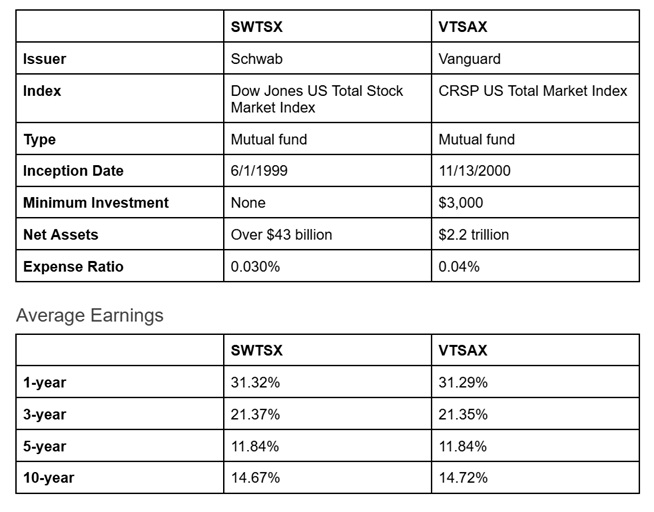
Here is a side-by-side comparison between the two funds along with their average earnings (as of Jun 2026).
Similarities and Differences
While SWTSX and VTSAX track different indexes, they're similar in many ways. Let’s look at the biggest similarities and differences between the two.
Similarities
- Total market exposure: Both funds hold thousands of US stocks across all market capitalizations, giving investors broad diversification in a single fund.
- Passive management: Both are passively managed mutual funds with low turnover, making them cost-effective for long-term investors.
- Nearly identical returns: Over a decade, the two funds have delivered returns within a few basis points of each other. For most investors, the performance difference is negligible.
- Sector overlap: Both funds hold similar weightings across major sectors like technology, financial services, and healthcare, since they're both trying to represent the total US market.
Differences
- Expense ratio: SWTSX has a slightly lower expense ratio than VTSAX. While the difference is small, it can add up over decades of compounding.
- Minimum investment: SWTSX has no minimum investment, while VTSAX requires a $3,000 minimum. This makes SWTSX more accessible for newer investors or those just getting started.
- Underlying index: SWTSX tracks the Dow Jones US Total Stock Market Index, while VTSAX follows the CRSP US Total Market Index. Both aim to represent the full US market, but the methodologies differ slightly in how they weigh and select securities.
- Brokerage platform: SWTSX is a Schwab fund, and VTSAX is a Vanguard fund. Buying a fund outside its native brokerage can sometimes result in transaction fees or restrictions.
- VTI vs. VTSAX: Returns, Fees, and Tax Efficiency
- FSKAX vs. VTSAX: What Is the Best Total Stock Market Index Fund?
Which Option Should You Choose?
SWTSX and VTSAX are both excellent total market funds with low costs and nearly identical long-term performance. The real question may come down to which brokerage firm you prefer. For example, if you already invest through Schwab or plan to do so, SWTSX is the natural choice. If you're a Vanguard investor or hold other Vanguard funds, VTSAX will fit well into your portfolio.
The one other major distinction is the minimum investment. If you're just starting out or investing smaller amounts, SWTSX's lack of a minimum makes it the more accessible option. For investors who've already met the $3,000 threshold, that difference may not matter. Either way, you're getting broad US market exposure at an extremely low cost, which is exactly what a long-term investor needs.
The White Coat Investor is filled with posts like this, whether it’s increasing your financial literacy, showing you the best strategies on your path to financial success, or discussing the topic of mental wellness. To discover just how much The White Coat Investor can help you in your financial journey, start here to read some of our most popular posts and to see everything else WCI has to offer. And make sure to sign up for our newsletters to keep up with our newest content.