

Here at The White Coat Investor, we strive to create an environment where anyone can ask any financial question without fear of criticism. We understand that most of the issues our audience deals with would be considered “champagne problems” by the vast majority. We also know that not every post is for every reader. All of that particularly holds true for this post. If there is nothing useful to you in this post, that's OK. Know that you are in the majority of our audience, and come back tomorrow to hopefully read something more useful to you. Or maybe stick around and, just for fun, peek a little into how the 0.1% lives. Today's subject? Fractional jet ownership.
The Main Question
If you call up a sales rep for a fractional jet ownership program, the first thing they should ask you is this question:
“How are you going to use it?”
After learning more about the service, I understand exactly why that is the first and most important question. This is actually the main issue when considering private jet travel. At least the main issue once you are wealthy enough to consider it. Which is the main issue for most people, of course.
Private Jet Travel Can Be a Time Machine
Most users consider private jet travel to be like a time machine. Some people just absolutely hate the experience of commercial travel, and they will never fly commercial again. But I don't think that is the majority of users of this service. The majority are trying to use their wealth to buy time. How do you buy time with a private jet? In a few ways:
- No going through the airport (perhaps an hour saved on each end for a typical domestic flight)
- No connections (varies, but could save several hours)
- Flying faster/higher (minor time savings)
- Not having to adjust your schedule to the airline schedule (can save hours to days)
Where do you get the biggest time savings for your buck? Short, domestic flights—especially multiple flights in a day—to and from places that do not get regular jet service, especially at odd hours. Flying from Salt Lake City to New York City every other Monday morning is not that. Flying to London is not that. Most private jet users don't fly private from the US to London. They fly commercial across the Atlantic, and then use the service as needed for short hops around Europe.
More information here:
Should I Fly First Class? Is First Class Worth It?
How Much Is It to Rent a Private Jet: The Real Calculus
In reality, the calculation you make when deciding whether to fly private is, “How much time are we going to save and what is our time worth?”
I think it's a pretty good idea to know what your time is worth. In her famous book, Your Money or Your Life, Vicki Robin teaches you how to calculate this exactly. But it's not hard to guesstimate it. For example, a typical emergency doc gets paid $200-$300 an hour. If you're spending after-tax money, you should reduce that for taxes. Perhaps, it's something in the $150 an hour range. In theory, you should be willing to spend up to $150 an hour to save an hour of time. A housekeeper charges less than that and so does a lawn service, so those would be great ways for an emergency doc to buy time. High-powered surgeons could possibly earn quite a bit more, at least with some of their time. A business executive might find that their time is even more valuable. Perhaps they work 50 hours a week and earn $1 million a year working 46 weeks. That's $1 million/(50 x 46) = $435 per hour. If that jet service is paid for with business (pre-tax) funds, it would be worth buying if the price is less than $435 per hour saved.
Next, you have to figure out how many hours you are saving. Consider some of the trips you make, especially those you make frequently. How many hours of your time would flying private save you? Sometimes, it is not very much at all. My wife frequently flies commercial from Provo, Utah, to Mesa, Arizona, to visit family. Incidentally, that flight often costs less than $100. Taking only a carry-on, she spends less than an hour in either airport, certainly not more than 1.5 hours total. The flight itself is 1 hour and 45 minutes. The flight time itself is mostly the same whether you fly commercial or private. But the cost is not. If the cost is $10,000 per hour to fly private, that trip would cost $35,000 round trip. And flying private would only save three hours. Her time would have to be worth more than $10,000 per hour to justify this expense. Unfortunately, nothing she or I do is worth $10,000 per hour. In fact, I'd do just about anything you want for $10,000 an hour, even if I were just giving it to charity.
But let's say you need to fly into a little airport in Montana. Only one flight a day goes from Salt Lake to this airport. It's in the evening, and it is 1.5 hours each way. And you need to be there first thing in the morning for a business meeting. Not only do you have to spend four hours round-trip in airports, but you have to spend another 24 hours in that little town where you do not wish to be. Now, we're talking about 28 hours saved. Flying private at $10,000 an hour costs $30,000, but now the cost per hour saved is only $1,071 per hour. That might very well be worth it to someone who is highly compensated or, more likely, their business. With a private jet, that person can wake up early, jump on that plane, have the meeting, and be back for lunch with the spouse (or an afternoon at work). It's possible some other expenses would be saved (dinner, hotel, rental car) in addition to the time savings.
The real game-changer is when you fill the plane. Sure, your time might not be worth $1,000 a hour, but what if you combine your use with 5-10 other people?
Why Consider a Private Jet Rental Service?
Status Symbol
In addition to the time savings, arriving in your own jet is a pretty awesome status symbol, if you are into that sort of thing. You can loan it out, too. “I'll have a jet waiting for you at 8am to bring you over to have lunch with me.”
Privacy
You would need to be a whole lot more famous than I am to value this, but if I were Brad Pitt, you better believe I would be interested in this feature of private jet travel. When you are ultra-famous, you are working every time you are around other people. The more you value privacy, the more you might be willing to spend to travel privately. Private means just that. No one else knows where you are going, when, why, or how (although some people might still try to track you on flight radar apps).
Hassle
Getting rid of hassle is the main thing many find attractive about flying private. I really hate parking at the airport, riding the shuttle bus, standing around in a line, going through security, sitting around at the gate, dealing with delays, standing in the jetway, waiting your turn to board and disembark, listening to the flight attendant and pilot schpiels over and over again, being told to put your tray or your seat back up and your computer away, waiting your turn to use the bathroom or whatever it is that irks you about flying commercial.
Almost all of that goes away with flying private. You drive up next to the plane, someone takes your bag out of the trunk for you and puts it in the plane, you walk up the ladder and sit down, the door closes, and you head on down the taxiway. Pretty nice.
More information here:
Why I Designed My Life Working Part-Time 931 Miles from Home
How to Think About Credit Card and Travel Hacking
How NetJets Private Jet Service Works
This next section might read a bit like an ad for NetJets. We have no financial relationship, although perhaps we should explore one. NetJets is the biggest company in this space (perhaps as much as 63% of the market share), and it has a reputation for being a premium provider. Flexjet and Wheels Up are competitors that might be worth checking out. For our purposes today, NetJets will certainly provide a reasonable example of how these services work.
NetJets Has 3 Options
NetJets offers three options, which vary mostly in the commitment you make. When I say “hours,” the only hours we are talking about are the hours the plane is in the air.
#1 NetJets Card
This is a punch card, either 25 or 50 hours of flight time that must be used within two years. There are two options for how many blackout dates you want. Blackout days, of course, are on the most popular days for use, like the days around holidays. One is called “Card275,” and the other is called “Card320.” The number refers to how many days are not blacked out, i.e., there are 45 blackout days for a Card320 purchaser. In addition to blackout days, NetJets also has days around the blackout days where the company may alter your desired leaving time by up to three hours. In the Card320 program, there are another 45 days where you have to be flexible. Here's what those days might look like in a given year (blue are the true blackout days).
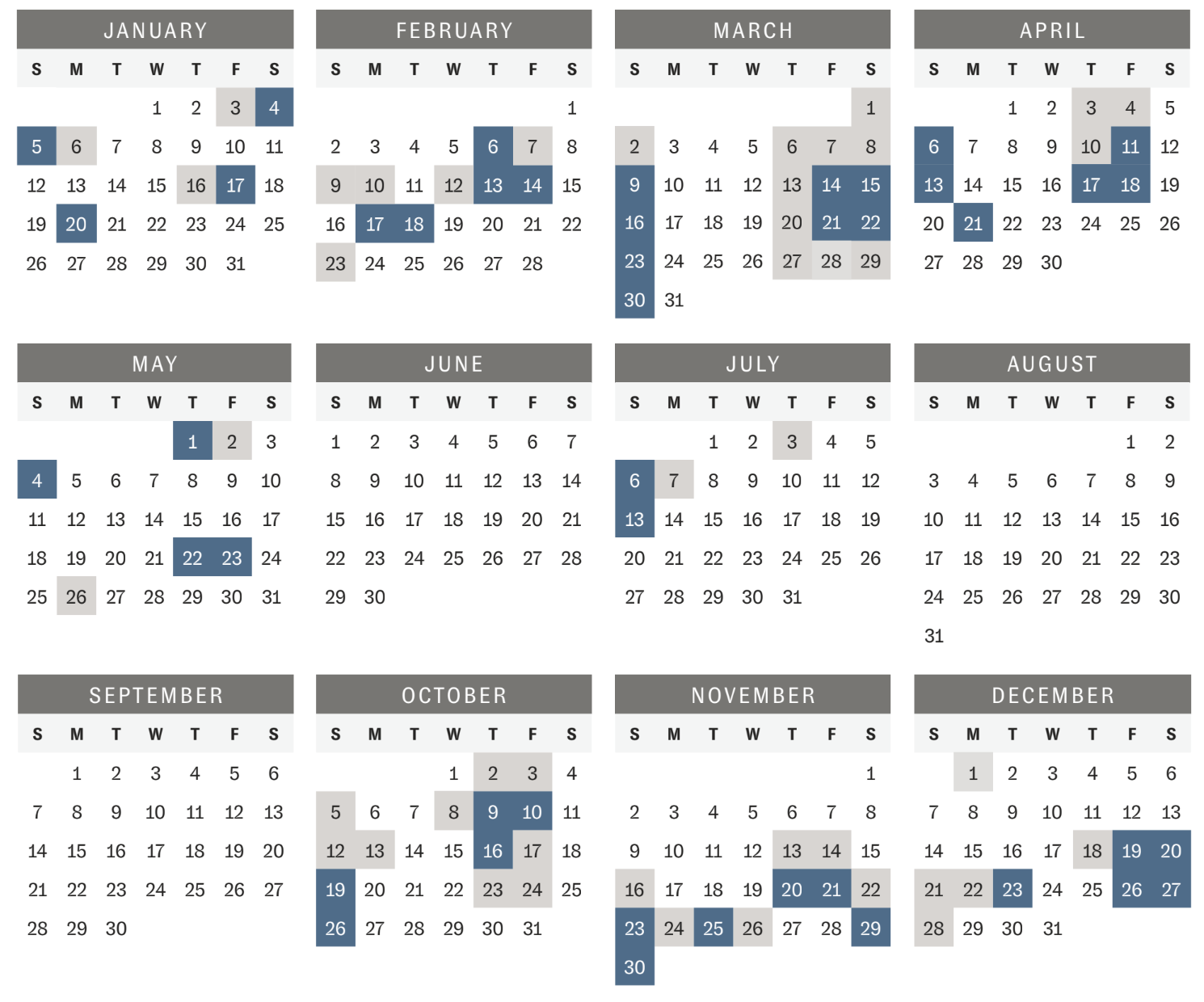
With the NetJets card, you must give 48 hours notice for when you want to fly, so you have to plan ahead a bit more than with the other options. It also might be one of the more expensive ways to use the service, as you are putting all the risk of depreciation and fuel costs on the company. But it is the ideal way to “try before you buy” since it requires no ongoing commitment. You buy 25 hours, and that's it. When you have used your 25 hours, you can walk away.
#2 NetJets Share (Fractional Ownership)
This is the way most clients use NetJets. Think of it as a jet time-share. You actually own some percentage of the jet. The smallest percentage is generally 1/15 of a jet, which works out to be about 50 hours of use a year. But you have to buy the jet. And even 1/15 of a jet is a lot of money. After you buy it, your operational costs are lower than the all-in NetJets card costs, but you are also going to be paying for the depreciation of the jet. Which is not insignificant. A reasonable estimate might be that you only get back 30% of the value of your buy-in after 10-15 years. You'd have two types of operational costs: a flat monthly fee, which you pay no matter how many hours you fly, and two hourly fees. The flat monthly fee covers fixed costs, and the hourly fees cover variable costs.
If you use fewer hours than you are allotted, they can be carried over to the next year. If you go a little over, that's OK, too. Additional hours come from the next year, but they are charged at a progressively (punitively?) higher rate. If you go over by a lot, somebody will be talking to you before too long, and you will be expected to buy more jet. The owners have no blackout dates, and you only have to give 4-10 hours of notice to have a jet waiting for you. You would also have a three-year minimum commitment.
As an actual owner, you can use the depreciation on your taxes, at least for the business use of your jet. During those 100% bonus depreciation years, this dramatically lowers the cost of ownership, especially if you only have business use during the first calendar year you owned the jet. Note that bonus depreciation was limited to 40% of your purchase in 2025 and only 20% in 2026. Technically, it takes months for the jet you buy to be delivered, but you can start using the service right away as soon as you put down your 20% down payment.
#3 Leasing
This is also an option. While probably more expensive overall than ownership, you are putting the risk of high depreciation back on the company, and you benefit from a more fixed cost of use. There are no blackout dates, and you only have to give 4-10 hours of notice for use.
The Fleet
NetJets has more than 750 jets and more than 9,000 employees, and it flies something like 1,300 flights a day. The jets range from the “light jet,” a Phenom 300 that seats six and can go for up to 3 1/2 hours without refueling, to midsize jets such as a Citation Latitude that seats eight and can go for up to five hours without refueling, to large jets like a Challenger 650 (seats 11 for up to eight hours) to long-range jets such as a Global 6000 (seats 13 for up to 13 hours). The bigger the plane, the more it costs to buy and use. You are allowed to upgrade from “your” jet; it just costs more of your hours. You can also downgrade for shorter trips with fewer people and stretch your hours further. Downgrades are guaranteed; upgrades are not.
How Much Does NetJets Actually Cost?
Now, the part you have all been waiting for. So far, this all sounds pretty awesome, doesn't it? As a wealthy friend once told me, “This is my favorite thing to spend money on, but it's pretty expensive.” He's right. While pricing changes over time (it mostly goes up), these numbers should get you in the ballpark of whether this is something reasonable for you to buy.
Card275
This is the least amount of money you can spend at NetJets. This is for a 25-hour punch card.
- Embraer Phenom 300/E $215,000
- Cessna Citation XLS $235,000
- Cessna Citation Sovereign $285,000
- Cessna Citation Latitude $300,000
- Bombardier Challenger 350 $400,000
- Bombardier Challenger 650 $425,000
If you spread your 25 flight hours over two years, you can get into this game for as little as $107,500 a year. While most doctors can't afford that, some can.
Card 320
You get more flexibility with use here, but you are going to pay for it. Here are the prices for 25 hours that must be used within two years.
- Embraer Phenom 300/E $280,000
- Cessna Citation XLS $315,000
- Cessna Citation Sovereign $370,000
- Cessna Citation Latitude $400,000
- Bombardier Challenger 350 $500,000
It's a little cheaper per hour if you buy 50 hours instead of 25.
- Embraer Phenom 300/E $515,000
- Cessna Citation XLS $580,000
- Cessna Citation Sovereign $680,000
- Cessna Citation Latitude $735,000
- Bombardier Challenger 350 $920,000
Share365 (Ownership)
Upfront cost for 1/15 of a jet (50 hours per year)
- Phenom 300 $634,375
- Citation Ascend $1,062,500
- Citation Latitude $1,500,00
Fixed costs
- Phenom 300 $167,640
- Citation Ascend $208,248
- Citation Latitude $219,216
Occupied hourly fee (for 50 hours)
- Phenom 300 $2,654 per hour ($132,700)
- Citation Ascend $2,786 per hour ($139,300)
- Citation Latitude $3,723 per hour ($186,150)
Fuel fee (varies, 50 hours at fuel price at time of writing)
- Phenom 300 $1,131 per hour ($132,700)
- Citation Ascend $1,430 per hour ($139,300)
- Citation Latitude per hour $1,614 per hour ($186,150)
Total estimated annual expenses for 50 hours of use
- Phenom 300 $356,878 ($7,138 per hour of use)
- Citation Ascend $419,071 ($8,381 per hour of use)
- Citation Latitude $486,160 ($9,723 per hour of use)
Share 365L (Lease)
Fixed fees
- Citation Latitude $420,610
Occupied hourly fees (for 50 hours)
- Citation Latitude $3,723 per hour ($186,150)
Fuel fee (varies, 50 hours at fuel price at time of writing)
- Citation Latitude per hour $1,614 per hour ($186,150)
Total estimated annual expenses for 50 hours of use
- Citation Latitude $687,553
Now, most of you know why you don't own a jet. They're really expensive to buy and really expensive to operate.
Should You Buy Fractional Jet Ownership If You Can Afford It?
You can't take your money with you. If you can afford something and you want it, we mostly think you should buy that thing. But before buying fractional jet ownership, I want you to at least consider two other aspects.
The first is to weigh the environmental cost of your lifestyle. My politics might lean slightly right overall but not when it comes to environmental issues. I definitely lean more left there. Dividing the environmental costs of jet travel by hundreds of people is one thing. Dividing them by a single person is completely different, and it gives me at least a little bit of pause. I hope it makes you pause a bit, too.
The second is the opportunity cost of the money you're spending. A million dollars followed by half a million dollars a year is a lot of money. What else could you do with it? You could give it to charity. You could give it to family. You could give it to friends. You could buy a houseboat and a wakeboat and a truck to pull it. Is flying private instead of commercial really going to make you happier than those other things?
If you're undecided, consider taking a half step instead of a whole step. Start flying first class everywhere you go, especially overseas in a lie-flat seat. Or maybe just try out something like a Card275 first and see how it goes. Also consider other time-saving purchases. If you can save the same amount of time hiring out lawn care and housekeeping and another employee at your business for far less money, maybe do that first, too. Buy the steak if you want the steak; it's a lot cheaper than a jet.
More information here:
It’s a Lifestyle, Not a Vacation
From Road Trips to Bush Planes: Getting to All of the National Parks on an Evolving Budget
The Bottom Line
Private jet travel is widely available and affordable for a small segment of wealthy and high-income people and their companies. However, most will still need to do a calculation to determine whether the time and hassle savings will be worth the price.
What do you think? Have you considered fractional jet ownership? How did you calculate whether it was worth it for you? For those who cannot afford it, if you could, would you spend your money in this way? Why or why not?