

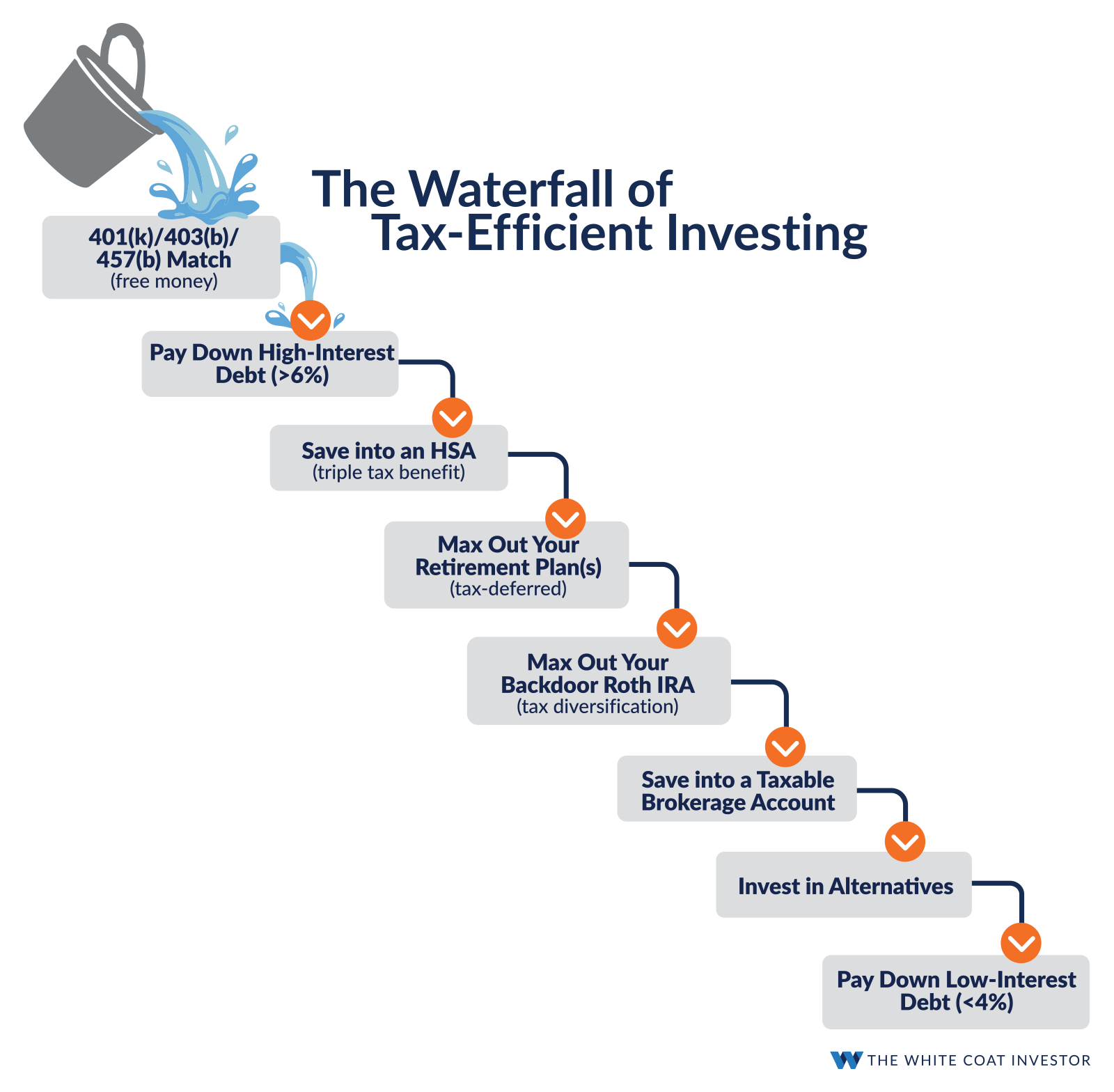
Today’s post is inspired by one of our keynote speakers at WCICON25 and a longtime WCI friend, Sarah Catherine (SC) Gutierrez, CFP. At the first WCI conference in 2018, she presented what she calls “The Waterfall” of tax-efficient investing. How does a waterfall work? As you fill one pool, it spills over into the next cup as demonstrated in the first graphic below.
Let’s get more into it, especially as it relates to new residents and attendings.
White Coat Investor Financial Waterfalls
Doctors love this kind of thing—a list that tells them exactly what to do with their money. Reality is a little more complicated than just a list, and a hardcore hobbyist can usually pick a few nits with any list. But they’re still pretty useful as a rule of thumb. What I would like to do today is present both priority lists and “waterfalls” for both new residents and new attendings. I’m sure the comments section will be full of nits, which is great. None of this is set in stone. But I think it will still be useful to many readers.
Let’s start with an example of a tax-efficient waterfall so you can understand the concept.
Now, let’s get to the waterfalls that are specific for residents and new attendings. Be aware that I’m not just talking about money in my “waterfalls;” I’m also talking about time and life energy.
Resident Financial Waterfall
Before we get to the waterfall concept for residents, let’s discuss the biggest financial priorities for new residents in detail. First, the overall list:
- Finish residency in good standing.
- Buy disability insurance with an additional purchase rider.
- Buy life insurance if anyone else depends on your income.
- Get wills if you have children.
- Designate/review beneficiaries of accounts/policies.
- Refinance private student loans.
- Develop a plan for federal student loans (IBR vs RAP? PSLF?).
- Get a written spending plan (i.e., be living on a deliberate budget).
- Personalize cash flow waterfall.
- Have your attending employment or partnership contract reviewed prior to signing anything.
- Become financially literate.
- Have a written financial plan for the first 12 months of attending income in place prior to graduation.
#1 Finish Residency in Good Standing
The lifetime financial plan for physicians (borrow a ton early and start earning later, but make up for it by having a high income) only works if that high income does indeed eventually show up. If you don’t finish residency and learn what you need to learn to be a good doctor, that high income won’t ever show up. Your medical training HAS to be your first priority—not just because it’s important to be a good doc, but also because that critical high income will only come to those who successfully complete residency.
#2 Buy Disability Insurance
If your time, energy, and money are so limited that you can’t afford to do anything else, I recommend getting disability insurance. An individual policy (with a rider to lock in insurability) is probably best, but get a group policy at a minimum.
#3 Buy Life Insurance
If you’re single without children, disability insurance is probably enough for now. But if someone else depends on your income (spouse, children, parents, etc.), you will also need some term life insurance.
#4 Get Wills If You Have Children
Everyone should probably have a will, but it is critical for parents of minors. This is the document that names the person who will be raising your child if you cannot. Seems rather important.
#5 Designate/Review Beneficiaries
Retirement accounts, 529s, HSAs, annuities, and life insurance policies all have listed beneficiaries. When you get married, get divorced, have children, or have a family member die, you had best review them all to make sure your money is going to go where you want it to should the worst happen to you. This and a will is probably all the estate planning a resident needs to do.
#6 Refinance Private Student Loans
Refinance private student loans early and often. If you can get a lower interest rate, get a lower interest rate. There are reasons not to refinance federal student loans, but none of them apply to private loans. As your credit score, credit history, and debt-to-income ratio improve or as interest rates fall, you likely will qualify for lower rates. You should take advantage of them. If you go through the links on The White Coat Investor site, you will also usually get cash back from the lender and a free online course from us.
#7 Develop a Federal Student Loan Plan
Student loans are usually a major piece of a resident’s financial life, and you need a plan you can rely on for them. You need to make sure you’re in the right Income Driven Repayment (IDR) plan, filing your taxes properly, certifying your annual PSLF forms, and refinancing when indicated. You most likely will need to enroll in the Repayment Assistance Plan (RAP), which replaces SAVE (which essentially replaced REPAYE). RAP has features that are like the SAVE/REPAYE plans, where it subsidizes all unpaid interest. This ensures that if you make your required payment, your loan balance will never go higher. RAP has no payment ceiling, requires direct federal student loans, qualifies for PSLF, and includes a private sector forgiveness track at 30 years. If you need help sorting out this plan, we recommend StudentLoanAdvice.com.
#8 Written Spending Plan
Stop trying to figure out where your money went and start telling it where to go. Every dollar of it. Use an app if helpful, but you can even do it just with pencil and paper. Once you have a plan (and it’ll take a few months to work out the kinks), follow it.
#9 Personalize Your Cash Flow Waterfall
While the waterfall you’ll see below works just fine for most residents, you might need to tweak it a little to make it fit your situation. That’s perfectly fine.
#10 Contract Review
Don’t be penny wise and pound foolish. You’re about to sign a contract that will pay you millions over your career. Spend a few hundred dollars and have it reviewed by an expert to make sure you’re being paid fairly and so you understand exactly what you’re signing. Fifty percent of new docs change jobs within two years. While this is only sometimes due to not understanding what they signed, the provisions of that contract will certainly apply when you do change jobs.
#11 Become Financially Literate
Let me get this straight. You’re going to spend more than 10,000 hours learning to practice medicine well, but you can’t spend a handful of hours learning to manage the money you will make doing so? Really? Maybe start by subscribing to this free blog or the accompanying White Coat Investor podcast.
#12 Develop a Written Financial Plan
Want to be on the fast track to financial success? Or just want to avoid screwing up the greatest financial opportunity of your lifetime? Write down before residency graduation where your first 12 attending paychecks will go (i.e., this much to living expenses, this much to investments, this much to student loans, etc.). You’ll be shocked at what a difference this will make.
Resident Waterfall for Cash Flows
Now, let’s move on to the actual waterfall. This graphic will help you visualize where your “extra” cash (money not needed for current living expenses) can be most effective. Fill up each pool before moving on to the next one.
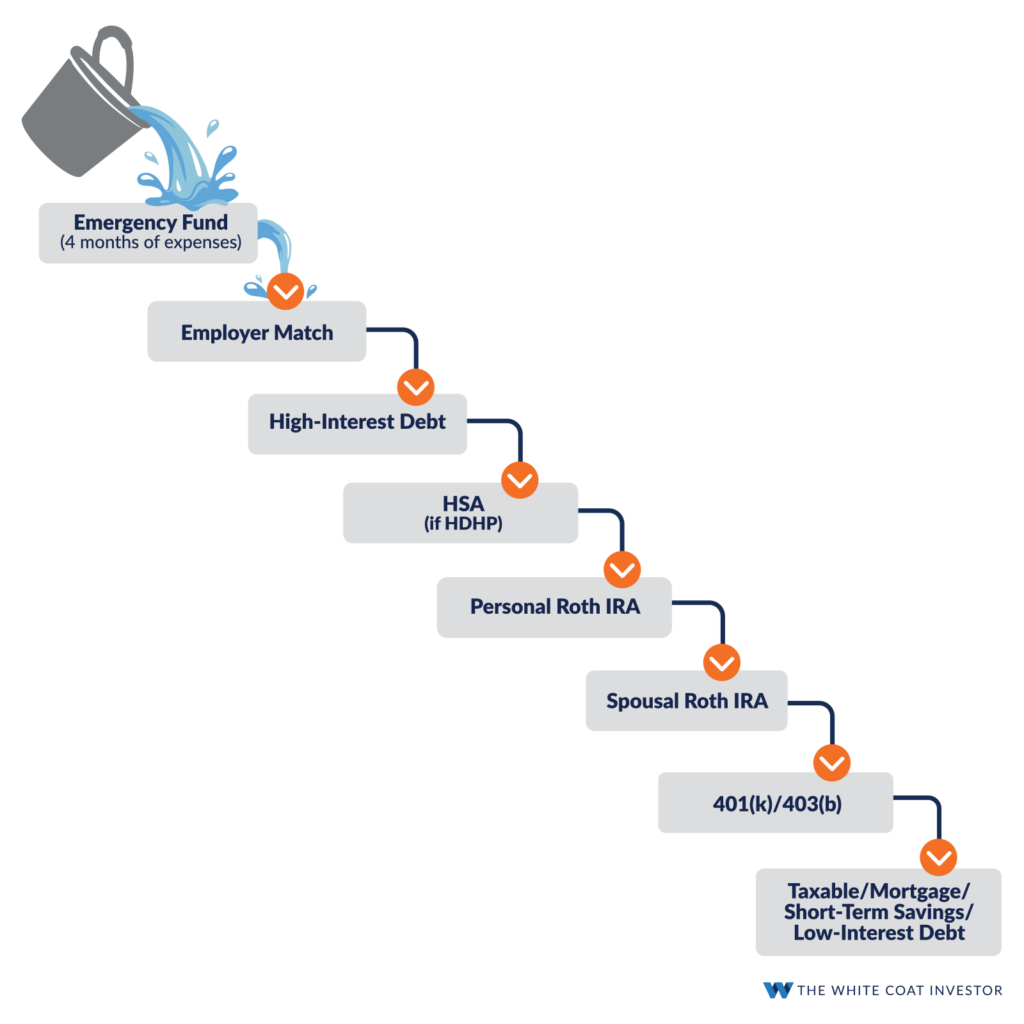
Let’s talk about the waterfall now.
Emergency Fund
The first step is an emergency fund, but this should be a resident-sized emergency fund. This is enough money to replace a washing machine, fly to a funeral, and maybe even buy a beater without taking on new debt. Traditionally, an emergency fund is 3-6 months of expenses, but since disability insurance policies generally don’t pay you until after three months, four months seems to be the right number for a doc.
Dave Ramsey recommends against a 3-6 month emergency fund for anyone with debt, simply because they have better things to do with their money. I agree that a huge emergency fund isn’t a major priority for residents for a few reasons:
- First, your job and pay are very stable as a resident.
- Second, you have a ton of great uses for your money, probably including a six-figure 6%+ debt.
- Finally, direct contributions to a Roth IRA can be taken out at any time tax- and penalty-free, and, in that respect, it can serve as an emergency fund.
It just doesn’t make sense to have a five-figure amount sitting around earning, say, 3%-4% interest while passing up the tax benefits of Roth accounts and paying 6%+ interest on a loan. But $1,000? Sure. What about $2,000-$5,000? OK. Maybe even up to $10,000. But no more than that for a family primarily relying on the earnings of a resident to survive.
Employer Match
Want to leave part of your salary on the table? Probably not, but that’s what you’re doing if you’re not putting enough money into employer-provided retirement accounts to get the full employer match. Not all residents qualify for a match, but ask HR if you do. If so, make sure you get it. Maybe that means putting 6% of your income ($4,000?) into a retirement account to get a match of 3% ($2,000?) or something like that.
High-Interest Debt
Your next priority is high-interest debt. What do I mean by that? I mean those credit cards you used to pay for interview expenses. I mean that 9% relocation loan you took out. I mean that 7% car loan you have. Pay it off. Experienced investors salivate over guaranteed 7%-30% returns, and you’ve got them just sitting around in your filing cabinet.
Health Savings Account
Your next investing priority may be a Health Savings Account. This triple-tax-free account is the best deal going in investing, but most residents aren’t eligible for one since they don’t have a high deductible health plan. That’s OK if you’re not, but if you are eligible, be sure to use this account. Your employer might even put some money in there for you.
Roth IRA
Next comes the Roth IRA. As a resident, you may be in the lowest tax bracket you’ll ever be in for the rest of your life. Take advantage of this tax-free account while you still can. You can even do one for a non-working spouse from your income. One possible exception to Roth contributions as a resident is if you are trying to minimize your income so you can take advantage of Public Service Loan Forgiveness. But in the long run, most people are going to be glad they invested in tax-free accounts during residency. Remember, you have until Tax Day of the following year to make your contribution. Also, if you are doing a lot of moonlighting, have a high-earning spouse, or file taxes Married Filing Separately, you might have to make these contributions through the backdoor.
401(k) or 403(b)
Next comes your 401(k) or 403(b), again using the Roth option if available, with the same student loan-related potential exception for those going for PSLF who may wish to use a tax-deferred account. If there is no Roth option available, convert the whole thing to a Roth IRA in the tax year you become an attending (assuming you separate from your employer).
The Rest
If you still haven’t run out of money at this point, you’re probably some kind of supersaving resident (or married to an attending, in which case you might want to combine this waterfall with the one below in a way that makes sense for your situation). But if you’ve got the cash, here’s what to do next. Pay off your private loans (and even your federal ones if not going for PSLF). No loans? Then, start playing attending. Build up your emergency fund, start saving up a down payment (or paying down the mortgage if you bought a house in residency), and start investing outside of retirement accounts (in index funds in a brokerage account, perhaps in real estate, or maybe even a little crypto for fun). And for heaven’s sake, go on a vacation.
Attending Waterfall
Before we get to the waterfall concept for attendings, let’s discuss the biggest financial priorities for attendings in detail. First, the overall list:
- Buy additional disability insurance.
- Buy additional life insurance.
- Review your estate plan.
- Refinance private student loans again.
- Finalize student loan plan (PSLF vs. refinance/live like a resident).
- Develop a giving plan.
- Review short- and long-term savings goals.
- Personalize cash flow waterfall.
Again, we’ll discuss each step in turn.
#1 Buy Additional Disability Insurance
Nobody would sell you as much disability insurance as you needed when you were a resident, and even if they were willing, you couldn’t afford it. Now it’s time to increase the amount to the amount you actually need. If you’re no longer insurable for any reason, you can at least exercise the additional purchase rider you bought on that policy as a resident. If you’re still insurable at good rates, you can shop around and buy any policy you want.
#2 Buy Additional Life Insurance
New attendings tend to get married, have babies, start taking care of relatives, and more. As more people rely on your income, you probably need additional term life insurance.
#3 Review Estate Plan
Make sure your will still says what you want it to say. Make sure your beneficiaries are correct. Eventually, you might want to meet with an estate planning attorney in your state and discuss trusts and more complicated techniques, but few new attendings need to make that a priority.
#4 Refinance Private Student Loans Again
Higher income? That means a better debt-to-income ratio and probably a lower interest rate on your student loans. Take advantage of it to pay them off even faster.
#5 Finalize Student Loan Plan
Does that new attending job qualify for PSLF or not? If not, you might as well refinance those loans and commit yourself to living like a resident until you wipe them out over 1-5 years. If so, make sure you’re filling out all the necessary forms. Also consider filing a tax extension for the next couple of years so you can show the government the lowest possible income when certifying and thus make the lowest possible IDR payments.
If you’ve refinanced your loans, your next priority is to pay enough toward them that they will be gone within five years. I’ve had plenty of people push back on this recommendation, but if you live like a resident and don’t have extreme debt, you can do this with money to spare. No rule of thumb is ever 100% and correlation is not necessarily causation, but I can tell you this: the majority of doctors who become financially successful are rid of their student loans within five years. The majority of those who did not become financially successful still had loans after five years. If you’re going for PSLF, you still need to make those payments. Just make them into your investing accounts, so if something happens to PSLF, you don’t come out behind. Working at a 501(c)(3) is not a permission slip to not live like a resident for 2-5 years after residency.
#6 Develop a Giving Plan
There are five important money activities in life:
- Earning,
- Saving,
- Investing,
- Spending, and
- Giving.
Learn how to do each of them as best you can. You’re an attending physician. You have a six-figure income. You can afford to give some of it away to people and causes who need it even more than you do. Giving is good for them and for you, and some data shows that givers actually build more wealth over time. Perhaps it’s because giving causes our psyche to feel less anxious about money. Giving sends a not-so-subtle message to your psyche that you have “enough and to spare.”
#7 Review Short- and Long-Term Savings Goals
All good investing is goal-driven. Figure out your goals and review them periodically. Make sure your financial plan is actually likely to achieve all of your goals. If it isn’t, tweak the goals or the plan until they are aligned.
#8 Personalize Your Cash Flow Waterfall
While the waterfall you’ll see below works just fine for most docs, you might need to tweak it a little to make it fit your situation. That’s perfectly fine.
Attending Waterfall for Cash Flows
Now let’s move on to the actual waterfall. This graphic will help you visualize where your “extra” cash (money not needed for current living expenses) can be most effective. Fill up each pool before moving on to the next one.
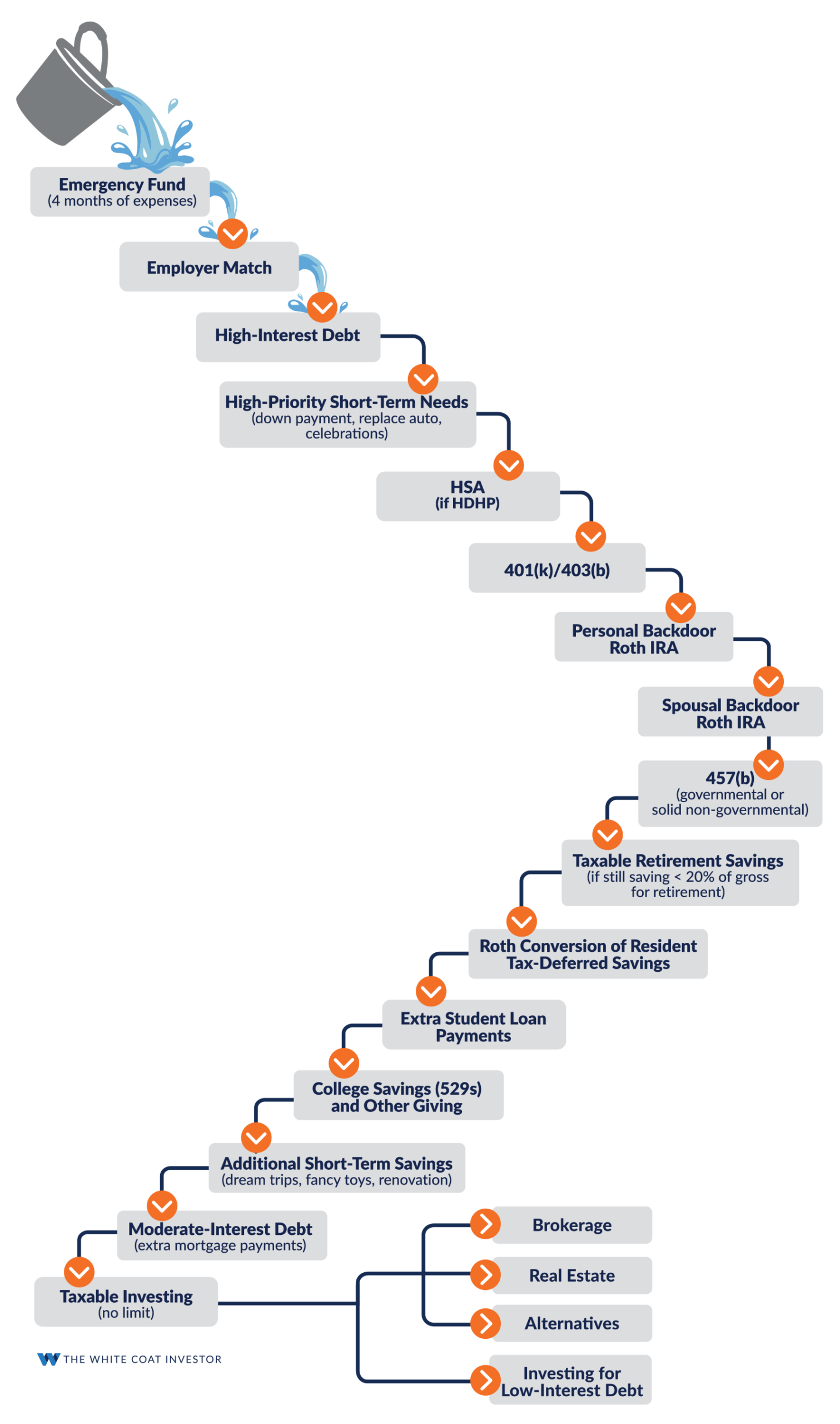
You will notice that this waterfall is way more interesting (and convoluted) than the resident one above. If you’re like most new attending physicians, you have way more good uses for money than you have money. You probably won’t get anywhere near the bottom of the waterfall for a few years. That’s OK, the water (cash) will get there eventually. The point of the waterfall is to prioritize all of these good things to do with money and make sure they’re aligned with what you value. Let’s go through it step by step.
Emergency Fund
This is still important for attendings, and since you’re probably spending at least a little more money than you did as a resident (few of us are disciplined enough to TRULY live like a resident), you probably need to beef it up a bit.
Employer Match
It’s still free money you don’t want to leave on the table, but as an attending, you’re more likely to get it (at least after that first year) and it’s probably a lot more money.
High-Interest Rate Debt
Paying off high-interest rate debt is the best investment available to most people. Paying off a 30% credit card, a 15% car loan, or a 12% private student loan is a FANTASTIC guaranteed investment. Even 7%-10% is pretty darn attractive, given how much risk you must take to earn that much in the markets. Make sure you prioritize paying off high-interest rate debt. Need some motivation? Maybe read this.
High Priority Short-Term Needs
Guess what? Life happens. Maybe you’re getting married and need to pay for a honeymoon. Maybe that beater that got you through med school and residency is now on its last legs. Maybe you like your job and your job likes you, and it’s time to buy a house. Funding these short-term needs has to come from somewhere, and sometimes they’re a higher priority than longer-term needs like retirement savings, paying off student loans, and saving up for college. The fun part about personalizing your waterfall is YOU get to decide which ones are the high-priority short-term needs.
Health Savings Account
HSAs are still triple tax-free, and that’s even more valuable as a new attending. If a high deductible health plan is right for you—and it often is for young docs—make sure you fund and invest in an HSA.
Retirement Accounts
If there were an account where your money grows faster, is easily distributed to heirs when you die, and is protected from your creditors, would you want to invest in it? Guess what, you’re in luck. This account exists, and it is often provided by your employer. It’s called a 401(k) or a 403(b). Fund it next. If you’re self-employed, start a solo 401(k). If you’re both an employee AND self-employed, you can actually do both.
Roth IRAs
Roth IRAs are still great investments. As an attending physician, you almost surely have to fund yours via the indirect (backdoor) method. Don’t forget the spousal Backdoor Roth IRA either.
457(b)s and Other Deferred Compensation Accounts
These can be really great accounts to use to save more for retirement after you’ve already maxed out available 401(k)s and Roth IRAs. Note that governmental 457(b)s are basically just a second 401(k), but non-governmental 457(b)s are available to your employer’s creditors and often have much less attractive distribution options after you retire. Investigate carefully before using one of those. You still may want it, but it’s not the no-brainer that a governmental 457(b) is.
Taxable Retirement Savings
I give residents a pass on saving for retirement, but attendings get no quarter. You need to save 20% of your gross income every year for retirement. If you didn’t stuff that much into 401(k)s, Roth IRAs, and 457(b)s, you need to make up the difference in a non-qualified, taxable brokerage account before moving down the waterfall.
Still have extra money? Good for you. We’ll just let it keep flowing. But don’t feel bad if you’re in your first year or two out of residency and you’re already out of money at this point in the waterfall.
Roth Conversion of Resident Retirement Accounts
If you couldn’t make Roth contributions in your resident retirement account, consider converting them into your Roth IRA the year you leave residency. There’s a tax bill associated with this, but it’s probably lower this year than it ever will be again.
Extra Student Loan Payments
What do I mean by “extra?” You have funded a student loan payoff plan already. Perhaps that plan is to pay off your loans in four years. Well, now you’ve got some extra cash. How would you like to be done with those loans in 3 1/2 years instead? Sounds pretty good, right?
Don’t fall into the trap of, “They’re only 5%-6%; I’ll bet my investments can do better than that.” Maybe you’re one of those rare docs who really invests the difference and whose prescribing habits aren’t affected by Big Pharma advertising, but you’re probably not. Yes, the long-term math is likely to work out, but the long-term behavior usually doesn’t.
College Savings
Are your student loans paid off? Have any kids? Maybe it’s time to start saving for them so they don’t have the same loans you had. Most parents start with a 529 account to save for their college (and/or private K-12). But you can also save for your kid’s retirement with a 530A (Trump) account. You can save for their “20s fund” with a UTMA. If they’re disabled, fund an ABLE account. Plenty of options here.
Additional Short-Term Savings
Still not out of money? Why not spend some of it? All that stuff you’ve dreamed about buying or doing? It’s time to do it. Don’t borrow to do it; save up the money first. But then spend it guilt-free.
Moderate-Interest Rate Debt
Got a mortgage or other 4%-7% debt? How would you feel about getting rid of it and improving your cash flow situation? We paid off our mortgage 11 years out of residency, and we haven’t missed it a bit.
Taxable Investing
Still got unused cash flow you don’t want to spend on anything? You can always invest more in “taxable” whether that is some index funds in your brokerage account, a few real estate properties or syndications, or maybe some precious metals or other alternatives. Go wild.
Low-Interest Rate Debt
It’s hard to make a mathematical argument to pay off debt with an interest rate less than what money market funds are paying; that’s why it is at the bottom of the waterfall. But some people have enough money to get to the bottom, and this is what they find.
What do you think? Do you agree with these waterfalls? Why or why not? What would you change or add?
[This updated post was originally published in 2018.]
Did you find this article helpful? Share it!