

Back in 2013, I was pitched an IUL policy. Recently engaged and starting a multiple sclerosis fellowship, I was beginning to think more seriously about finances. An old friend had taken a new job as a financial advisor—a strange choice as his degree was in an unrelated field, and he had no prior experience in money management. He explained that as part of his training, he was asked to bring friends and family for a free meeting with his supervisor.
I quickly agreed, certain he would do the same for me.
The IUL Pitch
The supervisor was young, confident, and charming. There was no pressure or questions about my finances, but he had the gift of gab.
“Did you know that a lot of people are overpaying for common recurring expenses like car insurance? We can shop around and get you the same coverage for a lower price. Do you know a quick way to calculate how long it will take an investment to double? Use the rule of 72: Divide 72 by the return, and you get the number of years it takes (i.e., with a 9% return, eight years). Retirement is a long way away, but planning is important since no one can earn income forever. Do you know how the famed Dodgers announcer Vin Scully keeps working?”
A die-hard fan, I caught him off guard: “He only does home games and takes a break in innings 4-6.” He nodded approvingly, and we both agreed I couldn’t count on working into my late 80s, like Scully had.
And then came a warning delivered so smoothly and pristinely that it must have been practiced a thousand times.
More information here:“Did you know that Social Security is underfunded and not able to meet its future obligations? With the rising national debt and demographic changes, experts project significant increases in future taxes. High-income professionals are a perfect target, and they are often above the income limit for a Roth IRA. The stock market is volatile, and valuations are forebodingly high. Your secure retirement could be in peril, but we have a solution.”
What Is an IUL?
Enter Indexed Universal Life (IUL). This product combines universal life insurance with an investment component. Unlike term life insurance, universal life is permanent, lasting your entire life and eventually paying out. Because claims represent a loss for the insurance company, the product is much more expensive, often 10X-20X the cost of term insurance for the same death benefit.
The other part of your premium payment goes to the investment component of the IUL, which is indexed to a benchmark such as the S&P 500. But instead of the market return, the insurance company credits you with an artificial return, and they will include a “floor,” often at 0% to protect you from losses. This is offset by a “cap,” or maximum return, perhaps at 10%-14%. Here are the credited interest rates on an IUL from Allianz (averaging 6.4% between 2006-2023).
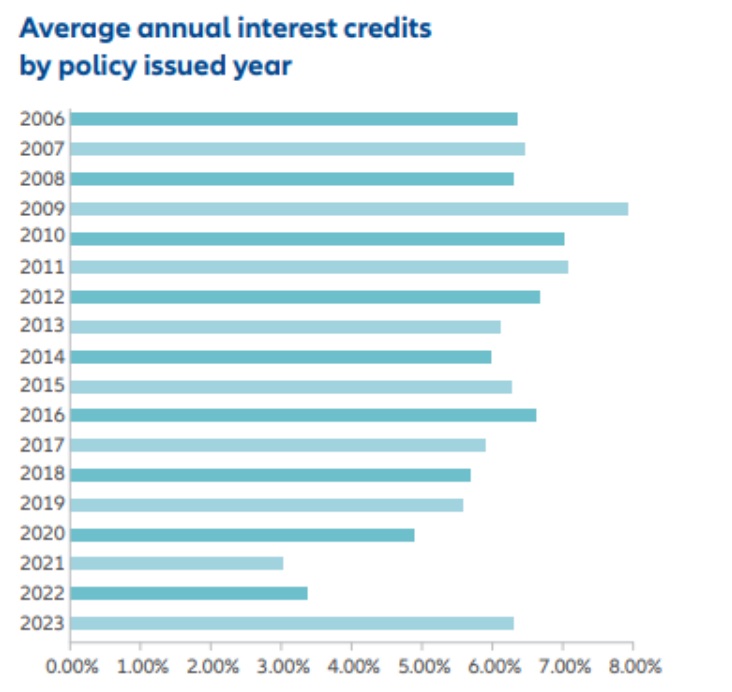
As Doug Andrew, an IUL agent, said, “Imagine a casino where you never lose your money, and you often gain up to 10% or more. That’s how indexing works in a properly structured IUL.”
Furthermore, the insurance company will let you borrow money against the policy, and loans—as opposed to 401(k) distributions, pensions, W-2 statements, etc.—don’t count as income per the IRS and aren’t taxable. You’ve just created a giant risk-free Roth IRA!
But this is the same trick as every drug commercial. When you speak only about the upsides and not the downsides, everything looks good.
More information here:- Universal Life Insurance for Physicians: Is It Worth It?
- Why Whole Life Insurance Is a Bad Investment—Debunking the Myths
The Negatives of an IUL
Nonetheless, even a “good” IUL policy has the following drawbacks:
- Large first-year fees: Money lost from your cash value to the agent’s commission and other policy expenses is front-loaded, often 50%-100% of the premiums you pay in the first year. Because of these early fees and the high cost of insurance, a typical policy may not break even for 10-15 years.
- No dividends: The credited interest rate in IUL policies does not consider stock dividends, a significant proportion of the total long-term return (about 30% historically). For instance, if the actual index returns 5% but 2% of this is dividends, you only get 3%. Thus, you will trail the market whenever the total return is >0%, about 75% of the time.
- Participation rates: The policy owner (you) does not always achieve the full credited interest rate. Your “participation rate” could be reduced from 100% to, say, 80%, and you would only get this percentage of the return. For instance, at 80% participation, a 5% credited interest would be lowered to 4%.
- Cap rates: While the colorful brochure advertises a sexy high-capped interest rate like 12%, the fine print of the contract you will sign may allow the insurance company to lower it, often at its discretion.
- More fees: Unfortunately, fees and commissions are paid throughout the life of the product. Commissions can range from 1%-3% per year. Other ongoing costs include admin fees, premium loads (money taken out of each premium payment), index crediting fees, insurance costs (which rise with age), and a policy fee. There are also charges for specific riders, such as those that allow you to withdraw funds for a critical illness.
- Loan interest: While you can avoid taxes by borrowing against the policy, the issuer charges interest, typically around 5%-6%. This may be less than your return, so you might not see the cash value decline, but it saps your future compounding gains.
- The MEC: The IRS has strict limits on IUL policies. If they are overfunded relative to the insurance component, they become a Modified Endowment Contract (MEC), and loans and withdrawals of the cost basis are no longer tax-free. There would also be a 10% penalty on withdrawals prior to age 59 1/2, just like with some retirement accounts.
The main point is that the advertised promises of consistent growth between the “floor” and “cap” are a mirage because you won’t get this return on your premiums—only on a lesser (often much lesser) dollar amount. If you pay $10,000 in premiums and get a 10% return on $5,000, is it really 10% growth? Meanwhile, $10,000 in a Roth 401(k) really would go up to $11,000. The protection offered by the “floor” is another mirage. When the insurance company does poorly—let’s say because the options they purchase to maintain the policy expire worthless—they are contractually allowed to pass this loss onto you by lowering the cap rate or decreasing the participation rate. So, who exactly is taking the risk?
A WCI follower even then, I passed on the IUL. My friend quickly became disenchanted with his employer, realizing he was hired for his social network rather than his expertise. Before quitting, he unfortunately purchased his own IUL policy. That’s right: snake oil salesmen believe in snake oil and take it themselves. Luckily, he could cancel without penalty during the 30-day “free-look” period. His ex-supervisor, who once endeared himself as a mentor, harassed him ruthlessly as the cancellation undermined his own metrics and compensation.
The lesson is simple. Be aware of the incentives of anyone offering financial advice, and never sign up for something you don’t fully understand.
Have you ever bought an IUL policy? What happened? Was it worth it? Would you do it again?
Did you find this article helpful? Share it!