

Today, we talk with anesthesiologist and palliative care physician Dr. Sarah Gebauer, author of Go Anyway: The Practical Guide to Long-Term Travel with Kids, about how she and her family have taken 3-5 month international sabbaticals while maintaining a successful medical career. She and Dr. Jim Dahle discuss building a workable sabbatical policy, using trusted locums coverage, and why living abroad can sometimes cost less than staying home. They also cover how physician families can navigate schooling, friendships, different practice settings, and dual-physician careers while creating more flexibility and reducing burnout. Financial independence is not just about growing wealth. It is about creating the freedom to spend more time with the people and experiences that matter most.

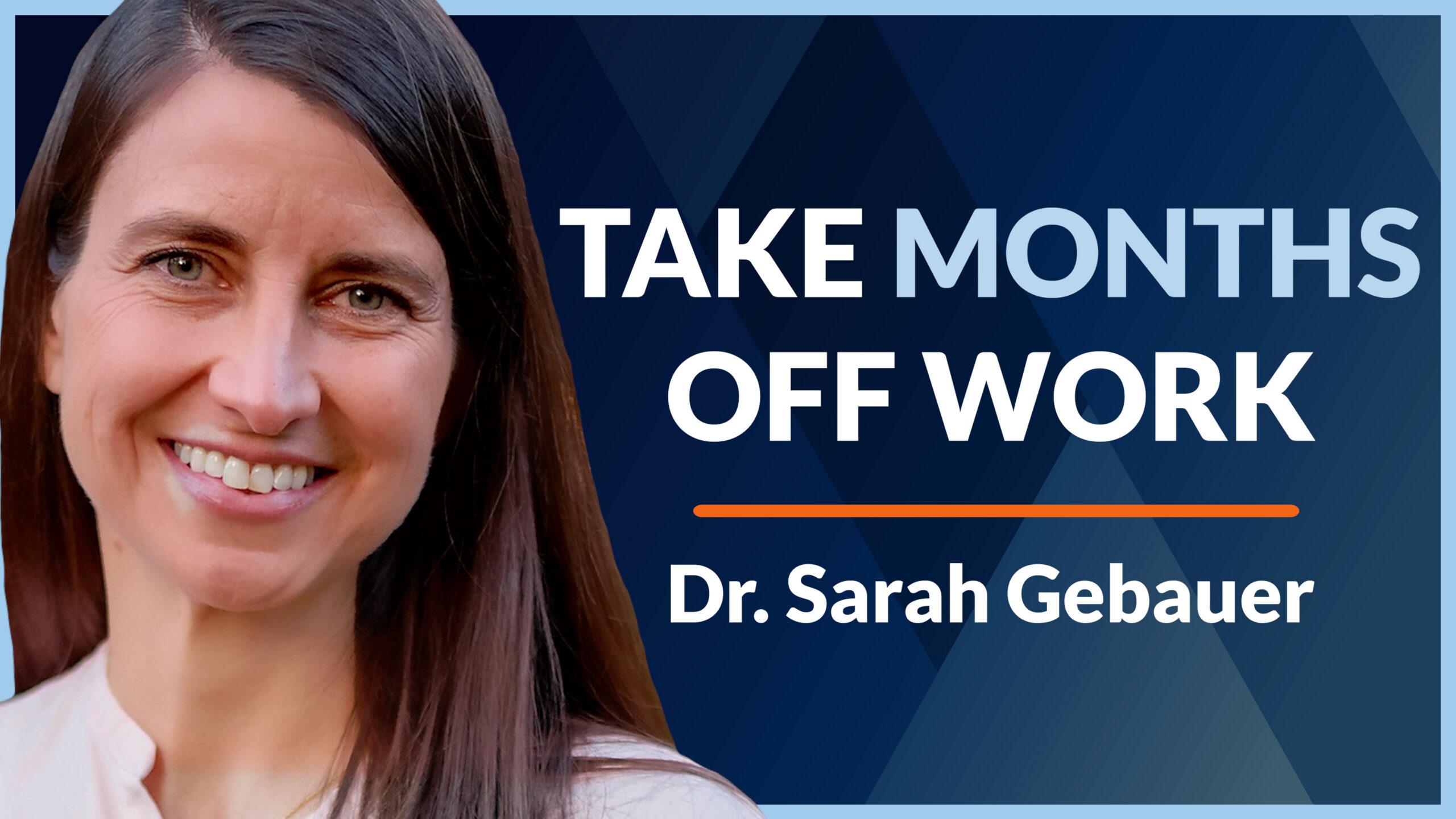



Making Long-Term Family Travel Possible Without Sacrificing Your Career
Dr. Sarah Gebauer explained that the biggest obstacle to extended family travel is rarely money or logistics. It is believing that it simply cannot be done. She wrote Go Anyway after hearing physicians express one of their biggest regrets—that they always intended to take their families on a long trip but waited until the opportunity disappeared. She emphasized that her family is not independently wealthy, did not grow up traveling, and built this lifestyle through careful planning rather than extraordinary circumstances. Instead of accepting obstacles as permanent, she approached each one like a medical problem, identifying every barrier and finding a practical solution. That process included writing a formal sabbatical policy for her anesthesiology group, finding trusted locum physicians to cover both her practice and her home, and working collaboratively with her partners so the arrangement benefited everyone.
She also highlighted how financial independence creates options that many physicians underestimate. Sarah explained that while she works 3-5 months less each year, the reduction in income is smaller than expected because the lost income comes from her highest tax bracket. She also works additional shifts before and after each trip, when she returns refreshed rather than burned out. Her family intentionally spends very little on material possessions, choosing experiences over expensive homes, boats, RVs, or luxury items. That lifestyle allows them to redirect money toward extended travel without compromising long-term financial goals, including continuing to maximize retirement accounts most years.
Jim pointed out that every physician can quickly generate reasons why this type of travel would not work for them, from demanding practices to children’s activities. Sarah argued that every family has unique challenges, but many can be solved creatively with enough planning. She shared examples of partners in her own practice who later used the same sabbatical policy for their own extended trips, demonstrating that creating flexibility often benefits an entire practice rather than just one physician. While some specialties have more logistical challenges than others, she believes many physicians could negotiate longer leaves than they initially assume.
Sarah addressed the concern of lacking skills or being out of practice, coming back to work after months off. She found that her medical knowledge remained sharp, with the biggest adjustment being changes to electronic documentation rather than clinical skills. More importantly, stepping away from constant work created mental space to reflect on her career and personal priorities. During one sabbatical, she became fascinated with artificial intelligence, studied it extensively simply out of curiosity, and unexpectedly launched an entirely new career in healthcare AI. Rather than harming her professional trajectory, the extended break ultimately expanded it in ways she never anticipated.
More information here:- WCI Travel Club: Meaningful Trips to Half Dome, Thailand, and Alaska
- When Everything Clicks into Place: How Foreign Travel Can Make You a Better Doctor
Educating Kids, Building Family Relationships, and Experiencing the World Together
One of the biggest concerns physicians have about long-term travel is how it affects their children, and Sarah spent much of the interview explaining how her family has navigated education, friendships, and activities. When her children were younger, homeschooling consisted primarily of daily reading, math, and language practice that mirrored habits they already followed at home. As her older children entered high school, they transitioned to accredited online courses that transferred directly back to their traditional school. Sarah even contacted several competitive universities, including Stanford and Emory, to understand how admissions offices viewed online coursework after COVID. The consistent advice was to focus on rigorous, recognizable courses—such as AP classes—rather than unconventional electives so colleges could easily evaluate academic preparation.
She noted that despite spending months abroad, her children have consistently returned academically prepared and often ahead of their classmates. Socially, her family discovered that children adapt far more easily than adults often expect. Although the kids initially worried about leaving friends behind, they quickly reconnected when they returned home. Traveling with four siblings also meant they always had built-in companions throughout the journey. Sarah encouraged parents not to interpret children’s initial reluctance as proof that travel is a bad idea. Her own children resisted the first trip because they feared leaving familiar routines, but by the end, they wanted to continue traveling rather than return home.
The family’s travels have also become an immersive education that extends well beyond traditional classrooms. Rather than simply reading about evolution, the children explored the Galápagos Islands, where Darwin developed many of his ideas. They studied Middle Eastern history while traveling through Morocco, Egypt, and Jerusalem. They spent months living in Spain, where they attended a regular Spanish-language Montessori school despite knowing only basic Spanish beforehand. Later trips included exploring Southeast Asia, the Balkans, Eastern Europe, North Africa, Greece, and the French Alps while learning French together as an entire family. During their current travels, they are studying both Arabic and French while living in Morocco.
Jim emphasized that these experiences provide educational benefits that cannot easily be replicated at home. Travel exposes children to different cultures, governments, businesses, languages, and ways of living while teaching adaptability and confidence. Sarah added that spending months together without the constant pull of sports schedules, extracurricular activities, and work commitments dramatically strengthened their family relationships. Living together around the clock forced deeper conversations, helped them as parents and children solve unfamiliar problems together, and created memories that became far more valuable than any material purchase.
More information here:- It’s a Lifestyle, Not a Vacation
- From Road Trips to Bush Planes: Getting to All of the National Parks on an Evolving Budget
Keeping Costs Low, Overcoming Common Objections, and Taking the First Step
Sarah challenged the common assumption that extended international travel must be prohibitively expensive. She explained that everyday living expenses in many countries are actually lower than in the United States. Housing, groceries, children’s activities, transportation, and even private school tuition can cost significantly less abroad. During one stay in Spain, her family rented a three-bedroom apartment for about $1,200 per month, while local Montessori tuition cost only a few hundred dollars monthly. The largest travel expense is frequent transportation between destinations, which is why families can dramatically reduce costs by staying in one location longer. Her own family further controls expenses by traveling with only one backpack per person, using buses, staying in simple accommodations, and avoiding unnecessary purchases.
The interview also explored practical concerns physicians frequently raise. Some worry about maintaining continuity of patient care or protecting referral relationships, particularly in specialties such as surgery or primary care. Sarah acknowledged those concerns but believes creative solutions often exist, including locum coverage, virtual work where appropriate, or shortening the length of travel if necessary. Others fear homeschooling, career setbacks, or children’s resistance. She explained that online education options expanded dramatically after COVID, making flexible schooling far more accessible than it once was. She also argued that children frequently become enthusiastic travelers after experiencing life abroad, even if they initially resist leaving home.
Jim and Sarah also discussed how different families can customize this lifestyle rather than copying one specific model. Some physicians may continue working remotely while living overseas, as White Coat Investor COO Brett Stevens recently did during a three-month stay in New Zealand. Others may pursue early retirement and spend years slow traveling, as many in the FIRE community have done. Some families may only travel for a month, while others stay abroad for an entire school year. The important point is that financial independence provides flexibility to design a life that matches a family’s own priorities rather than someone else’s expectations.
Sarah closed by encouraging physicians to begin with a conversation rather than a detailed itinerary. She recommended discussing the idea openly with a spouse, identifying what type of travel would appeal to both partners, and then honestly evaluating the family’s finances with flexibility instead of assuming current spending patterns are fixed forever. Once a family commits to making extended travel a priority, many of the logistical barriers become solvable. Jim concluded by reminding listeners that the ultimate purpose of financial freedom is not simply accumulating wealth but creating the ability to pursue meaningful experiences, whether that means traveling the world with children, changing careers, working part-time, or following another lifelong dream.
To learn more from this episode, read the WCI podcast transcript below.
Sponsor
Today’s episode is brought to us by SoFi, the folks who help you get your money right. Paying off student debt quickly and getting your finances back on track isn’t easy, but that’s where SoFi can help—it has exclusive, low rates designed to help medical residents refinance student loans—and that could end up saving you thousands of dollars, helping you get out of student debt sooner. SoFi also offers the ability to lower your payments to just $100 a month* while you’re still in residency. And if you’re already out of residency, SoFi’s got you covered there, too.
For more information, go to sofi.com/whitecoatinvestor
SoFi Student Loans are originated by SoFi Bank, N.A. Member FDIC. Additional terms and conditions apply. NMLS 696891
Milestones to Millionaire
#283 — How This Doctor Became a Millionaire at 38
Today, we are talking with a physician who reached a $1 million net worth by age 38 while also receiving more than $300,000 in student loan forgiveness through Public Service Loan Forgiveness. We discuss the financial habits and decisions that helped build wealth early in his career, how loan forgiveness accelerated his progress, and the lessons he learned along the way. Reaching financial independence is rarely about one big win. It is the result of making consistently smart decisions with your income, debt, and investments over time.
To learn more from this episode, read the Milestones to Millionaire transcript below.


Sponsor: Goodman Capital
Financial Boot Camp Podcast
Financial Boot Camp is our new 101 podcast. Whether you need to learn about disability insurance, the best way to negotiate a physician contract, or how to do a Backdoor Roth IRA, the Financial Boot Camp Podcast will cover all the basics. Every Tuesday, we publish an episode of this series that’s designed to get you comfortable with financial terms and concepts that you need to know as you begin your journey to financial freedom. You can also find an episode at the end of every Milestones to Millionaire podcast. This podcast will help get you up to speed and on your way in no time.
Buying a Car
For most physicians, buying the wrong car is unlikely to derail their financial future because their income is high enough to absorb an occasional mistake. However, for many people, overspending on vehicles is one of the biggest obstacles to building wealth. Reliable transportation does not have to be expensive, and dependable used cars can often be purchased for $5,000-$10,000. Because cars are depreciating assets that simply provide transportation, spending significantly more than necessary often comes at the expense of investing, paying down debt, or reaching other financial goals. Wealth is determined by what you keep after earning and spending, not by the vehicle sitting in your driveway.
The recommendation is to buy less car than you can comfortably afford, particularly while you are still building wealth. Before purchasing a more expensive vehicle, it is worth considering whether that money would have a greater impact if it were invested, used to fund retirement accounts, saved for a child’s education, or spent on experiences that better align with your values. Modern vehicles are already much safer than older generations, and the improvements found in the newest model year are often relatively small. Buying a quality used car, especially from a private seller, can provide excellent value while avoiding much of the depreciation that comes with purchasing new.
Whenever possible, cars should be purchased with cash rather than financed. If a loan is necessary, it should be paid off quickly, and the same monthly payment can then be redirected into savings to fund future vehicle purchases. Buyers should also remember that dealerships are motivated to sell financing, longer loan terms, and more expensive vehicles, so it is important to stay focused on what you actually need. The total cost of ownership extends beyond the purchase price and includes maintenance, repairs, insurance, and depreciation. Ultimately, spending on a vehicle should reflect your priorities. If cars are truly a passion and your financial goals are already on track, spending more may be reasonable. Otherwise, choosing reliable transportation over luxury can free up significant resources to build long-term wealth.

To learn more about buying a car, read the Financial Boot Camp transcript below.
WCI Podcast Transcript
INTRODUCTION
This is the White Coat Investor podcast where we help those who wear the white coat get a fair shake on Wall Street. We’ve been helping doctors and other high-income professionals stop doing dumb things with their money since 2011.
Dr. Jim Dahle:
Welcome to the White Coat Investor podcast.
Today’s episode is brought to us by SoFi, the folks who help you get your money right. Paying off student debt quickly and getting your finances back on track isn’t easy, but that’s where SoFi can help. They have exclusive low rates designed to help medical residents refinance student loans. That could end up saving you thousands of dollars, helping you get out of student debt sooner.
SoFi also offers the ability to lower your payments to just $100 a month while you’re still in residency. And if you’re already out of residency, SoFi’s got you covered there too. For more information, go to sofi.com/whitecoatinvestor.
SoFi student loans are originated by SoFi Bank, N.A. Member FDIC. Additional items and conditions apply. NMLS 696891.
All right. We have a great interview today. You’re going to love it. You’re going to love it because you deserve it. You deserve the information you get on this podcast and you deserve the opportunity that we’re going to be talking about today on this interview. It’s a pretty awesome opportunity. It’s going to take a little bit of work, but it may change your life and your family’s life in a lot of ways that you may not even think possible as we just get started into this.
Thanks for what you do out there day to day and recognize that with a few tweaks, you might be able to have a significantly different life while still doing what you’re doing. It’s so important out there.
Before we get into it though, I want you to know about Financial Boot Camp. Those of you who are just listening to this podcast for the first time or relatively new listeners or still catching up to everybody else, feel like you don’t know everything. We have two versions of Financial Boot Camp. Actually, we kind of have three because there’s a book called The White Coat Investor’s Financial Boot Camp too.
But the two versions, one is a podcast version. And if you go to whitecoatinvestor.com/bootcamppodcast, you can get all of those podcasts. You’ll notice you’ll hear some of them if you listen to the Milestones to Millionaire podcast. We tend to tack one on to each one of those. But if you just want to listen to them separately, you can do that.
Go to whitecoatinvestor.com/podcastbootcamp or whitecoatinvestor.com/bootcamp podcast. Let’s do both of those. Can we just set it up so it’s podcast bootcamp too? And that way, even if you guys screw up the URL, you’ll still get to the right place. Totally free. Totally free education for you, gets you up to speed with everybody else.
We also have an email version. And if you go to whitecoatinvestor.com/bootcamp, you’ll get the email version. And just like the podcast, it’s totally free. You can unsubscribe at any time. There’s no commitment here. 98% of what we do here at White Coat Investor is totally free to you.
These resources will help you get up to speed in no time. You’ll get the high yield information that you need to know in order to feel a part of the White Coat Investor community. But more importantly, get your financial ducks in a row. So you can start benefiting from the financial freedom that starts flowing into your life the second you start using money as a tool and set it into its proper place in your life. So it’s not running your life, but it is enabling you and empowering you to have the life that you deserve.
Now, let me tell you what a White Coat Investor has done with that financial freedom. This is the best part about this. After we finished this interview, we had a long chat, she thanked me for putting the White Coat Investor stuff together and pointed out that the life that she has put together that you’re about to hear about is in large part due to getting her financial ducks in a row early in her career.
They learn to manage money and they learn to define their financial priorities and spend their money on what they value. And optimize the rest of their finances to allow them to do that. So, our discussion, our topic today is long-term travel with kids. I think you’re really going to enjoy this interview. So let’s get our guests on the line and get into it.
MAKING LONG-TERM FAMILY TRAVEL POSSIBLE WITHOUT SACRIFICING YOUR CAREER
Dr. Jim Dahle:
Our guest today on the White Coat Investor podcast is Sarah Gebauer. She is an anesthesiologist and palliative care physician. She’s traveled to over 50 countries with her husband and four kids. She has taken three to five months sabbaticals each year for the past four years while working as a partner in a private practice anesthesiology group.
She is also a healthcare AI expert having worked at RAN and doing AI model evaluations for National Security and founded Validara Health to help healthcare AI companies with AI governance and evaluation. Lives in Steamboat Springs, Colorado when she’s not traveling, which may not be that much of the year based on how much you’re traveling, Sarah. Welcome to the podcast.
Sarah Gebauer:
Thank you and thanks so much for having me. Yeah, I have been such a fan of your podcast and your blog and all of the things that you’ve done over the many years now. I’m thrilled to be here and with all of your listeners with whom I feel a real affinity because I have been reading their comments and their suggestions and their thoughts on the blog and on different groups for many years as well.
I am one of you. I have been there from the beginning and so I’m thrilled to be here and to get the chance to talk about really my favorite subject, which is how to explore the world with your family and to do it in a not expensive way that will not derail your family’s future.
Dr. Jim Dahle:
Awesome. So, for those who are not aware, Sarah has a book out. Those of you watching this on YouTube, I’m holding it up here. The title is Go Anyway: The Practical Guide to Long-Term Travel with Kids. Pretty awesome book, pretty awesome title. Sarah, why did you decide to write a book?
Sarah Gebauer:
Yeah, after we finished our fourth trip, what we call our big trips, I have been talking to some friends and some other physicians and a couple times they said something that really stuck with me, which was these were older physicians kids in their late teens, early 20s, mid 20s, and they said we always wanted to do that. And it was never quite the right time. We never could figure out how to make it work from a financial standpoint. There was always some reason that we just didn’t go.
And now it’s one of my biggest regrets. And we missed that window. We’ll never get it back. It’s something that I’ll just have to live with for the rest of my life that we never had that experience with our kids, even though we really wanted it. We wanted it to happen.
And I don’t want other physicians to have that feeling. This is something that’s very much within reach of normal physicians. We do not have a trust fund. We are totally from normal families who did not help us with anything. And we figured how to do this on our own.
The impetus for writing the book was really to help those others. I was thinking of the White Coat Investor readers, really, when I was writing it, those other kinds of people who are like, this seems great, but logistically, it just seems so overwhelming. I was trying to put together some of the logistic pieces for people to make it seem because it is really doable.
Dr. Jim Dahle:
So, is this a passion project? Is this a business? Is there a blog and a podcast called Go Anyway? Or what is this?
Sarah Gebauer:
Not at this point, I was just so excited about being able to help other physicians. The most rewarding thing has been that I’ve been hearing from physicians and even non physicians, just professionals who say I read this, and now I feel like this is something I can actually do. And that to me is, that’s what I wanted. If I just helped one person be able to fulfill this lifelong dream that they may have had, that was the reason for writing the book. I am just so passionate about helping people do this, because it’s been such a special experience for our family.
I think many people can relate to. We have four kids. They’re doing all the activities, all the things, they’re in the soccer and the music stuff and the art stuff and the birthday parties. And all of a sudden, you’re all in different places all over the place, and you’re working. And suddenly, you kind of see each other in passing or for a few minutes, even though we sit down and have dinner together every night. But still, a lot of the other time, we are in all kinds of places.
The travel has been really special, because we are forced to be together as a family, whether we like it or not, 24 hours a day, seven days a week, and doing all kinds of things that we would never do otherwise. And having all kinds of conversations that we would never have otherwise has been a really special way to get to know each other better as a family and for the kids to see us in challenging situations and see us navigate things that we normally wouldn’t have to do in our normal lives.
And then also for them to ask questions about the world and the people and how people live and why we make certain choices that other people don’t make. And that has really brought us closer as a family. So, to me, it’s the most special time we’ve spent as a family has been on these trips. And that kind of gift is something that I would love to facilitate other people to be able to give to their families.
Dr. Jim Dahle:
So, quantify this. For the last four years, you’ve gone for three to five months a year. Is that right?
Sarah Gebauer:
It is. Yeah.
Dr. Jim Dahle:
That’s more than a year of those four years that you were gone traveling.
Sarah Gebauer:
Oh, yeah. Yeah. And usually what we do, just kind of contextually, is we’ll leave the latter part of the summer. And our school, especially for our younger kids, is on a trimester system. So, we take them out for the first trimester of school. And we have them back for the second trimester, which starts in November in our school system. This year will be gone for the entire semester because our kids are older and they’re now on a semester system.
But it does add up to quite a bit of time. I’ve been really lucky to have amazing partners in my private practice group who have been fine with me finding trusted locum stocks who come and stay at our house and work for me and live at our house, take care of our cats. And it’s been a great situation for them. They get to live in a resort town.
Dr. Jim Dahle:
They took your house and your job and your cats.
Sarah Gebauer:
Yeah. I know.
Dr. Jim Dahle:
How did you work that out? That’s awesome.
Sarah Gebauer:
I always thought that that would just, that was just like, fine sky would never happen. And I managed to do it four years in a row. So I think it does make sense. There are people looking for these kinds of situations in the world. You just don’t know until you start asking around and really trying to make it happen.
Dr. Jim Dahle:
You are an expert at this. That is so impressive that you lined all that up with one person to solve all these issues. Because there are a whole bunch of people out there listening to this going, “Oh, that wouldn’t work for me because of this, this and this. Everybody’s got this, this and this. My kids are too old. My kids didn’t travel hockey. No way would my partners let me do that. I’d have to get a new job. I don’t know how we could lose a quarter of a year’s income to do this.” All these things. And yet you said, “Despite all that, we’re going to solve those problems.”
What makes you different, I think, from somebody out there sitting in White Coat Investor podcast land going, “I can’t do this.” Are you different from them? Do they just need their matrix experience where their mind will be open to this possibility? Or are you different from them?
Sarah Gebauer:
I am not different than them. I did not have a passport until I was 20. I did not grow up traveling. My parents don’t have passports. This is not a thing that I did regularly. I did start traveling pretty regularly when I was younger, like my 20s. And so, I am probably more experienced in traveling than some other people, but foundationally very much the same. I have a job, I have bills to pay, I have things that need to get taken care of.
The only thing that made me different was just kind of approaching it really kind of how a doctor would approach any medical problem, which is like, “Okay, what are the issues? And how can we figure those out?” And so, I just went down the list of, “Okay, how am I going to keep my job? We love our town. We love our community. How can I stay there and still do this trip?”
And so, I wrote a sabbatical policy. I have a great group of partners. They were kind of like, “Sure, as long as it doesn’t cost me time or money that’s probably fine. We want to know who’s going to replace you. We want to be able to approve that person and make sure it’s not a complete crazy person that everyone’s going to hate.” But as long as those things are true, then it’s fine.
And then the really rewarding thing has been that now they have taken sabbatical. So they’ve actually used this policy that they had never really thought about developing. And one of them went on a month-long biking trip through the Rocky mountains. One of them went to visit extended family in Ireland for a month and got to meet her cousins and extended cousins and this huge Irish clan that she hadn’t really gotten to spend time with before.
That’s been really neat too, I put this policy in place really for me. But it’s been great to see the other people in my group take advantage of it as well. And then after that was solved, the money piece, it’s a big piece and we are very, very frugal. We are White Coat Investor people, but the real, almost crazy side of the White Coat Investor people.
Dr. Jim Dahle:
Optimizers. That’s what we call people like that.
Sarah Gebauer:
There we go. Yes, we are. We are real optimizers. And part of it for us is that we don’t care about a lot. We’re not things, we just don’t really care about things very much. And that’s been very helpful. So, it hasn’t felt like deprivation at all. I drive the oldest car in the parking lot and our furniture has had many children pee on it over the years that with four kids.
Dr. Jim Dahle:
There’s no boat, there’s no RV, there’s no second home.
Sarah Gebauer:
No, no huge toys, none of that. But in exchange, we’ve had these amazing experiences and something that’s been actually kind of surprising has been that my income hasn’t decreased that much on the years that we’ve traveled. You’d think it’d be a huge difference.
Dr. Jim Dahle:
Especially after tax, because you’re dropping the most highly taxed income.
Sarah Gebauer:
Exactly. We’re dropping those highly taxed income. We’re not taking as many vacations during the year as we normally would. We don’t want to, we’re happy to be home. I get settled in and get to see all of our friends and kind of get back in the routine of being home.
And so, a lot of people might take 10 weeks of vacation over a year. That’s a pretty normal amount of vacation for a lot of private practice groups. So if you just saved it all pretty much for one chunk, that’s more or less what we’re doing. And the income didn’t go down nearly as much.
I was also happy to work extra, take extra calls, take extra shifts, both before and after we got back, just because I wasn’t burned out or I was excited. I was like, “Sure, I’ll take another shift. I know that’ll pay for this flight to Borneo or whatever.” It’s much more motivating when you have that. Or if I haven’t worked for three months, I’m like, “Sure, I’ll take another shift. I don’t mind having been working.”
It was easy to make up that difference. I think everyone was surprised, both me and my partners and my husband. We were all surprised how little that actually impacted how much I made.
Dr. Jim Dahle:
Part of the issue of taking time off. And I’ve noticed this when I’ve had three or four weeks off at a time. I’m not quite as sharp when I come back. It takes me a few shifts to kind of get up to speed. Have you noticed that at all after being gone for three to five months? Do you feel like it takes a week to warm back up? Or how do you feel like that fits in with your clinical skills?
Sarah Gebauer:
Yeah, it’s a great question. And it’s something that I was definitely worried about. I have not noticed any decrease in clinical skills. What I’ve noticed is a decrease in my efficiency at charting. The medicine is often the easy part, or this is what I know how to do. I’ve been doing this a long time. It’s the, “Okay, now I have to do this computer piece that is new or that I didn’t use to have to do or something.” That’s been the real challenge going to and from, honestly. Otherwise, it has not been an issue at all.
EDUCATING KIDS, BUILDING FAMILY RELATIONSHIPS, AND EXPERIENCING THE WORLD TOGETHER
Dr. Jim Dahle:
Now, Katie and I, we do a lot of traveling. Katie loves traveling. She loves it way more than I do, which is one of the obstacles we have to do in more traveling is that I’m like a couple of international trips a year, I’m kind of good and she’s like, let’s go on a couple more. And I’m like, I don’t know how much I want to do that. So, that’s one obstacle.
But the bigger obstacle for us at this stage of life is not actually work, it’s kids. Our kids are involved in activities, they’re involved in school. So, walk us through the kid part of this. You’re taking your kids out for a semester. Are you homeschooling them on the trip? Are they trying to cram it in during the summer? Talk to us not only about their education, but about their activities and their friendships and that sort of stuff and how you work through all that to be able to go on these trips each year.
Sarah Gebauer:
Yeah, that’s a great question. And that’s something we were really concerned about when we started this. When we started doing this, my youngest was six, my oldest was 11. They were, frankly, probably the best ages to travel with, because as long as they can read and do math, like they’re not going to get that far behind. And so, we homeschooled, but we were not very adamant about exactly how much they did. We tried to get them to do half an hour of math, half an hour of language. They had to read half an hour a day. This is stuff they have to do anyways at home for us, regardless of their school schedule. So they’re already used to that and they were already in that routine. That was easy.
Once they hit high school, it’s definitely gotten harder. I have two. I have one going into freshman year and one going into sophomore year this year. And so they are having to take online high school courses and get the credits and complete those. And that is definitely harder. They have to take exams. They have to be in a quiet room where they can show that they’re they have an online proctor that’s looking at them while they’re taking the exams, a lot of logistic pieces to that, but also totally doable at the same time.
Scholastically, this is going to make me sound like a complete crazy person, but I actually called, I will tell you, I called a bunch of different competitive colleges because I don’t know if my kids will want to go to a competitive college. I don’t really care. But I don’t want to ruin their chances of it by doing this. I want them to continue to have options if they want them.
And so, I called a bunch of competitive colleges and said, “How do you see online schooling versus going to school in a brick and mortar place?” I called Stanford, Emory, some of our local highly competitive colleges, and all of them said since COVID especially, we see a lot of kids doing some hybrid learning. So maybe they’ll take some classes at the high school, some classes online for a variety of reasons, whether it’s competitive sports or they are more advanced in certain areas and their high school simply doesn’t offer that kind of class. So we’re very used to seeing that.
And they said, the main thing is to just make sure that they take the most normal classes possible. They don’t want them to take art and neuroscience and hula dancing. They’re not going to know how rigorous that is. Maybe it’s harder than AP biology, but the college is not going to look through the syllabus and make sure.
So, have them take AP classes. If they’re on an AP route, just have them take AP classes. If they take AP classes, they do well, and they do well on the AP exam. We know that they’re college ready, and we’re not going to worry about them. And that’s what we’ve been doing. We’ve just been having them take the classes. Our physical school has a great collaboration with an online school. So they’ve just been doing that. The credits transfer very easily.
For our younger kids, we do some online classes and some workbooks, and they have never come back behind their classmates. Somewhat depressingly, they have come back ahead of their classmates, even when we’ve only done half an hour of work a day, which makes me worry a little bit about our schooling system.
Dr. Jim Dahle:
Although part of that might be nature versus nurture. Presumably they got a decent set of genes here.
Sarah Gebauer:
Well, I don’t know. They have forcing them to do things all day. That’s for sure. And then I think the friendship part is hard, and we’re still navigating that as they become teenagers and want more independence. But part of it is having a big family. They already have friends already built into the family, which is nice.
And then part of it is that we return to the same place. And especially when we only are gone for three months, not that much happens realistically in like August, September, October. What do most kids do during that time? Not a lot. Maybe they play some soccer games. That’s probably it.
Pretty quickly, they realized that they weren’t really missing out on anything significant, and they’ve been able to slide right back into their same friendships, their same schools, their same classrooms. We are in a smaller town, which helps because when they go back to school, they are always in a class with somebody they know just because it’s a smaller place. And it’s been pretty smooth transitions every time. We were worried about that too. And for all four of our kids just has not been an issue.
QUOTE
Dr. Jim Dahle:
This is a good place to insert our quote of the day. Our quote of the day today comes from Lewis Carroll, who said, “Actually, the best gift you could have given her was a lifetime of adventures.” That’s pretty applicable. I think Megan picked that for today’s episode.
And you think about all the things you could do for your kids, help them get into this top notch Emory or Stanford or whatever, and get them into some hyper competitive travel sports program, or do all these things for them. And it’s not like travel has no benefits whatsoever. That’s also a pretty awesome gift.
Our kids have seen many, many countries and our daughter who went on what I call a boondoggle trip, she actually got 12 or 14 college credits for it. She went on an international business elective this last year and visited 15 countries on around the world trip. And basically, she was having to teach everybody else on the trip how to travel that she learned growing up with our family.
And so, there are some benefits to getting out meeting people in other parts of the world and seeing how they live and how they run businesses and how they do all these things.
So, let’s pivot for a minute and tell us about the trips where you went and what you did. Everyone’s kind of mulling this over in their mind how they could do something like this. But tell us what you actually did and inspire them to make the sacrifices and make the changes it would take to do this.
Sarah Gebauer:
Yeah, the main thing to know is that whatever you plan for your trip probably will change a bunch of times and that’s okay, too. Do not be deterred if your first plan does not work out exactly how you expect, that is probably how you will have the most fun anyways.
During the first trip, we went to 17 countries. Some highlights are we spent three weeks in the Galapagos traveling to the different islands. To your point about education, learning about we went to where Darwin went and we saw the finches and we saw the tortoises and learned a lot about how evolution was discovered.
And then we went to the Middle East for quite a long time. Through Morocco and Egypt and Israel, Jerusalem. History there is hard to beat. So, our kids learned a ton of history just from doing, like you’re saying.
And then we put the kids in a Spanish school, so a small Montessori school for three months in Spain. They had very basic, like, “Hola, Adiós” kind of Spanish. And we just put them in school and said good luck. And they did great.
Dr. Jim Dahle:
It was just Spanish or a standard school in Spanish?
Sarah Gebauer:
Just standard school in Spanish, just a regular old school. They came home the first day and I was like, “Oh, did you make any friends? Was it okay?” And they’re like, “Oh, yeah, we made friends.” And I was like, “Oh, what are their names?” And they’re like, “Oh, I don’t know. We just played soccer.” You’re like, okay, that’s right. Children do not need this whole social thing. If you play soccer, you have friends. It’s great.
And then we traveled for another month, went to Australia, saw more penguins. We’d seen some Galapagos. Our kids love animals, so we did a whole bunch of animal stuff. And then the next year, we did a lot of Asia. Taiwan, Cambodia, Borneo, Malaysia, Singapore. All of those areas, which are incredible. We just ate constantly and saw really amazing animals also, as well as amazing public transportation systems.
And then the year after that, we did a very, what we call a go-go trip, which is we were in most places for about three nights. And we did 26 countries in three months. 26 countries in three months. We did all of the Balkans, Eastern Europe, Azerbaijan, Tunisia, and North Macedonia, which are, by the way, my three recommendations for hidden gem countries. North Macedonia basically, it’s north of Greece, has amazing food, people are very kind, and it’s very cheap. If I were going to be a digital nomad somewhere, that’s probably where I would go.
Azerbaijan is amazing because it’s between Russia and Iran. So it has this beautiful Russian, French-inspired walkways and buildings, but then also the souks and the Middle Eastern food that you would expect there. And then Tunisia has some of the best Roman ruins in the world. Because it is desert, and it wasn’t conquered as many times as Rome, and many of the other places in Europe, they had one of the largest Roman coliseums in the world is in Tunisia. And we were the only people there compared to going to the Coliseum in Rome. That was a really incredible trip.
We also spent two weeks driving around France and saw all of Normandy and did World War I history and World War II history. Saw the foxholes that were dug by the soldiers, and where you could go and find old gold and other kinds of souvenirs just lying around on the streets. And then we spent two weeks in Rome doing all of the lesser known basilicas and Roman history pieces, which were really incredible as well.
And then the next year, we did a month in Greece, doing a lot of Greek history. My husband and I love history, if you can sense the theme here. And then we spent two months in the French Alps, learning French as a family. Everyone said that would be a terrible idea. Many language schools said, we do not teach adults and children learn so differently. We cannot teach adults and children together. And I will tell you that I enjoy learning from games just as much as my children enjoy learning from games. And I do not enjoy sitting and listening to someone lecture at me just as much as my children do not.
And also that is quite motivating for children to be better at language than their parents, which is statistically the most likely outcome. So they really enjoy correcting you. And actually they will learn faster if they know that they are going to kind of get one up on you. So we did that. We learned French. And then right now, we are actually in Morocco for two months, learning Arabic and French as a family. And we will probably stay here, we are not sure actually where we are going to go after this, but it will be fun.
KEEPING COSTS LOW, OVERCOMING COMMON OBJECTIONS, AND TAKING THE FIRST STEP
Dr. Jim Dahle:
Pretty awesome. Okay. So let us talk about finances. We mentioned that, yeah, you got an income issue. You are going to lose a little bit of income if you take all these months off, but it is the most highly taxed income. But let us talk about the cost of the trip itself. I guess you have somebody in your home. Maybe they are paying your rent. So that helps offset the cost of your life back home. But what is it costing you to be out there doing this?
Sarah Gebauer:
Yeah, this is one of the biggest levers that I talk about in the book and that I think people do not appreciate is that living most anywhere else in the world is going to be less expensive than living in the US.
Depending on where you live and how stationary you are, you can vastly affect how much money you spend and how expensive your trip is. If you go to a country that has a very low cost of living and just stay there and hang out and enjoy the local culture and eat local food, you will likely spend a very small amount. Even in Spain, our rent, for example, was $1,200 a month for a three-bedroom, 1,300-square-foot apartment in the middle of the small town. That was very cheap. Our groceries in most countries are cheaper than in the US, so our grocery bill went down.
Most of the activities like kids’ soccer is not hundreds of dollars. It is like maybe $50 for the whole year or something. All of the things that you might want to do or think of are going to be less expensive. Your life will cost less.
What adds money is the constant travel piece. And we travel very cheaply. So we often take buses. We often stay in hostels. We travel in a very simple way. We each just have one backpack. That’s it. And my son has type 1 diabetes. We have one carry on full of type 1 diabetes equipment. But other than that, we really don’t carry anything with us.
Just not having a lot of things and not being able to buy a lot of things really decreases costs. I know this is something that you really hammer home on the podcast and on the website and everything that you do is that people’s lives become more expensive than they realize very quickly, to the point that they don’t realize how much they’re spending on a monthly basis. And I think if they took a hard look at that, as you encourage them to do, and then they look at what their likely cost of living in many other places, they would find that it’s going to be much less expensive.
A lot of places will educate your children for free. Not all of them. You have to do some research which countries will allow kids to arrive and have free education. But many private schools, especially local private schools rather than the big international American private schools, are a few hundred dollars a month for tuition. That’s how much it was for our kids to go to Montessori, $200 a month for kids. The expenses are not nearly as high as people assume they will be.
And then there are other. You can be creative with making money too. You’re a doctor, you can still, if you want to, you can be working online if you feel like you really can’t lose that income. There are things you can do from abroad to work, just being aware that that means you are still working.
I have been working frequently remotely doing healthcare AI work while I’ve been traveling. And I love the work, and I love that intellectual engagement, but it does mean that I have to miss some family dinners because I have to be home for meetings. And so, there is that trade-off between really being able to disconnect completely and focus on your family in some ways, and then versus having that extra income or that more sustained job if it’s something that you want to continue during the year.
Dr. Jim Dahle:
Okay. Well, there’s a bunch of people out there going, “Yeah, she’s anesthesia, so she can do this, but I’m a surgeon and I own a surgical practice.” What do you think? Is it a legitimate concern? Can they not do it because of their specialty? Or is this something that anybody could bring somebody in locums to care for their private practice for a couple of months, et cetera? What are the obstacles people might have in different work environments or different specialties?
Sarah Gebauer:
Yeah, I think it’s a great question. And it is true. It’s a lot easier for me or for you to take this kind of trip than it might be for people in more longitudinal specialties. I do see more and more people doing locums in those kinds of specialties now and doing locums as their primary job and taking long stretches to do this kind of travel. Having the locums be the primary thing and then the travel be what they do in between their locums jobs.
I have seen actually this work in primary care and when people have, or in OB-GYN and other practices where it’s pretty common to cover for other people’s patients. A lot of OB practices, for example, will have the pregnant patients see all the OBs on purpose because they don’t know who’s going to be on on the day that the person delivers. They want the patients to have seen all the providers before they deliver.
And so, in that kind of practice, it’s not a huge imposition for someone to leave because that churn is kind of expected and part of the system. It’s a kind of a feature, not a bug. For primary care, I think there’s more and more cross-cover of patients as well. And so, there is more ability to cover those patients.
There’s also, depending on where you go and what patients you’re seeing, you may be able to see some of your patients virtually from wherever you are, if that’s allowed. You can’t see the Medicare, Medicaid patients from abroad for the most part, but depending on where you are, that could be a possibility as well.
Again, there are creative ways to solve some of these. I think surgeons, that is harder. Referral-based practices are always going to be a little more challenging. Having said that, if you’re an established part of the community and somebody comes and fills in for you for two months and then you come back, I just don’t see the referrals completely going away during that two-month period. It’s a risk, but life is kind of full of risk-benefit analyses. And maybe you go for a month instead of two months or four months or five months.
Dr. Jim Dahle:
Okay. So when you come back and you tell people what you’re doing, what are the objections that other docs bring up to you? They say, “I can’t do that because of this or that or whatever.” What do you hear from your peers and your colleagues when you come back and talk about what you’ve been doing?
Sarah Gebauer:
Money is a big part of it. “How do you afford that?” And then “My kids don’t want to” is the other big part of it. I always say, yeah, of course they don’t want to, they don’t have any idea what it means. It’s like somebody being like, “Do you want to do this thing that takes you away from everything you like and puts you in a situation that you have no idea about?” Probably not. That sounds pretty bad. Expecting them, the kids to have some resistance, I think is normal.
Our kids didn’t want to go. When we talked to them about it, they were kind of like, “Why do we have to go for so long? I’m going to miss my friends.” My daughter was worried she was going to forget how to speak English, which I was like, that would be the best case scenario. And then they didn’t want to come back at the end.
After all this traveling, we had a lot of adventures. We had a really good time. They wanted to keep going. That to me, that “My kids wouldn’t want to go” is kind of like just an expected step in the process, not the end of the process. And the schooling is the other big objection. So it’s, “How do you school them? I don’t think I could.” I hear a lot of, “I don’t think I could homeschool my kids or basically my kids would be unhappy. And the homeschooling thing just seems too overwhelming.”
I would assure people that, especially after COVID, there were so many homeschooling and online options that you can choose your own adventure and find something that really fits your family and your kids’ learning style now in a way that you wouldn’t have been able to even seven or eight years ago.
Dr. Jim Dahle:
Tell us about your spouse and what issues popped up there. It just worked out great for your job. You put a sabbatical policy in place, but what happened in the other half of this partnership?
Sarah Gebauer:
Well, I am lucky. My husband and I met actually walking up to Everest Base Camp in Nepal. We met in a way that would perhaps suggest that we would continue to do this. And he is a photographer and has been staying home with our kids since our oldest was born.
In part to give us this flexibility and in part because daycare is very expensive for four kids and very quickly makes more financial sense for him to stay home with the amount that he gets taxed on his income than it does for him to be working and lose that flexibility.
For us, that’s been a great solution. Obviously if you have two jobs, it’s twice as much negotiation and figuring things out. But I have multiple friends who are both physicians who have managed to finagle this. And maybe it’s not for quite as long, like six weeks, perhaps, rather than multiple months, but you can definitely still do something.
A lot of jobs have, if nothing else, unpaid leave that you can take and you can be creative with some of your vacation time, et cetera. And people have been able to piece it together, even in dual physician households that I’ve known.
Dr. Jim Dahle:
It feels like a lot of work. Not only to arrange everything at home so you can go do this, but while you’re out there you got to, “Oh, where are we going to buy groceries now? Where are we going to eat now? Where are we going to stay now?” It’s a lot of work. Is it worth it? Are there times where you’re like, “Hmm, maybe that wasn’t worth that part of the trip?”
Sarah Gebauer:
There have been places that we’ve gone that we’ve kind of been like, “Okay, well, we are ready to go now pretty quickly.” And it is a lot of work. That is absolutely true. To me, the figuring out where the grocery store is and what’s in the grocery store and what I could make with the stuff in the grocery store is the fun part. And the finding the restaurants, where are we going to eat? That is the fun part. But what is the apartment going to look like? And what is it going to overlook? And what will my morning routine be like? That is the fun part for me.
I think that has to be part of the package. If you’re the kind of person who dreads that aspect of travel, then it’s probably not going to be really fun for you to go, especially not very fun for you to go to many countries. It may be more fun for you to go to one spot that is relatively similar to where you are in.
For example, when we went to the French Alps, we live in a mountain town, a mountain ski town. Now, we went to a French mountain ski town. They spoke a different language and the bread and the cheese were much better. But otherwise, it was very similar in terms of what people did on the weekends and what was kind of available and the services in a similar sized town. So going somewhere that’s in a different place, but otherwise relatively similar is probably going to be more comfortable for you if you really dread those kinds of activities and if they feel like work to you, which they don’t for me.
Dr. Jim Dahle:
Yeah, Chamonix and Steamboat are not that different, it turns out. Very cool. Very cool. Well, a couple of experiences that I can weigh in with here. I have not done this. Almost all of our international travel is one to two weeks and we don’t arrange anything at home. We just take time off and just so kids might miss a little school or whatever, but it’s relatively straightforward, traditional, not long travel or slow travel or whatever you want to call it.
But two vicarious experiences I have. One of the wonderful things about working at the White Coat Investor is that everybody works remotely and so you’re location independent. So, our COO, Brett, a couple of times since he’s been working here has gone for months to another country. His most recent one, I think, was three months long in New Zealand, took the family and he worked from there and it was fine. He essentially take any more vacations than he would take at home.
But what he found is with the time zone difference, he could work by getting up early and put in a full day’s work and then amazingly, because everything else in his life besides work was gone, he had eight hours to go do travel stuff with the family. And so, they did awesome stuff because all of his volunteer work and church stuff and taking care of the house and all those things were all gone. He wasn’t coaching the mountain bike team while he was there.
And so it was really a family bonding experience. He went with fairly older kids. He had kids in high school, one about to graduate that he went and did that with. And so, that’s one option of how this might look for people.
Another option, those who have listened to the podcast for a long time have heard Leif Dahleen on here for a long time, famously retired from anesthesia at 43. And part of the reason why was so he could do slow travel with his two boys while they were young. And they did, they’d go one place for three or four months and then they go someplace else for a while someplace else for a while.
And as they got into the high school years, they wanted a little bit more stability. And so he’s actually doing a little less now than he has in the past. But I think as soon as they graduate, he’s going right back to it.
But this can look different for different people. It doesn’t just have to look exactly like how Sarah has done it. Anybody can anybody can do this and make it look like the way they want to. If they only want to go for a month, they can. If they want to go for a year and just do it once, they can. There’s lots of different ways to do this.
Okay, we’ve talked about the book. We’ve talked about how to take care of your kids when you go. We’ve talked about what you can do while you’re out there. We’ve talked about the finances. We’ve talked about dealing with the job. What have we not talked about when it comes to adopting this go anyway lifestyle? What have we not talked about that people need to hear?
Sarah Gebauer:
Well, I think a lot of people worry about reentry, which is when people get back, are they going to still be happy where they are? And so, I think there are two pieces to this. One that I hear from people quite a bit is “I left because I was burnout” or “I’m leaving because I feel burnout.” Will I be able to come back to my same job? And I think that’s a hard question to answer without going and doing the thing.
But I do think that most people I know who have done this have come back and at least had the time to think about, do I need to make a change in my life? And at least I have the mental bandwidth to be able to think about that in a relaxed way and not just kind of shove that decision into the small pieces of time when I’m not working or being otherwise inundated by constant things that I have to do.
And another thing that people really worry about is doctors increasingly, as we all know, are not just clinicians, but they’re also managers. They are leaders of their hospital, they are in administrative positions, and they are increasingly worried about just like what I would consider a normal job, you’d be worried about losing your kind of spot in a normal job where you’re on this promotion track. And what does it say about me if I’m taking this time off? And where am I going to end up? Am I going to end up kind of at the bottom of the pile again kind of having to fight my way up? Basically, is it going to crater my career?
And that’s something I was really worried about when I left the first time. I was the medical director of the OR, I was a service line chair, I was on the medical committee. I was in all the leadership, I was doing all the leadership things.
Dr. Jim Dahle:
Of course, some people out there like me are like, “You mean I get out of all that if I go on this trip?” They’ll sign up to go just to get out of those jobs. But I understand what you’re saying, we all have different career goals.
Sarah Gebauer:
Right. What really surprised me was that when we were gone, and my kids were in school, and for the first time, and since I was probably 12, I wasn’t working. And I was like, “What am I actually interested in? What do I want to fill my brain with when I don’t have to be doing something else?” And so, I learned about AI just totally for fun, because I’m a huge dork. And it was 2022. And I was like, “It’s so cool, you can teach a computer how to speak and learn a language. That’s amazing. How does it actually work?”
I read a bunch of textbooks. Again, this is making me sound ridiculous. But I read a bunch of textbooks and watched a whole bunch of videos from MIT and Stanford and really got into it. And again, this is just for fun. I was just like, this is cool. I want to learn about this in a way that I would never would have been able to. And with my super busy working 50 to 60 hours a week, clinically, plus all these leadership roles, plus four kids, and they have all the things to do.
It started a completely new career for me totally unexpectedly, I was not looking for that. And that was not the reason I started to learn about any of it. But I had a curiosity that I was able to follow because I took this sabbatical, took this time off. And I was able to become an expert in something that other people didn’t know much about at the time.
And it’s really taken me on this path, this career path, that has been so amazing. I’ve met wonderful people, I’ve been able to learn and grow in my career in a way that I was completely unexpected at the time.
So, part of what I want your listeners to know, too, is that it doesn’t have to mean that you’re giving up on your career, it might lead you into a completely new direction that you are really excited about and think is really incredible, that you just can’t see quite yet, without having that time and space to be able to think about it.
I think that’s something that is important for doctors who are very goal oriented and I need to know how this will benefit me now in order to feel okay about doing it. Or at least that’s often how I feel about things, that may be your experience. And that is not just me, I know other people who have had a similar experience. If you’re a smart, curious person, you’re going to follow your curiosity, and it may lead you somewhere exciting.
Dr. Jim Dahle:
Yeah, I can relate to that. I once started just kind of reading finance books, because I thought they were interesting. And here we are having this conversation 20 years later.
Okay, well, let’s talk about the rubber hitting the road here. For a physician listening right now who’s never taken more than two weeks off in their life, what’s the first concrete step?
Sarah Gebauer:
The first concrete step is talking to your partner and your spouse. And saying this is something I’m interested in. What are your thoughts?
Dr. Jim Dahle:
Maybe have them listen to this podcast. Start by listening to this podcast with you.
Sarah Gebauer:
Exactly. I think that’s getting on the same page. Because like you mentioned, these trips can look so different. I think a lot of people would be open to, I want to do something like this, it doesn’t have to be one specific way for it to be the right way. And so, aligning with your partner on what seems reasonable to you. If your partner is not a big traveler, you’re probably going to want to stay put in one place, at least for the first time that you go somewhere for a longer period, and they’re going to be happier that way.
Plan a trip like that, make it as easy for both of you to get on board with and be actually excited as much as possible, because that will translate down to your kids. If one person is kind of annoyed that you’re doing this, your kids are going to know.
Dr. Jim Dahle:
Yeah, yeah, they’re going to split you is what they’re going to do.
Sarah Gebauer:
And then I think the other piece is to really take a realistic look at your finances in terms of what could it actually look like? And with, like you said, an open mind in terms of what could we do to make this possible, rather than “I need this much per month to make my life happen.”
If worst case scenario, like a good White Coat Investor listener reader, I maximize all of my retirement accounts every year and always have even with all this travel. But if one year maybe you can’t contribute the absolute maximum, maybe that’s okay having a little bit of flexibility in that. And then I think after that is once you make the decision to go, the barriers will start falling away. If you decide this is what we’re going to do, then that’s when it will actually happen. If you are kind of like, “Oh, I hope this happens”, it’s not going to happen.
Dr. Jim Dahle:
Good advice. Good advice. All right. We’ve been talking with Dr. Sarah Gebauer, author of Go Anyway. Thank you so much for sharing your experience and maybe inspiring some White Coat Investors to do something similar in their lives.
Sarah Gebauer:
Thank you so much for having me. It’s been a pleasure.
Dr. Jim Dahle:
Okay, I hope you enjoyed that. It’s awesome to see what White Coat Investors do with financial freedom. I’ve seen lots of different things. I’ve seen early retirement, I’ve seen going part time, I’ve seen changing to another career, I’ve seen practicing in the way they want to, I’ve seen serving a community they really wanted to serve with their life. I’ve seen slow travel and long term travel and all these things that financial freedom empowers you to do.
So, get your ducks in a row. And go do something cool. Maybe it’s living with your family in Belgium for three months. Maybe it’s going to 50 countries with your kids before they graduate from high school. I don’t know what your thing is going to be but by managing your money well, you’ll be able to do it.
SPONSOR
Dr. Jim Dahle:
As I mentioned at the beginning of the podcast, SoFi could help medical residents like you save thousands of dollars with exclusive rates and flexible terms for refinancing your student loans. Visit sofi.com/whitecoatinvestor to see all the promotions and offers they’ve got waiting for you.
SoFi student loans are originated by SoFi Bank, N.A. Member FDIC. Additional terms and conditions apply. NMLS 696891.
All right, don’t forget about Financial Boot Camp. The podcast version, totally free, whitecoatinvestor.com/bootcamppodcast. Email version, whitecoatinvestor.com/bootcamp.
These are going to help you get up to speed with the rest of the White Coat Investor community in no time. It’s like just the high yield stuff. So if you don’t feel like you understand most of the stuff we’re talking about in these podcasts, and when you read the blog, this is your way to get the base information under you that will allow you to understand all the discussions being had not only on the podcast and on the blog and in the newsletters, but in the White Coat Investor communities like the forum and the Facebook group and the subreddit and all that. It’ll make you feel like you’re one with us and you’ll be up to speed with the rest of us.
Thanks for leaving five-star reviews about this podcast. It really does help spread the word. That’s the way the podcast medium works. If we’re going to get anybody else to listen to it, we have to have five-star reviews.
A recent one came in from Rural Maine Doc who said, “Helped me get on track. This podcast is a practical and pragmatic approach for high-income professionals to become financially literate and achieve the financial goals they may not have even known they had.” Like taking your kids on long travel maybe.
“I appreciate that so much of what is discussed here is good sense for everyone to live below your means and to make a plan for the future. The variety of people at many different stages of career brings a depth of perspective. I love and appreciate growing my financial literacy while feeling connected to a larger community. Thanks for all you do.” Five stars. I appreciate that review.
All right, that’s the end of our podcast. Keep your head up and your shoulders back. You’ve got this. We’re here to help. Have a great time this summer. Hope you’ve had a chance to do some traveling, even if it isn’t long traveling. We’ll see you next time on the podcast.
DISCLAIMER
The White Coat Investor podcast is for your entertainment and information only and should not be considered financial, legal, tax, or investment advice. Investing involves risk, including the possible loss of principal. You should consult the appropriate professional for specific advice relating to your situation.
Milestones to Millionaire Transcript
INTRODUCTION
This is the White Coat Investor podcast Milestones to Millionaire – Celebrating stories of success along the journey to financial freedom.
Dr. Jim Dahle:
All right, welcome back to the Milestones podcast.
Goodman Capital is a premier real estate credit investment firm specializing in senior secured, low loan to value lending on class A properties and prime markets across the greater New York metro area.
Founded on a family legacy dating back to 1987, Goodman has closed more than $850 million plus across 95 plus loans with a track record of zero principal loss. Their flagship private mortgage REIT, Liquid Credit Strategy Fund One, delivers a steady 9% net dividend yield since inception at a very conservative sub 50% loan to value ratio.
Invest in tax efficient, high yield, risk adjusted, debt investment strategies with Goodman Capital at whitecoatinvestor.com/goodman.
We always have a lot of fun here and it’s especially fun because we get to connect with you. And sometimes I get excited about some random topic in finance talking about options strategies or some interesting things some mutual funds doing and we get off in the weeds.
But by connecting with you guys out there, whether it’s on the podcast, whether it’s some speaking gig, whether it’s a WCICON, it brings me back to real life. And real life is that mostly what I need to be doing here is not educating you about some off in the weeds topic, but somehow inspiring you, encouraging you, motivating you to do the basic things you need to do in order to be financially successful.
It’s not that complicated. We bring enough people on this podcast. If you’ve been listening for a while, you recognize, “Wait, this isn’t all that complicated. All these other doctors have done it. They’re no smarter than I am. They had no more benefits or luck than I did. And I can do this too.”
Well, one of those things you need to do is to get disability insurance. Okay, you don’t have to hold it forever. When you become financially independent, you can get rid of it. But if you depend on your income, and especially if anybody else depends on it too, you need disability insurance. Doctors get disabled all the time. It breaks my heart to see GoFundMe for doctors. And I see them out there.
Attendings, fellows, residents, something terrible happens. Now they can’t work, and there’s a GoFundMe. The average GoFundMe is like a five-figure amount, low five figures or even four-figure amount. Now, some of these ones I’ve seen for these docs might’ve been a higher five-figure amount, but it’s nowhere near the amount of money that they need to live the rest of their life with their now disabled condition.
GoFundMe is not a life insurance company. It is not a disability insurance company either. You really do need to buy these policies. Someone else depends on your income, you need disability and term life insurance. If just you depend on your income, you just need disability insurance. But you can get both of these by going to whitecoatinvestor.com/insurance.
Yes, this helps support the mission of the White Coat Investor. And if there’s profit left over, it comes to us because we’re the owners of White Coat Investor. But the truth of the matter is, you actually do need this stuff. And we found the best people we can find to sell it to you. And they’re going to help you get the best policy that you need.
All you got to do is go to whitecoatinvestor.com/insurance. We’ll get you connected with these folks that sell literally hundreds of these policies to White Coat Investors every year. And they’re going to help you get the policy you need that is going to take care of you if you’re one of those people who actually does get disabled during their careers.
And if you look at the statistics, it’s not insignificant. One out of four 18-year-olds will become disabled for at least three months between 18 and 65. One out of four. Now, I don’t know what the exact statistics are for doctors and the insurance companies don’t necessarily want to pass that information out. But it’s not a small number. We’re not talking about 1 or 2%. It’s 10, 15, 20, 25%. Those sorts of numbers are the percentage of people actually using their disability insurance policies.
That’s why they’re expensive policies because they actually get used. So make sure you get yours. If you don’t have one yet, you need to go get one. Even if you’re a resident, even if you’re a fellow, certainly if you’re beyond there, the expense just keeps going up as you get older. So the earlier you buy it, the better. whitecoatinvestor.com/insurance.
All right, let’s get our guests on the line. We’ve got a great interview today.
INTERVIEW
Dr. Jim Dahle:
Our guest today on the Milestones to Millionaire podcast is Sam. Sam, welcome to the podcast.
Sam:
Hey, thanks for having me, Jim.
Dr. Jim Dahle:
It was fun to meet you in person a few months ago at WCICON and it’s great to have you on the podcast where everybody else gets to meet you too. But introduce yourself a little bit to them. Tell us how far you are out of training, what you do for a living, what part of the country you’re in.
Sam:
Again, my name is Sam. I’m an academic family physician down in Galveston, Texas, where I teach and educate and see patients. I’m eight years post-residency and fellowship graduation.
Dr. Jim Dahle:
Okay, very cool. And we’re actually celebrating two milestones today and they’re kind of classic seven, eight year milestones and you’ve knocked them both out. So tell us about your two milestones you’ve done.
Sam:
First milestone happened a year ago, February of 2025. I had PSLF and all my loans were completely forgiven.
Dr. Jim Dahle:
Woohoo! Three years of residency, seven years out, now you’re at 10 years, 10 years of payments, you get PSLF, awesome.
Sam:
Correct. And it was approved, I guess, let me say it like that. It was approved February, 2025, but they backdated it all the way to June of 2024 when I started PSLF right after med school.
Dr. Jim Dahle:
Yeah, it was a little messy there for a while.
Sam:
Yes. And the second one is on my birthday this year, my wife and I crossed over the $1 million net worth threshold.
Dr. Jim Dahle:
Oh, what a coincidence, what birthday was it?
Sam:
It was my 38th birthday.
Dr. Jim Dahle:
38. Millionaire at 38, pretty awesome. That’s pretty awesome. Okay, all right, let’s do the first one. You’re in academics, so your job qualifies for PSLF.
Sam:
Yes.
Dr. Jim Dahle:
Did you know you were going into academics in med school?
Sam:
No, I actually was looking at private practice all throughout medical school and even in residency, but I got the opportunity to do a fellowship after residency and did a one year fellowship and fell in love even more with teaching and working with students, working with the residents, and I’ve been here ever since.
Dr. Jim Dahle:
And it has a financial benefit. Typically, not always, but typically, academicians are paid a little bit less, but getting PSLF is a nice little cherry on the top of that pay. Tell us, how much did you borrow from med school? How much did you owe when you came out?
Sam:
I owed about $240,000 by the time I came out of medical school. When I finally became a faculty member, that had gone up to about $300,000 or so and maybe a little more. And so by the time PSLF happened, I had roughly $300,000 forgiven.
Dr. Jim Dahle:
So, in one day, your net worth went up by $300,000. How did that feel?
Sam:
It was unreal. We really couldn’t believe it. We kept staring at the notice and said, “Is this real?” And then we’d go and check the bank account and make sure that it actually showed it was gone.
Dr. Jim Dahle:
It’s a pretty awesome, pretty great program. Okay, did you ever lose faith in it?
Sam:
There were some times that I was really concerned that it wasn’t going to happen. I was really cautious because part of this happened during the COVID years. And so, I had a couple of years where I had to pay nothing and was really unsure if those years were going to count, if it was going to set me back even more. And we even tried to do a little bit of saving just in case I had to pay those off the time that we just didn’t have any payments on the PSLF.
Dr. Jim Dahle:
Kind of started a little PSLF side fund just in case.
Sam:
Yes.
Dr. Jim Dahle:
What’d you end up doing with that?
Sam:
That actually went to help pay for down payment for our home that we purchased a couple of years ago.
Dr. Jim Dahle:
Very cool. Okay, how much do you think you paid over the 10 years toward your loans?
Sam:
Because I started right out of medical school, following actually some advice on the forum and White Coat Investor website, I paid total less than $30,000 for my entire PSLF timeframe.
Dr. Jim Dahle:
Yeah, pretty awesome, pretty awesome. I have met a few people that paid even less than that. I’ve had a few that were $10,000 or $15,000, but that’s pretty awesome. Between making no payments because your income was student and then lower payments because your income was resident and fellow. And then, of course, the student loan holiday was in your timeframe as well.
Sam:
That really helped a lot.
Dr. Jim Dahle:
Yeah, because you were in attending at that point and not making payments, that makes a big difference. Okay, let’s turn to your other milestone here. You became millionaires. Give us a sense of income in the family. You, your spouse, what kind of money have you guys been making the last eight years?
Sam:
We’re a single income family. My wife currently stays home with our two daughters because she wants to be there and be with them. And we make enough that we can do that. And currently about 75% of our net worth is in stocks and bonds and investment portfolio. About 5 to 10% of that is in real estate investments. And then 20% is our house, our two homes currently, but we’re in the process of selling one of them.
Dr. Jim Dahle:
There was a recent move or?
Sam:
We did, yeah. Two years ago, my spouse and I moved because we were expanding our family. We ended up buying a little bit of a bigger home. And so have that second home in the first one we were renting out and now are selling that home currently.
Dr. Jim Dahle:
And I’m presuming income wise. When I look at surveys, academic family physicians are typically in the $200,000 to $350,000 range. Is that kind of where you’ve been the last eight years?
Sam:
That is about where I’ve been. When I started eight years ago, it was actually $175,000. It was really low and then has slowly increased throughout the years. And part of my salary is based on RV use and what I bring in. And so, that has actually pushed me to the upper limits. I make about $350,000 per year.
Dr. Jim Dahle:
Okay, but if we added that all up, it probably adds up to something around $2 million and you’ve still got a million of it left, which is a pretty awesome ratio. Give us a sense for what you guys did differently than most doctors do not, because they’re not building wealth at this level, despite sometimes having significantly higher income.
Sam:
Number one was actually, I don’t know if you noticed right down here is your book that I give away a lot to students or residents. We just followed the book, man. We lived like a resident. Our first two, three years at a residency, we lived in a small one bedroom condo until the birth of our first child and then ended up moving into a home and buying.
And that really helped set us up for success with just those low payments on mortgage until our most recent home, our mortgage payments were 8% of our total spending each year. That really helped. We were really aggressive in saving and specifically using the backdoor Roth IRA and then making sure that I got the complete match with my employer for retirement.
Dr. Jim Dahle:
Yeah, very cool. You just did the basics, the basic White Coat Investor stuff and it really works. It’s amazing. That’s awesome. Okay, well, there’s somebody out there that’s like you. Maybe they want to go into academics, maybe they don’t. Maybe they’re just hoping PSLF works out for them and maybe they want to be a millionaire seven or eight years out. What advice do you have for them?
Sam:
I think the biggest advice I can give is to create a plan and stick with it. My wife and I sat down early in our marriage and said, “This is where we want to be. This is what we want.” And regularly meet together to make sure that we’re on target with our savings, we’re on target with our spending and to talk through just the long-term financials.
Even with that, we still take time to do the things that we love. And so, we go on a bigger vacation at least once a year with our family or with friends and still have the opportunity to do the things we love but are just very intentional about how we spend our income.
Dr. Jim Dahle:
I get the sense that you guys never fight about money. Is that true?
Sam:
I’m a bit of a spender in our relationship actually. There have been times that I’ve had to call her and say hey…
Dr. Jim Dahle:
You’ve been reigned in a little, huh? Well, very cool, very cool. You’ve been very successful. You should be very proud of what you’ve accomplished. You’re in route to financial freedom in not that long from now.
And then you’re going to be dealing with that existential crisis that all these financially independent docs in the White Coat Investor Community have to deal with. Figuring out how much they want to work and what kind of work they want to do and how they want to spend that money and how much they want to give and all that. So, congratulations to you. You’re making awesome progress and should be very proud of what you guys have accomplished so far.
Sam:
Thanks very much, Jim.
Dr. Jim Dahle:
Okay, that was a fun interview. At about seven or eight years is where we typically see people making a lot of traction in their financial plans. If you’re actually paying attention to this stuff and you’re doing what you should be doing, you ought to be getting your debts paid off in within about five years of coming out of training. If you’re going for PSLF and you only did three years of training, it might be seven years before you get PSLF. But that sort of timeframe, that’s what we expect people to be getting medical school paid for.
Now, sure, there’s 27% of you that didn’t have any debt coming out of medical school, although some of you had contracts. Again, those contracts are typically paid off in something like four years. And so, in that time period is when you’re really getting your debt under control and your savings are really starting to add up.
In my book, the first book, The White Coat Investor, I think the chapter is called Millionaire at 38. And our goal is to be millionaires by age 40. We made it a little bit early, by 38. The success of White Coat Investor had nothing to do with that. White Coat Investor had not made any money by that point. I don’t know, maybe it made $5,000. That was it. This was all from my clinical work, four years of which I spent in the military.
My income when I came out of residency as a military emergency physician that first year was $120,000. And despite that income, which did go up over time, and of course, once I got out of the military, it went up, and once I made partner in my group, it went up.
But on average, on less than $200,000 of income, for those eight years, we became millionaires. And that’s not all that dissimilar from what some of our recent guests on this podcast have had. You can do this.
Do you have to be intentional about it? Yes. Do you actually have to deliberately build this wealth that’s going to give you the financial freedom you want? Yes. You don’t have to start the next White Coat Investor to do this. You don’t have to save 90% of your income to do this. You have to save some of it. You have to invest it in some sort of reasonable way. You have to have some sort of reasonable plan to pay for medical school. You have to buy the insurances that are going to cover you if something terrible happens to you.
But you can do this. You can be successful. And you’ll be amazed seven or eight years out of training when you pick your head up, look around and go, “Wow, we’re millionaires. They were right. All those people at White Coat Investor were right. If we just put this plan in place and follow the plan, a few years later, we’re exactly where we want to be, where we need to be. And we now have this wonderful financially free life to do what we want to do.”
So, keep at it. Those of you in that period of time, that first seven or eight years out, keep grinding it. You’re going to get there. Pay attention to your finances. Obviously, that’s not the most important thing in life, but you got to pay some attention to it. And you too can be successful, build wealth.
And that’ll help you to not only be a better physician, it’ll help you be a better partner to your partner. It’ll help you be a better parent to your kids. You’re just going to be a better person all the way around when you can quit worrying about money.
FINANCE 101: UMBRELLA INSURANCE
Dr. Jim Dahle:
Umbrella insurance is a personal liability policy, different from a professional liability policy like your malpractice policy. It’s called an umbrella policy because it sits over the top of your auto policies, any recreational vehicle policies, like a boat policy you might have, and your homeowner’s or renter’s policy and provides additional liability coverage.
Each of those individual policies typically has an amount of liability insurance. And you’re required to have that on your car in every state in the union. But the amount you’re required to have is often ridiculously low, sometimes as low as $25,000 or $50,000, which is really nothing when people are out there driving around in $100,000 cars. If you total their car, that’s 100,000. If you also send them to the hospital, that could easily be hundreds of thousands of dollars. And you need liability coverage, or you’re going to be paying out of pocket for that.
And so in general, the recommendation is to increase your personal liability to a few hundred thousand and then add on an umbrella policy on top of that. And the amount of the umbrella policy is typically seven figures. Common amounts are 1 million or 5 million. You can get something in between those two. I hear these days you can even get as much as 10 million, although that was hard to get a few years ago the last time I shopped this around.
It’s not about how much net worth you have. It’s about the liability you have. Because if you hit somebody and cause them serious damage worth millions of dollars, it doesn’t matter whether you have $300,000 or $3 million or $30 million, your liability is the same. And so, that’s what you’re buying when you’re trying to decide how much umbrella policy to buy.
And what you will find is that like with malpractice, when people get a million bucks, they feel like, “Okay, I’ve been compensated for the damages. This is a lot of money in my life. This is nice. Me and my attorney are willing to walk away with policy limits on this.” That’s kind of the million dollar mindset that goes on out there. And typically that’s the amount I recommend people have. Obviously that’s going to pay for your defense, just like with malpractice. It’s also going to pay for any settlement and any judgment that might come out against you.
Now, is it possible to have a judgment against you for more than a million dollars? Yes, it is. But the higher you get, the less likely it is. And the less likely it is that that person decides, even if they get a judgment above policy limits, to go after your personal assets. It’s just much harder to get personal assets than it is to get the money out of a liability insurance policy. But that’s how it works. It just gives you additional liability coverage.
You might be surprised to learn that most of these are not from people slipping and falling on your walk or from being bitten by your dog or a kid being injured on your trampoline or your pool or something like that. Most of them are auto-related. 80% of umbrella claims are auto-related.
So, if you’re and maybe not the world’s best driver, nobody thinks they are, maybe it’s worth having a little more liability coverage. If you’ve got teenage drivers, they’re far more likely to get into a wreck than you are. Good reason to have significant umbrella coverage. You’ll pay for it, of course, as soon as they find out you’ve got a 16-year-old boy in your house, especially once he gets a ticket or two or has a wreck or two, you’re going to find your insurance goes up pretty significantly in price.
But in general, lots of people find that they can buy a million dollars of umbrella coverage for $300, $400, $500 a year. It’s dramatically cheaper than your disability insurance. It’s cheaper than your life insurance. It’s dramatically cheaper than your malpractice insurance. It’s not that expensive of stuff.
Now, if you decide I’m a belt and suspenders kind of person, I want a whole bunch of liability coverage. You want to get yourself a $5 million policy, you might be paying $1,500, $2,000, $3,000 a year for that.
And who should get that? Well, if you’re getting to the point where you’re considering expensive complex asset protection techniques, you’re thinking about an overseas trust or a family LLC or a grant or trust like a SLAT, something like that. You’re thinking about paying thousands of dollars to attorneys to come up with these additional asset protection techniques.
Well, at a certain point, you got to go, “Well, maybe I ought to just buy more umbrella coverage too for a couple thousand dollars a year. It’s way cheaper than setting up a bunch of trusts.” And it seems like a reasonable addition if you’re still concerned about asset protection kind of situations.
But it covers all kinds of personal liability. It can even cover things like libel. Read the coverage in the policy. Every one of them is a little bit different, but it’s going to cover damage from car accidents. It’s going to cover people getting hurt at your home. It covers things like libel. It covers all kinds of things you might not expect it to cover. So, if you have some sort of a claim against you, make sure you check your umbrella policy. And you might be surprised that you do have coverage for that thing.
It’s not, however, going to sit over the top of your malpractice coverage. It doesn’t give you additional professional liability insurance. So if you were thinking you were going to get another million dollars you could pay to a patient if they sue you as you damage them, that’s not the case. None of them cover that. So, be aware of that.
But basically it just sits on top of your auto and home policy limits. Your auto policy pays out its whole amount, and then you go to the umbrella policy. And often it’s with the same company. Sometimes it’s not, but that’s how it works. Your auto policy is only going to pay out policy limits, and above and beyond that, it’s up to the umbrella policy.
I think the main takeaway here is that this is just one of those insurances you need to have. You need to have health insurance. You need to have disability insurance, assuming you’re not yet financially independent. You need to have some term life insurance if anybody else depends on your income too. You probably ought to insure your house. So, if it burns to the ground, you can replace it. Most of us can’t afford to self-insure our house. And liability coverage. Both malpractice and personal liability coverage.
The place people usually start is just to go to whoever’s providing them their auto policy or their homeowner’s policy. Often that’s the same company, but we have got a service here at WCI. If you go to our insurance page, we’ll get you connected with that. If you go under the recommended tab, you will find that, and we can help you get not only home and auto coverage, but umbrella coverage as well.
SPONSOR
Dr. Jim Dahle:
Our sponsor for today’s episode is Goodman Capital, a leading real estate investment firm focused on asset-backed private lending in prime markets across the greater New York metro area.
Since 1987, Goodman has built a cycle-tested platform with more than $850 million plus enclosed transactions and over a thousand investors served, including physicians and medical professionals.
Their institutional infrastructure, third-party administrators, auditors, and counsel ensures transparency and compliance while their focus on senior secured, low LTV loans provides strong downside risk protection.
Join Goodman Capital and access tax-efficient, passive monthly income with principal safety at whitecoatinvestor.com/goodman.
All right, that’s the end of another episode. If you want to be a guest on this, apply at whitecoatinvestor.com/milestones. Until the next one, keep your head up, your shoulders back. You’ve got this. We’re all here to help you. This one big, huge White Coat Investor community. Let’s help docs be successful so we can provide better medicine, have better lives, have less burnout, and let’s get after this. See you next time.
DISCLAIMER
The White Coat Investor podcast is for your entertainment and information only. It should not be considered financial, legal, tax, or investment advice. Investing involves risk, including the possible loss of principal. You should consult the appropriate professional for specific advice relating to your situation.
Financial Boot Camp Transcript
Dr. Jim Dahle:
A lot of people ask me questions about buying cars. What they may not recognize is that I’m a bit of an extremist on this topic, and so I’ll try to temper that a little bit with the recognition that you do not have to be an extremist on this topic to make a good decision and to be financially successful. A typical doctor these days makes something like $370,000-$500,000 a year. They might be married to somebody else. Their household income might be $500,000 a year, that wouldn’t be unusual in the white coat investor community. If you are making $500,000 per year, it doesn’t matter what you do with your cars. You pretty much can’t go broke buying regular cars, no matter how you do it, no matter how you finance them, etc. Now, if you’re going to go buy a bunch of Maseratis and McLarens or something, then sure, you can go broke buying cars. But the advice about cars is very important for lower earners. I am firmly convinced that the vast majority of people who don’t build wealth in this country fail to do so because of something that’s sitting in their driveway. The truth is that you can get an extremely reliable car without spending very much money. I used to tell people you get a $2,000-$4,000 car and have it be reliable. Numbers probably gone up in the last few years, cars have just become more expensive. Insurance or inflation seemed to hit it a little bit more than some other areas in our lives. But still, you can get a very reliable car that will get you to work, that will get you the places you need to go, with a relatively low risk of breakdown for something between five and $10,000 because of that, because reliable transportation can be had so inexpensively, especially on a high-income professional income, there’s little reason for anybody to ever have a car loan of more than $10,000 A five-figure car loan seems kind of dumb to me. If you need to pay for your car with credit, you should be buying something that costs less than five figures total, and thus you shouldn’t have a car loan more than four figures. But the truth of the matter is that it doesn’t matter that much for doctors because they earn enough to make a financial mistake or two, and this is a relatively common financial mistake that people make. They just spend too much money on cars, and why do they do that? Well, they do that because they can, because cars are available that cost a lot of money. It’s not that hard to go buy a Tesla for $120,000 a nicely equipped pickup truck can run you close to $100,000 There are plenty of cars out there for $40,000, $50,000, or $60,000 So the cars are available. You’re driving past them every day, and sometimes that FOMO and desire to keep up with the Joneses causes us to maybe spend more than we otherwise would on cars.
Now, a car is a tool. It’s generally a depreciating asset. You know, maybe a few classic cars. That’s not the case, but those are the ones you’re not really using for transportation anyway. You’re just keeping them in your garage and rubbing them with a diaper and pulling them out for a parade a couple of times a year. We’re talking about the real cars that you use, that you drive around, that you take to the store, that you take to work, etc. They’re depreciating assets. They’re tools. You’re exchanging money for transportation. And while I get it, it’s fun to drive a nicer car with better features that might be slightly more safe than a little bit older car. It is what it is, right? It’s just transportation. It’s four wheels. It’s a hunk of metal. There’s another one down the street, so don’t get too attached to cars. Remember the lesson that I teach my children: that you are not what you drive.
A lot of white coat investors have discovered they drive a sensible, relatively inexpensive, often previously owned, economical car and park it in the doctor’s parking lot, and they walk past a lot of very nice cars on their way into the hospital, and they do that for a few years, and then they realize the people driving the expensive cars are not actually building much wealth, and they start asking them these doctors driving these beaters for for financial advice, so it’s not you know wealth is not what you spend, it’s not what you earn, it’s what you have after you get done earning and spending. So keep that in mind. These are depreciating assets. The less you spend on your car, the more money you can use to build wealth. Now. You don’t need to die the richest doctor in the graveyard, but you probably ought to wait until you’re wealthy before you try start trying to live like you’re wealthy. So, don’t spend too much money on a depreciating asset, especially if you’re not wealthy yet. Now, if you’re a multi-millionaire, fine. Spend a little bit more more money on a car. You know, we drove inexpensive cars for a long time. Now we buy brand new ones, often custom ordered, because we have the money, and it’s fine. It’s a relatively small part of our financial world. But if a car is still a big part of your financial world, be very careful how much money you spend on it. And you should generally be buying less car than you can afford. You know, one of the one of the famous people out there said, if you can’t buy it twice, don’t buy it at all. I think there’s some wisdom to that. Just buy less than you can afford. I mean, reliable transportation you can have for five, 810, $1,000 Okay, that doesn’t mean you you can never buy a car more than $8,000 but it means you ought to be thinking twice before you you spend a lot more than that on cars. You ought to think: Do I have a better use for my money? Would this be better off going into a college fund for my kid? Would this be better off paying off some debt that I have? Would this be better off being used to max out a retirement account or going toward something we want even more, like a really nice vacation or you know a lake home or something like that? Make sure your money’s going toward what you actually care about, rather than just trying to keep up with the Joneses, or, or because of some ridiculous fear about not driving the very safest thing on the road. You know, all cars that have been manufactured in the last 10 years are dramatically safer than all cars that were manufactured 40 years ago. You don’t need the 2026 model or the 2029 model. You know when your old car was from the year before, right? Doesn’t it’s not dramatically safer than whatever you could have bought a year or two or five or even 10 years older than that. It’s only a little bit safer, and some of those features don’t make all that much difference at all. It’s been a long time since they sold a car without any, you know, seatbelts, airbags, you know, anti-lock brakes, those sorts of things.
Consider buying pre-owned or used. You can buy these off a private party, and will often get a better price than you will going to a dealership or going to a car lot, those guys have additional expenses, and they’re a little bit more savvy about what cars cost and what people are willing to pay. So they generally charge more. The best deal out there is usually buying from a private party. Now that comes at slightly more risk. Some risk that you’ll have to do a little more work to the car. That’s generally not that expensive work to make it look a little better, or to update a few things, or just you know bring maintenance up to speed that that dealership would have done for you. But you know when you get the car for $2,000 less, you can afford to put a little bit of money into it. And often a private party has different motivation to sell than that used car lot, and so they’ll often give you a much better deal on the car, right? That’s often where you get these cars that were driven by grandma to church once a week, and they’re 10 years old, but they only have 20,000 miles on them. These kind of cream puff cars-that’s that’s where you usually get them-is from that sort of a of a private party.
In general, you should pay cash for cars. You should pay cash for everything you can, right? It’s a little bit hard for doctors and similar high-income professionals to pay cash for their educations. They don’t come from a wealthy family. They’re often having to use some student loans, and housing tends to be such a big piece of your financial life that waiting years to buy while saving up cash probably isn’t very wise, but when it comes to a car, a typical physician is getting paid $20,000, $30,000, $40,000, or $50,000 a month, and if you can get reliable transportation for eight or $10,000 well, you don’t have to save up very long to come up with that cash, right? Certainly within two or three or four, heaven forbid six months, you should be able to save up enough money that you can pay for cash.
If you do have to buy a car with a loan, make it the last one you ever buy with a loan. By after you finish paying it off, continue making those payments into a savings account, so that when it comes time to buy your next car, you already have it paid for, and if you do finance a car, keep in mind that they’re selling you loans, right? Yeah, they sold you a car as well, but they often make more money on the loan. They’re highly motivated to get you to finance a car. Okay, they want you to buy as much car as you can. They want you to pay for it over as long of a time period as you’re willing to, and they want you to pay as high interest as you can. And so, if you’re going to finance something, try not to finance it all. Try not to buy as expensive of a. Try not to finance it for very long, right? Paying off a car in three months or six months is not dramatically different from just paying cash for it, but paying it off over seven years sure is. I mean, I hope doctors can get rid of their student loans in less time than that. There’s no reason they ought to be dragging out car payments for seven years.
Don’t forget about the hidden costs of car ownership. Right, it’s not just the price you pay up front. There’s going to be some maintenance. Even new cars break down every now and then. Just buying a car with with zero or 20 or 50,000 miles doesn’t mean you’re never going to have it in the shop. You’re never going to have it in the dealership. They break down too, maybe not quite as often as a car with 150 or 200 or 250,000 miles. They certainly do break as well. So focus more on reliability than luxury. Luxury’s nice. I get it. I’ve got some nice cars, and it’s nice to have nice stuff, but at the end of the day, the really frustrating thing isn’t that your seat is cloth instead of leather. The really frustrating thing is when the car doesn’t get you where you need to go. So focus first on reliability. Then, if you have some extra money, feel free to throw in a little bit of luxury.
The bottom line: Anytime you buy anything, whether it’s a car or something else, is you need to make sure where you’re spending your money aligns with your values, the things you care about most. If what you care about is your child’s education, maybe you’re better off putting money toward private K through 12 and a college education than spending a bunch of money on an expensive car, or if you value vacations, maybe the money ought to go toward that. Or if you value, you know, having a really nice home, maybe the money ought to go toward that. But on the other hand, if you’re a quote unquote car guy, feel free to spend some money on cars. Just make sure it’s money you can afford while still reaching all of your financial goals.
The White Coat Investor podcast is for your entertainment and information only, and should not be considered financial, legal, tax, or investment advice. Investing involves risk, including the possible loss of principal. You should consult the appropriate professional for specific advice relating to your situation.
Did you find this article helpful? Share it!