
Let's talk about the number one threat to your financial plan: physician burnout. Without career longevity, those financial plans fall apart. That’s where Physician Burnout Coaching can help. Studies show that as many as 50% of doctors are burned out at any given time. The joy and excitement they felt when they were accepted to medical school or when they matched into their chosen specialty are long gone. Things have become even worse during the COVID pandemic and beyond with pressure on physician incomes, increased isolation, and outright hostility toward healthcare workers. On social media and in real life, doctors are hurting.
Physician coaching, as a general rule, involves a physician coaching another physician through some aspect of their lives. Most commonly, it is due to an episode of burnout. However, it might also involve experiencing a malpractice lawsuit, becoming a physician executive, running a practice, or even starting a non-medical business. If a doc is coaching another doc, it's physician coaching. It usually involves changing mindset and eliminating negative ways of thinking that are keeping the doctor from doing their best at whatever it is that they want to do.
There is precious little data on this topic. Anecdotally, both physician coaches and their clients speak of amazing, life-changing breakthroughs that have helped combat and manage their burnout. They frequently cite increased motivation, comfort, and confidence. Remember that a coach doesn't do anything to you or for you. They can only help you do something for yourself. If you are ready to make some real changes, a coach can aid you in that transformation.
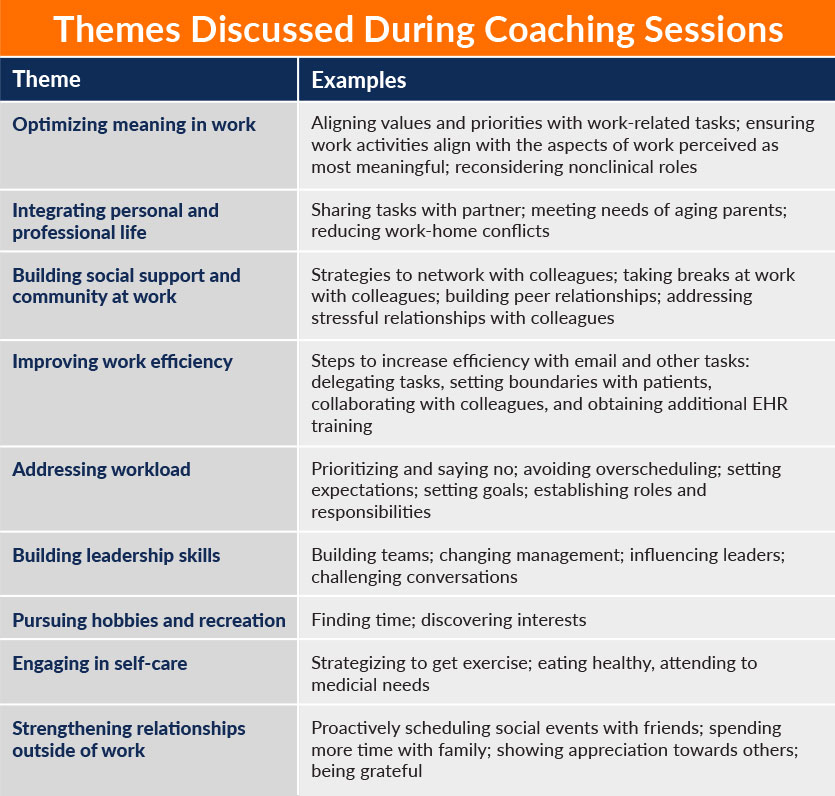
Some of the best data on the topic came out of a JAMA article in 2019 about the effects of physician life coaching on burnout. The study took 88 internists, family physicians, and pediatricians and put 44 of them randomly into the “coaching group” who received 3 1/2 hours of coaching over six months. They were allowed to get coaching on whatever they wanted. This is what they discussed:
At the end of that six months, the coaching group had the following benefits:
Coaching did not seem to help:
So yes, coaching works. However, the process is highly dependent on you wanting it to work. The more you put into it, the more you get out of it.
Unfortunately, the answer to this question is all over the board. The coaching intervention in the study above cost about $1,400 per person for 3 1/2 hours of one-on-one coaching ($400 an hour), and that was several years ago. That is certainly on the low end of what you should expect to pay. There are numerous options in the four-figure range, but that is usually only for a limited time period of a few months. If you need ongoing help, it is going to cost more.
Remember, physician coaching is not going to be cheap. Some physicians are paying as much as $60,000 a year for their life coach and some business coaching programs charge $150,000-$1 million a year. Most of them say it is worth it, but there is obviously a huge psychological incentive to not feel like you are wasting your money after such a significant purchase. A non-physician, non-executive coach can also be much cheaper, as little as $200-$1,000 per month, but most physicians want to be coached by someone who has been in their shoes.
But is it all worth the money? Consider a doctor so burned out that he or she is ready to quit tomorrow. If that coach can help them recover and design their ideal life and practice and help them to stay in the career another decade or two, what is that worth? Millions of dollars. So investing a few thousand to make millions can obviously be very worthwhile. The same principles can apply to business and other types of coaching. If your business grows 30% faster with a coach than without, what is that worth? Like most business investments, the return on investment cannot be known upfront.
At The White Coat Investor, though, we feel you'll get plenty of value by making this investment in yourself.
Some burned-out doctors also suffer from depression and anxiety. Many physicians prefer to engage with a coach rather than a therapist to avoid stigmas associated with mental health issues and to avoid licensing and credentialing issues that may come up from seeking mental health care. While coaching may help with these conditions, this is not really their role. Both coaches and therapists help you to correct maladaptive thought processes, but if you have serious mental health conditions, we recommend you seek out professionals who specialize in treating those in addition to or instead of a coach who also happens to be a physician.
Coaches and other advocates would say everyone should have a coach. Certainly, those struggling with burnout, which may be as much as 30%-50% of doctors, are highly likely to benefit. If you find yourself struggling with balancing home and work, achieving what you want in your career, starting a business, or building a practice, chances are good you can benefit from meeting with a coach. Many coaches even offer an introductory discovery session, where all you have to lose is your time.
Coaching represents a commitment, not only financially and time-wise, but also in the form of a commitment to change your life. If you are not quite ready to make that, we would encourage you to seek out other resources until you are. These may include books, blogs, and online courses such as the following:
Created by WCI, this course contains the material from our most popular Fire Your Financial Advisor course plus a section on Physician Wellness and Burnout Prevention. The Physician Wellness presenters include Dr. Nisha Mehta, Dr. Fahd Ahmad, Dr. Dawn Baker, Dr. James Turner, Dr. Bonnie Koo, Dr. Jordan Grumet, and Dr. James Dahle. This material qualifies for up to 8 hours of CME/CE credit.