

I recently (re)read The House of God, the venerable book on the grueling reality of residency training in the pre-hour-restricted era. Written by a physician under a pseudonym, the book was published in 1978. It is dated and potentially offensive by today's standards. However, it is both hilarious and poignant, shedding a satirical light on the absurdity of the medical hierarchy. Although certain parts of the book are problematic, it’s considered a classic for a reason.
Each time I read it, I take away something new. This time, the advice of the cardiologist Dr. Pinkus stuck with me. He encourages the protagonist, Dr. Roy G. Basch, to find hobbies to deal with the stresses of medicine (and strengthen his cardiovascular system). Pinkus' hobbies, as he repeatedly and proudly proclaims, are running for exercise and fishing for calm.
After initially falling under the spell of the charismatic cardiologist and taking up running, Dr. Basch eventually rejects Pinkus and his teachings. While hailed as a victory by his friends, I can’t help but wonder how this affected Roy’s future cardiovascular health. Did he survive the horrors of “The House of God” and its inferior sequel “Mount Misery,” just to have a heart attack from inactivity and too many cigarettes?
While much maligned in the book, I believe that Dr. Pinkus was on to something—that every medical professional needs a hobby. What’s more, what you choose may have an outsized influence on your mental and physical health, the length of your career, and even the state of your finances.
Benefits of Hobbies
Hobbies play an important role in our lives. They are an outlet for our energies: physical, mental, emotional, competitive, and artistic. The right hobbies strengthen our bodies, expand our knowledge base, and provide a welcome distraction from our stressful profession. In addition, they can provide a valuable conduit for social connection and may ultimately extend our careers and our lives.
A study published by Nature Medicine in 2023 suggests that participants with a hobby reported better health, more happiness, fewer symptoms of depression, and higher life satisfaction. Yet too many young physicians I meet have no hobbies outside of medicine. Or rather, they have allowed outside interests and passions to die while navigating the medical education gauntlet, eerily reminiscent of the characters in The House of God.
Can You Choose Your Hobbies?
We all have our own natural interests, which often manifest in childhood. If you’ve spent your whole life jumping horses and you still enjoy it, by all means, keep calm and equestrian on. However, interest in hobbies can change and evolve over time.
I was obsessed with basketball when I was younger, memorizing player stats, shoveling snow from the court so I could play during long Illinois winters, and spending countless hours playing a basketball board game (Strat-O-Matic). Yet today I’m a casual fan at best.
More importantly, hobbies can even be manufactured. I'm not saying I first learned how to cook in college to impress a girl, but I'm also not saying I didn't. I had no desire to fish with my dad when I was young, but now that my own son is interested, guess what I’m doing? We can all try something new and focus our attention on hobbies we believe will align with our long-term goals.
After all, Dr. Pinkus was an unhealthy, type-A, stressed-out doctor before finding his hobbies. Now, he's the picture of fitness and calm.
Not All Hobbies Are Created Equally
While most things are acceptable in moderation, not all hobbies are equal. After 20 years in the ER, there are two things I'd never let my children do: bull riding and motocross. Even if you’re an avid rodeo fan currently reaching for your lasso, we can still probably agree that smoking cigars, collecting Beanie Babies, and cave diving might be less desirable than swimming, gardening, and yoga.
A well-chosen hobby can also accelerate your path to financial independence by moderating expenses, promoting a healthy lifestyle that allows you to work longer, and even potentially generating side income. A poorly chosen one can sabotage your financial life. What, then, makes an “ideal hobby” for a financially conscious medical professional?
The 7 Characteristics of Healthy Hobbies
Optimal hobbies are not only inexpensive and low risk but can also be enjoyed into advanced age with friends, improving physical and mental health along the way. And if they provide other ancillary benefits such as networking, career advancement, or generational wealth, so much the better. Here are seven characteristics of healthy hobbies.
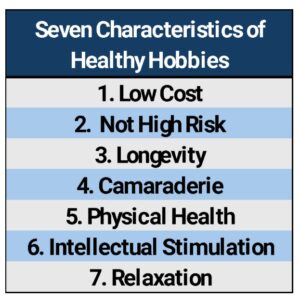
#1 Low Cost
Some hobbies are expensive by their very nature, but almost any activity can be taken to the extreme; there are $1 million Pokémon cards for goodness’ sake! Excessive spending on hobbies can quickly derail the financial plan of even the highest earners.
Every dollar you save and invest at the start of your career multiplies through the power of compound interest. Unfortunately, new grads often gravitate toward the following activities, filling the void left by medical training with a new, expensive “doctor” hobby. Much of the spiraling costs of these hobbies are from keeping up with the older, more established Dr. Joneses, so use discretion if any of these are your passions.
- Flying: Getting a pilot’s license is not prohibitively expensive, although lessons, plane rentals, and fuel costs add up. The real financial danger comes with purchasing and maintaining your own plane. The sky is literally the limit of what you can spend on this pastime.
- Golf: The stereotypical hobby of doctors, golf can be as expensive as you make it. Stick to off-the-shelf clubs and public courses, and you'll be fine. Even custom clubs and professional lessons are OK. But venture into exclusive country club memberships and exotic trips to play famous courses, and the costs can quickly become an albatross.
- Boating/Sailing: Boat jokes speak for themselves. “A boat is a hole in the water into which you pour money.” “You don’t really want a boat—you want a friend with a boat.” “Did you hear about the yacht owner who’s worth a fortune? He started with a much bigger fortune.”
- Travel: You can drive, fly business, or fly private. You can stay in an RV, the Marriott, or the Four Seasons. While travel itself is amazing, you can upgrade your way into bankruptcy.
- Other potentially expensive hobbies: Auto racing, collecting (watches, art, cars, etc.), skiing.
More information here:
How to Add Adventure to Your Life
How I Went from Chief Medical Officer to a Mushroom-Growing Hiker and the Family Chef in Retirement
#2 Not High Risk
As a physician, the ability to generate a substantial income is your biggest asset. Participating in unreasonably dangerous hobbies threatens this ability. While you can and should purchase disability insurance, policies often have carve-outs for high-risk activities.
I've jumped out of airplanes, ridden motorcycles, played rugby, and hiked some seriously sketchy trails, so I'm not immune to the lure of potentially dangerous hobbies. However, risk is something we must consider, especially when we have families and are in the accumulation phase of our careers. Here are some high-risk hobbies you should think hard about before participating:
- Hiking/Mountaineering/Canyoneering: Just ask WCI founder Dr. Jim Dahle about this one. He can afford to take extended time off or even retire due to injury. Can you?
- Flying: Believe it or not, I’ve treated two people who survived plane crashes over the years. But small planes are called doctor-killers for a reason.
- 4-Wheelers, RZRs, etc.: I regularly see patients with injuries from these machines. I even broke a couple of ribs myself snowmobiling in Iceland. I recently saw six unhelmeted high-school kids turn over a RZR, killing one, badly injuring another, and leaving four with minor injuries and a lifetime of regret.
- Other potentially risky hobbies: Motocross (off-road motorcycle racing), motorcycle riding in general, bull riding, MMA, skydiving, surfing, full-contact team sports (football, rugby, lacrosse).
#3 Longevity
Not every hobby can be continued indefinitely; Father Time is undefeated, as they say. Yet if we don’t use our minds and bodies, they deteriorate rapidly. While I encourage early financial independence, the longer you stay healthy and active, the longer that working remains your choice. Fortunately, some pastimes can be enjoyed at any age, contributing to health and longevity.
- Physical activities: swimming, golf, hiking, tennis, pickleball, hunting.
- Non-physical activities: reading, bingo, puzzles, teaching, gardening, painting, writing.
More information here:
Functional Longevity: What Use Is Retirement If You Can’t Move and Think?
Getting Rich and Ripped: How WCI Principles Help Build Wealth and Improve Your Physical Fitness
#4 Camaraderie
Despite being financially independent, one of the reasons I still work is the camaraderie I experience while working in the ER. It is well established that having meaningful friendships and social connections is beneficial for both your mental health and quality of life. Yet it's hard to make non-work friends after we finish school. Men, in particular, seem to struggle with this as they age. Regularly bringing you together with a group of individuals with similar interests is one way that hobbies can enrich and perhaps prolong your life, especially if you plan to retire early.
Some places to build camaraderie include group sports, social clubs, interest groups, volunteer organizations, and religion. It might offend some to consider religion a “hobby,” but if viewed through the lens of our seven factors, active religious membership covers many of the bases.
#5 Physical Health
The average American is overweight and sedentary, so even a small amount of exercise is beneficial. Essentially, any hobby involving physical activity is a bonus.
#6 Intellectual Stimulation
Hobbies that stimulate the mind can improve mental acuity and perhaps delay or reduce the risk of dementia. While medicine is intellectually stimulating, a hobby that can reinvigorate the desire to learn provides immense benefits. This is another broad category, as virtually any hobby that requires us to learn something new is beneficial.
Intellectually simulating activities include reading, writing, personal finance, chess and other board games, bridge and other card games, playing a musical instrument, and learning a foreign language.
More information here:
How This Financially Literate Doctor Got Scammed Out of $75,000
#7 Relaxation
As medical professionals, we have stressful jobs. Finding something that allows us to relax in a healthy and productive way is beneficial for our health and may even extend our careers. Relaxation comes in many forms. Some find it in the doing, while others find it in the blank spaces.
Relaxing activities include yoga, meditation, gardening, and painting.
Bonus: Networking/Ancillary Benefits
Sometimes, it's who you know. Social clubs, alumni groups, country clubs, and charitable organizations all provide opportunities to expand your professional network, potentially leading to career enhancement. If your favorite hobby provides these or other ancillary benefits, even better.
Too Much of a Good Thing?
While having no hobbies can be detrimental to your physical and mental health, being a “hobbyist” can hurt your wallet and relationships. I have a good friend who is a serial hobbyist. He is a doctor, pilot, scuba diver, runner, hunter, fly fisherman, gun collector, DJ, videographer, snowboarder, and welder—just to name a few.
While he might be the most interesting ER doctor in the world, my friend delves deeply into each new hobby, often going to extremes in terms of time and cost. While new passions are great, they can take time away from your family and loved ones. And what happens after you’ve lost interest and have an airplane hangar full of scuba, fly-fishing, and welding gear?
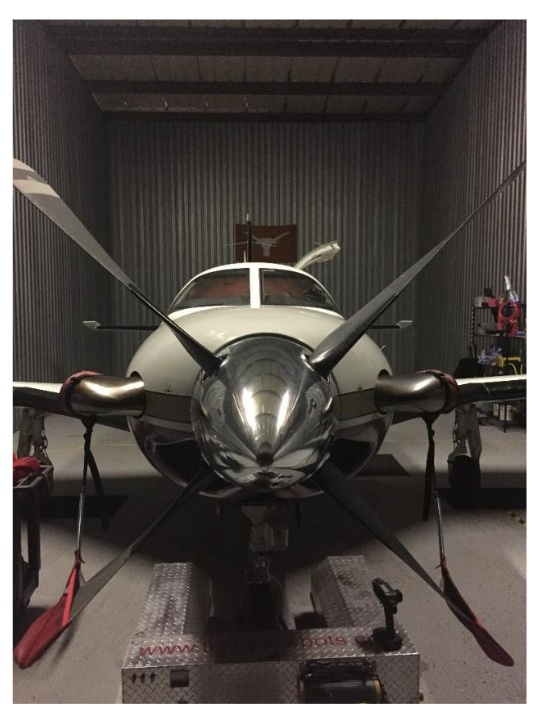
The Most Interesting ER Doctor in the World's airplane
It’s normal to experiment until you find your passion. Just don’t overextend yourself; rent or at least don’t buy professional equipment until you’ve found the two or three healthy hobbies that meet your criteria.
Should You Turn Your Hobby into a Business?
The best hobbies are an escape, a respite from the daily grind. Sometimes, people enjoy a hobby so much that they want to pursue it as a business. If you love what you do, you'll never work a day in your life, right?
The question is, will you still experience the same joy if your hobby becomes your job? My friend loves to fly, but would that passion last if he became a commercial airline pilot? I enjoy writing about personal finance, but I’m not under an editor’s deadline in order to make my mortgage payment.
You also might not be any good at it. The E-Myth Revisited taught us that just because you make delicious cupcakes doesn’t mean you’ll excel at owning a bakery. Doctors have an added hurdle in that many hobbies are simply not lucrative enough; it’s hard to replace a surgeon’s income making quilts, even if you’re great at it.
Medical professionals may be best served by keeping their careers and their hobbies separate. However, if you feel you must turn your passion into a source of income, start with a side hustle and take some time before giving notice at the hospital.
What About Me?
For those of you who don’t know, nothing relieves the stress of an ER shift like hitting someone as hard as you can without pads. Rugby is inexpensive, but it’s a young man's game. I stopped playing when I became an “old boy” at 35, leaving with a few good friends, some chronic neck pain, and a gaping hole in my social life. For a time, I replaced rugby with running adventure/obstacle races with my friends, but eventually this faded away along with the cartilage in my knees.
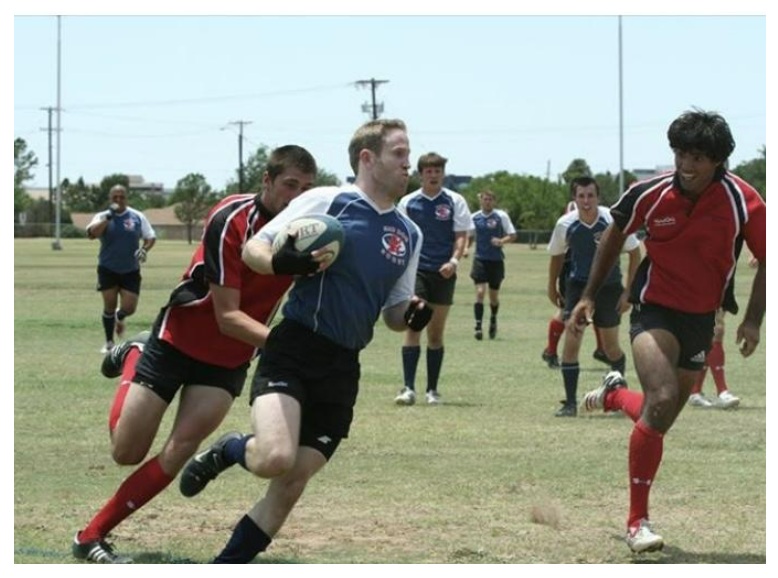
The author runs for his life while playing rugby.
For the last 15 years, business and personal finance have been my hobbies. I have spent years learning about real estate, securities investing, and business. More importantly, I put what I learned into action, starting several successful businesses (and a few that failed).
While some may not consider these activities a hobby, I do. I hate TV. I was never interested in flying. And I don’t have the patience for golf. Business and personal finance have been a welcome distraction from the stress of the ER, providing an outlet for my physical and mental energy. This focus helped me achieve early financial independence, allowing me to now spend more time with my family and less time in the ER.
So, I currently lift weights for fitness and write about personal finance and the business of medicine for calm. If my son has anything to say about it, I may have to add fishing to that list as well. While I miss contact sports, I see more money and fewer concussions as an absolute win.
The Bottom Line
Unlike other parts of The House of God, Dr. Pinkus's advice has stood the test of time. Running and fishing are inexpensive, healthy activities that can be enjoyed (knees willing) until an advanced age.
Participation in healthy hobbies is an excellent way for young medical professionals to make friends while reducing the stress of a new career. For doctors in the middle, hobbies can enhance life satisfaction and reduce burnout. In retirement, hobbies can be a social lifeline and a source of purpose and longevity. For everyone, choosing the right hobbies can facilitate your journey to financial independence.
If you have long-standing hobbies that you still enjoy, cultivate them for a lifetime of benefits. If you have hobbies that are no longer serving you, consider upgrading to healthier alternatives. And if you’ve let all your former hobbies slide, discover new ones using the seven characteristics. Follow Dr. Pinkus’ advice and take up _______ for exercise and _____ for calm. How will you fill in the blanks?
What are some other healthy hobbies you enjoy? What activities have helped you extend your career? Have you turned a hobby into a profitable business? Have expensive hobbies derailed your financial plans?