

The medical school admissions process is one of the highest-stakes application journeys in higher education. In 2024, just 44.58% of applicants received an acceptance letter from at least one MD program in the US, according to the AAMC. The rest faced another year of studying, rewriting essays, retaking the MCAT, and delaying entry into a profession that can pay over $400,000 annually once fully licensed.
Many students are turning to medical school admissions consultants because it saves them thousands of dollars. The question is, how much can they save?
This post breaks down a step-by-step method to measure the return on investment (ROI) of medical school admissions consulting. By the end, you’ll know how to apply this same framework to find the highest-ROI med school admissions consultants in 2026.
Defining and Understanding ROI in Medical School Admissions Consulting
In finance, ROI is calculated with this formula:
In the context of medical school admissions consulting, the “investment” is the cost of your consulting package. The “net gain” comes from the measurable benefits that consulting helps you achieve—such as scholarships, avoided expenses, and earlier entry into residency.
Admissions consulting firms, like Inspira Advantage, help students increase their acceptance rate with more competitive medical school applications. The most reliable consultants provide extensive personalized support that turns weaknesses into strengths; help students draft, edit, and refine school-specific essays; and highlight impactful research, volunteer, and community service experiences relevant to each student’s target medical school.
More information here:
How to Go to Medical School for (Almost) Free
Factors to Include in Your ROI Calculation
#1 Average Scholarship Value
Competitive applications often lead to merit-based scholarships. If consulting raises your application profile and gets you an offer with $35,000 per year in tuition coverage, that’s $140,000 over four years.
For example, according to the AAMC’s survey of 2024 graduates, 65% of medical students received some form of non‑loan financial assistance—such as scholarships or grants—with more than a quarter of them receiving totals of $50,000 or more. In this case, you would multiply $50,000 by four to determine the scholarship value over four years.
#2 Avoided Reapplication Costs
The cost of reapplying to medical school is ~$2,500. This includes paying for primary and secondary application fees, plus travel for interviews. If a consultant helps you get accepted on your first try, you avoid this entirely.
#3 Avoided MCAT Retake Cost
MCAT retakes include a $345 registration fee.
#4 Avoided Lost Residency Wage Earnings from Delayed Entry
According to Medscape’s 2024 Resident Salary Report, average PGY-1 earnings are $65,000. Delaying admission by a year means losing that income, plus delaying your career by a year. Consulting that gets you accepted this cycle preserves that pivotal first-earning year.
#5 Total Financial Benefit
Sum the scholarship value, avoided reapplication cost, avoided MCAT retake cost, and preserved PGY-1 salary.
#6 Package Price
Determine the exact cost of the consulting package you’re considering purchasing. Admissions consulting packages can cost anywhere from a few thousand dollars for targeted services to more than $10,000 for comprehensive options that even guarantee medical school acceptance.
What’s harder to put a dollar figure on, but still matters:
- Acceptance rate advantage: Students who work with an admissions consultant often have a significantly higher chance of acceptance than students who apply without an admissions consultant’s support. There’s often a notable gap between acceptance rates of supported vs. unsupported applicants. The difference can be decisive in a year when over half of the applicants are rejected.
- Admission to more competitive schools: The percentage of students admitted to higher-ranked or reach programs, which can influence residency match competitiveness and lifetime earnings.
- Added value services: Securing publication opportunities, arranging clinical shadowing with physicians, or connecting you to research mentors—all of which strengthen your CV in ways that last far beyond the application cycle.
- MCAT prep courses: Can cost $1,000-$3,000 and hundreds of study hours. If guidance improves your first-attempt score, that’s money and time saved.
- Stress reduction: Avoiding months of rewriting personal statements, re-prepping for the MCAT, or struggling through secondary essays alone. While you can’t attach a hard dollar value to reduced burnout, the emotional bandwidth preserved can be significant.
How to Calculate ROI in Med School Admissions Consulting
Here’s the final ROI formula you can use to see if medical admissions consulting is really worth it.
To find the estimated value of the Total Financial Benefit, use the formula below.
Total Financial Benefit = Scholarship Value + Avoided Reapplication Costs + Avoided MCAT Retake Cost + Preserved PGY-1 Salary.
Then, divide the Total Financial Benefit by the cost of the consulting package you’re considering purchasing and multiply the result by 100 to get an ROI percentage.
With the ROI formula, you can determine the percentage return you’re getting on your investment in consulting, showing exactly how much value you’re gaining compared to what you spent.
More information here:
Cheapest Medical Schools in the US
How Much Should You Sacrifice to Pay for Your Child’s Medical School Education?
Example ROI Calculation
Let’s take Inspira Advantage, an established brand in the med school admissions consulting industry, as an example. Let’s substitute Inspira’s known figures into the ROI formula.
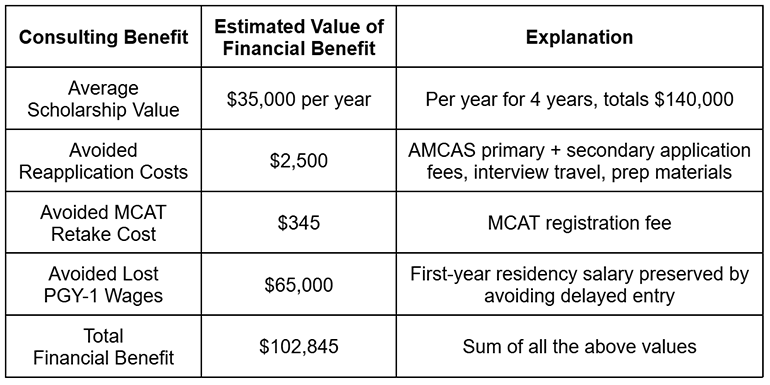
Inspira’s total financial benefit = $35,000 + $2,500 + $345 + $65,000 = $102,845. The cost of the package = $10,300 (for the 30 Secondaries + Interviews Director package). That means the ROI formula looks like this:
Now, $102,845 − $10,300 = $92,545; and $92,545 ÷ 10,300 = 8.98; and 8.98 x 100 = 898%. That means this consulting service yields an 8.98x return on investment. That’s a nearly 9-to-1 return, and this doesn’t even account for intangible benefits like reduced stress and stronger residency prospects.
The Bottom Line
Calculating the ROI of medical school admissions consulting helps reframe it from an emotional decision into a financial one. By assigning dollar values to scholarships, avoided costs, and preserved earnings, you can objectively determine whether a service is worth the investment.
The rule of thumb is that if your estimated ROI exceeds 100% and your assumptions are realistic, it’s a strong candidate for investment. In a process where one year’s delay can cost over $65,000, the right consultant can pay for themselves many times over before you’ve even written your first tuition check.
What do you think? Have you considered medical school consulting? Have you ever done it? What was the experience like? Was the ROI worth it?