

It was late at night when I heard the door creak open. I jolted upright in my dorm bed, heart racing. My body tensed, bracing for danger or a way to escape, until a whisper came from my roommate in the doorway: “It’s just me, Fatimah.” I exhaled, but the fear lingered.
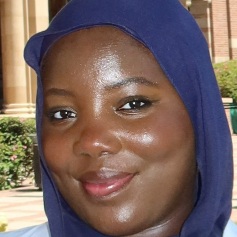
Fatimah Mumuney
That feeling of fear had become my new reality since Boko Haram kidnapped over 270 girls from their boarding school in Chibok, Nigeria. The girls were dragged from their beds at night and held in captivity, enduring sexual violence and other forms of unimaginable trauma. The event sparked nationwide fear, but for us, just miles away, that fear was visceral. We didn’t know why their school was targeted, only that it could have been ours, too. There were no debriefings or explanations. I kept going because I had to, but the absence of support left a mark. It pushed me to think deeply about what role I could play in moments like that, and I began to imagine being someone who could walk into a crisis, stay grounded, and help people understand what their minds and bodies were going through.
That desire began to take shape years later when I became a medical advocate supporting survivors of sexual assault in the emergency room. One night, I was called in for a teenager, “Grace,” who kept the TV on and made jokes with the nurses while waiting for her exam. She seemed almost unaffected. But when the hospital gown slipped and the exam began, I saw her hands start to tremble. She kept her face pointed at the screen and kept laughing, but her body portrayed a different truth.
I felt like my presence didn’t matter at the time. Still, I offered my hand, half-expecting her to ignore it. She grabbed it and didn’t let go.
That night, my understanding of care shifted. Grace didn’t need me to speak or solve anything. She just wanted to feel less alone. Being a medical advocate has taught me that people heal in different ways and that my role isn’t to define care but to listen closely and respond to what each person needs. Despite witnessing the power of presence with Grace, I also knew what it felt like when presence wasn’t enough. I had felt that most deeply with my mum.
For most of my teenage years, I watched my mum struggle with chronic hives, gut inflammation, and fatigue. Tests came back normal, but life didn’t feel normal. After high school, I spent a year taking care of her as best I could. Some days, I scrubbed our home from top to bottom to keep her flare-ups at bay. Other days, I sat beside her in waiting rooms through long nights of frustration. Despite that, I couldn’t erase her discomfort. I remember waking up one night and hearing faint, stifled sobs. My mum lay curled on her side, whispering under her breath in Yoruba, “Kílódé tó fi burú báyìí?”—“Why is it so bad?” Her medication hadn’t helped. I sat beside her in the dark, wishing I could offer something more than my presence.
When I left my mum in Nigeria to attend college in the US, I couldn’t keep caring for her in the same way, but I didn’t want to walk away from the questions her experience raised. I kept thinking about how the tools we rely on to guide care—tools that have saved countless lives—often don’t capture the full scope of what patients experience. At Tufts University, I worked on developing a 3D model of the human intestine to better replicate the gut environment and make disease development easier to study. In some way, research became a continued form of caregiving. Even though I knew it wouldn’t change her condition, it felt like a way to keep showing up for her and for others whose suffering didn’t have a name.
But getting to Tufts University for my undergraduate degree had required support of its own. When my father’s business in Nigeria went into debt, my family could no longer afford the educational opportunities that had once seemed possible. Even so, my parents encouraged me to continue applying to universities in the United States, believing that if I was fortunate enough to receive financial aid, it could change the course of my future. Receiving need-based financial aid from Tufts made that possibility a reality.
That support made college possible, but it did not eliminate financial challenges. Throughout college, I balanced coursework with employment while remaining involved in research, leadership, and community service. During academic breaks, I also experienced periods of homelessness and housing insecurity until I successfully advocated for year-round campus housing and later became a resident assistant. It was clear to me how much financial stability could shape my ability to pursue opportunities.
Now, as a first-year medical student at the David Geffen School of Medicine at UCLA, I am financing my education primarily through student loans while managing the high cost of tuition and living expenses. I know firsthand what financial support can make possible, and I also know what it feels like to pursue an education while worrying about how to sustain it. A WCI scholarship would help reduce that burden and give me greater flexibility to focus on the experiences that are most important to my development as a future physician.
I was selected for UCLA’s Global Health Equity Pathway because it closely aligns with my long-term goal of building a career in academic medicine focused on improving how care is delivered and accessed across the United States and West Africa. The program provides dedicated time during medical school to build long-term collaborations with partner institutions abroad, including several months working alongside local physicians and researchers. For me, that means returning to Nigeria during medical school to contribute to research in a way that is sustained rather than limited to a brief elective. Financial support would give me greater flexibility to fully engage in that training, continue my research, and pursue meaningful clinical and community experiences throughout medical school.
I may never know why 276 girls were kidnapped just miles away while we watched terrified. But living through that silence taught me what genuine care asks of me. My experiences as an advocate, caregiver, and researcher have shown me both the beauty and the limits of each. Presence can comfort, but not always heal. Caregiving can ease suffering but not erase uncertainty. Research can uncover truths but remains distant from the people living them.
Medicine brings them together. It is where standing beside patients, providing care, and searching for answers can exist as one calling. This is why I want to be a physician.