

The Schwab S&P 500 Index Fund (SWPPX) and the Fidelity 500 Index Fund (FXAIX) are both low-cost mutual funds that track the S&P 500. Both funds are designed for buy-and-hold investors and are similar in many ways. So, if you’re comparing SWPPX vs. FXAIX, you may find it hard to choose between the two. But there are a few differences that can help you determine which fund makes more sense for your portfolio.
Let’s look at the biggest similarities and differences.
What Is SWPPX?
SWPPX is a passively managed mutual fund offered by Schwab that seeks to track the S&P 500’s total returns. Launched in May 1997, SWPPX is one of the oldest S&P 500 index funds on the market. That means it’s been through multiple market cycles, including the 2008 financial crisis and the COVID-19 pandemic.
SWPPX has an expense ratio of just 0.02%, which is one of the lowest available for any S&P 500 fund. As of 2026, the fund holds approximately $124 billion in net assets across around 503 holdings, closely mirroring the composition of the S&P 500. There’s no minimum investment requirement, making it accessible to investors of all levels.
Because SWPPX is a Schwab fund, it's best suited for investors who already have a brokerage account with Charles Schwab. Schwab offers the fund commission-free, and it integrates seamlessly with Schwab's other investment tools and accounts, including IRAs and 401(k)s, where the fund is offered.
Pros
- Low 0.02% expense ratio
- No minimum investment
- Long track record since 1997
Cons
- May incur fees at other brokerages
- Smaller asset base than FXAIX
- No ETF share class
More information here:
How Do You Evaluate and Compare Mutual Funds and Exchange Traded Funds?
Schwab vs. Fidelity — Which Is Best for Your Investments?
What Is FXAIX?
FXAIX is a passively managed mutual fund offered by Fidelity Investments that tracks the S&P 500 Index. It launched in May 2011, and it has grown into one of the largest mutual funds in the world, with approximately $715 billion in net assets as of early 2026.
FXAIX carries an expense ratio of 0.015% and requires no minimum investment. It holds around 503 securities, essentially mirroring the S&P 500. The 10-year annualized return for FXAIX is approximately 14.75% per year, marginally outpacing SWPPX's 14.72% over the same period.
FXAIX is ideal for investors with a Fidelity brokerage account and is available commission-free. Fidelity also offers a broader range of comparable index funds, like FZROX and FNILX.
Pros
- Low 0.015% expense ratio
- No minimum investment
- One of the largest funds in the world
Cons
- Best accessed through a Fidelity account since users may incur fees elsewhere
- Shorter track record than SWPPX
- No ETF share class
SWPPX vs. FXAIX: A Side-by-Side Comparison
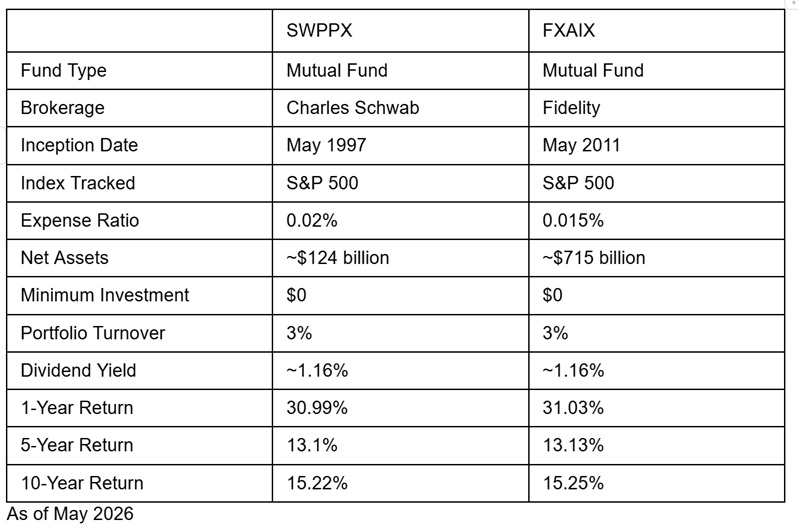
The following table provides an overview of how SWPPX and FXAIX compare, as of May 2026:
Similarities and Differences
At first glance, SWPPX and FXAIX look nearly identical, but understanding where they differ can help you make the best choice for your situation.
Similarities
- Same index: Both funds track the S&P 500, meaning they hold essentially the same stocks in essentially the same proportions.
- Similar expense ratios: SWPPX and FXAIX both charge low expense ratios, which can save you thousands over your investing career compared to actively managed funds.
- No minimums: Neither fund requires a minimum investment, making both accessible from Day 1.
- Passively managed: Both are index funds designed for low turnover, low cost, and long-term holding.
- Same turnover rate: Both report a 3% annual portfolio turnover, meaning they rarely trade and they are highly tax-efficient.
- Identical dividend yield: Both currently yield approximately 1.16% annually.
Differences
- Brokerages: SWPPX is a Schwab fund and works best within a Schwab account, while FXAIX is a Fidelity fund and works best within a Fidelity account. If you already have an account at one of these brokerages, that will play a role in your decision.
- Fund size: FXAIX is substantially larger than SWPPX. While neither fund has any liquidity concerns, FXAIX's scale does reflect its broader adoption, particularly in 401(k) plans.
- Track record: SWPPX launched in 1997, giving it more than 28 years of history. FXAIX has only been around since 2011, though its performance over that period has been nearly identical.
- Historical returns: Over the past 10 years, FXAIX has returned 15.25% annually, which is slightly higher than SWPPX’s 15.22%.
- Zero-fee alternatives at Fidelity: If you're a Fidelity investor and want to push costs even lower, Fidelity offers FNILX with a 0.00% expense ratio. Schwab doesn't have an equivalent zero-fee fund for the S&P 500 specifically, though SCHB comes close.
More information here:
Do I Need to Spread My Assets Between Different Brokerages?
The Bottom Line
SWPPX and FXAIX are two of the best S&P 500 index funds available. They track the same index, charge the same expense ratio, require no minimum investment, and deliver nearly identical returns.
Most investors will do well with either fund, so it really comes down to your personal preferences and whether you already have an account at Schwab or Fidelity. What matters more than which of these two funds you choose is that you invest consistently and keep your costs low. Both SWPPX and FXAIX can help you do that.
The White Coat Investor is filled with posts like this, whether it’s increasing your financial literacy, showing you the best strategies on your path to financial success, or discussing the topic of mental wellness. To discover just how much The White Coat Investor can help you in your financial journey, start here to read some of our most popular posts and to see everything else WCI has to offer. And make sure to sign up for our newsletters to keep up with our newest content.