

The biggest triumph of my gambling life occurred on a Sunday evening at a Tex-Mex restaurant in downtown Austin with COVID about to bear down on us and shut down the world. I was playing in a charity poker tournament with about 70 others in February 2020, and I somehow managed to squeeze myself into the final table.
I had played solid poker for most of the day, and I was still treading water with about 20 players remaining. I was nowhere near the chip lead. But I grinded, won a decent-sized pot or two after having to put all my chips in the middle of the table, and avoided any catastrophic defeats.
At the final table, nine people were left, and I had an average chip count. One by one, the other competitors went all-in with their chips and lost, and the number of participants dwindled down until it was just me and one other fellow, going heads up for the championship.
He had probably 10 times as many chips as me. That meant I was a huge underdog, and I’d have to get real lucky in the next few minutes to have a chance to win the entire tournament.
Then, I got real lucky.
I’ve been playing cards for money since I was a kid. Like I wrote about a few months ago when discussing the pitfalls of prediction markets like Kalshi and Polymarket, I’ve had a few harrowing (but ultimately harmless) moments in my gambling career that have taught me some financial lessons.
As the World Series of Poker gets ramped up in Las Vegas for the next six weeks, today is a good day to discuss the lessons I’ve gleaned from playing on the green felt.
Don’t Get Cocky When You’ve Amassed Your Nest Egg
This was one of the problems my opponent faced when we were heads up in the tournament. He had played so well for the previous few hours to get to the point where he had me 10-to-1 in chips. But he had also gotten overconfident, telling the final table participants how awesome he plays at his weekly card games with his buddies. When it was just him and me left, I could almost feel him scoffing at my pathetic pile of chips.
But here’s where I got real lucky. For much of the day, I hadn’t gotten great starting hands. But in this moment, I got a couple of pocket pairs in a row. I started going all-in with the better cards. Since he wanted to end the tournament as quickly as possible, he started calling my bets with weaker hands. He got too confident and too loosey-goosey with his finances.
As heads-up poker players know, it only takes a couple of successful all-in bets to level up in chips. Soon, I had more chips than him, and his cocky grin had been replaced with a frustrated smirk. He had gotten overconfident, and I had gotten lucky at the right time. A few minutes later, I was holding up my first-place trophy and smiling for the cameras.
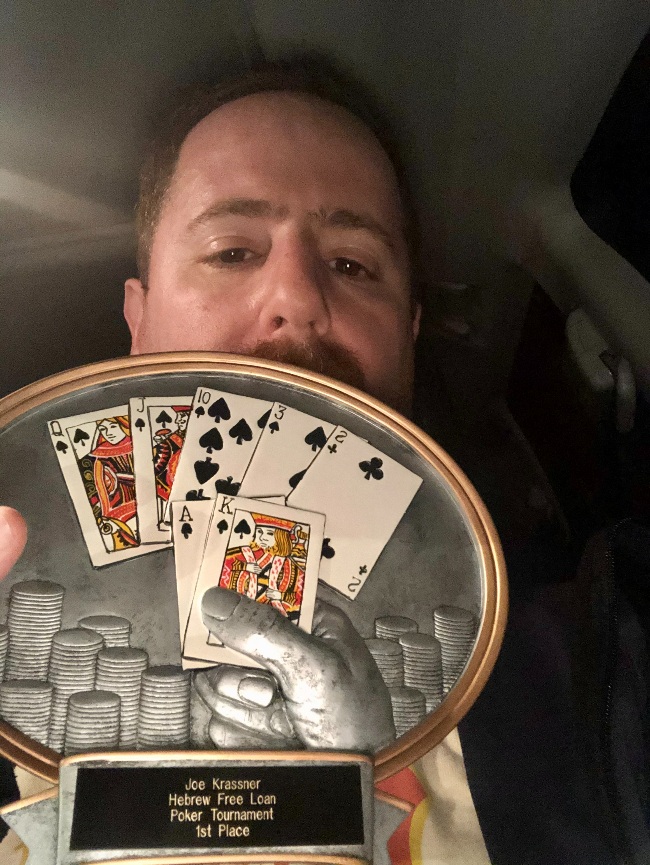
In my car after the tournament win.
He had gotten greedy and reckless, and then the market turned against him. And soon enough, all his money was gone. Call it the poker version of the Sequence of Returns Risk.
Inflation Is a Killer
At the beginning of a poker tournament, the blinds (when two players at the table are forced to make opening bets to start to build the pot) are small. Maybe one player, known as the “small blind,” has to put in $1 worth of chips, and a second player, the “big blind,” has to put in $2. Since the rest of the table can fold without penalty, you could not play a single hand, and your chip stack (say it’s a starting stack of $1,000) won’t be affected much.
But as the tournament progresses, the blinds get bigger. Soon, it’s $5 for the small blind and $10 for the big blind. Then, it’ll be $20 and $40. At some point, it could be $100 and $200. If your chip stack at the moment only represents $1,000, you’re in big trouble.
You have to win early pots and build a chip stack. Otherwise, the inflation of the blinds is going to kill your investment strategy. As you would in investing, always adjust for inflation in long-term planning. You can’t just park your money in a savings account to let it ride and hope you beat inflation in the same way you can’t fold most every poker hand and expect to be there at the end of the tournament.
You Don’t Have to Invest (or Bet) in Everything
We talk all the time at WCI about how there are no called strikes in investing. You don’t want to invest in real estate? You don’t need it to have a successful retirement. You don’t want to tax-loss harvest? Not a problem. You don’t want to make your portfolio any more complicated than a target date fund or a three-fund portfolio? That’s fine. As long as you invest reasonably, you’re probably going to build a nice nest egg.
The same is true in poker. I’m usually a relatively conservative player. I don’t make many splashy moves or bet in some kind of outlandish way. I’m the same way with investing. I don’t gamble with Bitcoin. I don’t angel invest. I don’t day trade. I’ll hopefully still be successful in my financial life.
A few years back, I spent four hours inside the Bellagio poker room in Las Vegas. I had a great time. I had some fun conversations. I was thoroughly entertained. I started the day with $300 in chips. I walked out of the casino with $308 in chips, a whopping $2 earned per hour.
Maybe I could have made more money if I took more chances. But I (literally!) played the hands I was dealt reasonably, and I still walked out a winner.
Be Aware of Scams and Cheaters
The financial world has its fair share of scams and cheaters. So does the poker world. Be aware of somebody trying to take an unfair advantage against you or someone you love. Watch out for the Worms of the world, as seen in the following clip from Rounders, when Edward Norton’s character (Les “Worm” Murphy) gets caught trying to help Matt Damon’s character (Mike McDermott) cheat and win a pile of money.
Beware, there’s some cursing and hand-to-hand violence in this clip.
Now, I’m not saying you should beat in somebody’s face because they’re scamming you; I’m just saying you have to watch out for the “hangers.”
Be Kind When Somebody Mucks It Up
We’re all about teaching financial literacy at WCI, and we know our readership ranges from the neophyte to the expert. We try to cater to everybody, and we hope that if one of our readers or forum members feels another person is making a mistake with their strategy, they’ll not be maliciously nasty about it.
The same is true at the poker table. If somebody gets caught bluffing and has to show what amounts to a nothing hand, you should be kind and empathetic, not nasty and vindictive.
Case in point: I was playing at a house game a few years ago with some buddies, and a new guy was sitting in for the night. My friend, M, got into a hand with this guy who, with the exception of one person, didn’t know any of us. It turns out this new guy was bluffing in a hand, but he bet convincingly enough to convince M that he should fold his hand.
As soon as he did, the new guy made a major breach of etiquette. He went into the pile of discarded cards, aka the muck, and pulled out M’s hand to see it and then taunt him with his bluff (turns out M would have won the pot if he hadn't folded his cards). M got so upset that he nearly started a fistfight with the new guy.
My buddy was right to be mad. You don’t go into the muck to see what somebody else folded. And in investing, you don’t callously point out somebody else’s mistake to make yourself feel better. It’s just not nice. And as Dalton, the best movie bouncer of all time, says, you should be nice . . . until it’s time not to be nice.
Don’t Take Investments at Face Value
This is especially true in real estate investing. You can’t just look at a few numbers and decide to buy into a syndicate or a private fund. You have to explore the issue. You have to vet the situation. You can't take it at face value.
I was once on a cruise, where I made back-to-back final tables among the 50 or so tournament participants, and I was locked in a hand with an older gentleman who didn’t have much of a poker face. When the cards were dealt and it was just him and me in the action, he stared at his hand, and the disappointment showed all over his face.
My hand was decent, but based on this dude’s reaction, I knew I was going to win this hand. I was wrong. His hand was far superior. What I had thought was a poker tell was him fooling me into believing his story.
I took him at face value (literally!). I hadn't taken the time to really vet the scenario, and I lost money in the deal because of it.
After the charitable poker tournament was finished and I had been pronounced the winner, I could feel the vibes from the guy who I had beaten. He was probably thinking that I had gotten lucky against him and that I shouldn’t confuse my victory as an indication of who was more skillful. He was right, too. He probably is a better poker player than me.
But as we all know, sometimes it’s better to be lucky than good. That’s at the poker table, but sometimes, that’s also true in finance.
More information here:
The Perils of Using Prediction Markets Like Kalshi and Polymarket — And How They Could Wreck You
A Winning Hand: Meet the Lawyer Who’s Making Huge Money at the Poker Table
Money Song of the Week
Now that we have a new Federal Reserve chairman in Kevin Warsh, who replaces one of Donald Trump’s favorite political targets in Jerome Powell, it’ll be interesting to see if the Fed begins cutting interest rates again. With inflation beginning to tick higher again (it’s at 3.8%, as of this writing), the decision of the Fed could have a major impact on how much we pay for groceries and clothes.
If you were to ask blues legend BB King what he thinks, he’d probably sing you his 1983 tune called Inflation Blues.
As King sings,
“Mr. President/Please cut the price of sugar/I wanna make my coffee sweet/I wanna smear some butter on my bread/And I just got to have my meat.
When you start rationing/You really played the game/And things are going up/And up and up and up/And my check remains the same.
That's why I got the blues/Got those inflation blues.”
At the time King, who died in 2015, released that song, inflation was between 2.5%-3.9%, so for much of 1983, it was actually not that far off from the Fed’s target of 2%. In January 1982, though, inflation stood at 8.4%, and in the few years before that, double-digit inflation was the norm.
Maybe the lesson is simple. If you’re worried about inflation, get a famous blues guitarist to sing it all away.
Buddy Guy, the nation turns its lonely eyes to you.
More information here:
Every Money Song of the Week Ever Published
Reel of the Week
Sometimes, your grand plans just don’t work out.
What do you think? Is playing poker analogous to finance? Have you learned any gambling lessons that could teach others about money?