

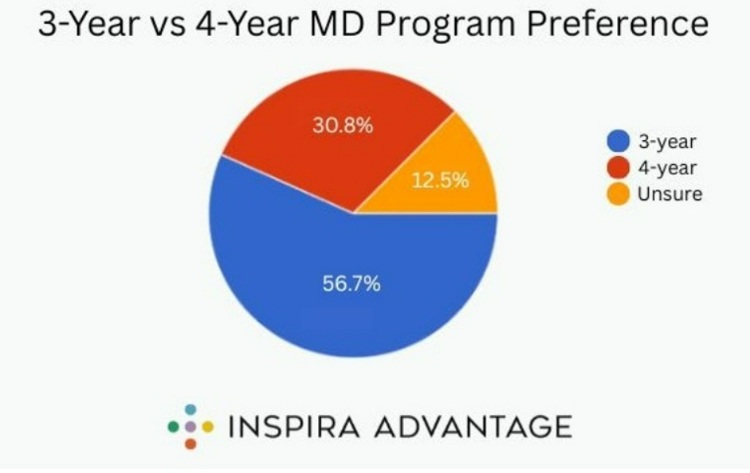
A new survey of 224 aspiring and current medical students by Inspira Advantage, a medical school application advising firm, found that 56.7% of aspiring medical professionals would prefer a three-year medical school program over the traditional four-year route.
The driving force behind this shift, as you might have guessed, is student debt.
Summary of the Survey Results
The survey found that of those who preferred a three-year MD path, 82% cited cost and debt reduction as their top reason. The preference toward accelerated pathways comes at a time when medical students are facing unprecedented financial pressures.
Starting in July 2026, the federal government will impose new limits on graduate student borrowing:
- $50,000 per year maximum for medical school
- $200,000 total lifetime cap
- Grad PLUS loans will be eliminated entirely
According to the New York Times, the median cost of four years of medical school in 2025 reached more than $297,000 at public schools and surpassed $400,000 at private schools.
According to our survey, 66.5% of respondents said these new federal limits make them more likely to consider a three-year MD program, if given an option. Among those influenced by the loan cap, nearly two-thirds (65.1%) prefer a three-year MD. Currently, there are more than 30 medical schools—such as NYU Grossman School of Medicine; University of California, Davis School of Medicine; and Wayne State University School of Medicine that already offer three-year programs in the US. According to the Times Higher Education rankings, NYU Grossman School of Medicine and University of California, Davis School of Medicine are in the top 50 US medical schools.
More information here:“Students already feel crushed by the price of becoming a doctor. When you add federal borrowing caps and eliminate the only loan that covers full tuition, it pushes students toward accelerated programs that cut debt and get them working sooner,” said Arush Chandna, co-founder of Inspira Advantage.
- How to Go to Medical School for (Almost) Free
- Do For-Profit Medical Schools Provide an Inferior Education for Higher Costs?
Other Reasons Students Prefer a 3-Year MD
While cost and debt reduction were the top driving forces behind a fast-track MD, students also cited other reasons they might prefer it:
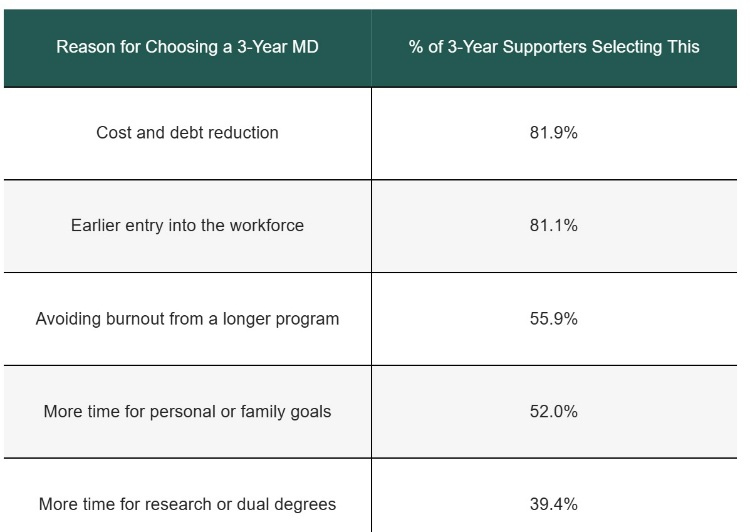
These responses suggest accelerated training could help reduce burnout, allow earlier family planning, and shorten the decade-long path to becoming a practicing physician.
Eliminating a year of medical school also offers the opportunity to reach attending-level income one year earlier. Salaries that exceed $200,000 can meaningfully reduce student loan balances, limit interest accumulation, and allow physicians to focus on their savings. Supporters of accelerated programs argue that this earlier financial footing helps to ease some of the economic pressures linked to burnout.
Further, a three-year accelerated MD program can address the shortage of physicians in the country by making more physicians available sooner. According to a 2024 Association of American Medical Colleges (AAMC) report, the US will face a shortage of up to 86,000 physicians by 2036.
Factors to Consider Before Adopting a 3-Year MD Path
Even among students who prefer a three-year MD, anxiety remains high:
- 60.6% worry about training quality
- 57.1% worry about residency competitiveness
- 50.8% worry about being underprepared clinically
These concerns align with broader student anxieties about training quality, residency competitiveness, and whether a faster pace might reduce academic or clinical flexibility, further exacerbating the work-life balance already present in medical school.
To address this, we asked whether a linked residency spot would change their perspective. An overwhelming 92.9% of three-year supporters and 75.4% of four-year supporters said yes, they would choose a three-year pathway if residency placement was guaranteed. NYU Grossman School of Medicine’s accelerated program and Wayne State University’s School of Medicine are among medical schools that offer placement into the same hospital system as the medical school, as long as certain criteria are met.
More information here:“The interest in accelerated training makes sense from a financial and lifestyle perspective, especially for young adults who delay lifestyle goals, or women, who face delayed fertility,” said Dr. Aanika Warner, a medical admissions expert at Inspira Advantage and a Johns Hopkins physician. “But we also must answer the harder questions: what happens if someone fails a course or needs more time? How will competitive specialties view three-year graduates?”
A Medical School System Under Pressure
The med school pipeline is already showing signs of financial strain. Among the current medical students in our survey, 44% report that they're more than $100,000 in debt, and 22% report over $200,000. With the federal government capping medical school loans at $50,000 per year and $200,000 total after the One Big Beautiful Bill Act (OBBBA) passed in 2025, many future students will face tighter borrowing limits than ever before.
Debt-related burnout is also a major concern. A national survey of family medicine physicians found that physicians with $250,000-$350,000 of debt are 24% more likely to experience burnout symptoms, and those with more than $350,000 are 47% more likely.
While it is too early to know how students will ultimately adapt, our survey suggests that preferences are already shifting. Accelerated programs that may once have been perceived as niche or unconventional are now seen by many students as a practical, financially sound alternative to the traditional four-year track.
“The move toward three-year MD programs reflects both financial reality and student demand,” Warner said. “What matters most is designing programs that maintain clinical rigor, support student wellness, and prepare future physicians to thrive, regardless of how long the degree takes.”
[FOUNDER'S NOTE BY DR. JIM DAHLE: Spending less time in school sounds great. You have a smaller student loan debt burden and you start earning money sooner, and more doctors are around to care for patients. What's not to like? But why stop at three years? Why not just make medical school two years long and get rid of residency altogether? Oh wait, that's called PA school. So, we're left with the philosophical question of how much you can shorten the educational process and still end up with a real doctor?
If I were going to cut time out of my education, it would be my fourth year of college and the last half of my MS4 year. I learned very little in that year and a half that was ever useful in my career. And don't get me started on gap years. But there's an issue with dropping the last year in a given school. Those are the years in which you're applying for the next level, whether that be medical school or residency. And that process takes time. If you move up that application process a year, now you have to apply for residency early in your MS3 year, or take the MCAT before taking the subjects it covers. How can you even know if you want to be a pediatrician if you haven't done your peds rotation yet? Much less any specialty where the rotation is an elective. You can't. So, something else must be cut out. Less pharmacology? Less pathophysiology? Embryology? At a certain point, you're only getting 3/4 of a medical education. You're somewhere between a PA and a doc. But your practice won't be supervised. Hope that's OK with you and your future patients.
It's kind of similar to a doc who goes and hangs out a shingle after just doing an internship. Yes, it's legal, but I don't think a lot of us, all else being equal, would choose that doctor for our primary care. Residency has value, and so does medical school. At any rate, if we want to shorten the medical training pipeline, drop the gap years first; then take out something from the undergraduate education; and then and only then, something out of medical school.]
What do you think? Would you have considered a three-year MD path instead of the fourth-year path? What would be the pros? What would be the cons?
Did you find this article helpful? Share it!