

I confess that I play favorites. Back in 2005, when I finally started figuring out what the heck I was doing with my four-figure investment portfolio, the first mutual fund I ever purchased without the “assistance” of a commissioned salesperson masquerading as an advisor was the Vanguard Total Stock Market Index Fund (TSM). It is still my favorite mutual fund, and I suspect I will own it until the day I die.
In fact, at 25% of my current retirement asset allocation, TSM is my largest investment holding, and it may always remain so. It (or a similar fund from Fidelity) is our only HSA investment and plays a large role in my children’s Roth IRAs (Target Retirement 2060) and UGMAs (TSM and Total International Stock Market Index Fund). I have owned it via three different brokerages and have owned all three “retail” share classes (Investor in my Vanguard individual 401(k), Admiral in Vanguard Roth IRAs, and the ETF in my Schwab 401(k) and Fidelity HSA.
We spend a lot of time on this website talking about “alternative” investments, real estate, factors, and all kinds of fancy stuff. Today, let’s go back to basics and talk about eight reasons why TSM is such an awesome mutual fund.
The Vanguard Total Stock Market Index Fund (TSM)
#1 Awesome Long-Term Performance
I don’t select mutual funds based on past performance. There is a very good reason why all mutual fund prospectuses must tell you that past performance is no indicator of future performance. But the process I use to select mutual funds leads to excellent long-term performance, the only kind I actually care about. What is the track record of TSM? Let’s take a look (most of the data in this post is from June 30, 2026). Let’s start with a quick look at Vanguard’s list of mutual funds.


We see that VTSAX has already made nearly 10% in 2026, but that column is almost irrelevant. Let’s move a little more to the right. We see that it made 23.15% in the past 12 months, 12.23% from 2021-2025, and 15.03% from 2016 to 2025. The Admiral share class started in 2000, near the beginning of the tech stock bust. So, even including most of TWO of the worst bear markets the US has ever seen (during the dot.com bust of 2000-2002 and during the Great Recession of 2007-2009), it still made 9.11%.
The Investor share class opened in 1992, 34 years ago. Its annualized return over the last 10 years is 14.92%, and it has returned nearly 11% per year since inception.

If you can’t retire on returns of 14.92% per year, you have a savings problem, not an investing problem. But even so, absolute performance isn’t everything. It is also important to consider relative performance. I mean, other mutual funds exist. Let’s see how TSM did against its peers.
Morningstar is the world’s preeminent authority on comparing mutual funds. Here’s what it has to say about this fund in 2026:
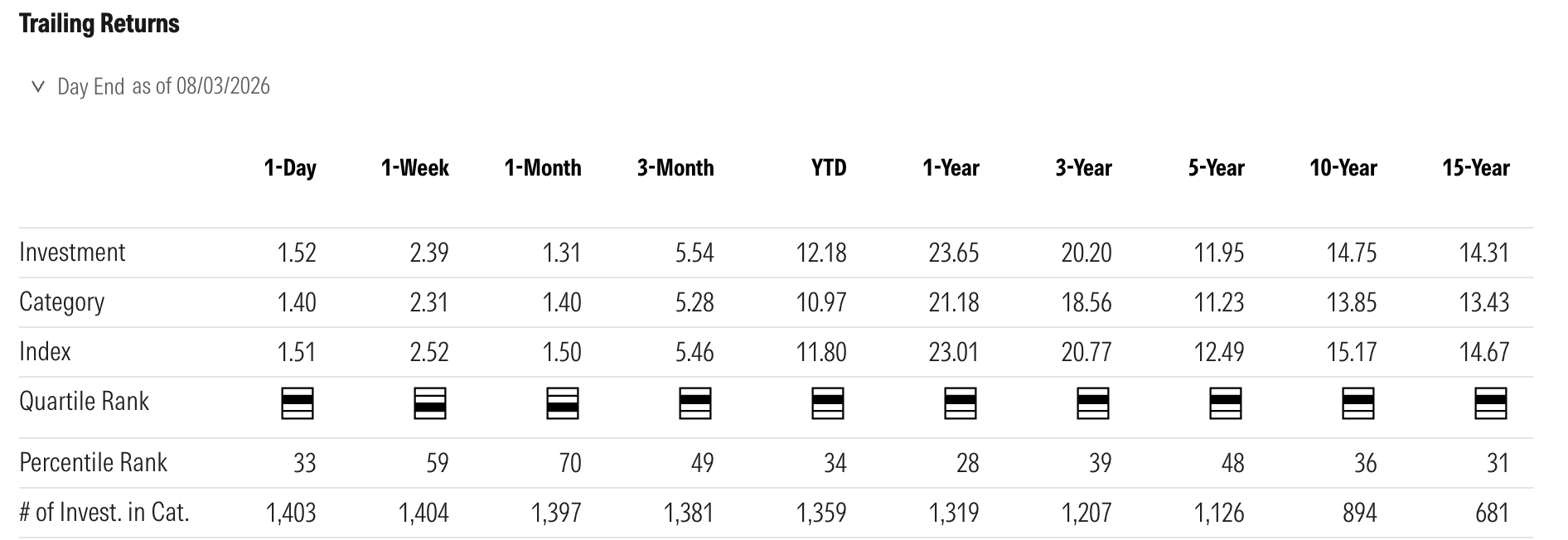
Due to the run-up in large growth tech stocks over the last few years, this is about as bad as this chart has looked in the 20 years I’ve been investing in it, but even so, it has beaten more than 2 out of 3 funds in its category over any time period between 1 and 15 years. It would be higher for longer time periods. Back in 2017, that chart looked like this:

The relevant line here is: “rank in category.” While over the previous year it was only 20, over the prior 15 years it was 12. Meaning it beat nearly nine out of 10 mutual funds. Not bad considering its “know nothing” strategy.
#2 It Isn’t Going Anywhere
At this point, a few of you are thinking, “I don’t want to invest in TSM if some other funds are beating it over pretty long periods of time. I want to invest in one of the funds that beat TSM.” Aside from the folly of taking a gamble on something you only have a tiny chance of doing (although there are ways to increase that percentage, such as only choosing low-cost actively managed funds), the real issue is that those “rank in category” numbers don’t include all the funds that closed over those long time periods. That is not an insignificant number of mutual funds, and it introduces “survivor bias” into the data. Morningstar had this to say in 2016 about survivor bias specifically when discussing TSM:
“After adjusting for survivorship bias, the relative performance of existing funds looks better . . . Low-cost, broad-market, cap-weighted index funds, like Vanguard Total Stock Market Index and SPY, have a better chance of surviving than their actively managed counterparts. Over the 20-year period, only 34% of active large-blend share classes survived, while 55% of index fund share classes survived. Consequently, their relative performance is better than many investors realize.
It’s weird to think that 45% of index funds disappeared, but I guess that’s what happens when you open an index fund, charge 0.9% a year for it, and hope enough financially illiterate people invest in it.
More information here:- 10 Reasons I Invest in Index Funds
- How Do You Evaluate and Compare Mutual Funds and Exchange Traded Funds?
#3 It Is Super-Tax Efficient
But wait, there’s more. Many investors are investing in taxable accounts, where tax-efficiency matters. TSM, by virtue of its strategy (which can be found in the prospectus) . . .

. . . is inherently extremely tax-efficient. You should not be surprised that when you adjust the data for taxes, TSM looks even better than its peers. The chart below is about 10 years old, but it still makes a good point.

As you can see, at the 10- and 15-year mark, TSM was beating 93%-94% of its peers, almost 19 out of 20. Now, imagine adjusting that for survivorship bias and running the numbers out to 30-60 years, your likely investing career length. Still want to take a bet on choosing a fund that will beat it? I wouldn’t. One of the reasons TSM is so tax-efficient is that it can use its unique ETF share class structure to flush appreciated shares (with their associated capital gains) out of the fund. But the main reason is its low, low turnover. Since it just buys all the stocks, those stocks never leave the index. There just isn’t any rapid-fire buying and selling, like you’d see in an actively managed fund (and to a lesser extent, in an index fund that only covers a small portion of the market).
An updated view (2026) of a similar chart shows higher returns and thus higher tax costs, but it is still a very tax-efficient investment.

Morningstar now reports it like this:
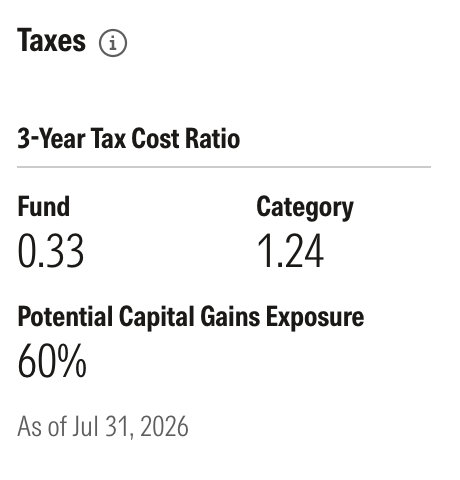
Meaning the fund return is reduced by 0.33% per year due to taxes, and the average fund in the category has its return reduced by almost four times as much.
#4 No Tracking Error
Investing isn’t all about logic. It is also about behavior and discipline. One of the hardest things for investors to do is to stick with their portfolio through the good times and the bad. That is especially hard when their portfolio deviates significantly from that of their peers and the overall US market, which is reported on a daily basis in numerous sources—print, TV, and online.
That deviation is called tracking error. Guess what? TSM essentially doesn’t have any tracking error. Tracking error is MEASURED from TSM. That helps the investor to stay the course.
#5 Super Diversified
Diversification protects you from what you don’t know. If you were omniscient, you would simply pick the stock that is going to go up the most and leverage up as much as you possibly could. But you’re not, so you don’t. Instead, the smart move is to diversify.
Is TSM a diversified fund? Do skiers love powder?
The number of stocks held by TSM? It’s 3,531. That’s a lot of companies. What’s going to happen to your investment if a couple of them go out of business this year? You’re not even going to notice (unless the two that go bankrupt are Nvidia and Apple). Why only own some of the stocks when you can own all the stocks? Lots of people, including Warren Buffett, like the S&P 500 index fund. Sure, I guess 500 stocks is pretty diversified. But it seems downright silly when compared to 3,531 stocks.
#6 Economies of Scale
TSM is huge. How huge? In total net assets, it’s at $2.3 trillion. By comparison, that’s larger than the GDP of 47 of the states in this country. Larger than Spain’s GDP. When you have more than $2 trillion, you can benefit from some sweet economies of scale. You get great prices on your trades. People come to you (and pay you) when they want to borrow shares. You can get expense ratios down into the single digits. Admiral shares are four basis points and ETF shares are three basis points.
What does that mean? That means for every $1,000 you have invested in the fund, the fund spends only a few cents on its expenses. It is essentially free. You can own the equivalent of every publicly traded company in the most economically successful country in the world and buy and sell it online in 10 seconds—all basically for free.
Now, there are some “me too” funds out there. Schwab has a TSM fund (three basis points for the ETF). So does Fidelity (1.5 basis points and even zero basis points) and iShares (three basis points). Is it worth it to go to these other funds to save 1-2 basis points? I don’t think so, but all of these funds are excellent investments.
More information here:- Managers Don’t Beat Markets (Why Index Funds Are the Best Way to Invest in the Stock Market)
- The Truths About Index Fund Investing (According to Vanguard)
#7 No Manager Risk
One of my favorite aspects of TSM is that it is an index fund. That means low costs and excellent long-term returns, but it also means that I can “set it and forget it.” While there is a manager for this fund and he has a team and there is a bit of an art to running an index fund well, it’s still basically all done by a computer, and that computer isn’t going to retire, get dumb, or get unlucky. I don’t have to watch it, check on it, benchmark it, or anything. I certainly don’t have to worry about whether the manager has “lost their touch” or become senile. Why run a risk that isn’t necessary?
In fact, as we updated this post, I learned that Gerard O’Reilly, who managed this fund for many years, died this summer. I met him at a conference not long ago, and I was hoping to get him on the podcast. Our condolences to his family, and may he rest in peace. But there’s a reason his death didn’t bother fund investors or spawn hundreds of articles like Warren Buffett’s retirement. He has helped to create something that doesn’t require him to be successful. Hopefully Buffett has, too, but I guess time will tell. There’s just a lot more uncertainty for Berkshire Hathaway investors than for TSM investors.
#8 Widely Acknowledged to Be Smart
Every investment authority who is worth listening to acknowledges that a low-cost, broadly diversified index fund like TSM is a great way to invest.
Warren Buffett:
“Most investors, both institutional and individual, will find that the best way to own common stocks is through an index fund that charges minimal fees. Those following this path are sure to beat the net results (after fees and expenses) delivered by the great majority of investment professionals.”
Allan Roth:
“The S&P 500 fund is a great way for investors to harness the return that capitalism has to give. In fact, I think it’s better than 99.9% of mutual funds out there. A total stock market fund is just slightly superior.”
Jack Bogle:
“The index fund is a sensible, serviceable method for obtaining the market’s rate of return with absolutely no effort and minimal expense. Index funds eliminate the risks of individual stocks, market sectors and manager selection, leaving only stock market risk.” Jack noted multiple times in his life that TSM was also his favorite mutual fund, despite being most famous for the Vanguard 500 Index Fund.
Jonathan Clements:
“Santa Claus and the Easter Bunny should take a few pointers from the mutual fund industry. All three are trying to pull off elaborate hoaxes. But while Santa and the bunny suffer the derision of 8-year olds everywhere, actively managed stock funds still have an ardent following among otherwise clear-thinking adults. This continued loyalty amazes me. Reams of statistics prove that most of the fund industry’s stock pickers fail to beat the market.”
Jeremy Siegel:
“There is a crucially important difference about playing the game of investing compared to virtually any other activity. Most of us have no chance of being as good as the average in any pursuit where others practice and hone skills for many, many hours. But we can be as good as the average investor in the stock market with no practice at all.”
William Bernstein:
“An index fund dooms you to mediocrity? Absolutely not: It virtually guarantees you superior performance.”
Taylor Larimore (whose favorite fund is also TSM):
“Index investing is an investment strategy that Walter Mitty would love. It takes very little investment knowledge, no skill, practically no time or effort, and outperforms about 80% of all investors. It allows you to spend your time working, playing, or doing anything else while your nest egg compounds on autopilot. It’s about as difficult as breathing and about as time consuming as going to a fast food restaurant once a year.”
I think you can now see why the Vanguard Total Stock Market Index Fund is my favorite mutual fund and my largest individual holding.
What do you think? Do you own TSM? Why or why not? What part has it played in building your wealth?
[This updated post was originally published in 2017.]
Did you find this article helpful? Share it!